
On this page
Start here
Quick answer
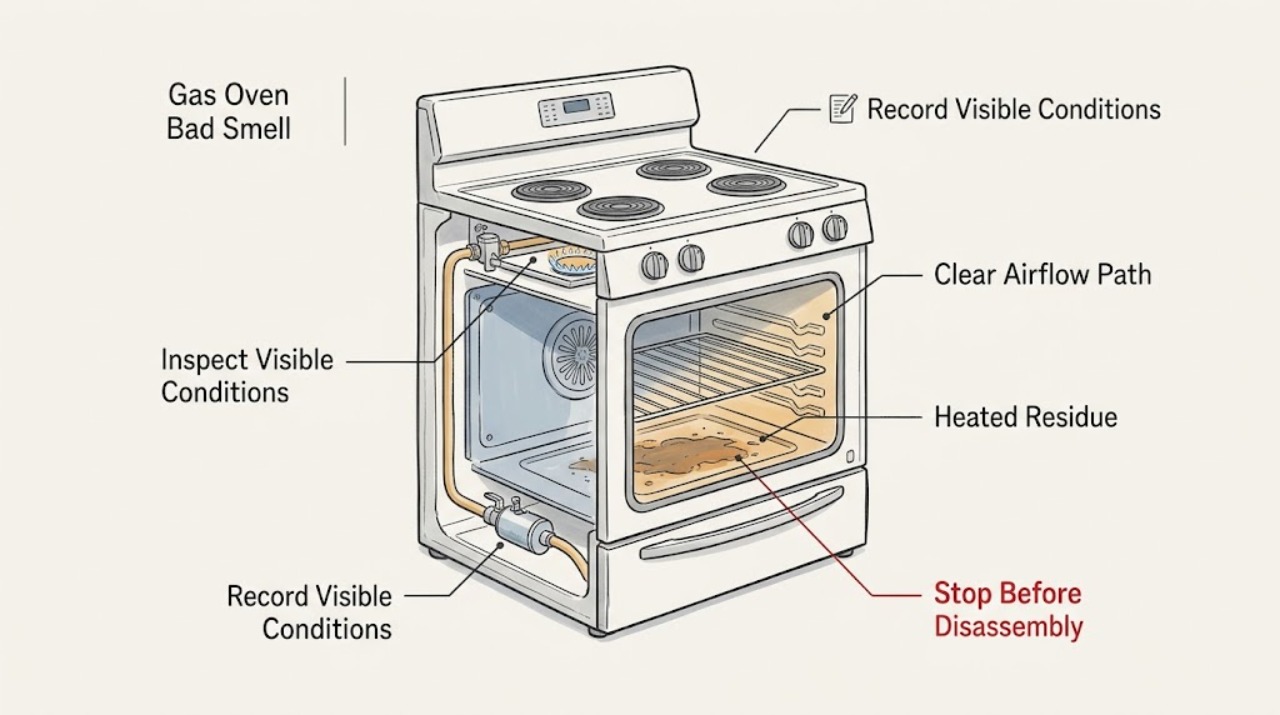
Treat an unknown or persistent gas-oven smell as a possible gas or combustion emergency until it is safely ruled out. If the odor is strong or continues when the oven is off, or you hear hissing, see an abnormal flame or smoke, or a carbon-monoxide alarm sounds, do not light anything, operate electrical switches, use a phone inside, search for the leak, or keep troubleshooting. Leave on foot and contact emergency or gas-safety help from a safe location. A brief faint odor during ignition on a correctly operating gas oven, a new-appliance manufacturing odor, or food and cleaner residue can have different explanations, but only after no gas-leak or combustion warning is present should you inspect the cool cavity from outside and use the exact model manual. Do not relight, dismantle the gas path, or repeat a suspect ignition.
Work through in order
Diagnostic checks
Use only checks that match the exact appliance or system and its official guide.
-
Check 1
Stop using the oven and, without touching controls or electrical equipment in the affected area, identify whether the smell is strong or persistent, present while the oven is off, accompanied by hissing, an abnormal flame, smoke, or a carbon-monoxide alarm, or limited to a faint brief odor during an observed ignition event.
Expected result: A gas-leak or combustion warning is present, or the odor is brief and faint with no warning sign.
Next step: For any warning or uncertainty, leave on foot, keep away, and contact emergency or gas-safety help from a safe location. Only when no warning is present and the oven is cool should you continue with the outside-only observations.
Why this matters
Why: A persistent or warning-associated odor cannot be safely classified as food or new-appliance residue. A brief ignition odor may have a narrower appliance explanation, but it does not justify repeated ignition.
-
Check 2
From outside the appliance and only after the emergency branch is excluded, record when the smell occurs: during ignition, while preheating, during steady operation, after switching off, during cooling, or when the oven has not been used; do not relight or run another cycle to compare.
Expected result: The smell occurs only briefly during ignition, increases during heating, remains after shutoff, or appears while the appliance is idle.
Next step: Keep the oven out of service for an off-cycle, increasing, delayed, or unexplained odor and request qualified gas-appliance service. Do not repeat the ignition or search for a leak.
Why this matters
Why: A brief ignition odor can differ from a heated residue or airflow issue, while an off-cycle or increasing odor keeps gas leakage, delayed ignition, or combustion trouble in focus. Timing alone cannot clear a gas path.
-
Check 3
With the oven cold and disconnected from use, look through the door and at the accessible cavity opening for forgotten packaging, food or grease residue, foil or a liner covering an air path, or visible cleaner residue; do not reach into a hot cavity, remove gas components, or clean while gas or smoke is suspected.
Expected result: Packaging or residue is visible, the cavity is clean, a liner or foil is present, or the smell source remains unclear.
Next step: If the manual permits cool-cavity cleaning, remove only the clearly identified residue using its instructions and do not mix cleaners. If the odor persists, becomes gaseous, or any flame or smoke is abnormal, stop and request qualified service.
Why this matters
Why: New materials and heated food or cleaner residue can create non-gas odors, while a liner or obstruction can interfere with airflow or combustion. A clean cavity does not rule out a burner, igniter, vent, gas connection, or combustion fault.
-
Check 4
Confirm from the rating label or manual whether the appliance is actually gas, dual-fuel, or electric and record the model; do not assume every oven has the same burner, ignition, vent, or gas connection.
Expected result: A gas fuel path is confirmed, the appliance is dual-fuel, or the appliance is electric despite a nearby gas odor.
Next step: Use the exact model manual for any ordinary user setting and request qualified service for a gas or combustion concern. If the odor is present around an electric oven or source is uncertain, follow the same gas-emergency evacuation boundary.
Why this matters
Why: A gas or dual-fuel model can have ignition, burner, supply, or combustion issues. An electric oven has no oven gas path, but gas from another appliance or line can still be an emergency.
-
Check 5
From a safe position, observe an existing carbon-monoxide alarm and note any alarm, headache, dizziness, nausea, shortness of breath, confusion, or symptoms that improve after leaving; do not silence the alarm to continue using the oven or rely on smell to detect carbon monoxide.
Expected result: An alarm or symptom is present, or no alarm and no symptom is present.
Next step: For an alarm or symptoms, leave immediately and obtain emergency medical or fire-safety help from outside; do not re-enter or use the oven until cleared. Without a warning, continue only with the model-specific service handoff, not internal diagnosis.
Why this matters
Why: Carbon monoxide is odorless, and an alarm or compatible symptom can indicate a combustion or venting hazard even without a gas smell. No alarm does not prove the appliance is safe.
-
Check 6
Prepare a service handoff with the model and fuel type, odor description, exact timing, whether the oven was on or off, ignition delay or clicking if already observed, flame or smoke appearance, packaging or residue, vent or liner condition, alarm or symptom history, and what was done before the odor appeared.
Expected result: The record supports a new-oven or residue branch, a brief ignition odor, an ignition or burner fault, a gas-line concern, or an unresolved combustion issue.
Next step: Keep the oven out of service until the professional clears it. Use emergency help for strong odor, hissing, smoke, flame, an alarm, symptoms, or any uncertainty about an active gas leak.
Why this matters
Why: The sequence lets a qualified gas-appliance technician or gas-safety professional choose a safe inspection without relighting, opening the appliance, or searching for a leak.
Use your observations
Decision map
Find the observation that best matches what you see, then follow the next safe action.
-
PATH 01Next step
What you see
The odor is strong, does not fade, returns when the oven is off, or is accompanied by hissing or another gas-leak sign.
Do this next
Do not operate switches, phones, flames, or the oven. Leave immediately and call emergency or gas-safety help from a safe location. Do not locate the leak, shut a gas valve as a troubleshooting step, or re-enter until cleared.
Why this path and its safety boundary
Why it matters: A gas leak or appliance gas fault cannot be ruled out and can ignite from a flame or electrical spark.
-
PATH 02Next step
What you see
A carbon-monoxide alarm sounds or occupants have headache, dizziness, nausea, shortness of breath, confusion, or symptoms that improve away from the building.
Do this next
Leave immediately, obtain emergency help and medical advice from outside, and do not use the oven or re-enter until authorities or qualified professionals clear the area.
Why this path and its safety boundary
Why it matters: Combustion or venting may be producing an odorless hazard even if no gas smell is present.
-
PATH 03Next step
What you see
The odor is brief and faint during an otherwise normal ignition, with no hissing, delayed ignition, abnormal flame, smoke, alarm, or off-cycle smell.
Do this next
Follow the exact model manual and have a qualified technician assess any recurrence, increasing odor, ignition delay, or uncertainty. Stop immediately if any warning sign appears.
Why this path and its safety boundary
Why it matters: A small ignition odor can occur, but the boundary is narrow and the appliance should not be repeatedly ignited to compare.
-
PATH 04Next step
What you see
The oven is newly installed, all packaging is accounted for, and the odor is limited to the first few uses without gas-leak or combustion warnings.
Do this next
Use only the exact model's first-use instructions, remove packaging, ventilate as the manual allows, and keep food out until the documented process is complete. Stop for gas odor, heavy smoke, abnormal flame, or symptoms.
Why this path and its safety boundary
Why it matters: New parts, insulation, protective coatings, or shipping material can create a temporary odor or small amount of smoke.
-
PATH 05Next step
What you see
The odor is strongest when residue heats, and a cool outside-only inspection finds food, grease, a liner, foil, or cleaner residue without gas or combustion warnings.
Do this next
Let the oven cool and follow the model cleaning instructions without mixing chemicals or removing gas parts. Request service if the odor persists, smoke is heavy, or the source is uncertain.
Why this path and its safety boundary
Why it matters: Heated residue or an airflow obstruction can create a non-gas smell, but it must not be used to explain an off-cycle or persistent gas odor.
Helpful context
Understand the symptom
Start with the emergency branch
The smell description is not enough to declare a gas oven safe. A rotten-egg or sulfur-like odor, hissing, dizziness, headache, nausea, an alarm, an abnormal flame, or an odor that remains when the oven is off should be treated as a gas or combustion concern. Do not use a flame, electrical switch, phone, flashlight, or ignition attempt in the area. Leave and call from a safe location. Never wait to see whether the smell fades if a leak is plausible.
What can be normal only in a narrow situation
A faint brief odor during ignition can occur as a gas burner lights, and a new oven may smell from manufacturing materials or packaging. Food residue, foil or a liner that interferes with airflow, and cleaner residue can also create an odor when the cavity heats. These explanations are conditional: they do not apply to a strong, persistent, off-cycle gas odor, delayed ignition, abnormal flame, smoke, carbon-monoxide warning, or symptoms.
Do not confuse smell with carbon-monoxide detection
Carbon monoxide has no smell, color, or taste. A gas oven that burns or vents improperly can contribute to indoor carbon monoxide even when there is no gas odor. Keep a working carbon-monoxide alarm in the locations recommended by safety authorities, and treat an alarm or symptoms as an immediate evacuation and emergency-response event rather than an oven-cleaning problem.
Safety boundary
Stop conditions
- For strong or persistent gas odor, hissing, odor while the oven is off, delayed ignition, abnormal flame, smoke, a carbon-monoxide alarm, headache, dizziness, nausea, confusion, or shortness of breath, stop using the oven, leave the area, and obtain emergency or gas-safety help from a safe location.
- Do not use flames, electrical switches, phones or flashlights inside the affected area, search for a gas leak, operate an unknown gas valve, relight the oven, or repeat an ignition that produced an odor or delay.
- Do not open the oven, remove burner or gas-line parts, adjust pressure or combustion, bypass a safety device, or perform a vent or gas test. Leave internal diagnosis to a qualified technician.
- Do not assume that a new-oven, food, grease, foil, or cleaner explanation applies to an off-cycle, persistent, gaseous, or warning-associated smell.
When checks do not resolve it
Need a professional?
Use emergency help for strong or persistent gas odor, hissing, smoke, flame, a carbon-monoxide alarm, compatible symptoms, or any uncertainty about an active gas leak. Request qualified gas-appliance service for a recurring ignition odor, delayed ignition, abnormal flame, persistent smell, venting concern, or any internal burner, igniter, control, or gas-supply diagnosis. A new-oven or residue odor may be handled only with the exact model manual and only after the safety branch is clearly excluded.
Common questions
FAQ
Is a gas smell from an oven ever normal?
A brief, faint odor during ignition or a temporary new-oven odor can occur in a narrow situation, but a strong, persistent, off-cycle, hissing, delayed-ignition, abnormal-flame, smoke, alarm, or symptom-associated odor is not a normal troubleshooting case. Leave and get help if unsure.
What should I do if the oven smells like gas when it is off?
Do not use switches, phones, flames, or the oven, and do not search for the leak. Leave the area and contact emergency or gas-safety help from a safe location. Do not return until cleared.
Could food or cleaner residue cause a bad oven smell?
Yes, heated food, grease, foil or a liner, and cleaner residue can produce odors, and new materials can smell during first use. Inspect only when cool and safe, follow the exact manual, never mix cleaners, and do not use residue to explain a persistent or gaseous odor.
Can I smell carbon monoxide from a gas oven?
No. Carbon monoxide has no smell, color, or taste. If a CO alarm sounds or anyone has compatible symptoms, leave immediately and obtain emergency help from outside; do not continue troubleshooting the oven.
Read the exact guide
Official sources
- Odors and Smells of Newly Installed Range or OvenWhirlpool Product Help · Manufacturer guidance used for the narrow new-appliance branch; exact first-use instructions and fuel behavior depend on the appliance manual.
- Protect Your Family from Carbon Monoxide PoisoningU.S. Consumer Product Safety Commission · General U.S. consumer CO safety guidance used for combustion-risk boundaries; it does not diagnose a particular gas oven.
- Gas Supply DisruptionsNew York City Emergency Management · Municipal emergency-safety guidance used for general gas-odor and CO boundaries; local emergency and utility instructions govern the response location.
- Pipeline Leak Recognition and What to DoU.S. Department of Transportation Pipeline and Hazardous Materials Safety Administration · Federal gas-emergency guidance used for the gas-odor stop boundary; it is not a model-specific oven repair manual.
- Why does my oven smell like gas?Whirlpool Brand · Manufacturer guidance used as a cross-brand gas-oven example; controls, fuel systems, and exact service instructions depend on the oven model.
Community feedback
Share a repair observation
Share a plain-text repair observation. Accepted observations are published automatically; this page may take a moment to update.