
On this page
Start here
Quick answer
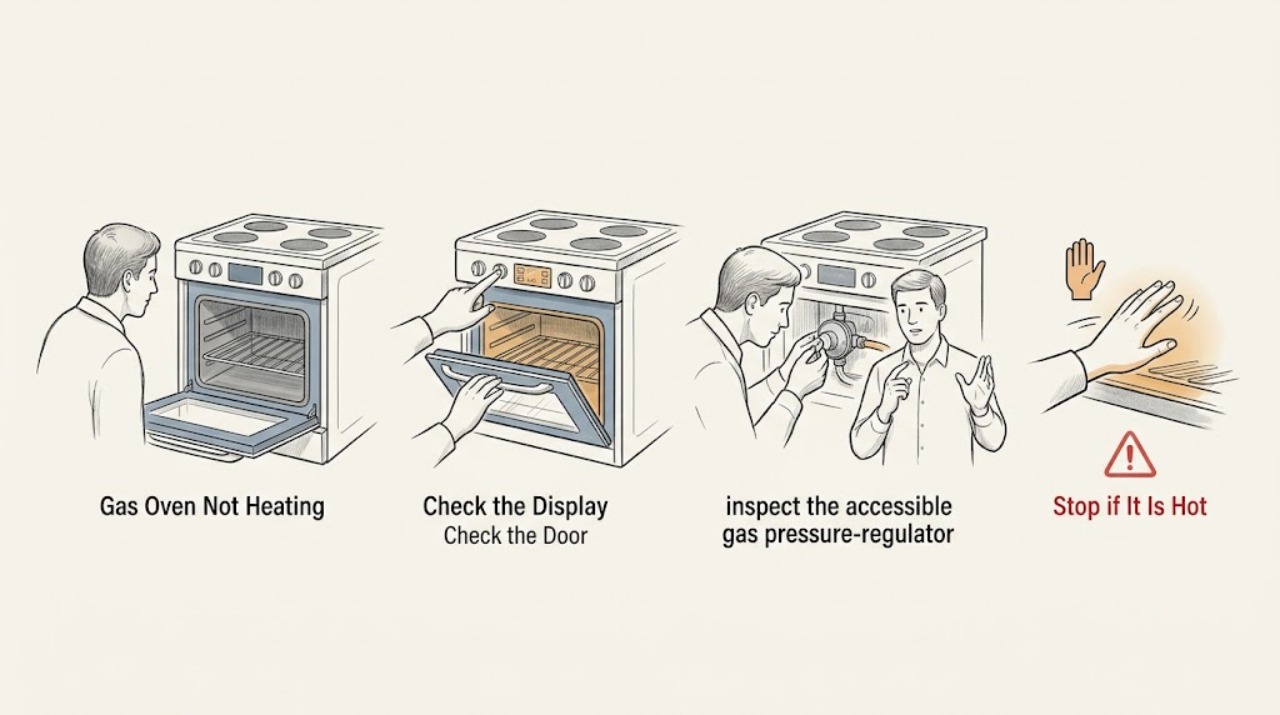
If an Amana gas oven is not heating, first check whether the cooktop works, whether the oven controls are set for a normal bake cycle, and whether the door is fully closed. A gas range can have working cooktop burners while the oven's pressure-regulator shut-off is closed, so the oven-specific gas path matters. Also confirm the accessible main gas shut-off and grounded power connection without opening the appliance. If there is a gas smell, no ignition after one normal start, a damaged cord, repeated breaker trips, or any need to access the igniter, burner, regulator, or wiring, stop and arrange qualified gas-appliance service.
Work through in order
Diagnostic checks
Use only checks that match the exact appliance or system and its official guide.
-
Check 1
Note whether the cooktop burners light normally, whether the oven display or clock responds, whether the oven clicks when a normal bake cycle is started, and whether any flame appears in the correct burner area. Make only one normal start attempt and stop immediately if you smell gas.
Expected result: Working cooktop burners with an oven that does not heat points toward the oven-specific regulator, igniter, burner, control, or door path. No clicking or a completely dark control can point toward power or control issues. A gas smell without normal ignition is an immediate stop condition.
Next step: If the cooktop works, continue with the oven door, regulator, and control checks. If nothing works, continue only with the safe external power and main-gas checks. For gas smell or abnormal flame, stop and call qualified service.
Stop if: Stop immediately for gas odor, flame outside the intended burner area, smoke, or a damaged cord.
Why this matters
Why: This separates a whole-appliance supply problem from an oven-only heating fault without asking the user to inspect internal components.
-
Check 2
With the oven off and cool, confirm that the door closes fully and that the oven bottom is not covered by foil or a liner. If the range has a storage drawer, remove only loose items that could visibly interfere with the igniter; do not reach behind the drawer or remove panels.
Expected result: An open door can prevent the heating elements from coming on, while foil or a liner can block air or gas flow to the burner. Items in an overloaded drawer can interfere with ignition on some models.
Next step: Correct only the obvious door, foil, liner, or drawer obstruction, then make one supervised bake attempt. If the oven still does not heat, continue to the separate gas-supply check.
Why this matters
Why: These are external installation or clearance conditions that can mimic an internal heating failure.
-
Check 3
If the cooktop works but the oven does not heat, inspect the accessible gas pressure-regulator shut-off indication only if it is visible without sliding or tilting the range. Do not move a hard-piped range, disconnect a gas line, or adjust a valve you cannot positively identify.
Expected result: Amana explains that the regulator shut-off can stop gas to the oven while cooktop burners still receive gas. A correctly identified open position with persistent no-heat points away from a simple regulator setting.
Next step: If the position is clearly off and the model instructions identify a safe user correction, stop and obtain qualified help rather than forcing it. If the position is open or uncertain, arrange service; do not slide the range to inspect the rear regulator.
Why this matters
Why: The oven has an oven-specific gas branch, so cooktop operation is not proof that this branch is open.
-
Check 4
Visually confirm that the appliance power cord is fully connected to the correct grounded wall outlet and that the outlet is operational by using a known-working small appliance, only if the outlet is dry and easily accessible. Check the accessible main gas shut-off indicator without turning fittings or disconnecting the supply.
Expected result: A failed outlet or closed main gas supply can prevent oven ignition. If the outlet and main gas supply are sound but the oven still has no heat, an oven control or ignition fault becomes more likely.
Next step: Restore only a clearly switched-off accessible supply control. If a breaker trips again, the outlet is questionable, or the gas valve position is uncertain, leave the oven off and call a qualified electrician or gas-appliance technician.
Stop if: Stop for scorch marks, heat at the plug, sparking, water near the outlet, or any gas odor.
Why this matters
Why: Amana states that oven igniters depend on a good grounded power connection and separately directs users to verify the main gas valve.
-
Check 5
If the oven has power, the door closes, the gas controls appear normal, and there is no gas odor, start one ordinary bake cycle and observe only the normal indicator or ignition sound from outside the closed oven. Do not repeatedly cycle the control, look under the burner, or remove the oven bottom.
Expected result: A normal start followed by no heat, repeated clicking without heat, or an immediate fault after the external checks supports an ignition, gas-valve, sensor, or control diagnosis that cannot be confirmed safely from outside.
Next step: Stop the test and arrange qualified service. Give the technician the cooktop result, clicking or indicator behavior, control setting, regulator observation, and any recent installation or reconnection history.
Why this matters
Why: The remaining causes are inside the gas-heating and ignition system, where incorrect handling can create fire, gas, or electrical hazards.
Use your observations
Decision map
Find the observation that best matches what you see, then follow the next safe action.
-
PATH 01Safety boundary
What you see
The cooktop works, but the oven does not heat.
Do this next
Check the fully closed door, clear foil or liner, storage-drawer clearance, and the externally visible oven regulator shut-off indication. Do not move a hard-piped range or open the cabinet.
Why this path and its safety boundary
Safety stop: Check only the safe external outlet and main gas supply indicators, then arrange service if the whole appliance remains inactive.
-
PATH 02Safety boundary
What you see
The door is not fully closed, the oven bottom is covered, or drawer contents can interfere with ignition.
Do this next
Correct the obvious external condition while the oven is off and cool, then make one supervised start attempt.
Why this path and its safety boundary
Safety stop: Continue with the external power and gas-supply checks.
-
PATH 03Safety boundary
What you see
The cooktop works but the oven regulator shut-off is visibly off or its position is uncertain.
Do this next
Do not force the control or slide a hard-piped range. Arrange qualified gas-appliance service or have the installation instructions reviewed by a professional.
Why this path and its safety boundary
Safety stop: Treat the regulator as not proven to be the cause and escalate persistent no-heat to service after the external checks.
-
PATH 04Safety boundary
What you see
The outlet is not operational, a breaker trips again, or the main gas supply is off or uncertain.
Do this next
Leave the oven off and have the household electrical or gas supply checked by the appropriate qualified professional.
Why this path and its safety boundary
Safety stop: If the oven still does not heat, stop user troubleshooting because the remaining fault may involve internal ignition, gas, sensing, or control components.
-
PATH 05Safety boundary
What you see
There is a gas smell, flame outside the burner area, smoke, or damaged electrical wiring.
Do this next
Do not operate switches or retry ignition. Leave the area if needed and follow local gas-emergency guidance from a safe location; arrange qualified service before using the oven again.
Why this path and its safety boundary
Safety stop: Arrange qualified appliance service for persistent no-heat or repeated clicking after one normal external test.
Helpful context
Understand the symptom
Why a working cooktop does not clear the oven
The cooktop and oven can use different parts of the gas path. Amana notes that a gas range may supply the cooktop while the pressure-regulator shut-off prevents gas from reaching the oven. The oven also depends on electrical power for its igniter, so a gas supply that looks normal does not rule out an appliance power or ignition fault.
Gas and electrical safety come first
Keep checks external and model-specific. Do not remove the oven bottom, open the cabinet, disconnect igniter wires, adjust a burner flame, bypass a safety device, or test live electrical parts. If you smell gas, see flame outside the burner area, or suspect damaged wiring, leave the controls alone and follow local gas-emergency guidance from a safe location.
Only after diagnosis
Potential parts
- gas oven igniter
Consider this only after a qualified technician confirms an ignition-system fault rather than a control, regulator, or gas-supply problem.
Confirm the complete Amana model identification and professional diagnosis before obtaining a replacement. - gas oven safety valve
Consider this only when a qualified technician confirms that the valve is not supplying the oven correctly after the external gas path is verified.
Gas-valve fit and installation are model-specific and professional-only; do not substitute a valve based on symptoms alone. - gas oven temperature sensor or control
Consider this only after service diagnosis identifies a sensing or control fault while the gas supply and igniter path are sound.
Have the exact model and diagnostic result verified before any part is selected or installed.
Common questions
FAQ
Why does my Amana gas oven not heat while the burners work?
The cooktop and oven can use different gas paths. Check the fully closed door and the externally visible oven pressure-regulator shut-off indication without moving a hard-piped range. If the oven still does not heat, arrange qualified service.
Could a power problem stop an Amana gas oven heating?
Yes. The igniter depends on the appliance having a proper grounded power connection. Check the accessible plug and outlet safely; if the outlet is questionable or a breaker trips again, leave the oven off and call a qualified professional.
What should I do if my Amana gas oven smells like gas?
Stop the ignition attempt and do not operate switches or retry the oven. Leave the area if needed and follow local gas-emergency guidance from a safe location. Do not use the oven again until qualified service confirms it is safe.
Read the exact guide
Official sources
- Oven Not Working - Cooktop Working - Not ClickingAmana · Amana gas oven door, regulator shut-off, drawer clearance, main gas, and grounded outlet checks
- Oven Not Working - GasAmana · Amana gas oven power, main gas supply, recent reconnection, and service checks
- Oven Not Working - Cooktop Working - ClickingAmana · Amana gas oven clicking, door, pressure-regulator shut-off, drawer, and burner-clearance checks
Community feedback
Share a repair observation
Share a plain-text repair observation. Accepted observations are published automatically; this page may take a moment to update.