
On this page
Start here
Quick answer
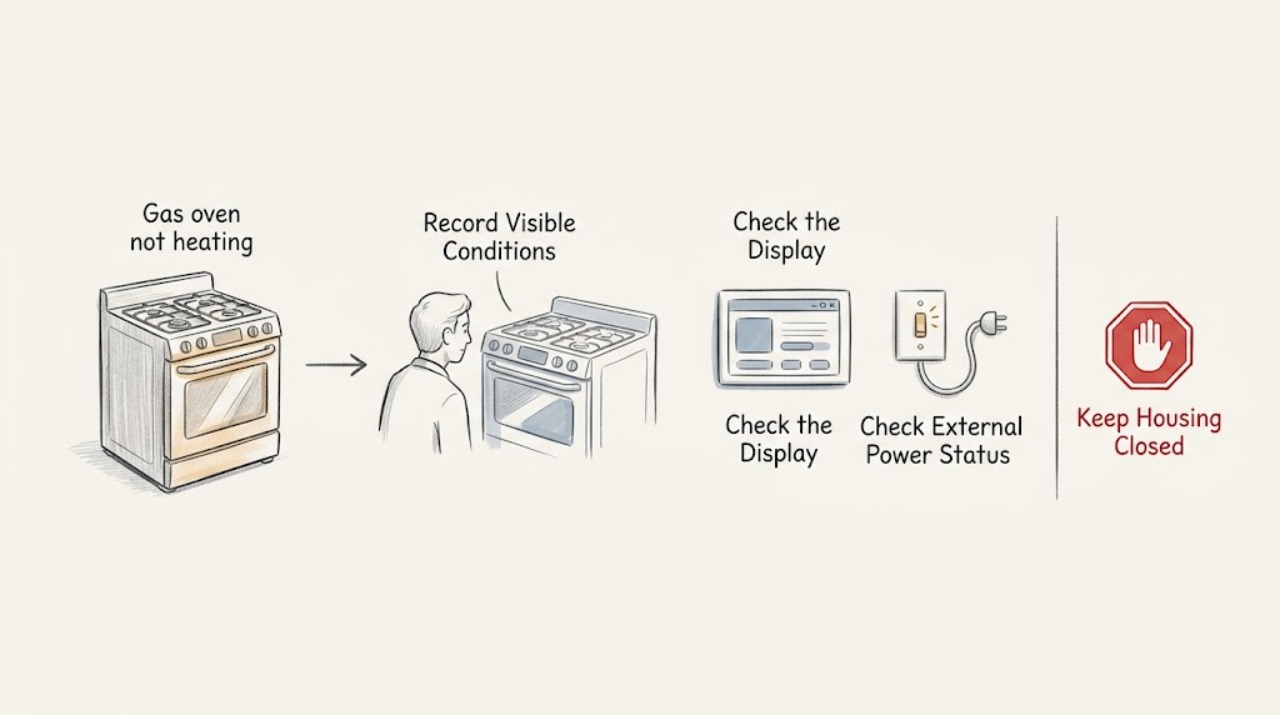
A gas oven that is not heating may be in the wrong mode, waiting for preheat, without electrical power, without gas supply, or unable to complete its ignition sequence. First record the model, display or error, selected mode, and whether the oven is cold, warming slowly, or heating unevenly. Check the clock or controls, door closure, and accessible power and gas status only as the owner's instructions permit. Do not remove the oven bottom or burner cover, test an ignitor, adjust a gas valve, or use a flame to look for leaks. If there is gas odor without ignition, delayed ignition or a bang, an abnormal flame, smoke, a carbon-monoxide alarm, burning odor, or repeated breaker trip, turn the control off, leave the area when appropriate, and arrange qualified gas-appliance service.
Work through in order
Diagnostic checks
Use only checks that match the exact appliance or system and its official guide.
-
Check 1
From ordinary safe access, record the oven model, display or error text, selected mode, set temperature, clock state, and when heating stopped; do not move a hot appliance or remove trim to find the label.
Expected result: Classify the symptom as a blank display, controls that respond but no heat, no ignition, slow preheat, one mode without heat, heat that stops, or an abnormal flame or odor.
Next step: Use the matching branch below and provide the model, display, mode, and timing to a qualified appliance technician if the external checks do not restore normal operation.
Stop if: Stop if gathering the model requires moving a hot oven, opening a panel, touching wiring or gas parts, or entering an unsafe area.
Why this matters
Why: A blank display points toward power or control behavior, while a responsive display with no heat points toward mode, gas supply, ignition, sensor, valve, or control paths. A mode-specific result should not be generalized to every gas-oven function.
-
Check 2
With the oven cool, confirm that the clock is set if the model requires it, the intended Bake or other heating mode is selected, the temperature is set correctly, and the door closes completely without a rack, pan, or food blocking it.
Expected result: Record a correct mode and temperature, a missing clock or delayed-start setting, a control lock or display message, a blocked or misaligned door, or a door that closes normally but produces no heat.
Next step: Remove only an obvious cool obstruction without force and follow the exact user-guide control procedure once. Request service for a damaged door, lock, hinge, seal, or persistent no-heat condition.
Stop if: Do not force or dismantle the door, defeat a lock, run with damaged glass or a door that cannot close, or access the burner through the cavity.
Why this matters
Why: A control, clock, delayed-start, lock, or door condition can prevent or reduce heating without proving a gas or ignitor failure. A correct control state with a cold cavity requires the gas and ignition branches, not more repeated setting changes.
-
Check 3
From a dry, safe position, check whether the display is powered and whether the known oven circuit or accessible appliance switch appears off; perform at most one manual reset only when the owner's instructions permit it and there are no hazard signs.
Expected result: Record a powered display, blank controls, a recent outage, a single reset that restores the controls, or a breaker that trips again, smells hot, shows damage, or is near moisture.
Next step: If the controls remain blank or the oven still will not heat, leave it unused and arrange qualified appliance or electrical service. Leave a repeatedly tripping circuit off.
Stop if: Do not open an electrical panel, expose wiring, perform live circuit checks, bypass protection, or reset a breaker again after an immediate repeat trip.
Why this matters
Why: A gas oven may need electricity for ignition and controls even when the heat source is gas. A repeat trip or electrical warning indicates an unresolved fault, not a reason to keep resetting or to inspect the ignitor or wiring.
-
Check 4
Only from normal user access and without removing any appliance panel, confirm whether other gas appliances have their expected supply and whether the oven's external control is in the intended position; do not loosen a connector or turn an unfamiliar gas valve as a diagnostic experiment.
Expected result: Record normal operation of other gas appliances, a wider supply interruption, an unknown or inaccessible oven supply state, or gas odor, hissing, or a damaged connection.
Next step: For a supply question without odor, provide the observations to a qualified gas-appliance technician. For gas odor or hissing, stop using the oven, leave the area when appropriate, and use the building or utility emergency gas-safety procedure from a safe location.
Stop if: Do not use a flame or spray to check for leaks, remove the gas line, adjust a regulator, relight internal components, or continue if odor or hissing is present.
Why this matters
Why: A broader supply interruption can explain no oven flame, while a problem isolated to the oven can involve its regulator, valve, ignitor, thermostat, or control. Gas odor, hissing, or damage is a safety event, not a user diagnosis.
-
Check 5
If there is no gas odor and the manufacturer's user instructions expressly allow a normal Bake start, observe only from the normal viewing position whether the oven indicates a heat call and whether a stable flame appears within the expected sequence; do not open the burner area or repeat the start to force ignition.
Expected result: Record a normal flame and warming, no flame after the call, repeated clicking, delayed ignition, a flame that goes out, yellow or uneven flame, smoke, or a bang.
Next step: Turn the user control off and arrange qualified gas-appliance service for absent, delayed, unstable, or abnormal ignition. Do not repeat ignition attempts when the first attempt is abnormal.
Stop if: Stop immediately for gas odor, delayed ignition or a bang, abnormal flame, smoke, soot, carbon-monoxide alarm, or any need to access the ignitor, burner, valve, or gas train.
Why this matters
Why: No flame can involve the ignitor, valve, control, thermostat, supply, or connection, and a delayed or unstable flame needs service. A flame observation cannot safely identify a failed part or authorize internal access.
-
Check 6
Prepare the service request with the model, fuel type, display and error text, mode and temperature, clock or lock state, preheat timing, door result, power event, other-appliance supply observation, ignition behavior, flame description, and any safe photo or recording.
Expected result: Confirm that the record contains external observations only and that no burner cover, oven bottom, ignitor, gas connector, wiring, valve, or control panel was disturbed.
Next step: Request qualified gas-appliance diagnosis and provide the exact symptom pattern. Let the technician verify gas pressure and ignition components, electrical isolation, combustion, and model-specific compatibility.
Stop if: Stop all user troubleshooting when the next step requires cabinet access, gas-line work, internal ignition work, electrical measurements, combustion checks, or operation near a hot burner.
Why this matters
Why: A complete timeline lets the technician separate a control or power issue from gas supply, ignition, thermostat, valve, burner, door, or heating performance causes without asking the owner to perform hazardous tests.
Use your observations
Decision map
Find the observation that best matches what you see, then follow the next safe action.
-
PATH 01Next step
What you see
The oven is powered, the clock and mode are correct, the door closes, and the cavity is warming or displaying a normal preheat state.
Do this next
Allow the documented preheat to complete before judging performance. If it stays cold or takes substantially longer than normal, arrange service.
-
PATH 02Next step
What you see
The display is blank, the control does not respond, or the circuit has tripped.
Do this next
Use only the accessible power check and one model-authorized reset. Leave a repeat-tripping circuit off and request qualified appliance or electrical service.
-
PATH 03Next step
What you see
The oven controls work but there is no ignition, and other gas appliances also appear affected without gas odor.
Do this next
Treat it as a possible supply issue and request qualified gas-appliance service. Do not loosen connections or adjust a valve.
-
PATH 04Next step
What you see
The controls call for heat but the burner does not ignite, ignition is delayed, the flame goes out, or repeated clicking occurs.
Do this next
Turn the control off and arrange qualified gas-appliance service. Do not repeat ignition attempts or access the ignitor, burner, or gas train.
-
PATH 05Next step
What you see
The door is blocked or damaged, a lock or delayed start is active, the wrong mode is selected, or the clock is unset where required.
Do this next
Correct only an obvious cool obstruction or the documented setting once. Do not force the door; request service for damage or an unresolved control condition.
-
PATH 06Next step
What you see
There is gas odor, hissing, delayed ignition with a bang, abnormal flame, smoke, soot, a carbon-monoxide alarm, burning odor, arcing, or a repeated breaker trip.
Do this next
Stop using the oven, keep people away, leave the area when appropriate, and use the relevant emergency gas-safety, electrical, or appliance response from a safe location. Do not restart it to reproduce the problem.
Helpful context
Understand the symptom
Separate preheat behavior from an ignition failure
A gas oven can take time to preheat, and the burner may cycle after reaching temperature. That is different from a cavity that stays cold, a control that calls for heat but never ignites, repeated clicking without a stable flame, or a flame that shuts off. A normal preheat delay should not be used to justify repeated ignition attempts. Record the mode, display, timing, and whether any heat reaches the cavity before choosing a service path.
Power and gas are separate requirements
Many gas ovens still need electricity for controls and ignition. A blank display or dead control can be a power issue, while a responsive control with no flame can be a gas-supply or ignition issue. Check only the external, user-accessible status described by the product manual. Do not remove panels, manipulate an internal valve, or assume a visible control response proves that gas is safe or available.
Gas odor and abnormal flames end homeowner troubleshooting
A faint expected ignition event is not a license to keep trying when the oven does not light. Gas odor that remains, delayed ignition, a boom, yellow or unstable flame, soot, smoke, or a carbon-monoxide alarm requires the oven to remain unused and professional attention. Do not use a match, lighter, spray, or other improvised leak test, and do not continue cycling the bake control to see whether the burner eventually catches.
Safety boundary
Stop conditions
- Stop immediately for gas odor, hissing, delayed ignition or a bang, abnormal flame, smoke, soot, carbon-monoxide alarm, burning odor, arcing, or uncontrolled heat.
- Stop and leave the circuit off for a repeated breaker trip, hot electrical area, exposed wiring, moisture near electrical parts, or visible equipment damage.
- Do not use a flame or spray to test for leaks, open the oven cabinet, access the burner or ignitor, adjust a regulator, handle gas connectors, perform live electrical checks, or force the door.
Only after diagnosis
Potential parts
- gas oven ignitor
Consider an ignitor only if qualified service confirms it is the failed component for the applicable model and ignition sequence; no heat or clicking alone does not identify it.
Confirm the exact oven model, fuel configuration, ignition system, electrical specification, and manufacturer-approved fit before selecting any replacement. - gas oven safety valve
Consider a safety valve only after a qualified technician verifies the supply, control signal, ignitor behavior, and valve fault; do not adjust or replace a gas valve from symptoms alone.
Gas components require qualified installation and exact model, fuel, certification, and manufacturer compatibility checks.
When checks do not resolve it
Need a professional?
Arrange qualified gas-appliance service when the gas oven remains cold after safe control, door, power, and supply observations; when ignition is absent or delayed; when the flame is unstable; when an error appears; or when internal access would be required. Use emergency gas-safety or electrical help for gas odor, hissing, smoke, a carbon-monoxide alarm, arcing, burning odor, or repeated breaker trips.
Have this ready
- Give the technician the model and fuel type, display and mode, clock or lock state, preheat timing, door result, power and supply observations, ignition behavior, flame description, and safe symptom record.
Common questions
FAQ
Why does a gas oven turn on but not heat?
The controls may not be calling for the intended mode, or the oven may have a power, gas supply, ignition, valve, thermostat, door, or control fault. Check only safe external settings and stop for abnormal ignition or gas odor; a technician must diagnose internal parts.
How long should a gas oven take to preheat?
Preheat time varies by model, mode, starting temperature, and installation. Follow the exact Use and Care Guide. A cavity that remains cold after the documented preheat or a preheat indication that completes without heat needs qualified service.
What should I do if I smell gas but the oven does not heat?
Turn the oven control off, stop using it, and leave the area if the odor is strong or persists. Follow the building or utility emergency gas-safety procedure from a safe location. Do not use a flame, operate switches near the odor, or repeat ignition attempts.
Read the exact guide
Official sources
- Gas Range - Oven Does Not Heat, But The Burners HeatGE Appliances · Official GE gas-range support guidance used for general gas-oven symptom triage; exact appliance instructions govern model-specific controls.
- Carbon Monoxide Fact SheetU.S. Consumer Product Safety Commission · Government gas-appliance safety guidance used for emergency boundaries, not for diagnosing an oven component.
- Oven Not Working - Gas RangeWhirlpool · Official Whirlpool gas-range support guidance used for general external checks; it does not establish facts for an unidentified model.
Community feedback
Share a repair observation
Share a plain-text repair observation. Accepted observations are published automatically; this page may take a moment to update.