
On this page
Start here
Quick answer
If a GE gas oven is not heating, first confirm that the issue is in the oven rather than the surface burners: GE notes that burners can work while the oven does not. With no gas odor or other hazard, verify the Bake or Broil setting, temperature control, power connection or breaker, and any self-clean latch or model-specific mode. Confirm only the accessible gas shutoff is on; do not move the range or loosen a gas fitting. On a model that uses a visible glow-bar igniter, a brief visual check for the expected glow can separate an ignition/control problem from a later gas-valve or burner diagnosis, but do not touch the igniter or attempt to light the burner. If the igniter does not glow, heating does not begin, a fault returns, or gas odor, smoke, scorching, or abnormal flame appears, stop and arrange qualified gas-appliance service. If unburned gas is smelled, clear the area and contact the gas supplier or emergency service from outside without operating switches or appliances.
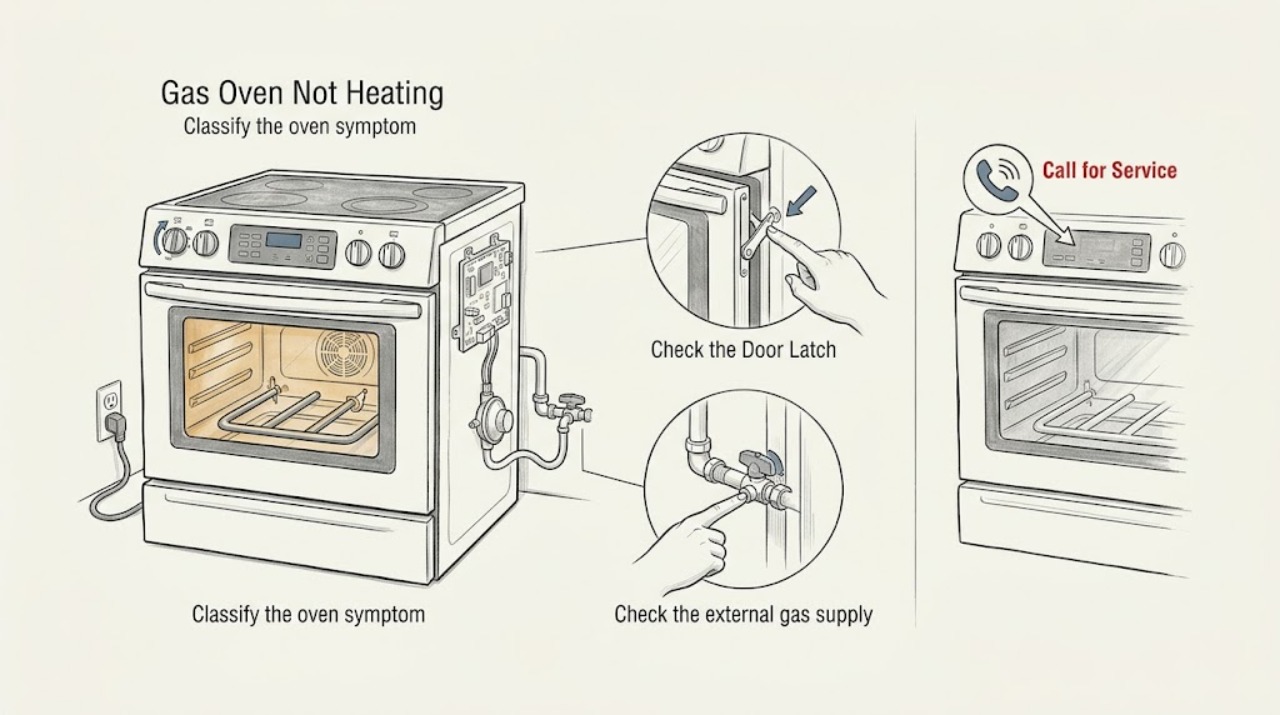
Work through in order
Diagnostic checks
Use only checks that match the exact appliance or system and its official guide.
-
Classify the oven symptom and check for immediate danger
Before trying another cycle, note whether the display or clock works, whether the surface burners operate, whether the oven fan or igniter attempts to start, and whether the oven is cold, warming slowly, or producing an abnormal flame. Look for smoke, scorching, a strong unburned-gas odor, or a damaged cord without touching hot or energized parts.
Expected result: There is a strong unburned-gas odor, smoke, scorching, an abnormal flame, exposed wiring, or no hazard and the oven simply remains cold.
Next step: For gas odor, clear the area, avoid switches and appliances, and contact the gas supplier or emergency help from outside. For no odor or visible hazard, continue with settings and external power checks without moving the range.
Stop if: Stop immediately for unburned-gas odor, fire, smoke, scorching, an unstable flame, or a hot/damaged cord or outlet.
Why this matters
Why: Gas odor, smoke, scorching, or an abnormal flame is a safety event rather than a routine setting problem. A cold oven with working burners makes the oven-specific control, gas path, or igniter branch more likely. A dark display or dead clock adds a power/control branch.
-
Verify the Bake or Broil setting, latch, and safe power state
With no gas odor and the oven cool, confirm the function and temperature controls are set for Bake or Broil and that any knobs removed for cleaning are back in their intended positions. On a self-clean model, confirm the mechanical door latch is fully unlocked; on an electronic model, check the owner's manual for any special mode that prevents normal heating. Check the breaker or fuse and the range power connection only as the installation instructions allow, without opening the appliance.
Expected result: The oven was set to an incorrect function or temperature, the self-clean latch or special mode was active, a breaker or fuse was open, the power connection was loose, or all external settings and power checks are correct.
Next step: Correct only the identified setting or model-approved external power condition, then make one supervised Bake or Broil start. If it still does not heat, stop repeated resets and continue to the gas-supply and ignition observation.
Stop if: Do not remove panels, handle wiring, move the range to inspect the gas connector, or keep resetting a breaker that trips again.
Why this matters
Why: A corrected setting, latch, mode, or supply issue can explain no heat without replacing a part. If the controls and power are correct while the oven remains cold, the gas supply, igniter, burner, sensor, or control requires the next branch.
-
Check the external gas supply without touching fittings
From a stable position and without moving the range, use the installation instructions to identify the appliance's accessible gas shutoff location. Confirm only that the valve is in the normal open position if there is no gas odor and the model instructions permit that check. Do not loosen a connector, adjust a regulator, relight a pilot by guesswork, or use a flame to look for a leak.
Expected result: The shutoff appears closed, the gas supply position is uncertain, the surface burners work but the oven does not, or the external gas position is correct.
Next step: If the valve position is uncertain or a gas component may have been disturbed, stop and call qualified gas-appliance service. If the model-approved external position is clearly correct and there is no odor, make the brief visual ignition observation once.
Stop if: Stop and leave the area for any gas odor; never move the range or disturb the gas connector to inspect it.
Why this matters
Why: A closed or uncertain supply can stop oven heating, including on a new or recently moved installation. Surface burners working does not rule out an oven regulator or ignition problem. If the external supply is correct, the next useful distinction is whether the model's igniter attempts to glow.
-
Make the model-approved visual igniter observation
If the exact GE model's instructions identify a visible glow-bar igniter, select Bake with the oven empty and cool, open the door only as the instructions describe, and observe from outside the cavity for the expected glow. Do not touch the igniter, reach into the oven, attempt to light gas manually, or continue observing if gas odor, smoke, or an abnormal flame appears.
Expected result: The igniter glows and the oven still does not heat; the igniter does not glow; the model has no visible igniter or uses a different design; or gas odor or an abnormal flame appears.
Next step: Stop the test and arrange qualified GE gas-appliance service for no glow, glow-without-heat, an unknown ignition design, or any abnormal flame. Do not repeat the ignition cycle to reproduce the failure.
Stop if: Stop immediately for gas odor, delayed ignition, flashback, smoke, soot, an unstable flame, or any need to touch the burner or igniter.
Why this matters
Why: No glow can indicate an igniter, control, or other electrical issue, but it does not identify a part for replacement. A glow without heat can require diagnosis of the gas valve, burner, regulator, sensor, or control. A different model design cannot be diagnosed by this observation, and gas odor or abnormal flame is an immediate stop.
-
Make one controlled retest and use the service boundary
After the safe settings and external checks are correct, make one supervised Bake or Broil start using the normal model instructions. Observe whether the oven ignites normally, begins warming, maintains a normal flame, and does not show a recurring fault. Do not keep cycling the oven to obtain heat, and do not use an oven thermometer or cooking result to justify opening the burner assembly.
Expected result: The oven heats normally; the oven remains cold; it heats briefly then stops; a fault returns; the flame is irregular or produces soot; or gas odor, smoke, scorching, or abnormal heat appears.
Next step: Stop using the oven and arrange qualified GE gas-appliance service for any repeat fault or no-heat result. For gas odor, clear the area and contact the gas supplier or emergency service from outside; provide the model, settings, burner result, igniter observation, and exact failure stage.
Stop if: Stop immediately for unburned-gas odor, fire, smoke, soot, delayed ignition, abnormal flame, a damaged cord, or repeated breaker trips.
Why this matters
Why: A normal cycle supports a corrected setting or external supply condition. Persistent no heat or an early stop points to ignition, gas-valve, regulator, burner, sensor, or control diagnosis. Irregular flame, soot, odor, or smoke is a safety stop and may indicate unsafe combustion or a leak.
Use your observations
Decision map
Find the observation that best matches what you see, then follow the next safe action.
-
PATH 01Safety boundary
What you see
Unburned gas odor, smoke, fire, soot, delayed ignition, or an abnormal flame is present.
Do this next
Do not operate the oven or electrical switches. Clear the room or building, extinguish open flames only if this can be done without risk, and contact the gas supplier, fire department, or emergency service from outside or another safe location.
Why this path and its safety boundary
Safety stop: True
-
PATH 02Next step
What you see
The display is dead, a breaker or fuse is open, or the oven controls are not set for Bake or Broil.
Do this next
Correct only the model-approved setting or external power condition once. If power will not hold or the controls remain dead, stop and arrange qualified electrical or appliance service.
-
PATH 03Safety boundary
What you see
Surface burners work but the oven does not heat and the external gas shutoff position is correct.
Do this next
Use the exact model instructions for a brief visual igniter observation only. No glow or glow without heat requires qualified diagnosis of ignition, gas, burner, sensor, or control components.
Why this path and its safety boundary
Safety stop: True
-
PATH 04Safety boundary
What you see
The model-approved igniter observation is normal, but the oven remains cold or stops heating.
Do this next
Stop repeated ignition attempts and arrange qualified gas-appliance service. The observation does not identify a safe owner-replaceable part or authorize gas-valve work.
Why this path and its safety boundary
Safety stop: True
-
PATH 05Safety boundary
What you see
Settings, power, gas supply, and the one controlled retest are normal, but no heat or a recurring fault remains.
Do this next
Stop using the oven and schedule qualified GE gas-appliance service. Provide the full model, whether surface burners work, settings, breaker behavior, gas-valve observation, igniter result, and fault stage.
Why this path and its safety boundary
Safety stop: True
Helpful context
Understand the symptom
A gas oven can fail while the burners still work
Surface burners and the oven do not prove the same parts are working. GE's gas-range guidance treats a burner-working/oven-not-heating symptom as a separate path involving the oven controls, gas regulator or supply, and ignition. Start with the least invasive observations and preserve the exact model information; do not assume a common ignition or valve part without diagnosis.
Keep gas and electrical boundaries clear
A gas oven still needs electricity for its controls and ignition on many models. A breaker or loose connection can therefore stop heating even when a gas supply is available. Conversely, an open gas valve or regulator condition can prevent the oven burner from heating. Check external controls and valves only as the manual permits; do not move the appliance, remove panels, touch wiring, or open gas fittings.
A glow check is a branch, not a repair
If the exact model exposes a glow-bar through the oven cavity, a safe visual observation while the oven is selected can show whether ignition is being attempted. No glow does not identify the failed component, and a glow does not authorize work on the gas valve or burner. Persistent no-heat, irregular flame, a returning fault, or any fuel odor belongs with qualified service.
Only after diagnosis
Potential parts
- oven glow-bar igniter
Consider an igniter only when the exact model uses one, the safe visual observation shows no glow or qualified electrical diagnosis confirms insufficient ignition, and the gas and airflow conditions are otherwise correct.
Confirm the complete GE model and approved part information; do not touch or replace the igniter with the appliance connected to power. - gas oven safety valve or regulator
Consider a valve or regulator only after qualified diagnosis of glow-without-heat, an incorrect gas-supply condition, or a repeat no-heat fault; surface burners working does not identify the failed part.
Gas components and adjustment procedures are model-specific and require qualified gas-appliance service; never loosen fittings or substitute a component by appearance. - oven temperature sensor or electronic control
Consider a sensor or control only when qualified diagnosis links a recurring fault or failure to that component after the settings, power, gas, and ignition checks.
Verify the complete GE model and manufacturer service information; do not infer a control or sensor fault from a cold oven alone.
When checks do not resolve it
Need a professional?
Call qualified GE gas-appliance service when the oven remains cold after the controls, power, gas supply, and model-approved visual checks, or immediately for gas odor, abnormal flame, delayed ignition, soot, smoke, repeated faults, or electrical damage.
Common questions
FAQ
Why do the burners work but my GE gas oven does not heat?
The surface burners and oven have separate settings and heating paths. Check Bake or Broil, the temperature control, self-clean latch or model-specific mode, external power, gas shutoff, and—only if the model instructions allow—a brief visual igniter observation. No glow or glow without heat requires qualified service.
Can I check the GE gas oven igniter myself?
Only as a visual observation if the exact model instructions expose the igniter and there is no gas odor or other hazard. Do not touch it, manually light the burner, remove panels, or use the observation to choose a replacement part.
Could a breaker stop a GE gas oven from heating?
Yes. GE gas ovens still use electrical power for controls and ignition on many models. Check the external breaker or fuse status once as the model instructions permit; if it trips again or the oven remains cold, arrange qualified service.
What should I do if I smell gas when the GE oven will not heat?
Do not keep trying the oven. Clear the room or building, avoid electrical switches and appliances, extinguish open flames only if safe, and contact the gas supplier or emergency service from outside or another safe location.
When should I stop troubleshooting a GE gas oven with no heat?
Stop for gas odor, smoke, soot, delayed ignition, abnormal flame, repeated faults, electrical damage, or no heat after correct settings, external power, gas-supply, and model-approved visual checks. Do not open panels, move the range, loosen gas fittings, or bypass a safety device.
Read the exact guide
Official sources
- Gas Range - Oven Does Not Heat, But The Burners HeatGE Appliances · GE troubleshooting guidance for an oven that does not heat while surface burners work, including settings, regulator condition on new installations, and visible glow-bar ignition.
- Certain Older Gas Connectors May Be DangerousU.S. Consumer Product Safety Commission · CPSC safety guidance not to move a gas appliance to inspect its connector and to leave immediately and avoid electrical equipment if a gas leak is suspected.
- Gas Range & Wall Oven - Oven Will Not Come OnGE Appliances · GE guidance for controls, breaker or fuse, power connection, gas shutoff, visible igniter, electronic reset, self-clean latch, special modes, and service escalation.
- Gas Range - Gas OdorsGE Appliances · GE safety guidance distinguishing a brief start-up combustion odor from unburned gas odor and directing occupants away from switches and appliances when gas is smelled.
- Support for GE Cooking ProductsGE Appliances · GE support hub directing owners to model-specific troubleshooting, manuals, qualified service, and parts information.
Community feedback
Share a repair observation
Share a plain-text repair observation. Accepted observations are published automatically; this page may take a moment to update.