
On this page
Start here
Quick answer
For the GE JGB905BEF2BB, a pizza that stays cold or takes far too long at a high setting is not automatically a failed oven. First separate a cooking/setup issue from an ignition or temperature-control problem: fully preheat before loading the pizza, confirm Bake rather than an unintended mode, keep the rack, pan or stone, and door seal clear, and note whether the oven actually reaches temperature before the problem occurs. GE says oven temperatures normally cycle above and below the set point, and convection conversion can lower the automatically selected temperature; the exact model manual controls the calibration procedure. If the bake burner repeatedly fails to relight, the oven drops far below the set temperature, the igniter glows without a stable burner flame, or there is gas odor, soot, smoke, delayed ignition, or an abnormal flame, stop using the gas oven and arrange qualified GE gas-appliance service. Do not replace an igniter, sensor, valve, or control from the pizza symptom alone.
Work through in order
Diagnostic checks
Use only checks that match the exact appliance or system and its official guide.
-
Check 1
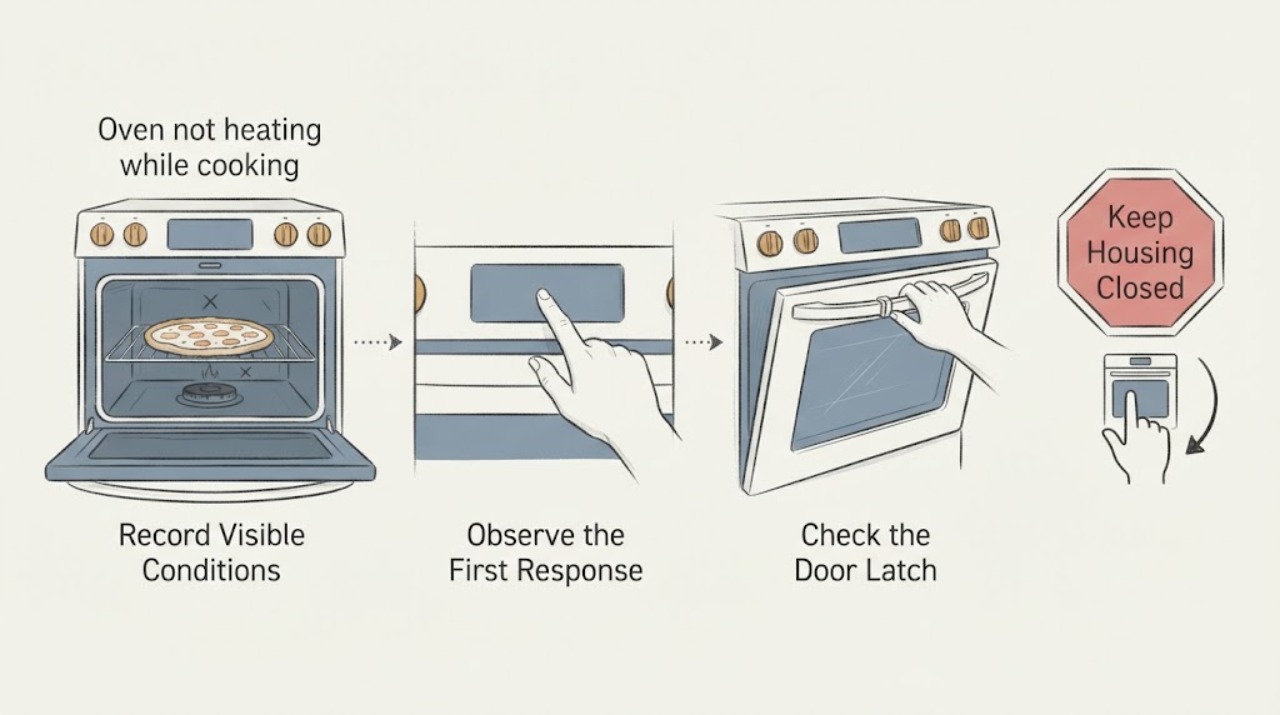
Before another pizza test, write down the complete model JGB905BEF2BB, selected mode, target temperature, whether convection or an automatic conversion is active, rack position, pan or stone type, and whether the oven was fully preheated before the food went in. Note every door opening and the time the pizza began cooking.
Expected result: The pizza was loaded before preheat, the mode or conversion was unclear, the rack/pan or stone blocked airflow, or the oven was fully preheated with a stable setup.
Next step: Use the exact model cooking guidance for rack and mode, preheat with the oven empty, and make only one supervised comparison. If the oven drops far below the set temperature or the burner fails to relight, stop testing and use the service branch.
Stop if: Do not keep opening the door to chase a temperature, leave the oven unattended at a high setting, or continue if there is gas odor, smoke, soot, delayed ignition, or an abnormal flame.
Why this matters
Why: An incomplete preheat, altered convection temperature, blocked circulation, or repeated door opening can lengthen pizza cooking without proving a failed gas system. A stable preheated setup makes a repeatable heat drop more meaningful.
-
Check 2
With the oven cool and no gas odor, compare the display's behavior with a high-quality oven thermometer only as a secondary observation. Record the temperature at initial preheat, after the oven signals ready, and when the pizza appears to stop cooking; do not open the door repeatedly to take readings.
Expected result: The temperature swings around the set point, stays consistently low, drops near 200°F with no burner recovery, or the thermometer reading changes when its location or the door changes.
Next step: If the issue is a stable temperature offset and the oven otherwise heats and cycles normally, consult the JGB905BEF2BB manual for calibration. If it cannot maintain heat or repeatedly stops far below the target, stop using it and arrange gas-appliance service.
Stop if: Do not calibrate around an ignition failure, use a cheap thermometer as proof of a failed part, or remove panels to measure the sensor or valve.
Why this matters
Why: GE says cycling above and below the set point is normal and can vary by roughly ±30°F, while probe placement and door openings affect readings. A stable large error or a low-temperature plateau with a failed relight is different from ordinary cycling and needs ignition/control diagnosis.
-
Check 3
Confirm externally that the Bake control is selected correctly, the range has stable electrical power, the accessible gas shutoff is in its normal open position, and the self-clean latch is not locked. Do not move the range or loosen a gas connection to perform these checks.
Expected result: The mode, breaker/power, gas shutoff, or self-clean latch was wrong or uncertain, or all external settings are correct while the surface burners work.
Next step: Correct one confirmed external setting only and make one supervised Bake start. If the gas position is uncertain, the appliance was recently installed/moved, or a regulator may have been disturbed, call qualified service rather than reaching behind the range.
Stop if: Leave immediately for a gas odor; do not operate electrical switches, move the range, adjust a regulator, or continue a breaker that trips.
Why this matters
Why: GE notes that a gas range can have working surface burners while the oven does not, including when the regulator or oven-specific ignition path is not supplying the bake burner. A correct external setup moves the decision to a controlled ignition observation or service, not to a random setting change.
-
Check 4
If the exact GE instructions for this model identify a visible glow-bar igniter, start a cool empty Bake cycle once and observe only from outside the cavity for the expected red glow and normal ignition sequence. Do not touch the igniter, reach into the oven, or manually light gas.
Expected result: There is no glow, the igniter glows but the main burner does not light or relight, the burner lights with an abnormal flame, or the ignition sequence looks normal.
Next step: Stop the test and arrange qualified GE gas-appliance service for no glow, glow-without-heat, repeated failed relight, delayed ignition, or an abnormal flame. A normal brief observation does not clear the high-temperature recurrence; provide the recorded pizza sequence to service.
Stop if: Do not repeat ignition cycles, test current with consumer equipment, bypass safety controls, remove the burner, or order a part solely because an igniter glows.
Why this matters
Why: GE says no glow can indicate an igniter, control, or other electrical issue, while glow without heat requires diagnosis of the gas valve, burner, regulator, sensor, or control. The exact-model Reddit pattern of short glow cycles without burner relight is a service clue, not proof of an igniter-only failure.
-
Check 5
After all safe external checks are normal, perform at most one supervised Bake retest without food. Note whether the oven reaches the set temperature, maintains a normal flame, recovers after cycling, and stays free of gas odor, smoke, soot, or delayed ignition. Do not use a pizza as the diagnostic load.
Expected result: The oven heats and cycles normally, it drops far below the target or fails to relight, or any gas/combustion hazard appears.
Next step: If the symptom returns only with the pizza setup, change one cooking variable at a time using the manual. If the oven itself loses heat or a hazard appears, stop using it and arrange qualified service; for gas odor, leave the area and contact the gas supplier or emergency help from outside.
Stop if: Do not continue cooking to see whether the burner recovers, run self-clean, or use the oven after delayed ignition, flashback, soot, smoke, or a strong unburned-gas odor.
Why this matters
Why: Normal empty-oven operation makes preheat, cookware, rack, convection, and door-opening effects more plausible for the pizza result, but does not prove the oven is healthy under high demand. Persistent low heat or abnormal combustion crosses into gas-appliance diagnosis.
Use your observations
Decision map
Find the observation that best matches what you see, then follow the next safe action.
-
PATH 01Next step
What you see
The oven is fully preheated and the high-temperature pizza setup is repeatable, but the oven falls far below the target with the bake burner off or fails to relight.
Do this next
Stop repeated tests and arrange qualified GE gas-appliance service. Provide the target temperature, preheat status, temperature observations, burner/glow sequence, and whether the surface burners still work.
Why this path and its safety boundary
Why it matters: This is not explained by normal ±30°F cycling alone. The exact-model report shows the same kind of high-temperature symptom, while GE's gas guidance points toward ignition, burner, regulator, sensor, or control diagnosis rather than a cooking-time adjustment.
-
PATH 02Next step
What you see
The oven reaches temperature and cycles normally without a gas or combustion hazard, but pizza cooks slowly when the door is opened, the rack/stone blocks circulation, or convection conversion changed the selected temperature.
Do this next
Preheat fully, use the model's rack and cookware guidance, leave circulation space, minimize door openings, and change one variable at a time. Use the manual's calibration path only for a stable offset after normal heating is established.
Why this path and its safety boundary
Why it matters: A cooking setup or expected convection/temperature behavior is more likely than a failed gas component. The symptom does not justify replacing an igniter or sensor.
-
PATH 03Next step
What you see
The igniter does not glow, glows without a stable main burner, cycles repeatedly without relighting, or the oven remains cold while the surface burners work.
Do this next
Stop using the oven and request qualified GE gas-appliance service. Do not manually light the oven, replace the igniter from a symptom, or perform current, pressure, valve, or live wiring tests.
Why this path and its safety boundary
Why it matters: The oven-specific ignition or gas path is not operating normally. GE lists the igniter, controls, gas regulator, burner, and other electrical components as possible service areas; the observation cannot select one part safely.
-
PATH 04Next step
What you see
There is unburned-gas odor, delayed ignition, a yellow/unstable flame, soot, smoke, fire, scorching, a damaged cord, or a breaker that trips during oven operation.
Do this next
Stop using the range, avoid switches and flames, leave the area for a gas odor or active fire, and contact the gas supplier, fire department, emergency service, or qualified gas-appliance technician from a safe location.
Why this path and its safety boundary
Why it matters: This is a gas, fire, combustion, or electrical safety event, not a temperature-calibration problem.
Helpful context
Understand the symptom
The high-temperature pizza condition changes what the first observation means. GE explains that an oven cycles on and off around its set temperature, that readings vary with probe location and door openings, and that convection conversion may lower the temperature selected for cooking. A pizza placed before full preheat, a blocked rack/pan arrangement, frequent door opening, or a stone that absorbs heat can look like a no-heat failure. That does not explain a repeated drop far below the set temperature with a bake burner that will not relight, so record the actual sequence rather than judging only the pizza.
The exact JGB905BEF2BB Reddit report describes two high-temperature pizza events in which the oven seemed to fall to about 200°F with the burner off, while a low-temperature test showed the igniter cycling and the burner eventually lighting after the door was opened. Replies suggested an igniter, but the thread did not confirm a repair. Treat this as a useful symptom pattern, not a license to replace a gas or electrical part.
GE's gas-range guidance supports external checks of the Bake/Broil controls, power, gas supply, and a brief visual glow-bar observation where the exact model instructions permit it. Do not touch the burner or igniter, manually light the oven, move the range to inspect a gas connection, or perform live current or gas-pressure tests.
When checks do not resolve it
Need a professional?
Arrange qualified GE gas-appliance service when the JGB905BEF2BB drops far below the set temperature, the bake burner fails to ignite or relight, the igniter glows without stable heat, the issue recurs after one controlled retest, or diagnosis would require moving the range, opening panels, touching gas components, testing live wiring, or measuring current or pressure. Stop immediately for gas odor, delayed ignition, abnormal flame, soot, smoke, fire, scorching, a damaged cord, or repeated breaker trips.
Have this ready
- Provide the complete model JGB905BEF2BB, serial number and market, target temperature and mode, whether convection conversion was active, preheat duration, rack/pan/stone setup, temperature observations, door openings, surface-burner result, glow/burner sequence, gas odor or flame observations, and the exact pizza symptom timing.
Common questions
FAQ
Why does the GE JGB905BEF2BB seem not to heat when making pizza at 550°F?
First separate setup from an oven fault: fully preheat, confirm Bake and the actual selected temperature, account for convection conversion, use the correct rack and cookware position, and minimize door openings. If the oven then drops far below the target with the bake burner off or fails to relight, stop testing and request gas-appliance service.
Is a temperature swing normal in this GE gas oven?
GE says ovens cycle above and below the set temperature to maintain an average, and the amount varies by model, measurement location, room conditions, and door openings. A stable offset may be calibrated through the exact model manual, but a failed burner relight or a large repeated low-temperature plateau is not something to correct with calibration alone.
Should I replace the igniter because the oven loses heat during pizza cooking?
Not from the symptom alone. GE says no glow or glow without heat can involve the igniter, controls, gas valve, burner, regulator, sensor, or other components. The exact-model community reply suggested an igniter but did not confirm a repair, so have qualified service verify the ignition sequence before replacing a part.
Read the exact guide
Official sources
- Gas Range & Wall Oven - Oven Will Not Come OnGE Appliances · Official general GE gas-oven guidance; use the exact JGB905BEF2BB manual for model-specific operation and calibration.
- Range & Wall Oven - Oven Temperature Is Not CorrectGE Appliances · Official general GE range/oven temperature guidance; it supports interpreting pizza cooking results but does not diagnose this model's gas components.
- Gas Range - Oven Does Not Heat, But The Burners HeatGE Appliances · Official general GE gas-range guidance; the JGB905BEF2BB manual controls exact controls and access, and the article does not authorize internal gas repair.
- Range & Wall Oven - How to Calibrate My OvenGE Appliances · Official calibration overview; it explicitly requires the owner manual for the exact control type and model.
- GE Gas Oven, Temperature Weirdness?Reddit r/appliancerepair · Exact GE JGB905BEF2BB report of high-temperature pizza heat loss and a low-temperature ignition observation; replies are unverified and no confirmed repair outcome is documented.
Community feedback
Share a repair observation
Share a plain-text repair observation. Accepted observations are published automatically; this page may take a moment to update.