
On this page
Start here
Quick answer
A KitchenAid gas oven that is not heating needs a fuel, control and ignition check in that order. Confirm the full model and that the appliance is a gas range or gas wall oven; the oven still needs safe electrical power for its controls and igniters. With no gas odor, delayed ignition, abnormal flame, smoke, burning odor, sparks, scorching, unusual heat or repeated breaker trip, confirm the door is fully closed, the clock and cooking mode are set, Start has been pressed, the main gas valve is on and the model-specific pressure-regulator shutoff has not been closed. A newly installed or reconnected range can have air in the gas line, but do not repeatedly ignite it. Use the KitchenAid manual for the one-time bake or broil check and stop when the burner does not light within the model's stated interval. Do not remove panels, adjust gas pressure, test a live igniter or use a mirror or open flame as a substitute for service. Gas odor, delayed ignition, abnormal flame, carbon-monoxide alarm, smoke, electrical odor, arcing, scorching or a repeated trip requires immediate stop, safe evacuation or isolation and qualified help. If one valid Bake or Broil cycle still produces no normal heat, arrange KitchenAid or licensed appliance service.
Before you begin
Safety first
- Do not loosen gas fittings, adjust gas pressure or air-gas mixture, open panels, probe live wiring, use an open flame, bypass a door or temperature safety, remove the oven bottom, repeatedly attempt ignition or continue after gas odor, smoke, sparks, abnormal flame, scorching or a carbon-monoxide alarm.
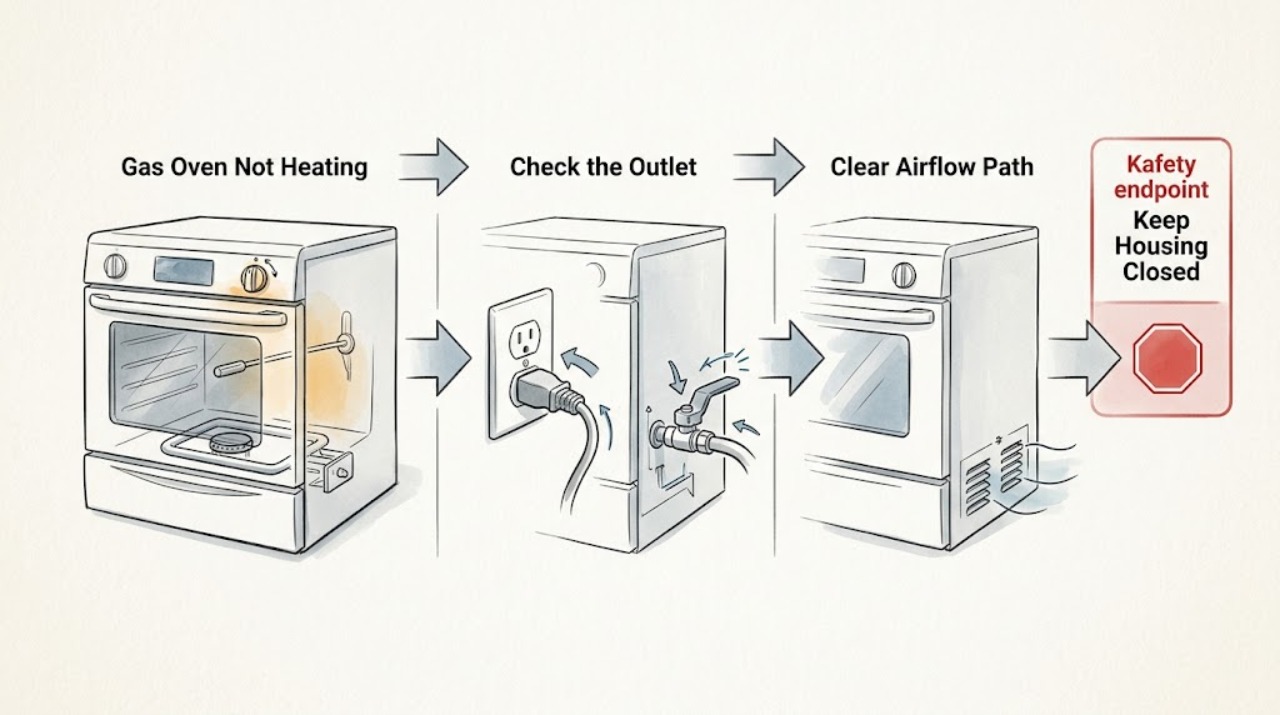
Work through in order
Diagnostic checks
Use only checks that match the exact appliance or system and its official guide.
-
Check 1
Stop the cooking attempt and record the model, fuel setup and visible behavior. Note whether the display and cooktop work, whether Bake or Broil was selected, whether the door is fully closed, whether there is clicking or a glow, whether a burner flame appears through the normal viewing path and whether any heat reaches the cavity. Stop immediately for gas odor, delayed ignition, abnormal flame, smoke, sparks, burning or electrical odor, scorching, carbon-monoxide alarm, abnormal heat, water near electrics or a repeated breaker trip.
Expected result: The display is dark, the cooktop works but the oven is cold, the burner never lights, ignition is delayed, the flame is abnormal, one mode works but another does not, or a hazard sign is present.
Next step: For gas odor, smoke or a carbon-monoxide alarm, do not operate switches or appliances; leave the area and contact emergency help from a safe location. For other hazards, isolate power only when safe. If no hazard is present, continue with power, control, gas and door checks.
Why this matters
Why: Gas ovens still need electrical control and ignition power. Cooktop operation does not prove that the oven gas path or igniter is healthy. A hazard requires immediate isolation or evacuation, not more ignition tests.
-
Check 2
Check the accessible electrical and control prerequisites without moving the range. Confirm the power cord is connected to the grounded outlet required by the model and that the household breaker or fuse is not open. Set the clock if the model requires it, cancel Delay Start, Sabbath, lockout or timer-only states, select Bake or Broil and press Start. Do not open the junction box, perform live electrical checks or use an adapter or extension cord.
Expected result: The display or ignition returns after a safe power correction, a lock or delay state was active, the clock was unset, the outlet or breaker is abnormal, or the oven remains cold with a stable display.
Next step: Correct only the accessible supply, clock or model-specific control state. If the breaker trips again, damage is visible or the oven remains cold after a valid command, keep it off and arrange qualified service.
Why this matters
Why: KitchenAid states that gas ignition depends on a grounded operational electrical path, and a control state can prevent a cooking function from being started. Stable controls with no heat shift the diagnosis toward gas, ignition or temperature control.
-
Check 3
Check the gas-supply conditions that the model manual exposes. Verify the main gas valve is on and, where the model has one, the pressure-regulator shutoff is in its normal ON position. If the range was recently installed or reconnected, follow the manual's first-use guidance only once and do not remove panels or loosen fittings. Keep the storage drawer clear and do not cover the oven bottom with foil or a liner that could block burner airflow.
Expected result: The main supply or regulator shutoff is off, the range is newly connected, the storage drawer is obstructed, foil blocks the oven bottom, the supply is normal or ignition still fails.
Next step: Correct only an intentionally closed accessible supply or visible storage obstruction when the manual permits, and remove prohibited foil after the oven is cool. Do not adjust pressure, remove the regulator or continue if gas odor or abnormal ignition occurs. Persistent failure requires service.
Why this matters
Why: KitchenAid notes that air can be trapped after a gas reconnection, that a regulator shutoff can leave cooktop burners working while the oven has no gas, and that drawer contents or foil can interfere with ignition or burner airflow.
-
Check 4
With the oven cool, check the door and temperature-sensing area without disassembly. Close the door fully and remove only visible items that prevent closure. Confirm the temperature sensor has not been bent or displaced, and make sure the vent and burner area are not covered by foil or an oven liner. Use the model manual for any approved external cleaning of grease or debris; do not scrape, bend or probe the igniter or burner.
Expected result: The door was open or obstructed, the sensor was moved, foil or a liner blocked airflow, grease or debris is visible in an accessible area, or the door and visible airflow path are normal.
Next step: Correct only the visible door, sensor-position or foil condition supported by the model instructions. If the igniter or burner still fails, stop and arrange service; do not remove the oven bottom or test live parts.
Why this matters
Why: KitchenAid says door position can prevent elements or burners from operating, a moved sensor can affect temperature control, and foil or a liner can block air or gas flow. A normal visible path does not rule out an internal ignition or control fault.
-
Check 5
After a safe correction and full cooldown, perform at most one supervised Bake or Broil check using the exact KitchenAid control sequence. Observe whether the burner lights without delay, whether the cavity warms, whether the flame is stable and whether the mode regulates heat. Do not repeat ignition attempts, use an open flame, test the igniter with live power, adjust gas mixture or continue after any odor, smoke, spark, abnormal flame or electrical symptom.
Expected result: The burner lights and the cavity warms normally, the burner clicks without lighting, ignition is delayed, the flame lifts or turns yellow, the oven stays cold, or a hazard returns.
Next step: Press Off and stop for failed ignition or any hazard. Keep the range off and arrange KitchenAid or licensed appliance service, giving the technician the model, mode, power, gas-supply, ignition, flame and temperature observations.
Why this matters
Why: A single normal run supports a corrected control, supply, door or airflow condition. Clicking without ignition, delayed ignition, abnormal flame or no heat indicates an igniter, valve, regulator, sensor, control or gas-supply fault that requires qualified diagnosis.
Use your observations
Decision map
Find the observation that best matches what you see, then follow the next safe action.
-
PATH 01Next step
What you see
The display is dark, the grounded supply is abnormal or the breaker or fuse trips again.
Do this next
Check the accessible breaker or fuse once only when safe. If power does not remain stable or damage is visible, keep the range off and arrange qualified electrical or appliance service.
Why this path and its safety boundary
Why it matters: The oven may lack the electrical path required for controls and gas ignition, or the supply has an electrical fault.
-
PATH 02Next step
What you see
The display works but Bake or Broil does not start because the clock, lock, delay, timer-only mode, door or selected control is wrong.
Do this next
Set the clock if required, cancel the active state, close the door, choose the correct cavity and press Start using the model manual. Request service if the control or door still fails.
Why this path and its safety boundary
Why it matters: A normal control or interlock condition is preventing the gas heating command.
-
PATH 03Next step
What you see
The range was recently installed or reconnected, the gas valve is on and there is no gas odor, but the first ignition is delayed.
Do this next
Follow the exact manual's one-time first-use procedure. Press Off and request qualified service if ignition does not occur within the model's stated interval or fails again.
Why this path and its safety boundary
Why it matters: Air in the gas line can delay first ignition, but this is a limited installation condition rather than a reason for repeated attempts.
-
PATH 04Next step
What you see
The cooktop works but the oven does not ignite, the pressure-regulator shutoff is off, the storage drawer is obstructed or foil blocks the oven bottom.
Do this next
Correct only an accessible shutoff, drawer obstruction or prohibited foil condition after the oven is cool and the manual permits. Do not adjust gas pressure or remove panels; service a persistent failure.
Why this path and its safety boundary
Why it matters: The oven gas or ignition path can differ from the cooktop, and visible installation conditions can obstruct the burner.
-
PATH 05Next step
What you see
The igniter clicks without a normal flame, ignition is delayed, the flame is yellow or lifting, the oven remains cold or a temperature fault persists.
Do this next
Turn the oven Off, keep the range off and arrange licensed appliance service. Do not repeat ignition, adjust the air-gas mixture or test the burner live.
Why this path and its safety boundary
Why it matters: An igniter, valve, burner, regulator, sensor, control or gas-supply fault may be present; the symptom does not identify a user-replaceable part.
-
PATH 06Next step
What you see
There is gas odor, delayed ignition with odor, abnormal flame, smoke, carbon-monoxide alarm, burning or electrical odor, sparks, scorching, abnormal heat or a repeated trip.
Do this next
Do not operate switches or appliances during a suspected gas leak. Leave the area and contact emergency help from a safe location. For other hazards, isolate power only when safe and obtain qualified service.
Why this path and its safety boundary
Why it matters: This is a gas, combustion, fire or electrical safety event, not a routine no-heat diagnosis.
Helpful context
Understand the symptom
Start with the exact gas-oven identity
This topic is for a KitchenAid gas oven or gas range oven. A dual-fuel model may use a different electrical and gas arrangement, and control steps vary by model. Record the model, whether the cooktop burners work, whether the display is lit, which mode was selected and whether the complaint is no ignition, weak heat or an oven that heats unevenly.
Normal ignition has a clear stop boundary
A recently installed or reconnected range can have air in the gas line. KitchenAid's installation manual describes a first-use bake or broil verification and says to stop and contact authorized service when the burner still does not light after the checks. Do not keep clicking, smell for gas, adjust the regulator or open the burner compartment.
Protect the ignition and combustion path
The oven needs a grounded electrical path for ignition and a correct gas supply. Door position, a storage drawer obstruction, foil covering the oven bottom, a moved temperature sensor or an incorrect mode can prevent normal heat. These observations do not authorize gas-system repair or live electrical testing.
Safety boundary
Stop conditions
- Gas odor, delayed ignition with odor, abnormal flame, smoke or a carbon-monoxide alarm
- Burning or electrical odor, sparks, arcing, melting or scorching
- Abnormal cavity or control-area heat or heat without a valid command
- Repeated breaker or fuse trip, damaged power connection or water near electrics
- A gas or ignition fault that persists after the one model-specific check
- Any need to open the cabinet, adjust gas components, test live parts or bypass safety protection
Only after diagnosis
Potential parts
- gas oven igniter or ignition electrode
Consider only when a licensed technician confirms an ignition fault after power, door, control, gas-supply and airflow checks.
Confirm the complete KitchenAid model and fuel configuration; do not test or replace an igniter in a live appliance. - oven gas valve or pressure-regulator component
Consider only when qualified diagnosis confirms a gas-flow or valve fault; an off accessible shutoff is not evidence that the component itself has failed.
Gas components are safety-critical and model-specific; pressure and conversion work belongs to qualified service. - oven temperature sensor or electronic control
Consider only when qualified diagnosis confirms incorrect temperature feedback or a control fault after ignition and supply checks.
Do not bend or probe the sensor or control wiring; verify the exact model before replacement.
When checks do not resolve it
Need a professional?
Arrange KitchenAid or licensed appliance service for failed ignition after one model-specific check, an igniter that clicks without a normal flame, delayed ignition, abnormal flame, no heat on Bake or Broil, a returning fault, a moved or damaged sensor, a repeated breaker trip, gas odor, smoke, carbon-monoxide alarm, burning or electrical odor, sparks, scorching or abnormal heat.
Safety scope: Do not loosen gas fittings, adjust gas pressure or air-gas mixture, open panels, probe live wiring, use an open flame, bypass a door or temperature safety, remove the oven bottom, repeatedly attempt ignition or continue after gas odor, smoke, sparks, abnormal flame, scorching or a carbon-monoxide alarm.
Common questions
FAQ
Why is my KitchenAid gas oven not heating even though the cooktop works?
The oven and cooktop can have different gas and ignition paths. Check the correct mode, closed door, grounded power, main gas valve and model-specific regulator shutoff. If the oven still does not ignite or heat, keep it off and arrange qualified service.
Can a newly installed KitchenAid gas oven take longer to ignite?
Yes. KitchenAid explains that air can be trapped in a newly connected gas line. Follow the exact model's first-use guidance once and stop if ignition does not occur within the manual's stated interval or if there is any gas odor or abnormal flame.
What should I check if my KitchenAid gas oven igniter clicks but there is no heat?
Confirm the door, mode, grounded power, gas valve, regulator shutoff, storage-drawer clearance and oven-bottom airflow condition. Do not adjust gas parts or repeat ignition indefinitely. Clicking without a normal flame needs qualified diagnosis.
Can foil cause a KitchenAid gas oven not to heat?
KitchenAid warns that foil or an oven-bottom liner can block air or gas flow to the burner. Remove only a visible prohibited liner after the oven is cool and follow the model manual; persistent no heat needs service.
When is a KitchenAid gas-oven heating problem an emergency?
Stop immediately for gas odor, delayed ignition with odor, abnormal flame, smoke, carbon-monoxide alarm, burning or electrical odor, sparks, scorching, abnormal heat or a repeated breaker trip. Do not operate switches during suspected gas leakage; leave the area and contact emergency help from a safe location.
Read the exact guide
Official sources
- Why Won't My Gas Oven Heat Up?KitchenAid · KitchenAid gas-oven power, igniter, temperature sensor, flame and gas-supply guidance
- Oven Not Working - Cooktop Working - ClickingKitchenAid Product Help · KitchenAid gas-range regulator shutoff, drawer obstruction, foil and ignition checks
- KitchenAid Gas Range Owner's ManualKitchenAid · KitchenAid gas-range electronic ignition, bake and broil burner verification and safety boundaries
- Oven Not Working - GasKitchenAid Product Help · KitchenAid gas-range power, grounding, gas-line and main-valve checks
- Oven Not Working - Gas and Dual Fuel RangeKitchenAid Product Help · KitchenAid gas and dual-fuel door, power, gas-supply and service guidance
Community feedback
Share a repair observation
Share a plain-text repair observation. Accepted observations are published automatically; this page may take a moment to update.