
On this page
Start here
Quick answer
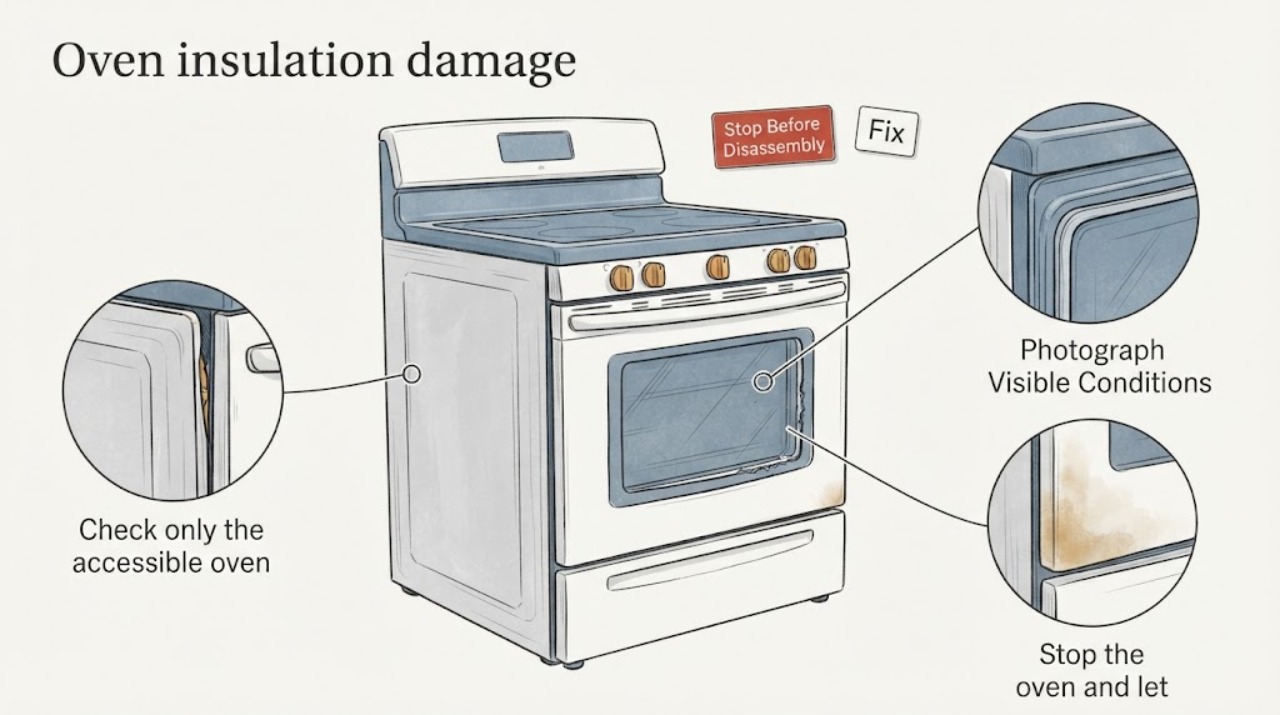
Treat loose, missing, displaced, or heat-damaged oven insulation as a stop-use and service condition. With the oven off and fully cool, document what is visible, the model and serial number, any unusual cabinet heat, odor, smoke, or temperature alert, and do not remove panels, pull at fibers, add insulation, run self-clean, or guess a replacement material. Frigidaire's safety guidance assigns non-listed repairs and construction changes to qualified service; its support guidance says to turn off and cool an oven reporting higher-than-normal temperature and contact support if the issue persists.
Work through in order
Diagnostic checks
Use only checks that match the exact appliance or system and its official guide.
-
Check 1
Stop the oven and let it cool completely; if there is active smoke, flame, an electrical odor, or unusually hot surrounding cabinetry, keep people away and isolate the appliance only if that can be done without approaching a hazard.
Expected result: The oven remains hot, a smoke or flame is present, an odor continues after controls are off, or adjacent cabinetry is hotter or discolored than expected.
Next step: Do not restart the oven or run self-clean. For active fire or spreading smoke, leave the area and call emergency services; otherwise arrange qualified appliance service after the unit is safely isolated.
Why this matters
Why: These signs raise the urgency beyond a cosmetic insulation question. Frigidaire treats higher-than-normal temperature as a safety alert, and CPSC fire guidance says to keep an oven door closed and turn off heat for an oven fire.
-
Check 2
When the appliance is cold and controls are off, record the exact model and serial number and photograph only the visible condition from accessible openings or the exterior.
Expected result: The material is loose, missing, charred, sagging, protruding into an opening, or visible behind a liner; alternatively, the only material visible is food residue or a normal gasket edge.
Next step: Send the model/serial and photos to Frigidaire support or a qualified technician. Do not pull fibers, probe behind liners, remove trim or panels, or substitute household insulation.
Why this matters
Why: A photograph and exact identity let Frigidaire or a technician match the correct manual and construction. Appearance alone cannot identify the insulation material, prove internal damage, or establish a compatible replacement.
-
Check 3
Check only the accessible oven vent and nearby cabinet surfaces while the oven is cold; do not block the vent or place plastic, paper, or other heat-sensitive items near it.
Expected result: The vent is obstructed, the cabinet finish is bubbled or discolored, or there is evidence of heat escaping where it normally should not; or the vent is clear and the surrounding surfaces look normal.
Next step: Remove only an obvious loose object from the vent area without disassembling the appliance. Keep the oven out of service when heat damage or escaping material is present and give the observations to service.
Why this matters
Why: Frigidaire identifies the vent as necessary for air circulation and warns that nearby surfaces can become hot. Clear venting does not rule out insulation damage, and a normal exterior does not prove the interior is safe.
-
Check 4
If the display shows F10 or the oven has produced a higher-than-normal temperature symptom, note the exact message and when it appeared rather than repeatedly resetting it.
Expected result: Frigidaire's support guide identifies F10 on standard range and wall ovens as detection of higher-than-normal temperatures and directs the user to turn the oven off, let it cool, and contact support if the issue persists.
Next step: Keep the oven off and cooled, preserve the code and model information, and arrange support. Do not use the code to select a heater, sensor, insulation, or other part without the exact manual.
Why this matters
Why: An over-temperature alert is evidence of a temperature-control or safety condition, not proof that insulation alone failed.
-
Check 5
Do not start the self-clean cycle while insulation is suspected to be damaged or displaced.
Expected result: The oven offers self-clean, but the condition of the insulation or surrounding cabinet is uncertain, or there has already been smoke, unusual heat, or a damaged-material finding.
Next step: Leave self-clean unused until qualified service has inspected the exact oven. Do not use self-clean as a diagnostic test or as a way to burn off exposed material.
Why this matters
Why: The Frigidaire manual says self-clean reaches temperatures well above normal cooking temperatures; a CPSC recall for specified Thermador models shows why insulation gaps during self-clean can create an overheating and cabinet-fire hazard.
Use your observations
Decision map
Find the observation that best matches what you see, then follow the next safe action.
-
PATH 01Next step
What you see
Visible insulation is loose, missing, charred, protruding, or accompanied by cabinet discoloration, smoke, unusual odor, or abnormal heat.
Do this next
Stop using the Frigidaire oven, do not run self-clean or remove panels, and arrange qualified model-specific inspection.
Why this path and its safety boundary
Why it matters: The condition is not safely identifiable as a cosmetic issue from the outside and may involve heat containment or another oven fault.
-
PATH 02Next step
What you see
The oven is cool and only food or grease residue is visible inside the cavity, with no displaced material, heat damage, odor, or temperature alert.
Do this next
Follow the exact Frigidaire manual's cold-oven cleaning instructions only; if insulation remains suspected, keep the oven off and ask service to identify the condition.
Why this path and its safety boundary
Why it matters: Residue is not evidence of insulation damage, although the absence of visible damage does not clear a hidden fault.
-
PATH 03Next step
What you see
The display reports F10 or the oven repeatedly runs hotter than expected.
Do this next
Turn the oven off, allow it to cool, record the code and model, and contact Frigidaire support or qualified service if it recurs.
Why this path and its safety boundary
Why it matters: Frigidaire describes this as a higher-than-normal-temperature safety alert; it does not identify insulation as the failed part.
-
PATH 04Next step
What you see
There is an active oven fire or smoke is spreading beyond a brief controlled incident.
Do this next
Keep the oven door closed, turn off the heat only if safe, leave the area, and call emergency services; do not use water on a grease fire.
Why this path and its safety boundary
Why it matters: This is an immediate fire emergency rather than a repair diagnosis.
Helpful context
Understand the symptom
Insulation damage is not a normal cleaning problem. The task has no Frigidaire model number, so the visible description cannot identify the insulation type, its location, or a compatible repair material. Use this page to make the appliance safe and collect useful evidence for service; it does not authorize opening the oven cabinet or patching the insulation.
Do not transfer the CPSC Thermador recall to Frigidaire. It is a model- and brand-specific example that gaps in oven insulation can be associated with overheating during self-cleaning. The practical conclusion for a Frigidaire oven is narrower: stop using an oven with suspected damaged insulation until the exact model and condition have been reviewed by qualified service.
When checks do not resolve it
Need a professional?
Arrange qualified Frigidaire or appliance service before using the oven when insulation is loose, missing, charred, displaced, or suspected behind a liner; when the cabinet is discolored or unusually hot; when smoke, persistent odor, or an F10/higher-than-normal-temperature condition occurs; or whenever the exact model-specific construction is unknown. Do not open the cabinet, remove panels, pull insulation, add filling material, bypass a safety device, or choose a replacement part from appearance alone.
Common questions
FAQ
Can I use the oven if only a small piece of insulation is visible?
Do not assume a small visible piece is harmless. Stop using the oven and have the exact model and condition assessed before heating it again; the appearance does not establish safe containment or a compatible repair.
Can I replace the insulation myself?
Not from this information. Frigidaire's wall-oven safety instructions limit user servicing to repairs specifically recommended in the manual, direct other servicing to a qualified technician, and prohibit modifying the oven by removing panels or wire covers.
Is an F10 code proof that the insulation failed?
No. Frigidaire defines F10 for standard range and wall ovens as detection of higher-than-normal temperatures. Turn the oven off and let it cool; if the issue persists, contact support rather than selecting an insulation or control part from the code alone.
Read the exact guide
Official sources
- Oven Error Codes and Alarms GuideFrigidaire Owner Center · Official Frigidaire support article explicitly covering standard range ovens and wall ovens; model-specific behavior and other codes still require the exact Use & Care Guide.
- Recipe for Safer CookingU.S. Consumer Product Safety Commission · U.S. regulator fire-safety guidance for cooking fires; it does not diagnose Frigidaire insulation.
- BSH Home Appliances Corp. Expands Recall of Thermador Built-In Ovens Due to Fire HazardU.S. Consumer Product Safety Commission · Regulator recall for named Thermador models only; it is category context for why suspected insulation gaps deserve service, not evidence of a Frigidaire defect or recall.
- Frigidaire Wall Oven Use & Care Manual, 139900303 Rev BFrigidaire / Electrolux Home Products · Official Frigidaire manual linked from the Frigidaire Canada FGEW2765PF product-support page; used for family-level safety boundaries only. Controls, construction, and service instructions vary by exact model.
Community feedback
Share a repair observation
Share a plain-text repair observation. Accepted observations are published automatically; this page may take a moment to update.