
On this page
Start here
Quick answer
A Frigidaire oven's convection fan normally runs to circulate heat and may cycle during baking or continue briefly while the oven cools. A steady airflow sound that occurs only in a convection mode can be normal, but a new scrape, grind, rattle, buzz, speed change, or fan noise that continues with the oven cool and all controls off points to a loose or obstructed fan area, worn motor, damaged blade or shroud, or another model-specific fault. First note when the sound starts, whether it changes with convection, preheat, baking, or cool-down, and whether it tracks fan speed. From a cool oven, check only the visible cavity, racks, pans, and obvious debris; do not reach through the fan guard, remove panels, or insert a tool. Stop using the oven for scraping, grinding, smoke, burning odor, electrical symptoms, or a fan that remains abnormal, and arrange qualified appliance service.
Before you begin
Safety first
- This article covers safe listening, mode history, cool visible cavity and accessory checks, and documentation. It does not authorize hot-surface contact, fan-guard access, panel removal, live electrical testing, blade or motor work, lubrication, control bypass, or internal debris removal.
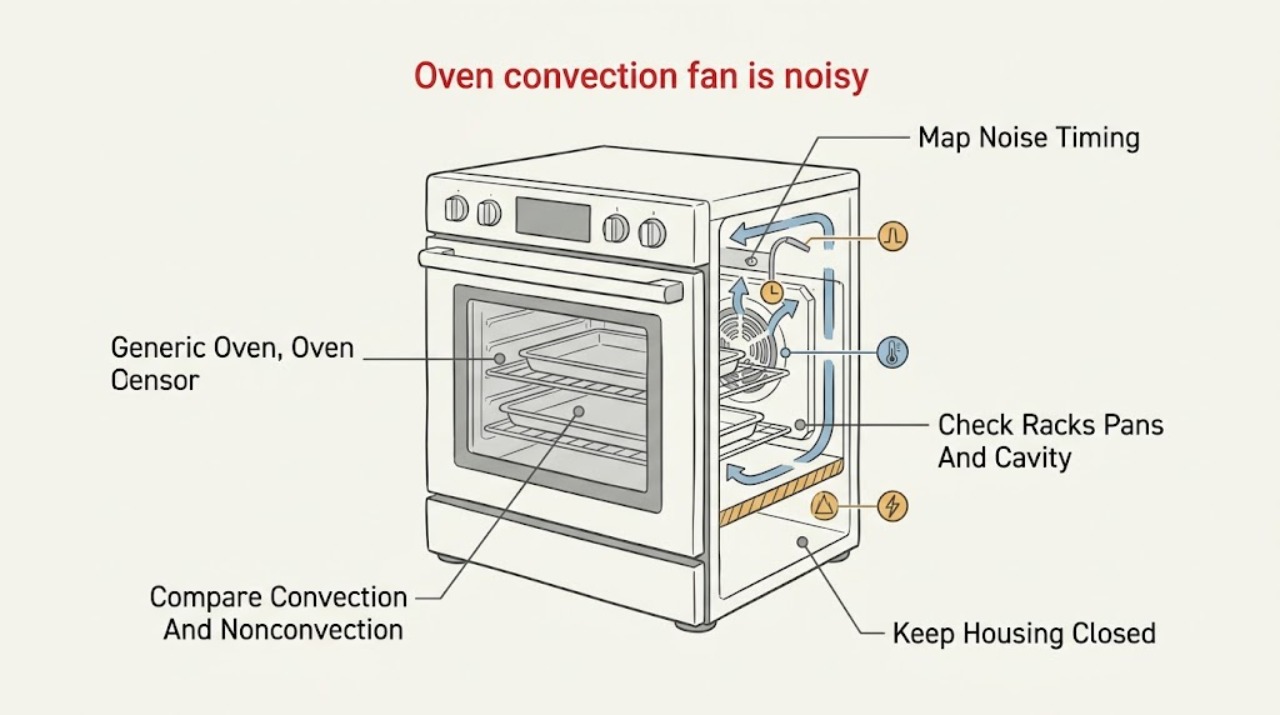
Work through in order
Diagnostic checks
Use only checks that match the exact appliance or system and its official guide.
-
Check 1
From a safe position, record whether the noise begins in Convect Bake or another convection mode, during preheat, during ordinary bake, only after the controls are turned off, or when no cycle has recently run. Do not open the oven or approach a hot cavity to listen closely.
Expected result: The sound is a smooth airflow whoosh that cycles with convection or cool-down, or it is a new scrape, rattle, grind, buzz, or intermittent knock that starts or stops independently of the expected cycle.
Next step: Use the sound pattern to choose a branch. Keep the oven out of service for scraping, grinding, smoke, burning odor, sparks, or a noise that continues when fully cool.
Stop if: Do not run repeated cycles to reproduce a harsh noise, and do not continue if the oven smells hot, smokes, sparks, trips power, or heats unexpectedly.
Why this matters
Why: A smooth sound linked to Frigidaire's described convection or cool-down behavior may be normal. A mechanical or electrical character, especially outside a cycle, makes a fan-area, motor, mounting, control, or other fault more likely.
-
Check 2
Only when the oven is cool and no hazard is present, compare the sound history from a normal non-convection setting with the history from a convection setting, using the exact Frigidaire manual to identify which modes use the fan. Do not start a cycle solely to test a scraping or grinding sound.
Expected result: The noise occurs only when a convection mode is selected, occurs in both modes, or occurs after the oven is off and cooling.
Next step: Record the mode, timing, and sound character, then arrange service for a new harsh or mechanical noise rather than testing through additional cycles.
Stop if: Do not force a mode, defeat a control lock, or operate the oven with smoke, burning odor, sparks, an error, or an abnormal fan that does not settle during the documented cool-down.
Why this matters
Why: A convection-only noise narrows attention to the convection fan path or its airflow, while a noise in multiple modes may involve a separate cooling fan, blower, relay, vibration, or another oven component. Post-cycle noise can be normal only when it matches the model's smooth cool-down behavior.
-
Check 3
With the oven fully cool and power left undisturbed, inspect the visible rack positions, trays, cookware, foil, and cavity floor for an item that could vibrate, contact a surface, or obstruct a visible air path. Remove only a loose, cool item that the manual treats as ordinary user-accessible; do not touch the fan guard or rear opening.
Expected result: A rack, pan, foil edge, or loose accessory is contacting or vibrating against the cavity, or the visible accessories and cavity are clear while the sound still tracks fan operation.
Next step: Reposition or remove only the accessible cool item according to the manual and document whether the noise changes on the next normal use. If the fan-linked sound remains, stop testing and arrange service.
Stop if: Do not reach behind the fan guard, insert foil or a tool into an opening, bend any fan blade, or remove a panel to look for debris.
Why this matters
Why: An accessory vibration can imitate a fan rattle and should change when the item is removed. A clear cavity with a rotation-linked scrape, grind, or buzz makes an internal fan, shroud, motor, mounting, or control issue more likely.
-
Check 4
After the oven is fully cool, inspect only the visible door, cavity surfaces, rack supports, fan guard, and exterior for scorch marks, loose trim, broken glass, impact damage, or anything visibly contacting the guard. Keep hands away from the guard and do not remove it.
Expected result: There is visible damage, a loose trim or guard, scorching, a foreign object, or no visible damage and no accessible obstruction.
Next step: Photograph the condition and arrange qualified appliance service for any damage, contact, or persistent rotation-linked noise; keep the oven unused if the guard or cavity is damaged.
Stop if: Stop for smoke, burning odor, sparks, exposed wiring, broken glass, a loose guard, or any sign that heat or moving parts can reach the cavity.
Why this matters
Why: Visible damage or contact can explain a new vibration or scrape but does not make the fan safe to repair without model-specific access. No visible issue does not rule out a bent blade, bearing, motor, wiring, or control fault behind the guard.
-
Check 5
If the only sound is a smooth fan sound after a completed cycle and there is no hazard, leave the controls Off and allow the oven to cool normally without blocking vents or touching the fan area. Do not repeat a hot cycle to prove the sound is normal.
Expected result: The fan sound fades as the oven cools, remains a harsh or changing mechanical noise, or continues after the oven is cool and no cycle is active.
Next step: If the noise fades and does not recur, keep the mode and sound history in the appliance record. If it persists, worsens, or returns with scraping or grinding, leave the oven out of service and request qualified repair.
Stop if: Do not block ventilation, touch hot surfaces, spray lubricant, or continue operation when the sound is harsh, the fan stalls, or any smoke, odor, sparking, or error appears.
Why this matters
Why: A sound that fades during the documented cool-down is more consistent with expected fan operation. A persistent or worsening noise after cooling is not explained by normal cool-down alone and needs service diagnosis.
-
Check 6
Record the exact Frigidaire model, oven type, selected mode, when the sound starts and stops, whether it follows fan speed, sound character, recent cleaning or movement, visible damage, and any cooking or control symptoms. Preserve a short recording only from a safe distance if no hazard is present.
Expected result: The sound is repeatable and mode-specific, intermittent and difficult to reproduce, accompanied by uneven cooking or an error, or accompanied by smoke, odor, sparks, or an electrical trip.
Next step: Give the record and model information to qualified Frigidaire appliance service. Do not remove the fan assembly or attempt a part replacement based only on the sound.
Stop if: Stop immediately for smoke, fire risk, burning odor, sparks, repeated electrical trips, exposed wiring, or a fan that remains engaged abnormally.
Why this matters
Why: A mode-specific repeatable sound helps a technician separate a convection fan from a cooling fan or accessory vibration. Uneven cooking or control symptoms broaden the fault, while smoke, odor, sparks, or trips make the appliance a stop-use condition.
Use your observations
Decision map
Find the observation that best matches what you see, then follow the next safe action.
-
PATH 01Next step
What you see
The sound is a smooth airflow whoosh, starts in a documented convection or preheat mode, cycles during baking, and fades during cool-down with no damage or hazard.
Do this next
Use the exact model manual to confirm the mode behavior and monitor without blocking vents or touching the fan area. Arrange service if the sound changes character or persists after cooling.
Why this path and its safety boundary
Why it matters: This pattern is consistent with Frigidaire's described convection and cool-down fan operation rather than proof of a failed fan.
-
PATH 02Next step
What you see
A scrape, grind, rhythmic rattle, or changing buzz starts with the convection fan or changes with its apparent speed, while visible racks and pans are clear.
Do this next
Stop using the oven and arrange qualified appliance service without removing the guard, opening panels, bending the blade, or inserting a tool.
Why this path and its safety boundary
Why it matters: A fan blade, shroud, mounting, motor, foreign object, or related control fault is more likely than normal airflow; the sound alone cannot identify which part failed.
-
PATH 03Next step
What you see
The noise is present only with a particular rack, tray, cookware item, foil edge, or loose accessible accessory and does not remain when the cool item is correctly repositioned.
Do this next
Follow the model manual for rack and cookware placement and monitor one normal use. Stop if the sound returns without the accessory or if any guard, cavity, or trim is damaged.
Why this path and its safety boundary
Why it matters: The accessory or its contact with the cavity is more likely than an internal fan failure, but an unchanged fan-linked sound would reopen the service branch.
-
PATH 04Next step
What you see
The fan noise remains harsh, intermittent, or mechanical after the oven is fully cool and all controls are Off, or it occurs when no recent cycle explains it.
Do this next
Leave the oven out of service and arrange qualified appliance repair. Do not keep cycling power or running the oven to reproduce the sound.
Why this path and its safety boundary
Why it matters: Expected post-cycle cooling does not explain a persistent mechanical or electrical noise; a fan, motor, control, mounting, or wiring fault needs diagnosis.
-
PATH 05Next step
What you see
The noise occurs with smoke, burning odor, sparks, electrical trips, visible damage, a fan that remains engaged abnormally, an error, or significant cooking or control changes.
Do this next
Stop using the oven, isolate power only from a dry and safe position when appropriate, keep people away, and seek qualified appliance or emergency assistance for the hazard involved.
Why this path and its safety boundary
Why it matters: This is no longer a sound-only troubleshooting case and may involve hazardous electrical, heating, control, or mechanical failure.
Helpful context
Understand the symptom
Separate normal fan operation from a mechanical noise
Frigidaire says the convection fan circulates heat uniformly, and its range guidance says the oven fan can come on during preheat, cycle during baking, and remain on after the controls are turned off while the interior cools. A smooth, repeatable airflow sound that follows those events is different from a new metallic scrape, rhythmic rattle, grinding sound, or electrical buzz. The timing and character of the noise are more useful than the word noisy by itself.
Use the exact Frigidaire manual for mode and access details
Convection is not available on every Frigidaire oven, and control behavior varies by model. Frigidaire directs owners to the Use and Care Manual for model-specific operation and control information. Do not assume that a rear fan cover, blade, panel, or cooling fan is user-accessible because another oven has a similar layout.
A cool-down fan is not permission to keep testing a damaged fan
Some fan operation after cooking is expected, but the sound should not be treated as normal merely because it happens after the oven is off. Let the oven complete its normal cool-down without touching the cavity or blocking ventilation. If the noise remains after cooling, changes to scraping or grinding, or is accompanied by smoke, a burning odor, sparks, an error, or poor cooking results, leave the appliance out of service and request qualified diagnosis.
Keep fan and electrical work inside the service boundary
A noise that follows fan rotation can involve the blade, shroud, motor, mounting, or a foreign object, but sound alone cannot identify the failed part. The fan area may be close to hot surfaces and electrical wiring, and an oven can have more than one fan. Do not remove a cover, reach through a guard, bend a blade, lubricate a motor, or work inside the appliance as a homeowner test.
Safety boundary
Stop conditions
- Stop using the oven for smoke, fire risk, burning odor, sparks, exposed wiring, repeated electrical trips, broken glass, or a fan that remains engaged or behaves unpredictably.
- Do not reach through the convection-fan guard, insert a knife, wire, probe, or other tool, bend a blade, spray lubricant, or try to remove a foreign object from a concealed fan path.
- Do not remove interior or rear panels, test energized wiring, bypass a thermal or door safety, or replace a motor, blade, shroud, or control as a sound-only experiment.
- Do not keep running preheat or baking cycles to reproduce a scrape, grind, rattle, or buzz; leave the oven out of service when the noise is harsh, worsening, or present after cool-down.
- Stop and arrange qualified appliance service when the exact model's manual does not describe the observed fan behavior, the source is concealed, or the sound remains after visible rack and accessory checks.
Only after diagnosis
Potential parts
- convection fan blade
Consider this category only when a qualified diagnosis confirms a damaged, bent, loose, or contacting convection-fan blade after ruling out normal airflow and accessible accessory vibration.
Confirm the exact Frigidaire model and fan design before selecting a part; do not infer fit from a similar-looking oven or sound. - convection fan motor
Consider this category only when qualified testing identifies a motor, bearing, or motor-drive fault that explains the rotation-linked noise.
Confirm the exact model, voltage and mounting requirements through the manufacturer's documentation and qualified service diagnosis. - fan shroud or guard
Consider this category only when service inspection confirms a damaged, loose, or misaligned shroud or guard contacting the fan or creating the noise.
Confirm the exact oven cavity layout and mounting points; a guard is a safety boundary and should not be removed or improvised by appearance. - fan mounting hardware
Consider this category only when the technician finds loose or damaged mounting hardware after the fan and shroud are safely accessed.
Confirm the exact fastener and heat-rated requirements for the model; do not substitute hardware or tighten parts inside a hot or energized oven.
When checks do not resolve it
Need a professional?
Arrange qualified Frigidaire appliance service for a new scrape, grind, rattle, or electrical buzz; a fan that remains abnormal after the oven cools; visible guard, cavity, blade, trim, or wiring damage; smoke, burning odor, sparks, repeated electrical trips; an error or significant cooking change; or any source behind a panel. Frigidaire's mode and control behavior varies by model, so this article supports safe observation only and does not authorize fan access, live electrical work, lubrication, guard removal, or internal part replacement.
Safety scope: This article covers safe listening, mode history, cool visible cavity and accessory checks, and documentation. It does not authorize hot-surface contact, fan-guard access, panel removal, live electrical testing, blade or motor work, lubrication, control bypass, or internal debris removal.
Common questions
FAQ
Is it normal for a Frigidaire oven convection fan to run after I turn the oven off?
It can be normal for the fan to remain on after cooking while the oven cools. A smooth airflow sound that fades during the model's normal cool-down is different from a new scrape, grind, rattle, or electrical buzz. Use the exact Frigidaire manual for the behavior of your model.
Why is my Frigidaire convection fan scraping or rattling?
A rotation-linked scrape or rattle can involve a fan blade, shroud, mounting, motor, foreign object, or an accessory vibration. Inspect only cool, visible racks, pans, and cavity surfaces; do not reach through the guard or remove panels. Leave the oven out of service and arrange repair if the sound persists.
Can I lubricate or bend the oven convection fan to stop the noise?
No. Do not lubricate, bend, pry, or remove the fan or guard as a homeowner test. The fan area may be hot and close to electrical parts, and the correct access and component depend on the exact model. Request qualified appliance service.
What should I check before calling about a noisy oven fan?
Record the selected mode and when the noise starts or stops, compare it with the model's documented fan behavior, and inspect the cool visible racks, pans, foil, cavity, guard, and trim without touching the fan. Preserve the model number and any safe-distance recording for the technician.
When should I stop using a Frigidaire oven because of fan noise?
Stop for scraping or grinding that continues after cool-down, a harsh or worsening rattle, smoke, burning odor, sparks, electrical trips, visible damage, an error, abnormal heating, or a fan that behaves unpredictably. Isolate power only from a dry and safe position when appropriate and arrange qualified appliance or emergency assistance for the hazard.
Read the exact guide
Official sources
- Ranges - Is it normal for a fan to come on while using my range and when does it stop running?Frigidaire Owner Support · Official Frigidaire support guidance used to distinguish expected fan timing from a persistent mechanical noise; exact behavior varies by model.
- Ovens - What is convection?Frigidaire Owner Support · Official Frigidaire explanation that Convection Cook uses a fan to circulate heat; it does not identify a particular noisy component without a model diagnosis.
- Ovens - How do I use Convection Bake?Frigidaire Owner Support · Official Frigidaire mode guidance used to establish that convection behavior and rack instructions are model-dependent.
- How do I use my display or controls?Frigidaire Owner Support · Official Frigidaire support guidance used for the model-specific control and manual boundary; it does not authorize internal fan access.
Community feedback
Share a repair observation
Share a plain-text repair observation. Accepted observations are published automatically; this page may take a moment to update.