
On this page
Start here
Quick answer
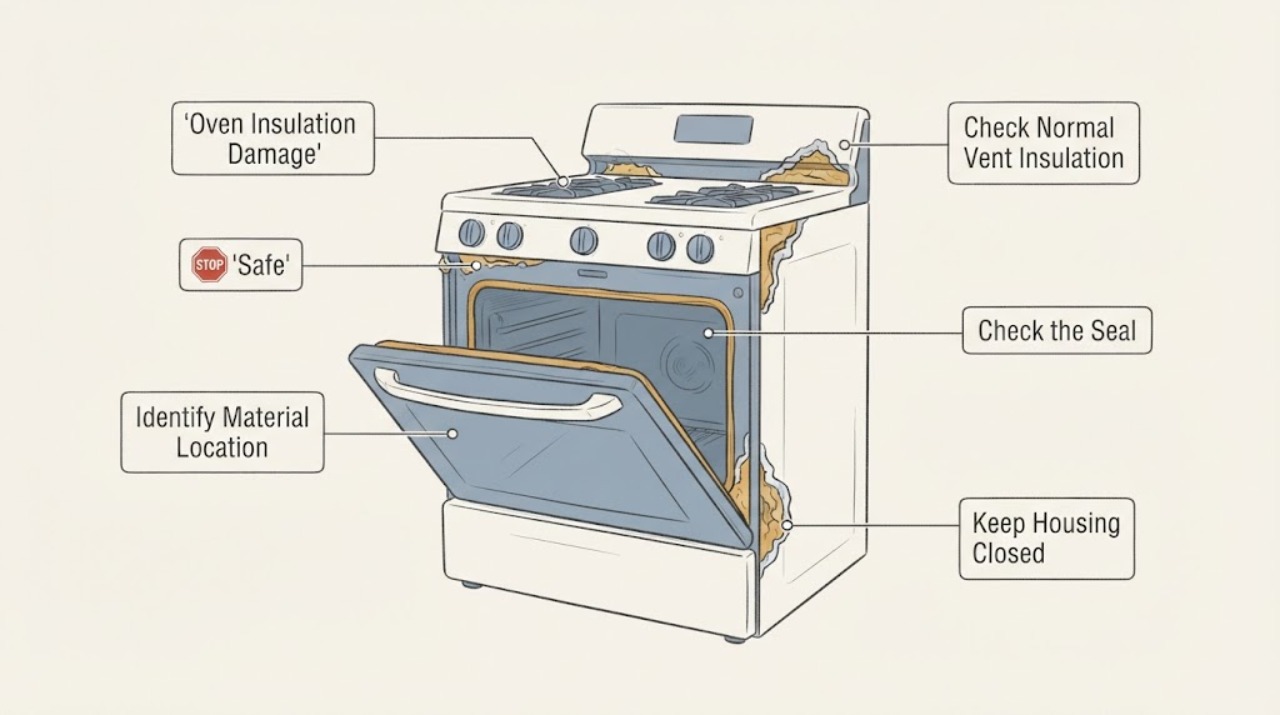
First identify what you are calling insulation and where it is: GE documents some Styrofoam around a range vent or rear lower frame and foil-wrapped insulation around a freestanding-range vent as normal design material that should not be removed. A loose or frayed door gasket, scorching or smoke stains, melted or fused liner material, burning odor, or insulation that has moved into a hot or electrical area is a different situation: stop using the oven, keep hands and tools away, and arrange model-specific service. Do not pull out visible insulation, line the oven with foil, scrape fused material, or open the appliance to inspect insulation.
Work through in order
Diagnostic checks
Use only checks that match the exact appliance or system and its official guide.
-
Check 1
With the oven switched off and completely cool, photograph the suspected material and record whether it is at the rear lower frame, behind the backsplash/vent, around the door, on the oven bottom, or beside a control/heating area. Do not touch or pull it.
Expected result: The material is intact foam or foil in a documented vent/frame location, a door gasket, fused foil/liner material, or loose/burnt material in an unknown location.
Next step: Use the matching branch below and keep the model-specific manual as the authority; if the location is near heat or wiring and the material is loose, stop use and arrange service.
Why this matters
Why: GE documents some foam and vent insulation as normal design material, while a damaged gasket, fused liner or loose/burnt material needs a different service decision.
-
Check 2
From outside the appliance, compare the material only with the documented GE vent/frame locations; do not remove a piece that is around a vent or rear lower frame.
Expected result: It is intact Styrofoam around a range vent/rear lower frame or foil-wrapped insulation behind a freestanding-range backsplash, with no smoke, scorching, looseness or abnormal odor.
Next step: Leave it in place and use the exact model manual for any remaining concern. If it is torn, displaced, overheating or accompanied by an odor, stop using the oven and request service.
Why this matters
Why: GE says these locations can contain normal insulation or a barrier and that the material should not be removed; visibility at some angles can be normal.
-
Check 3
When fully cool, look at the door gasket and the face of the oven without scrubbing the gasket or dismantling the door. Note tears, fraying, displacement, an uneven door or scorching/smoke stains.
Expected result: The gasket is intact and the only symptom is mild warm air around the door, or there is a torn/displaced gasket or scorching/smoke staining.
Next step: For a damaged gasket, uneven door or scorch/smoke marks, stop use and arrange a GE-qualified repair; do not treat it as a universal insulation replacement.
Why this matters
Why: GE says some heat leakage is normal because the oven needs airflow, but major leakage with scorching or smoke and a damaged gasket require service.
-
Check 4
Check only from the cool oven interior whether foil or a silicone liner was used on the bottom/drawer, or whether material has fused to the liner. Do not scrape, pry or heat it to remove it.
Expected result: No liner is present, or foil/liner is fused, melted or has damaged the oven bottom.
Next step: Remove no fused material and do not run the affected cavity; arrange model-specific service.
Why this matters
Why: GE warns that foil and silicone liners can trap heat and melt; for fused foil GE does not provide removal suggestions and recommends service.
-
Check 5
Stop operation and contact GE-authorized or qualified appliance service when insulation is loose, burned, displaced into a hot/electrical area, the oven has smoke/scorching/burning odor, or the exact material/location cannot be identified.
Expected result: The concern persists, affects the door seal/liner/vent, or would require a panel, door, control area or wiring to be opened.
Next step: Give service the full model/serial, range versus wall-oven type, location/photo, odor or smoke history and any foil/cleaning history. Do not open panels, splice insulation or perform a powered test.
Why this matters
Why: The supplied topic has no model or construction detail, and GE says door procedures vary by model; an external view cannot establish safe insulation repair or part fit.
Use your observations
Decision map
Find the observation that best matches what you see, then follow the next safe action.
-
PATH 01Next step
What you see
The suspected material is intact foam around the range vent/rear lower frame or foil-wrapped insulation behind a freestanding-range backsplash, with no abnormal heat, smoke, odor or displacement.
Do this next
Leave it alone, do not remove it, and use the exact model manual if the appearance still seems different.
Why this path and its safety boundary
Why it matters: GE documents those locations as normal design insulation/barrier locations; seeing material there is not proof of damage.
-
PATH 02Next step
What you see
The material is actually the oven door gasket, and there is only mild warm air around an otherwise even, intact door.
Do this next
Keep the gasket dry and unabraded. If it is torn, displaced, or the face shows scorching/smoke, stop use and schedule service.
Why this path and its safety boundary
Why it matters: GE says some heat leakage is normal because the oven needs airflow; a gasket is not automatically failed insulation.
-
PATH 03Next step
What you see
The oven bottom or drawer contains foil/silicone liner material, or foil is fused/melted onto the liner.
Do this next
Do not scrape or run the affected cavity. Arrange model-specific service and remove no panels.
Why this path and its safety boundary
Why it matters: The liner can trap heat and cause damage; GE does not provide a removal method for fused foil.
-
PATH 04Next step
What you see
Insulation is loose, burned, displaced near a heating element/control/wiring area, or accompanied by smoke, scorching or burning odor.
Do this next
Stop using the oven and, when safe, disconnect normal power without opening the appliance; obtain qualified service and provide model/location details.
Why this path and its safety boundary
Why it matters: The external symptom does not identify a safe repair or component, and continuing to heat the oven could worsen a heat or electrical hazard.
Helpful context
Understand the symptom
Identify the material before calling it damage
Look at the location only while the oven is cool and off. Foam near a GE range vent or rear lower frame can be part of the appliance design, and foil-wrapped vent insulation behind a freestanding-range backsplash may be visible from some angles. Do not pull, cut, compress or remove either material just because it can be seen. The exact model and whether the appliance is a range or wall oven still control any service procedure.
Separate a door-seal problem from cavity insulation
A door gasket is a heat seal, not proof that cavity insulation has failed. Some heat around the door is normal, but an uneven door, torn or displaced gasket, scorching or smoke staining on the oven face indicates a sealing or door problem that needs service. Do not wash or scrub a woven fiberglass gasket; GE says cleaning can damage it.
Do not add foil or scrape a damaged liner
Do not line the oven bottom or drawer with aluminum foil or a silicone liner. GE says these materials can trap heat, melt and damage the oven; if foil has fused to the liner, GE does not provide a removal method and recommends service. Keep any suspected melted or loose material untouched until the model-specific service decision is made.
Stop for heat, smoke, odor or electrical damage
If insulation is loose near a heating element, vent, control area or wiring, or you see smoke, scorching, burning odor, melted material or damaged insulation after a cycle, stop using the oven. Once it is safe and fully cool, remove power using the normal disconnect or breaker only if you can do so safely; do not remove panels or reproduce the condition. Arrange qualified service and report the exact location and symptoms.
Use the exact model instructions
GE notes that oven-door removal and reseating vary by model, and the exact Owner Manual or Installation Instructions should be used. With no model supplied here, do not apply a range procedure to a wall oven or assume a visible material is a replaceable insulation part. Provide the model label, appliance type, material appearance and location to GE service.
When checks do not resolve it
Need a professional?
Call GE-authorized or qualified appliance service for loose/burned/displaced insulation, damaged door gasket, scorching or smoke stains, fused liner material, an abnormal odor, or any concern requiring panels or door hardware to be opened.
Have this ready
- Provide the full model and serial, range versus wall-oven type, exact material/location, photographs taken while cool, whether foil/liner was used, and any smoke, scorching, odor or heat-loss symptom.
Common questions
FAQ
Is visible foam inside a GE range always damaged insulation?
No. GE says Styrofoam can be part of the range design around the vent or rear lower frame and should not be removed. Confirm the location against the exact model and stop for displacement, burning, smoke or odor.
Is a little heat around a GE oven door proof that insulation has failed?
No. GE says some heat leakage is normal because the oven needs airflow. A torn or displaced gasket, an uneven door, scorching or smoke staining needs service.
Can I scrape off foil or use foil to replace oven insulation?
No. GE warns against lining the oven bottom or drawer with foil or silicone because it can trap heat and melt. If foil has fused to the liner, GE recommends service rather than a removal procedure.
Can I open the oven panel to inspect the insulation?
Do not use a generic panel or door procedure. GE says door removal varies by model and directs owners to the exact manual; loose or displaced insulation should be evaluated by qualified service.
Read the exact guide
Official sources
- Range & Wall Oven - Oven Temperature Is Not CorrectGE Appliances · Official GE range/wall-oven support article; used for gasket heat-loss and service-tech replacement boundary, not as proof of insulation damage.
- Range & Wall Oven - Removing Grease Buildup on the Door SealsGE Appliances · Official GE support article; used only for the warning that woven fiberglass gaskets can be damaged by wet cleaning and the recommendation to clean the frame instead.
- Range - StyrofoamGE Appliances · Official GE support article for ranges; used only for the documented range locations and the instruction not to remove the material.
- Range & Wall Oven - Aluminum Foil Fused in OvenGE Appliances · Official GE range/wall-oven support article; used for the precise boundary that GE does not provide removal suggestions for fused foil and recommends service.
- Range & Wall Oven - Oven Gasket Not Sealing ProperlyGE Appliances · Official GE range/wall-oven support article; used for separating normal airflow from major leaks and service triggers.
- Freestanding Ranges - Foil in Backsplash or Oven VentGE Appliances · Official GE support article limited to freestanding ranges; used for the normal vent-insulation appearance and not generalized to every wall oven.
- Range & Wall Oven - Using Aluminum Foil or Silicone LinersGE Appliances · Official GE range/wall-oven safety article; used for no-foil/no-silicone guidance and heat/fire/shock hazard boundary.
- Range & Wall Oven - Removing or Reseating Oven DoorGE Appliances · Official GE support article; used only to require exact model manual and avoid a universal door/panel procedure.
- GE Appliances Service and SupportGE Appliances · Official GE support destination used only for qualified service routing after unsafe or model-specific conditions; it does not supply unseen repair steps.
Community feedback
Share a repair observation
Share a plain-text repair observation. Accepted observations are published automatically; this page may take a moment to update.