
On this page
Start here
Quick answer
A Frigidaire oven door that will not close is usually being held by an accessible rack, pan, foil, or debris, or the gasket, hinge, latch, frame, or lock is misaligned or damaged. First let the oven cool, keep hands away from hot surfaces, and look for an obstruction around the cavity and door edge without forcing the door. Check whether the oven is in a self-clean or door-lock state and use the exact model manual for unlocking or cool-down behavior. Inspect the visible gasket and hinge area for folds, detachment, impact, or a gap, but do not remove the door, spring, hinge, latch, or panels. If the door still will not close, cannot latch, remains locked after the documented cycle, has broken glass or a damaged frame, or leaves a gap that can release heat, stop using the oven and arrange qualified appliance service.
Before you begin
Safety first
- This article covers cool ordinary-access inspection of the closure path, gasket, visible alignment, and control state. It does not authorize hot-surface handling, door or hinge removal, spring or latch work, panel access, lock bypass, live electrical testing, or operation with a door that does not seal.
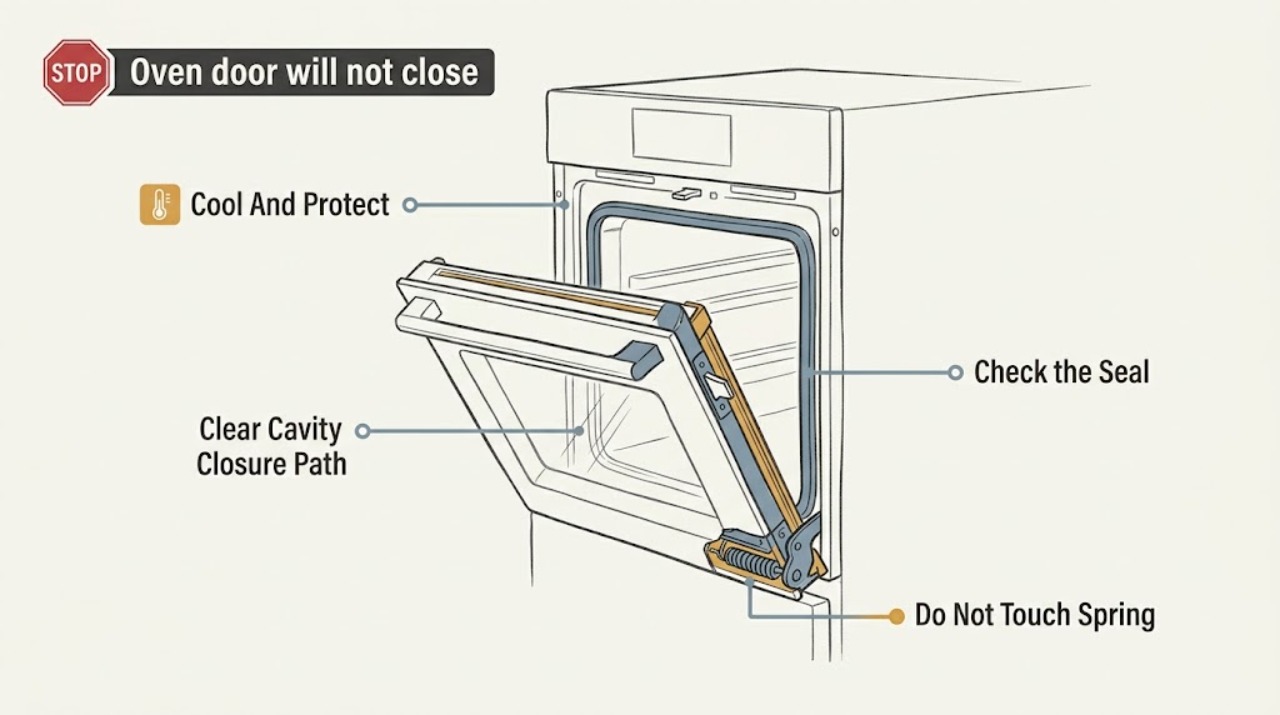
Work through in order
Diagnostic checks
Use only checks that match the exact appliance or system and its official guide.
-
Check 1
Turn the oven controls Off and wait until the door, handle, and cavity are cool enough for a safe visual check. Keep children and pets away and do not push, pull, or lift the door against resistance.
Expected result: The oven is still hot or in a cool-down, self-clean, or lock state; the door is cool but mechanically blocked; or there is smoke, burning odor, broken glass, or another hazard.
Next step: Allow only the model-documented cool-down or unlock sequence to finish. For a cool mechanical blockage or any hazard, leave the oven unused and arrange qualified appliance service.
Stop if: Do not force the handle, insert an object into the latch, open a locked door, or continue if smoke, fire risk, broken glass, or a burning odor is present.
Why this matters
Why: Heat and an active lock state can make normal door movement unavailable. A cool door that remains mechanically blocked points toward an obstruction, gasket, hinge, latch, or frame issue; smoke, glass, or heat damage is not a troubleshooting condition.
-
Check 2
With the oven fully cool, inspect the rack rails, racks, trays, cookware, foil, cavity floor, and door edge for an item or residue in the closure path. Remove only a cool, loose, ordinary-access item that the exact manual allows; do not reach into the latch or hinge.
Expected result: A rack, tray, pan, foil edge, crumb, or cleaning residue is contacting the door; the cavity is clear; or an item is stuck and cannot be removed without force.
Next step: Restore accessible racks and accessories only to positions specified by the manual and close the door gently once. If the item is stuck or the door still resists, stop and request service.
Stop if: Do not bend racks, pry cookware, scrape the frame with metal, or use the door as leverage to remove an obstruction.
Why this matters
Why: A clear obstruction can prevent the door from reaching its latch even when the door hardware is sound. A clear cavity with a persistent gap shifts attention to the gasket, hinges, frame, latch, or door alignment; a stuck item is a service boundary.
-
Check 3
Inspect the visible gasket around the full door perimeter for folds, tears, detachment, hard spots, residue, or a section that sits outside the frame. Look at the contact line without pulling, rubbing, trimming, or removing the gasket.
Expected result: The gasket is clean, intact, and evenly positioned; it is folded, torn, detached, or visibly displaced; or the door closes but leaves a visible gap or uneven contact.
Next step: Photograph the gasket and gap and use the model manual or qualified service to identify the correct repair. Clean only by the manufacturer's approved method; do not try to reshape or replace the seal by force.
Stop if: Do not pull on the gasket, apply unapproved adhesive, trim it, or use the oven if the seal is torn, detached, or unable to contact evenly.
Why this matters
Why: A compromised gasket can prevent closure or allow heat to escape even when the latch catches. An intact gasket with a one-sided gap makes hinge, frame, latch, or door alignment more likely.
-
Check 4
From a cool, ordinary-access position, compare the visible left and right hinge areas, door corners, handle, frame, and latch opening for an obvious bend, loose trim, impact mark, or asymmetry. Do not remove the door, hinge, spring, latch, or any cover.
Expected result: One side is higher or farther out, a hinge or frame appears bent, the latch does not align with its opening, hardware is loose, or the visible geometry looks normal.
Next step: Keep the door supported by its normal hinges without lifting or hanging weight from it, photograph the alignment, and arrange qualified appliance service for any asymmetry, looseness, or persistent resistance.
Stop if: Do not remove hinge locks, detach the door, compress or release springs, straighten metal, tighten concealed hardware, or force the latch into alignment.
Why this matters
Why: A one-sided gap or latch misalignment supports hinge, frame, handle, or door distortion rather than a simple rack obstruction. Normal visible geometry does not rule out concealed hinge or latch damage, especially when the door still will not close.
-
Check 5
Read the visible control indicators and recent-cycle history to determine whether the oven is in self-clean, a door-lock state, a control-lock state, or an error condition. Follow only the exact Frigidaire model's documented unlock or cool-down instructions; do not defeat the latch.
Expected result: A lock indicator, self-clean cycle, cooling state, door-lock error, or other documented message is present; or no lock or error state explains the closure problem.
Next step: Allow the documented cycle to complete and use the manual's normal unlock step. If the door remains locked, an error returns, or the problem exists outside that state, stop using the oven and arrange service.
Stop if: Do not pry the door, insert tools into the lock, bypass the door switch, or interrupt a cleaning cycle except as the exact manual directs for an emergency.
Why this matters
Why: A commanded lock or an oven that has not completed cool-down can prevent normal door movement. No active lock state with a cool mechanical mismatch makes obstruction, seal, hinge, frame, or latch damage more likely.
-
Check 6
After the oven is cool and any accessible obstruction is removed, make one gentle closure attempt with the door centered and the cavity empty of loose items. Record whether it closes flush, catches but leaves a gap, springs back, or stops before the latch.
Expected result: The door closes and seals evenly, closes but leaves a gap, stops at the same point, springs back, or the latch and lock remain abnormal.
Next step: If the door does not close and seal normally, leave the oven out of service and give the technician the model, photos, lock state, obstruction findings, gasket condition, and closure result.
Stop if: Do not repeat forceful attempts, use clamps or straps, tape the door shut, or run the oven with a door that cannot latch and seal normally.
Why this matters
Why: Even closure supports an obstruction or temporary position issue. A gap, repeatable stop, spring-back, or abnormal latch indicates gasket, hinge, frame, latch, or alignment trouble that cannot be safely diagnosed by repeated force.
Use your observations
Decision map
Find the observation that best matches what you see, then follow the next safe action.
-
PATH 01Next step
What you see
A rack, pan, foil edge, loose accessory, crumb, or residue is visibly in the closure path and the door aligns normally once the cool accessible item is removed.
Do this next
Restore racks and accessories only as the exact manual specifies and monitor one normal closure. Stop if resistance, a gap, or latch trouble remains.
Why this path and its safety boundary
Why it matters: The obstruction is more likely than a failed hinge or latch, although the door still needs to close flush without force.
-
PATH 02Next step
What you see
The door problem occurs during self-clean, an indicated door-lock state, a documented cool-down, or an oven error related to door locking.
Do this next
Use the model-specific unlock or cool-down procedure once. If the lock or error remains after the documented state ends, leave the oven unused and request service.
Why this path and its safety boundary
Why it matters: The control may be intentionally preventing normal door movement; forcing the door can damage the lock or create a safety hazard.
-
PATH 03Next step
What you see
The gasket is torn, folded, detached, displaced, or the door catches but leaves an uneven gap around the cavity.
Do this next
Stop using the oven and arrange model-specific service for the gasket and any underlying door alignment; do not trim, glue, or force the seal.
Why this path and its safety boundary
Why it matters: A seal failure can prevent proper closure or let heat escape even when the latch appears to engage.
-
PATH 04Next step
What you see
The cavity is clear and the gasket is intact, but one door corner is high, the hinge or frame looks bent, the latch misses its opening, or the door stops at a repeatable point.
Do this next
Keep the oven out of service and arrange qualified appliance repair. Provide side-by-side alignment photos and do not remove the door or release hinge springs.
Why this path and its safety boundary
Why it matters: Hinge, frame, handle, latch, or concealed alignment damage is more likely than a removable obstruction.
-
PATH 05Next step
What you see
The door has broken glass, smoke or burning odor, exposed hot parts, repeated lock errors, or still will not close and seal after safe visible checks.
Do this next
Stop using the oven, isolate power only from a dry and safe position when appropriate, keep people away, and seek qualified appliance or emergency assistance for the hazard involved.
Why this path and its safety boundary
Why it matters: This is beyond an ordinary adjustment and may involve thermal, mechanical, electrical, or safety-device failure.
Helpful context
Understand the symptom
Do not force an oven door into alignment
An oven door carries heat, glass, hinges, and a sealing gasket. Forcing it against a rack or a bent hinge can turn a simple obstruction into broken glass, frame damage, or a latch problem. Start only after the cavity and door are cool enough to inspect safely, and keep the oven out of service if the door cannot close and seal normally.
Separate an obstruction from a seal or hinge fault
The first visible distinction is whether something is physically in the closure path. A rack, tray, foil edge, cookware item, crumb, or cleaning residue can hold the door open. If the cavity is clear but one corner sits high, the gasket is folded or detached, or the hinges do not appear symmetric, the problem is more likely alignment, hinge, frame, or seal damage and needs model-specific service.
A lock state can look like a mechanical failure
Frigidaire says some ovens can lock the door and controls, and self-clean models keep the door locked until the oven cools. A door that will not open or close normally during a lock or clean state should be handled through the exact owner's manual, not by pulling the handle or defeating the latch. A lock indicator, an error, or a door that remains locked after the documented sequence is a service clue.
A door that closes but does not seal still needs attention
A door can appear closed while a warped, torn, detached, or compressed gasket leaves a gap. Frigidaire identifies the gasket as important for trapping heat, and a compromised seal can affect cooking results. Do not pull or rub a damaged gasket into place; photograph the gap and arrange service when the seal, hinge, frame, or latch does not restore even contact.
Safety boundary
Stop conditions
- Stop for smoke, burning odor, sparks, broken glass, exposed hot parts, a damaged frame, or a door that is locked or mechanically jammed.
- Do not force the handle, pry the door, insert tools into the latch, defeat a door switch, or use a clamp, strap, tape, or other workaround to keep the door closed.
- Do not remove the oven door, hinge locks, springs, latch, gasket, panels, or concealed hardware, and do not straighten metal or repair a frame as an ordinary user check.
- Do not run the oven or self-clean cycle when the door cannot latch and seal evenly, the gasket is damaged, or the lock state is abnormal.
- Stop and arrange qualified service when the cavity is clear but the door remains misaligned, leaves a gap, returns an error, or requires access beyond the exact Frigidaire manual.
Only after diagnosis
Potential parts
- oven door gasket
Consider this category only when the gasket is confirmed torn, detached, permanently deformed, or unable to seal after accessible obstruction and alignment checks.
Confirm the exact Frigidaire model, door style, gasket routing, and installation instructions; do not trim or glue a seal to make it fit. - oven door hinge assembly
Consider this category only when qualified inspection confirms a bent, worn, displaced, or damaged hinge causing the door to sit unevenly or stop before the latch.
Confirm the exact model and hinge design; hinge springs and door removal can be hazardous and require qualified installation. - oven door latch or lock assembly
Consider this category only when the model's lock or error behavior and qualified diagnosis identify a latch or lock failure after the cycle and closure path are ruled out.
Confirm the exact model and lock configuration; do not bypass the latch or substitute a part based only on an error message. - oven door frame, glass, or handle assembly
Consider this category only when inspection confirms impact, warping, broken glass, loose handle, or frame distortion that prevents a safe even seal.
Confirm the exact model and door construction; stop using the oven for glass or frame damage and do not straighten or clamp the door.
When checks do not resolve it
Need a professional?
Arrange qualified Frigidaire appliance service when the door still will not close after cool, accessible obstruction checks; when the gasket is torn, detached, folded, or leaves a gap; when the hinges, frame, handle, latch, or lock are misaligned; when a self-clean or door-lock state does not release according to the model manual; or when any error, broken glass, smoke, burning odor, sparks, or exposed hot parts are present. This article supports safe visual inspection only and does not authorize door removal, hinge-spring work, latch bypass, panel access, or operation with an unsealed door.
Safety scope: This article covers cool ordinary-access inspection of the closure path, gasket, visible alignment, and control state. It does not authorize hot-surface handling, door or hinge removal, spring or latch work, panel access, lock bypass, live electrical testing, or operation with a door that does not seal.
Common questions
FAQ
Why will my Frigidaire oven door not close?
Check first for a rack, pan, foil edge, loose accessory, or debris in the closure path. If the cavity is clear, the likely branches are a folded or damaged gasket, hinge or frame misalignment, latch or lock state, or concealed door hardware. Inspect only when cool and do not force the door.
Can a Frigidaire oven door stay locked after self-clean?
Yes. Frigidaire says the door can remain locked for safety until the oven cools, depending on the model. Use the exact owner's manual and normal unlock procedure. Do not pry the door, insert tools into the latch, or bypass the lock.
What should I do if the gasket keeps the Frigidaire oven door open?
With the oven cool, inspect the gasket for folds, tears, detachment, residue, or a displaced section. Do not pull, trim, glue, or force it into place. Photograph the seal and arrange model-specific service if it cannot contact the frame evenly.
Can I remove the Frigidaire oven door to fix the alignment?
Do not remove the door or release hinge locks and springs as a troubleshooting experiment. Door hardware varies by model and can cause injury or glass and frame damage. Have a qualified technician inspect and align the hinge, frame, latch, and seal.
When should I stop using an oven whose door will not close?
Stop when the door cannot latch and seal evenly, leaves a gap, remains locked abnormally, or has a damaged gasket, hinge, frame, latch, or glass. Also stop for smoke, burning odor, sparks, exposed hot parts, or repeated lock errors, and arrange qualified appliance service.
Read the exact guide
Official sources
- How do I use my display or controls?Frigidaire Owner Support · Official Frigidaire support guidance used to keep control and door behavior model-specific; it does not authorize internal door or latch access.
- Ovens - How do I use Convection Bake?Frigidaire Owner Support · Official Frigidaire oven guidance used for rack and accessory placement; it is not a door-hardware repair guide.
- Oven Error Codes and Alarms GuideFrigidaire Owner Support · Official Frigidaire error guidance used for door-lock and control-state branches; exact codes and remedies vary by model.
- What does the Lock feature do and how can I activate it?Frigidaire Owner Support · Official Frigidaire lock-feature guidance used to distinguish a commanded lock state from mechanical closure damage; instructions vary by model.
- Ovens - When and how do I use steam clean?Frigidaire Owner Support · Official Frigidaire oven guidance used for model-dependent door closure and clean-cycle state; it is not a universal door-repair procedure.
- Oven - Is Not Hot EnoughFrigidaire Owner Support · Official Frigidaire oven guidance used for gasket and safe-use implications; it does not establish a universal hinge or door layout.
Community feedback
Share a repair observation
Share a plain-text repair observation. Accepted observations are published automatically; this page may take a moment to update.