
On this page
Start here
Quick answer
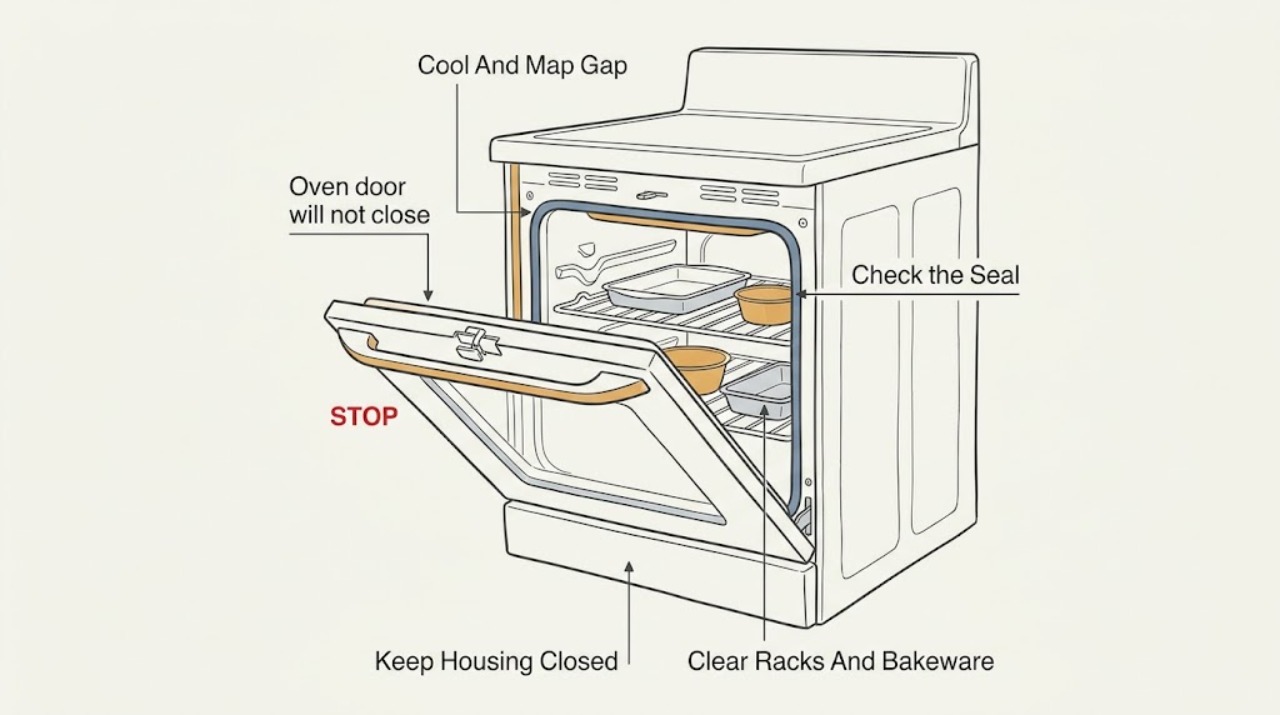
An Amana oven door that will not close is often being held open by a rack, roll-out rack, oversized pan, storage-drawer item, foil, food soil, or a latch that is out of position. A door removed and reinstalled incorrectly, a bent hinge, damaged gasket, or a control lock/self-clean state can also keep it from closing. With the oven off and cool, remove only loose cookware and check that the racks are fully inserted, the door frame and gasket are clear, and the visible latch is not bent. Make sure the range or oven is stable and level if the model instructions provide a normal check. Do not force the door, lift a heavy door, move hinge levers, remove hinges or panels, or run the oven with a gap. A door that remains misaligned, a damaged latch or hinge, a door removed recently, smoke or heat escaping, or a lock that will not reset needs qualified appliance service.
Before you begin
Safety first
- This article supports cool-oven observation, moving loose cookware, checking rack insertion, inspecting accessible gasket and latch areas, reading the model manual, and using a normal lock procedure once. Do not lift or remove doors, adjust hinges or latch hardware, open panels, or operate a misaligned oven.
Work through in order
Diagnostic checks
Use only checks that match the exact appliance or system and its official guide.
-
Check 1
Turn the Amana oven off and let it cool fully. From the front, note whether the door stops at the latch, contacts one corner first, remains open by a visible gap, or is held by a lock; photograph the gap and any visible damage without removing the door.
Expected result: The gap is even or one-sided, the handle or latch feels unstable, the door is locked, glass or gasket is damaged, or the door is simply blocked before reaching the frame.
Next step: Keep the oven off and continue only with cool, ordinary-access obstruction checks. Arrange service immediately for unstable hardware, broken glass, a damaged gasket, or a door that may fall.
Stop if: Do not force, slam, lean on, lift, or pull the oven door, and do not try to defeat a lock.
Why this matters
Why: A one-sided gap suggests hinge, level, gasket, or alignment trouble, while a stop at the latch suggests latch position or a lock state. A door that is visibly unstable or damaged is unsafe to keep testing. A consistent stop at an interior object makes an obstruction more likely.
-
Check 2
With the oven cool, remove loose bakeware and verify that each rack, including any roll-out rack, is pushed fully into its guides. Check that pans, casserole dishes, roasting racks, and storage-drawer items are not projecting into the door path.
Expected result: A rack is partly extended, a roll-out shelf is not engaged, a pan is oversized or misplaced, an item in the storage drawer reaches the igniter or door path, or the cavity is clear but the door still stops.
Next step: Remove or reposition only the loose obstruction and close the door gently. If the door still does not close, do not add pressure; continue to the gasket and latch checks and arrange service if the gap remains.
Stop if: Do not force a rack, use the door as a lever, or cook with an oversized dish or rack preventing closure.
Why this matters
Why: A rack, dish, or storage item can hold the door open without a hinge failure. A clear cavity shifts attention toward the latch, gasket, hinge, level, or door alignment.
-
Check 3
Inspect the cool door gasket, oven frame, latch opening, and contact surfaces for food soil, foil, shipping material, folds, tears, or a gasket pulled out of position. Clean only accessible residue using the exact owner-manual method; do not remove the gasket.
Expected result: Residue or material blocks the frame, the gasket is folded or displaced, the gasket is torn or brittle, the frame is bent, or the surfaces are clear and the door remains misaligned.
Next step: Remove only loose residue and recheck closure without pressure. Leave the oven off and arrange service for gasket, frame, or alignment damage.
Stop if: Do not glue, stretch, heat, cut, tape, lubricate, or substitute the gasket, and do not scrape the frame with a sharp tool.
Why this matters
Why: A loose obstruction or residue can prevent the gasket from contacting evenly. A torn gasket, bent frame, or displaced seal is a mechanical repair issue; a clear path makes hinge, latch, level, or door alignment more likely.
-
Check 4
With the door open and the oven cool, look at the visible lock-latch arm at the top front of the oven frame above the gasket. Compare its position with the exact Amana manual or support illustration; do not bend, push, or remove the latch.
Expected result: The latch arm appears bent up or down, remains in a lock position, is obstructed by soil or material, or appears aligned but the door will not close.
Next step: Keep the oven off and arrange qualified service for a bent, stuck, or unexplained latch. If the door is locked after self-clean, follow only the exact model's cool-down and unlock instructions and do not force it.
Stop if: Do not pry or bend the latch, defeat the lock, insert tools into the lock opening, or run a cycle with the latch abnormal.
Why this matters
Why: Amana identifies a bent or misplaced latch arm as a possible closure obstruction. A latch that appears normal does not rule out an internal lock motor, switch, hinge, or control problem.
-
Check 5
Record whether the Amana range or wall-oven door was recently removed, cleaned, installed, moved, or subjected to a drop, and visually check that the appliance sits stable and level; do not remove the door or adjust hinge hardware as a test.
Expected result: The door problem began after removal or installation, one side hangs lower, the appliance rocks or leans, the hinge lever is not in the expected position, or there is no recent history and the appliance is stable.
Next step: Keep the door supported by its closed position and arrange service for hinge or alignment issues. Use a model-approved leveling procedure only when it does not require lifting, tipping, or hardware removal.
Stop if: Do not lift a wall oven, tilt a range without securing it, move a heavy appliance, or operate with an unseated hinge or anti-tip concern.
Why this matters
Why: A recently removed door or one-sided hang makes hinge seating, hinge lock position, or alignment more likely. An unstable or unlevel appliance can change the door path. A stable unit with no history keeps latch, gasket, rack, and internal hinge damage in consideration.
-
Check 6
If the door is locked or the control shows a message, identify whether a self-clean or lock cycle was selected and use only the exact Amana manual's Cancel/Off and cool-down guidance; otherwise record whether the oven heats, displays an error, or releases heat through the gap.
Expected result: The door is locked after self-clean, the display shows an error or lock indicator, the door remains mechanically open, the oven is hot, or the control and temperature are normal but the gap persists.
Next step: Keep the oven off until the door closes and latches normally. Arrange qualified appliance service for a recurring lock, error, heat escape, or persistent mechanical gap; do not keep resetting the control.
Stop if: Do not force a hot or locked door, run self-clean to test the latch, repeatedly cycle power, or operate with an open gap.
Why this matters
Why: A lock state or control error differs from a physical closure obstruction and may require a latch or control diagnosis. A hot oven with a gap should not be operated. Normal controls with a persistent gap make gasket, hinge, latch, or alignment damage more likely.
Use your observations
Decision map
Find the observation that best matches what you see, then follow the next safe action.
-
PATH 01Next step
What you see
The door closes after a rack, roll-out shelf, pan, casserole, roasting dish, foil, or storage-drawer item is removed or fully repositioned.
Do this next
Keep racks fully engaged and use cookware that fits the model's cavity and circulation guidance. Monitor closure; arrange service if the same obstruction returns without overloading the oven.
Why this path and its safety boundary
Why it matters: An accessible obstruction was the likely immediate cause rather than a failed hinge or latch. Oversized or misplaced cookware can still affect heat circulation and door safety.
-
PATH 02Next step
What you see
The cavity is clear but the gasket is torn, folded, displaced, or dirty, or the visible latch arm is bent, blocked, or stuck above the gasket.
Do this next
Clean only accessible residue as directed, leave the oven off, and arrange qualified service for a damaged, bent, or stuck gasket or latch.
Why this path and its safety boundary
Why it matters: A gasket or latch-path problem is more likely than a rack issue. Bending or gluing the part can worsen the alignment and create a heat or lock hazard.
-
PATH 03Next step
What you see
The door was recently removed or installed, one side hangs lower, the hinge lever is not in its expected position, or the door stops unevenly despite a clear rack and gasket path.
Do this next
Do not lift, remove, or re-seat the door as a trial. Keep the oven off and arrange qualified service with the installation or cleaning history.
Why this path and its safety boundary
Why it matters: Hinge seating, hinge-lock position, appliance level, or door alignment is more likely. An improperly seated hinge can let a heavy door fall.
-
PATH 04Next step
What you see
The door is locked after self-clean, the display shows a lock or error, or the latch does not release even after the oven has cooled according to the exact model instructions.
Do this next
Use only the model-specific Cancel/Off and cool-down procedure once. If the lock or error returns, keep the oven off and arrange qualified appliance service.
Why this path and its safety boundary
Why it matters: A lock, latch motor, switch, or control state is more likely than a simple door obstruction. Repeated resets or forced movement can damage the mechanism.
-
PATH 05Next step
What you see
The racks, bakeware, gasket, latch path, and lock state appear normal, but the door still will not close evenly or remains visibly open.
Do this next
Leave the oven off and arrange qualified Amana appliance service. Provide photos and the exact model, door history, gap location, and any error or lock indication.
Why this path and its safety boundary
Why it matters: A bent hinge, frame, door, receiver, or concealed latch component is more likely than an accessible obstruction. The oven should not be operated with heat escaping through a gap.
Helpful context
Understand the symptom
Start with the obstruction, not the hinges
A rack that is not fully engaged, a roll-out rack left partly extended, an oversized roasting pan, or an item in the storage drawer can stop the door before the gasket reaches the frame. With the oven cool, remove only loose items and verify the rack position. Do not push against the door to make an oversized dish fit or line the oven bottom with foil.
The latch and gasket need an even path
Food soil, foil, shipping material, a folded gasket, or a latch arm that is bent above the gasket can prevent closure. Inspect from the front with the oven off and cool. A latch that looks bent, a gasket that is torn or displaced, or a door that contacts on one side only is a service clue, not an invitation to bend or lubricate hardware.
A recently removed door changes the risk
If the door was removed for cleaning or installation, the hinge arms and receivers may not be seated or locked correctly. Amana's service documentation warns that an improperly seated hinge can keep the door from closing and can let it fall when opened. Do not lift or reinstall a heavy door unless the exact model procedure, safe support, and a capable helper make that work appropriate; otherwise arrange service.
Do not operate an oven that cannot close
An open or poorly sealed oven door can release heat, affect cooking, and expose nearby surfaces to abnormal heat. A lock state after self-clean is a different problem from a mechanical gap and should be handled only through the exact model instructions. Stop for smoke, fire, sparking, damaged glass, or a door that is unstable or falling away from the frame.
Safety boundary
Stop conditions
- Stop using the oven for an unstable or falling door, broken glass, a large gap, smoke, fire, sparking, abnormal heat, or a door that cannot latch securely.
- Do not force, slam, lift, or remove the oven door, move hinge levers, bend a latch, or adjust hinge hardware without the exact model procedure and safe support.
- Do not glue, heat, stretch, cut, tape, or lubricate the gasket, and do not insert sharp tools into the latch, frame, or hinge area.
- Do not run self-clean, defeat a lock, repeatedly reset power, use an oversized dish, line the oven bottom with foil, or cook while the door remains open or misaligned.
- Arrange qualified appliance service for a persistent gap after obstruction checks, a damaged gasket, latch, hinge, frame, or glass, a recently removed door that will not close, or a recurring lock or error.
Only after diagnosis
Potential parts
- Amana oven door gasket
Consider this category only when the gasket is torn, displaced, or unable to seal evenly after loose obstructions and manual-approved cleaning are addressed.
Confirm the exact Amana model, oven type, gasket profile, and manufacturer's fit information; do not alter a seal to make it fit. - Amana oven door hinge or hinge receiver
Consider this category only when qualified inspection confirms a bent, unseated, or damaged hinge or receiver is preventing the door from closing evenly.
Confirm the exact model and hinge arrangement; do not remove or re-seat a heavy oven door as a trial. - Amana oven door latch or lock component
Consider this category only when the visible latch is abnormal, a lock state persists, or qualified diagnosis identifies a latch, switch, or lock-mechanism fault.
Confirm the exact model and diagnostic result; do not bend, bypass, or force a latch or lock.
When checks do not resolve it
Need a professional?
Arrange qualified Amana appliance service when the door remains open after cool-oven rack, bakeware, gasket, latch, and model-approved lock checks, when the door was recently removed, when one side hangs lower, or when a hinge, latch, frame, gasket, glass, or control fault is suspected. Stop immediately for smoke, sparking, fire, abnormal heat, an unstable door, or damaged glass.
Safety scope: This article supports cool-oven observation, moving loose cookware, checking rack insertion, inspecting accessible gasket and latch areas, reading the model manual, and using a normal lock procedure once. Do not lift or remove doors, adjust hinges or latch hardware, open panels, or operate a misaligned oven.
Common questions
FAQ
Why will my Amana oven door not close?
Check for a rack or roll-out shelf that is not fully inserted, an oversized pan, a storage-drawer item, foil, food soil, a folded gasket, or a visible latch obstruction. A recently removed door, unlevel appliance, bent hinge, or lock state can also prevent closure. Keep the oven cool and off while checking, and do not force the door.
Can an oven rack keep an Amana door from closing?
Yes. Amana says racks should be fully inserted and roll-out racks fully engaged, and that bakeware should not be too large for the cavity. Remove loose cookware and correct rack position only when the oven is cool. If the door still stops, the cause may be the latch, gasket, hinge, or alignment.
What should I do if the Amana oven door was removed and now will not close?
Stop using the oven. An improperly seated hinge arm or hinge-lock position can prevent closure and allow a heavy door to fall. Do not lift, remove, or re-seat the door as a trial unless the exact model procedure and safe support make it appropriate; arrange qualified service instead.
Should I bend the Amana oven latch back into place?
No. Amana's guidance supports a visual check of the latch arm, but a bent, stuck, or abnormal latch needs service. Do not pry, bend, lubricate, bypass, or insert tools into the latch, especially if the door is hot or locked.
When should I stop using an Amana oven with a door gap?
Stop whenever the door remains visibly open or misaligned, heat escapes, the door is unstable, glass or gasket is damaged, a lock or error recurs, or the latch or hinge is abnormal. Do not run self-clean or cook with the gap. Arrange qualified appliance service, and use urgent help for smoke, fire, sparking, or severe heat.
Read the exact guide
Official sources
- Oven is Locked - What to DoAmana Product Help · Amana oven support guidance; lock controls and cool-down behavior vary by model.
- How to Determine if the Rack is Keeping the Oven Door OpenAmana Product Help · Amana range and oven support guidance; rack styles and cavity clearances vary by model.
- Oven Door is Not Closing - Checking the LatchAmana Product Help · Amana range and wall-oven support guidance; exact latch design and repair access vary by model.
- Owner's ManualAmana · The named Amana owner's manual; exact control labels and door mechanisms vary by model.
- Service Manual - 16022506Amana · The named Amana service manual and related oven-door mechanism; exact models and door hardware vary.
Community feedback
Share a repair observation
Share a plain-text repair observation. Accepted observations are published automatically; this page may take a moment to update.