
On this page
Start here
Quick answer
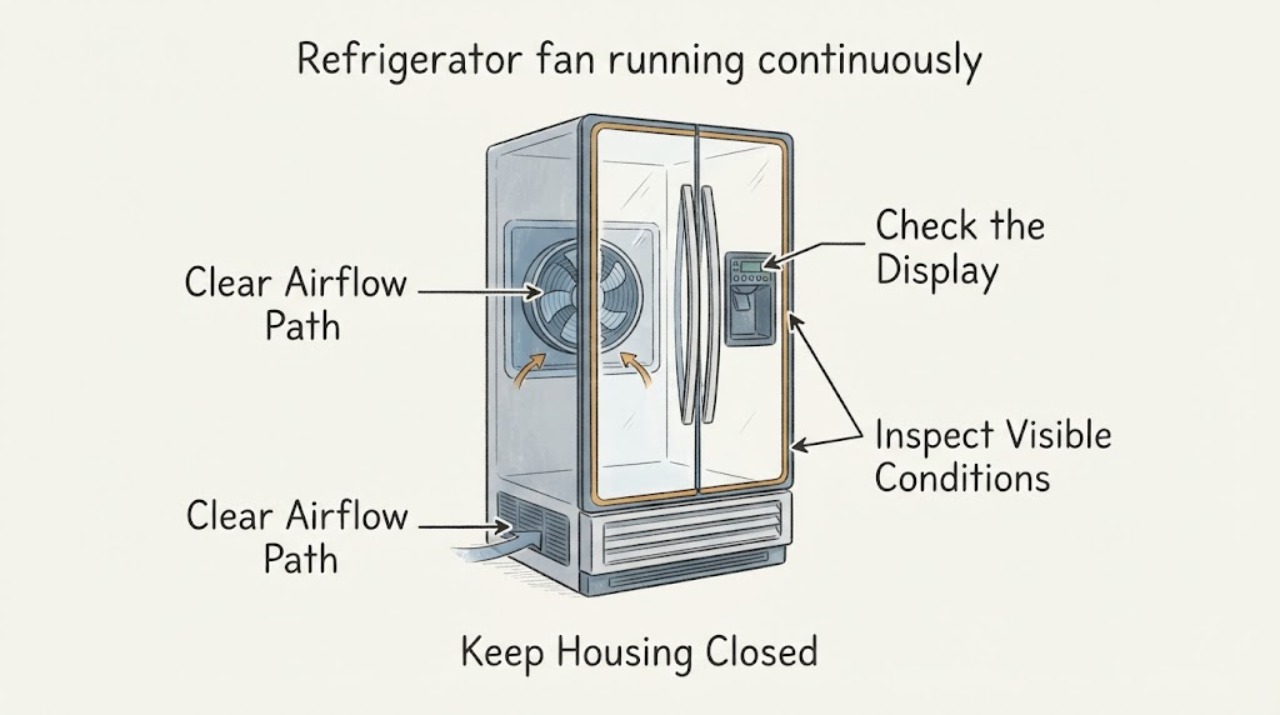
First confirm that the sound is actually a fan and check the refrigerator and freezer temperatures. Frigidaire's official guidance says airflow from the evaporator or condenser fan can be a normal refrigerator sound, and some French-door models use variable-speed compressors designed to run continuously except during defrost. A continuous fan sound is more concerning when temperatures are rising, vents are blocked, a door is not sealing, or the sound is scraping or electrical. Check the setpoints, doors, vents, external clearance, and model-specific guide without opening panels. Arrange service for warm food compartments, repeated alarms, abnormal noise, or a fan that remains abnormal after these external checks.
Before you begin
Safety first
- Limit owner checks to listening from outside, measuring temperatures, checking settings, visible vents, door closure and gasket condition, rear clearance, and model identification. Do not remove covers, reach into vents, obstruct a fan, perform live tests, or replace an internal fan, sensor, board, or compressor without exact model service instructions.
Work through in order
Diagnostic checks
Use only checks that match the exact appliance or system and its official guide.
-
Check 1
Identify the sound from outside the cabinet: note whether it is a steady airflow or hum, where it is loudest, and whether it changes during a normal door opening without placing hands into vents or moving panels.
Expected result: The sound resembles airflow from the refrigerator or rear condenser area, changes with the model's normal operation, or is scraping, rattling, buzzing, or accompanied by a burning smell.
Next step: If it is normal airflow and temperatures are stable, continue with the temperature and airflow checks rather than replacing a motor by guesswork.
Stop if: Stop the appliance if there is scraping, arcing, burning odor, or another unsafe sign, and arrange service without opening the cabinet.
Why this matters
Why: Frigidaire lists evaporator and condenser fan airflow as possible normal sounds, but the noise guide does not establish that every continuous sound is normal or identify a failed fan from sound alone.
-
Check 2
Measure the refrigerator and freezer temperatures with the appliance operating normally, and compare the controls with the model's Use & Care guide rather than turning the settings colder repeatedly.
Expected result: Temperatures remain within the model's expected range, or one or both compartments are warming, alarms are active, or the unit has not stabilized after a recent installation or power interruption.
Next step: Keep the documented settings and monitor the actual temperatures; do not infer failure solely from the sound.
Stop if: Follow the model-specific cooling support path and arrange service if temperatures do not recover or an alarm persists.
Why this matters
Why: Frigidaire says a long run can be normal for variable-speed compressors and after installation or power loss, but blocked airflow or a cooling problem can also make the system run longer. The run-time sound alone does not diagnose a fan or control failure.
-
Check 3
Check the external airflow and loading conditions: clear food from visible interior vents, confirm doors and drawers close fully, inspect the gasket for an obvious gap, and pull the cabinet only as far as the installation permits to look for dust at the rear vent cover and adequate clearance.
Expected result: A vent is blocked, a door or drawer is not closing or sealing, the rear vent cover is dusty, or the refrigerator is pressed too close to the wall; or these external conditions are normal.
Next step: Correct only the accessible loading, gasket-cleaning, dust, or clearance condition described by the Use & Care guide, then recheck temperatures.
Stop if: If the sound and temperatures remain abnormal with normal external conditions, stop at the cabinet and request model-specific service.
Why this matters
Why: Frigidaire says blocked vents and a non-sealing door can impair cooling, and that dust or restricted rear clearance can make the refrigerator work harder. These findings explain longer operation without proving a failed fan or compressor.
-
Check 4
Record the model and serial information before seeking model-specific help; for a top-freezer refrigerator check the upper-left fresh-food wall, and for a French-door or side-by-side refrigerator check the upper-right fresh-food area as described by Frigidaire.
Expected result: The full model is readable, or only a partial label is available.
Next step: Use the exact model's Use & Care manual or service route and report whether the sound is from inside, the rear, or a drawer area.
Stop if: Do not apply another model's fan test, reset, wiring, or part number; arrange support with a photo of the label if needed.
Why this matters
Why: Frigidaire identifies different tag locations by refrigerator type, and the model is needed to distinguish fan controls, normal post-door behavior, and permitted user checks.
-
Check 5
Check for escalation signs without repeating power cycles: warming food, high-temperature alarms, persistent ice buildup, water near electrical parts, scraping, smoke, burning odor, or a fan sound that remains abnormal after external conditions are corrected.
Expected result: One or more escalation signs is present, or the refrigerator is cool and quiet enough after the external checks but the owner is still concerned about the runtime.
Next step: Stop using the affected appliance when safety or food temperature is at risk and arrange qualified Frigidaire service.
Stop if: Continue monitoring actual temperatures and the documented normal sound pattern; do not replace an internal part based on continuous sound alone.
Why this matters
Why: Frigidaire's support pages direct owners to service when the documented external checks do not resolve the concern. An abnormal symptom does not identify the fan motor, sensor, board, or compressor without model-specific diagnosis.
Use your observations
Decision map
Find the observation that best matches what you see, then follow the next safe action.
-
PATH 01Next step
What you see
The sound is steady airflow or a low hum, temperatures are stable, and there is no scraping, odor, alarm, or water near electrical parts.
Do this next
Keep the model's documented settings, check vents and clearance, and monitor temperatures instead of replacing a fan by guesswork.
Why this path and its safety boundary
Why it matters: The opened Frigidaire guidance allows normal fan airflow and, on some French-door models, continuous variable-speed compressor operation; the sound alone does not prove a fault.
-
PATH 02Next step
What you see
The refrigerator or freezer is warm, an alarm is active, or the unit has recently been installed or lost power.
Do this next
Check actual temperatures, the accessible vents, door closure, gasket, settings, and installation conditions; arrange service if the temperature does not recover.
Why this path and its safety boundary
Why it matters: Frigidaire says a new or recently interrupted unit may need time to stabilize, but blocked vents, open doors, poor seals, or incorrect conditions can also prevent proper cooling and prolong operation.
-
PATH 03Next step
What you see
An interior or exterior vent is blocked, the door does not seal, the rear vent is dusty, or the refrigerator has insufficient clearance.
Do this next
Correct only the accessible condition using the model's care instructions, then recheck temperatures and sound.
Why this path and its safety boundary
Why it matters: Those external conditions are documented Frigidaire reasons for reduced airflow or longer cooling operation, but correcting them does not diagnose an internal fan or compressor part.
-
PATH 04Next step
What you see
The sound is scraping, arcing, or accompanied by burning odor, smoke, repeated breaker trips, water near electrical parts, or rapidly warming food.
Do this next
Stop using the refrigerator as appropriate, protect food and people, and arrange qualified service without opening the cabinet or repeating the test.
Why this path and its safety boundary
Why it matters: The symptom has moved beyond normal operating noise and external airflow checks; the official general pages do not support a safe owner diagnosis of the internal component.
-
PATH 05Next step
What you see
The fan still appears to run continuously after temperatures, vents, seals, clearance, and model identity have been checked, but there is no model-specific documentation explaining the behavior.
Do this next
Use the exact model manual and request Frigidaire service; do not guess a motor, sensor, board, or door switch.
Why this path and its safety boundary
Why it matters: The available official evidence does not identify whether the sound is an evaporator fan, condenser fan, drawer fan, compressor, defrost behavior, or a control condition for this particular Frigidaire model.
Helpful context
Understand the symptom
A refrigerator that sounds as if a fan never stops is not automatically showing a failed fan. Frigidaire's noise guide says air forced by the evaporator or condenser fan can be heard during operation, while its run-time guidance says some French-door models use variable-speed compressors that are designed to run continuously except during defrost. The first useful distinction is therefore what is running, whether the compartments are holding temperature, and whether the sound is normal airflow or an abnormal scrape, buzz, or electrical smell.
This task has no model number. Use the general Frigidaire checks below only for external observations. Do not assume that all Frigidaire layouts use the same fan location, door-switch behavior, diagnostic mode, or replacement motor. Record the model number and use its manual before any model-specific reset or access step.
Do not reach through vents, remove an evaporator cover, or perform a live electrical test to identify the fan. If the refrigerator is warm, an alarm is active, the sound is scraping or arcing, there is a burning smell, or water is near electrical parts, stop troubleshooting at the cabinet and arrange service.
When checks do not resolve it
Need a professional?
Use the exact Frigidaire manual or qualified service for persistent continuous fan operation, abnormal noise, warm compartments, repeated alarms, ice buildup, water near electrical parts, or any internal access.
Safety scope: Limit owner checks to listening from outside, measuring temperatures, checking settings, visible vents, door closure and gasket condition, rear clearance, and model identification. Do not remove covers, reach into vents, obstruct a fan, perform live tests, or replace an internal fan, sensor, board, or compressor without exact model service instructions.
Common questions
FAQ
Is it normal for a Frigidaire refrigerator fan to run all the time?
Continuous sound alone is not enough to decide. Frigidaire says airflow from the evaporator or condenser fan can be a normal sound, and some French-door variable-speed compressors are designed to run continuously except during defrost. Check actual temperatures and the exact model guide before treating the sound as a fault.
What should I check when the refrigerator sounds like it never stops?
First identify whether the sound is airflow or compressor hum, then check actual refrigerator and freezer temperatures, visible vents, door closure and gasket, temperature settings, rear dust, and clearance. Frigidaire says these conditions can extend run time. Do not open panels or infer a failed fan from sound alone.
Does a continuous fan mean the refrigerator fan motor is bad?
No. The opened official sources do not support that diagnosis from sound alone. They identify multiple normal operating sounds and several external reasons for longer operation. A motor, sensor, board, or compressor requires exact-model diagnosis, especially if temperature or safety symptoms are also present.
Where do I find the Frigidaire refrigerator model number?
Frigidaire says a top-freezer model number is along the upper-left side wall of the fresh-food compartment, while French-door and side-by-side models typically show it along the upper-right side of the fresh-food compartment. Record it before using model-specific guidance.
Read the exact guide
Official sources
- Refrigerator Runs Too MuchFrigidaire · Opened the official Frigidaire support article directly. It addresses refrigerator run time rather than a fan-specific fault and is used only for the documented external conditions and stabilization boundary.
- Where can I find my model and serial number?Frigidaire · Opened the official Frigidaire support article directly. Its refrigerator instructions support locating the model before applying model-specific fan behavior or service guidance.
- Refrigerators - Not CoolingFrigidaire · Opened the stable official Frigidaire URL directly. It applies to all refrigerators and supports external checks when continuous operation is accompanied by poor cooling; it does not identify an internal fan or control part.
- Refrigerators - Why does my refrigerator run most of the time? Is this normal?Frigidaire · Opened the official Frigidaire support article directly. It covers refrigerators including French-door, side-by-side, and top-freezer types; it discusses compressor operation and external airflow, so it is not used to claim that every refrigerator fan should run continuously.
- Refrigerators Noise GuideFrigidaire · Opened the official Frigidaire support article directly; it applies to all refrigerators and supports sound identification, not a diagnosis of a particular model's fan motor or control.
Community feedback
Share a repair observation
Share a plain-text repair observation. Accepted observations are published automatically; this page may take a moment to update.