
On this page
Start here
Quick answer
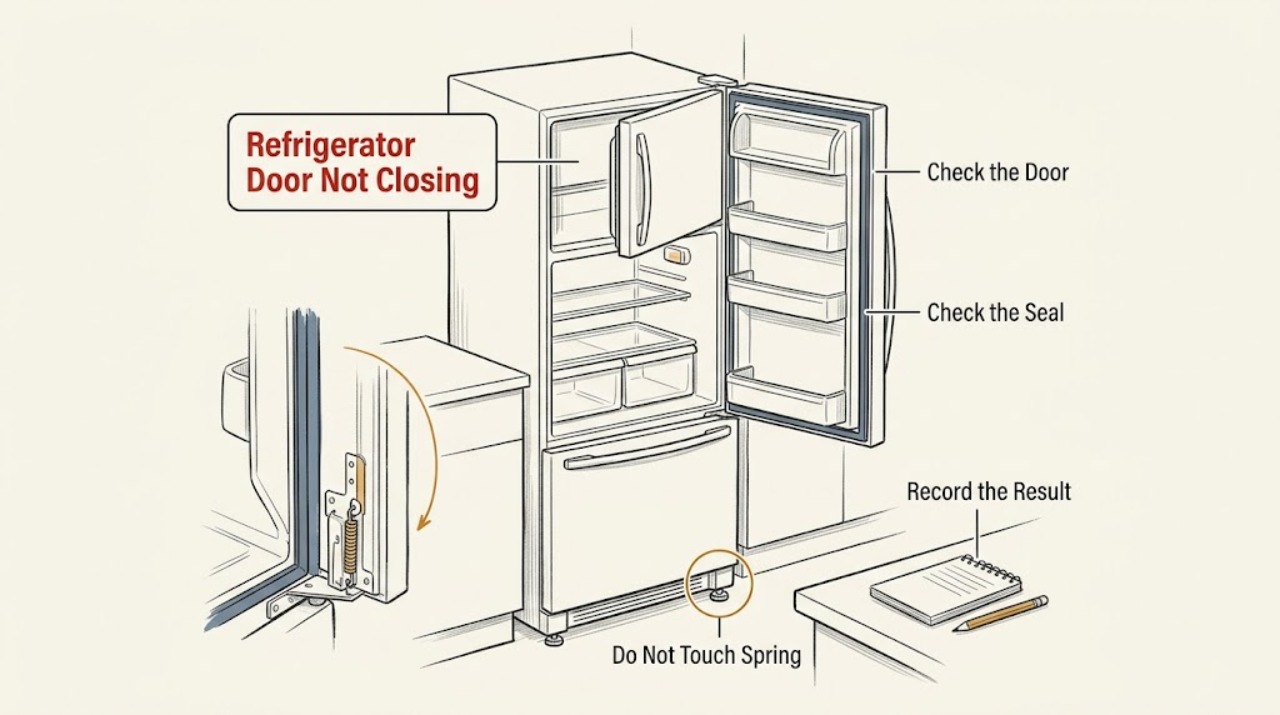
Do not slam or force a Frigidaire refrigerator door. Empty the affected door bin and check for a shelf, drawer, food package, ice chute flap, or other item blocking the closing path. Frigidaire's door guidance also says to remove anything blocking the doors and keep the gaskets clean; its frost guidance notes that a warped door or gasket can prevent a proper seal. Wipe the gasket with a soft cloth and look for folds, gaps, or displacement. If the door rubs one side, sits low, drops, the cabinet is not level, or the problem began after moving or installation, treat it as a model-specific alignment, leveling, hinge, or cabinet-clearance issue rather than a seal-cleaning issue. Some side-by-side, French-door, four-door, and top-freezer models use different adjustment and door-closer arrangements, so use the exact Owner's Manual and do not remove a heavy door or hinge spring as a home test. If the door closes but does not seal or the refrigerator reports a persistent door alarm, arrange qualified service; protect food if the compartment is warming.
Before you begin
Safety first
- This article covers model identification, external loading and clearance checks, visible gasket inspection and cleaning, normal door travel observation, food protection, and model-guide referral. Door removal, hinge springs, closers, leveling hardware, cabinet mounting, water lines, door sensors, controls, and internal wiring require qualified service.
Work through in order
Diagnostic checks
Use only checks that match the exact appliance or system and its official guide.
-
Check 1
Record the complete model number and identify the refrigerator layout: top-freezer, side-by-side, French-door, four-door, or a model with a separate temperature drawer. With the door empty enough to move safely, note whether it stops before the frame, reaches but will not stay shut, closes with an uneven gap, or closes while an alarm or frost problem remains.
Expected result: The problem is a blocked travel path, a low or dropped door, a door that springs open, a gasket gap, or a closed door with an alarm or temperature symptom.
Next step: Follow the matching checks below and keep the exact Owner's Manual available. Do not force the door or buy a part before identifying the failed path.
Stop if: Stop if the door, glass, hinge, closer, cabinet, water line, or wiring is damaged, or if the door is too heavy to support safely.
Why this matters
Why: The pattern separates loading/clearance, level/alignment/hinge, gasket/closer, and sealing or sensing branches. Frigidaire refrigerator families do not share one universal door adjustment.
-
Check 2
Remove or reposition obvious items in the door bins and inspect the shelf and drawer edges for a package, pan, bottle, shelf lip, or drawer that projects into the door sweep. On French-door or dispenser models, check that a drawer is fully home and the ice-chute flap is not held open. Close the door gently with the path clear.
Expected result: The door closes and stays shut after an item, bin, drawer, shelf, or chute obstruction is corrected, or it still stops with the compartment clear.
Next step: Reload within the model's shelf and bin limits. If the empty door still will not close, continue to the gasket and geometry checks without forcing it.
Stop if: Do not pry shelves, bend bins, use the door to push a drawer, or remove a heavy door to gain clearance.
Why this matters
Why: A change that follows loading is a clearance issue. A repeat with bins, shelves, and drawers clear shifts concern toward the gasket, hinge, closer, level, cabinet position, or door alignment.
-
Check 3
Inspect the full gasket and the mating cabinet surface for food soil, ice, a fold, a pulled-out section, a hardened area, or a tear. Wipe the gasket with a clean soft cloth and warm soapy water as appropriate for the model, then check whether it lies evenly in its channel. Do not heat, stretch, glue, or cut it.
Expected result: The gasket was dirty or visibly displaced and the door now seals evenly, or the gasket looks clean and seated but the door still leaves a gap or springs open.
Next step: Close the door gently and inspect for uniform contact. Arrange service for a torn, hardened, warped, or persistently displaced gasket rather than reshaping it.
Stop if: Do not use a heat gun, adhesive, sharp tool, or force to reshape the gasket or remove hinge components.
Why this matters
Why: Frigidaire identifies a dirty gasket as a possible reason a door does not close properly and links a warped gasket or door to a poor seal. A clean, sound gasket with persistent geometry points toward alignment, hinge, closer, or cabinet position.
-
Check 4
From the front and side, compare the door gap at the top and both sides. Observe whether the refrigerator rocks, shifts, or sits too close to an adjacent wall or cabinet, and whether the problem began after moving, flooring work, or installation. Check only the visible feet, clearance, and cabinet position; do not pull out a built-in or plumbed refrigerator.
Expected result: The cabinet is stable with an even gap, or the door rubs one side, sits low, drops, the refrigerator rocks, or an adjacent wall/cabinet limits travel.
Next step: Use the exact installation guide or have the installer/qualified service correct leveling, clearance, or cabinet position. Do not turn adjustment screws from another Frigidaire family.
Stop if: Do not pull out the refrigerator, disconnect a water line, loosen hinge or mounting hardware, or work under a heavy door alone.
Why this matters
Why: An even gap and stable cabinet make loading or seal causes more likely. Uneven geometry or limited clearance makes leveling, mounting, hinge/closer alignment, or installation position more likely.
-
Check 5
Move the door through its normal range without lifting or forcing it. Note whether it drops, scrapes, binds at one angle, fails to return toward closed, or closes only when pushed past a tight point. For French-door and multi-door models, compare the affected door with the other door without removing either.
Expected result: Travel is smooth and the door returns closed, or the door is sagging, rubbing, loose, binding, or the closer action is weak or inconsistent.
Next step: Stop at the observation and provide the pattern and model number to qualified service. Do not remove springs, lift the door off its hinges, or adjust a closer without the exact guide and proper support.
Stop if: Keep fingers clear of hinge and pinch points; stop for a loose hinge, damaged closer, cracked liner, or door that cannot be safely supported.
Why this matters
Why: Smooth travel with a good seal makes a simple obstruction or setting more likely. Sagging, binding, or inconsistent closer action points toward hinge, closer, door support, or cabinet geometry that needs model-specific service.
-
Check 6
After the door is closed normally, inspect for a visible gasket gap, frost along the door edge, a warm compartment, or a persistent door alarm. Keep the doors closed while checking and protect perishable food if temperature is rising. Do not use a persistent alarm as a reason to tape the door shut.
Expected result: There is no gap or frost and the alarm clears, or the seal remains poor, frost returns, the door alarm persists, or food is warming.
Next step: Arrange qualified service for a persistent seal, alarm, or warming condition. Keep the door closed and move food to a working appliance if needed.
Stop if: Do not chip frost with a sharp tool, apply direct heat to the gasket or liner, or continue operation with a door that cannot seal.
Why this matters
Why: A clear seal and cleared alarm support a resolved external issue. A returning frost/seal problem or persistent alarm with a closed door suggests gasket, door alignment, sensor, or control service and can affect temperature.
-
Check 7
Use the exact model's Owner's Manual for any permitted shelf, bin, leveling, or door-alignment procedure. If the manual does not clearly authorize an owner adjustment, record the complete model/serial information, door type, obstruction and gasket findings, gap pattern, and whether the issue followed installation or moving.
Expected result: The manual provides a model-specific owner check that restores closure, or no safe external check resolves the problem.
Next step: Arrange Frigidaire or qualified refrigerator service for hinge, closer, door support, gasket replacement, cabinet alignment, door switch, or control diagnosis.
Stop if: Do not order an unverified part, remove a door, access a closer spring, or open control/wiring covers as a troubleshooting step.
Why this matters
Why: Frigidaire documents that shelf and door arrangements vary by refrigerator family. A failure that remains after model-appropriate checks is not a universal gasket or hinge diagnosis.
Use your observations
Decision map
Find the observation that best matches what you see, then follow the next safe action.
-
PATH 01Next step
What you see
The door stops before the frame or closes only after shelves, bins, drawers, or food are moved.
Do this next
Reload within the exact model's limits and keep drawers, bins, and ice-chute parts fully home. Escalate if the empty door still stops.
Why this path and its safety boundary
Why it matters: The primary issue is loading or clearance, not proof of a failed gasket or hinge.
-
PATH 02Next step
What you see
The door reaches the cabinet but springs open, leaves a visible gap, or produces edge frost.
Do this next
Clean only the accessible seal surface and use the exact guide. Arrange service for a damaged seal or persistent gap; do not reshape it.
Why this path and its safety boundary
Why it matters: A visible seal problem is more likely in the first pattern. A clean seal with uneven geometry makes alignment, hinge, closer, or cabinet position more likely.
-
PATH 03Next step
What you see
The door rubs one side, sits low, drops, the refrigerator rocks, or adjacent cabinetry limits travel.
Do this next
Use the model installation instructions or installer/service. Do not pull out the refrigerator or apply a generic alignment procedure.
Why this path and its safety boundary
Why it matters: The first pattern makes level, clearance, mounting, hinge, or closer geometry more likely than a control issue.
-
PATH 04Next step
What you see
The door drops, binds, scrapes, feels loose, or no longer returns toward closed.
Do this next
Stop manipulating the door and arrange qualified service with the model number and travel pattern.
Why this path and its safety boundary
Why it matters: Repeatable abnormal travel points toward hinge, closer, door support, or cabinet geometry; these parts can be heavy or spring-loaded and are not a casual owner adjustment.
-
PATH 05Next step
What you see
The door appears closed but a door alarm persists, frost returns, or the compartment warms.
Do this next
Protect food and arrange service; do not tape the door shut, bypass a sensor, or open control covers.
Why this path and its safety boundary
Why it matters: A persistent symptom with a closed door makes a sealing, door sensor, control, or refrigeration-related service issue more likely than a simple loading problem.
Helpful context
Understand the symptom
Find the point where the door stops
A door that stops before the frame has a clearance or geometry problem. A door that reaches the frame but springs back has a gasket, hinge, closer, or latch-side alignment problem. A door that appears shut but leaves frost, a visible gap, or a door-open alarm has a sealing or sensing problem. These observations lead to different next steps; do not start by ordering a gasket or adjusting a hinge.
Loading differs by refrigerator family
French-door, side-by-side, four-door, and top-freezer Frigidaire models can have different shelf, bin, drawer, ice-chute, and door-closer layouts. Remove only an obvious obstruction and use the exact model guide for shelves or bins. A drawer that is not fully home or an ice chute flap that remains open can hold a door out even when the gasket looks fine.
Alignment and hinge work have a safety boundary
If the cabinet is out of level, the door has dropped, the gap is uneven, or the refrigerator shifts when the door moves, record the pattern and stop before pulling the unit out or removing the door. Large doors and hinge closers can be heavy and spring-loaded, and moving a plumbed model can stress water lines. Use the model installation guide or qualified service for leveling, cabinet clearance, hinge, closer, or door-removal work.
Safety boundary
Stop conditions
- Do not force, slam, tape, or hold the door closed, and do not bypass a door alarm or sensor.
- Stop for cracked glass or liner, loose or damaged hinge/closer, exposed wiring, a damaged water line, a cabinet that shifts, or a door too heavy to support safely.
- Do not remove the door, hinge spring, closer, mounting hardware, or water connection as a generic test; do not pull out a built-in or plumbed refrigerator alone.
- If frost returns, the door alarm persists, or food is warming despite an apparently closed door, protect food and arrange qualified service.
Only after diagnosis
Potential parts
- door gasket
Consider only when the exact model and inspection confirm a torn, hardened, warped, or displaced gasket after loading and alignment causes are excluded.
Confirm the complete Frigidaire model and manufacturer fit information; gasket profiles vary by refrigerator family. - door hinge or closer hardware
Consider only when qualified diagnosis finds a dropped, rubbing, binding, or non-closing door is caused by hinge or closer hardware rather than level or cabinet clearance.
Door weight, hinge, closer, and spring arrangements vary; internal work requires model-specific service. - door bin, shelf, or drawer component
Consider only when a cracked or distorted owner-removable bin, shelf, or drawer is confirmed to obstruct the door and the exact model identifies the component.
Frigidaire layouts and component positions vary; do not assume a bin or shelf from another refrigerator family fits. - door switch or sensor assembly
Consider only when the door closes and seals normally but a persistent door alarm or sensing symptom is confirmed by qualified diagnosis.
Confirm exact model and diagnostic result; do not bypass or replace a sensor based only on an alarm symptom.
When checks do not resolve it
Need a professional?
Arrange Frigidaire or qualified refrigerator service when the door will not close with the bins, shelves, drawers, and obvious obstructions cleared; the gasket is torn, warped, hardened, or still leaves a gap; the door drops, rubs, binds, or the closer is weak; the cabinet is out of level or clearance is wrong; or a closed door still produces an alarm, frost, or warming. Use the installer for a post-installation alignment or cabinet issue.
Safety scope: This article covers model identification, external loading and clearance checks, visible gasket inspection and cleaning, normal door travel observation, food protection, and model-guide referral. Door removal, hinge springs, closers, leveling hardware, cabinet mounting, water lines, door sensors, controls, and internal wiring require qualified service.
Common questions
FAQ
Why will my Frigidaire refrigerator door not stay closed?
Remove items blocking the door path, fully seat drawers, and check the gasket for dirt, folds, displacement, or damage. If the door is empty but drops, rubs one side, or leaves an uneven gap, suspect alignment, hinge, closer, or cabinet position and do not force it.
Can a dirty gasket keep a Frigidaire refrigerator door from closing?
Yes. Frigidaire says a dirty gasket can prevent proper closure. Wipe it with a clean soft cloth and inspect for folds or displacement. A warped, torn, hardened, or still-leaking gasket needs model-specific service rather than heat or adhesive.
How do I level or align a Frigidaire refrigerator door?
The procedure depends on whether the refrigerator is side-by-side, French-door, four-door, or top-freezer. Use the exact Owner's Manual and installation instructions. Do not remove a heavy door, hinge spring, closer, water line, or mounting hardware as a generic test; use qualified service if the cabinet or door is unstable.
Why is there frost even though my Frigidaire refrigerator door looks closed?
A door or gasket can look shut while a fold, warp, gap, ice-chute flap, or misalignment prevents a proper seal. Frigidaire links a warped door or gasket with frost and advises checking for obstructions and a good gasket seal. If frost returns after safe external checks, arrange service and protect food if temperatures rise.
Should I keep using the refrigerator if the door needs force to close?
No. Do not slam, tape, or hold the door shut. An incomplete seal can cause frost and unstable temperature. Remove obvious obstructions and clean the accessible gasket; if the door still needs force, stops unevenly, or has hinge/closer damage, arrange qualified service.
Read the exact guide
Official sources
- Refrigerators / Freezer - Frost Build UpFrigidaire · Official explanation of gasket/door seal, ice-chute, obstruction, and airflow relationships.
- Refrigerators - Can I adjust the shelves in my French-Door refrigerator to fit my spacing needs?Frigidaire · Official model-variation guidance for shelves, door bins, and freezer baskets.
- Refrigerator Clean and Care GuideFrigidaire · Official gasket-cleaning and safe cleaning guidance.
- Delivery and Installation Guide - RefrigeratorFrigidaire · Official installation-space and door-clearance guidance.
- Refrigerator Door IssuesFrigidaire · Official owner support for refrigerator doors that do not close.
Community feedback
Share a repair observation
Share a plain-text repair observation. Accepted observations are published automatically; this page may take a moment to update.