
On this page
Start here
Quick answer
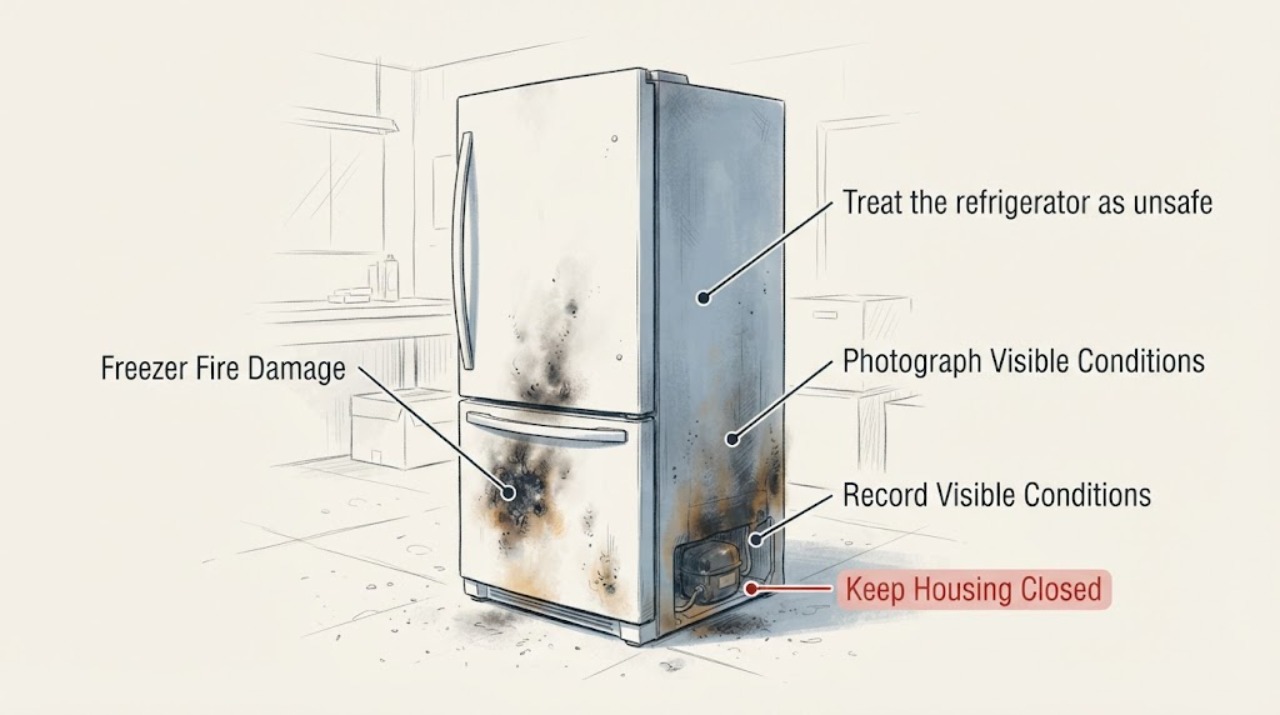
Do not decide that a Frigidaire FFTR1814TB0 is safe or repairable from a freezer fire, soot, melted plastic, or a scorch mark. Treat the refrigerator as out of service: keep people away from smoke or heat, disconnect power only if the plug and surrounding area are safe to reach, and do not restore power to test it. Have the fire department or other responding authority clear the scene, then arrange inspection by a qualified appliance technician and an electrician when wiring, receptacle, grounding, or the garage supply may be involved. Discard food exposed to flames, smoke, fire-fighting chemicals, or an unknown temperature history; FoodSafety.gov says a refrigerator keeps food safe for about four hours without power and a full freezer for about 48 hours only when the door remains closed. The opened Frigidaire documents identify the FFTR1814T S/W/B top-freezer family and its grounded 120-volt supply, but they do not make a fire-damaged FFTR1814TB0 safe to energize or identify a repair part.
Before you begin
Safety first
- Keep the refrigerator de-energized after suspected fire damage. Do not reset a breaker, restore power for a test, use an extension cord or adapter, open panels, probe live wiring, bypass a safety device, move the appliance through water or debris, or clean into hidden areas. Leave active fire, smoke, heat, arcing, gas or chemical odor, and unsafe garage conditions immediately.
Work through in order
Diagnostic checks
Use only checks that match the exact appliance or system and its official guide.
-
Check 1
Treat the refrigerator as unsafe to operate immediately. If there is active fire, smoke, heat, a gas or chemical odor, arcing, or a person at risk, leave the garage and call emergency services. If the scene is already safe, keep the refrigerator off and disconnect the plug only from a dry, unobstructed position where neither the plug, cord, receptacle, nor nearby floor shows damage; otherwise leave it for the fire department or electrician.
Expected result: There is active smoke or heat, a hot or damaged plug or receptacle, melted insulation, exposed wiring, water near the electrical connection, or only a cold inactive appliance with no visible supply damage.
Next step: Keep people away, do not move the refrigerator, and obtain scene clearance followed by qualified electrical and appliance inspection. Do not restore power to see whether it still runs.
Stop if: Do not touch damaged wiring, pull a plug through water, reset a breaker, use an extension cord, or enter a smoky or hot garage.
Why this matters
Why: Smoke, heat, char, melted material, or a damaged electrical connection is an immediate fire or shock concern. The absence of visible heat does not prove that hidden wiring or insulation is sound.
-
Check 2
Without opening panels or disturbing the scene, photograph and record the freezer and exterior from a safe distance: soot or smoke deposits, melted liner or trim, blistered paint, warped doors or gasket, damaged cord or receptacle, water or extinguishing residue, the fire location, and whether the fire department identified an origin. Keep the refrigerator in place for the inspection and insurance record.
Expected result: Damage is confined to a removable-looking exterior trim, or soot, melted plastic, charring, smoke residue, water, or deformation reaches the cabinet, door, cord, rear area, or freezer interior.
Next step: Give the photographs, model/rating label, and fire-scene information to the appliance technician, electrician, fire investigator, insurer, and manufacturer as applicable. Leave cleaning and disassembly to the responsible professionals.
Stop if: Do not scrape soot, wash the cabinet, remove a rear cover, bend melted trim, or probe behind the freezer liner.
Why this matters
Why: Visible damage establishes that inspection is needed, but it cannot show whether a hidden harness, insulation, control, sealed system, or grounding path remains safe. A localized-looking mark is not a repair diagnosis.
-
Check 3
Preserve the exact identity before anyone orders a part or schedules a repair: read the rating label and record FFTR1814TB0, the serial number, electrical ratings, country or market, and any installed ice-maker kit. Compare the label to the opened FFTR1814T S/W/B specification and Frigidaire support family, but do not treat the sibling FFTR1814TW page as proof of exact fire-damage parts or procedures.
Expected result: The label clearly reads FFTR1814TB0 and matches the FFTR1814T family, or the suffix, label, market, or documentation does not match.
Next step: Send the complete label and photographs to Frigidaire and the qualified service providers. Ask them to confirm the exact manual and inspect the affected electrical, cabinet, insulation, and cooling areas before discussing repair versus replacement.
Stop if: Do not select a gasket, fan, control, wiring assembly, or other part from the model prefix, a scorch location, or a generic parts page.
Why this matters
Why: The family documents establish a top-freezer refrigerator and grounded 120-volt electrical class, while the exact suffix controls fit and service documentation. Identity uncertainty blocks a model-specific repair decision but does not justify powering a damaged unit.
-
Check 4
Separate fire-exposed food from an outage-only food event. Put no food back into the refrigerator. Discard food touched by flames, smoke fumes, soot, water used to fight the fire, or fire-fighting chemicals; do not taste it. If there was only a power loss and no smoke or chemical exposure, record the time without power and keep doors closed while using the official temperature and time chart.
Expected result: Food or packaging has smoke, soot, chemical, heat, or water exposure, or the refrigerator was only without power and the food stayed closed and cold.
Next step: Discard fire-exposed food and use the official chart for outage-only items. Move any food that can be safely saved to a clean, safe cooler or another cleared appliance without re-energizing this refrigerator.
Stop if: Do not taste questionable food, wash soot into food, rely on smell alone, or reopen the damaged refrigerator repeatedly.
Why this matters
Why: Fire and chemical exposure can contaminate food even when packaging looks closed. For an outage without those exposures, FoodSafety.gov gives about four hours for refrigerated perishables and about 24 to 48 hours for a half-full or full freezer with the door closed; these limits do not make a fire-damaged appliance safe to use.
-
Check 5
Have a qualified electrician assess the garage supply and a qualified appliance technician assess the refrigerator, after the fire authority permits access. The inspection should cover the receptacle, grounding, cord, rear connection, cabinet and insulation, internal wiring and controls, compressor and sealed-system area, water or extinguishing residue, ventilation, and any fire or heat path; the refrigerator must remain de-energized during this decision.
Expected result: The electrician or technician can document intact supply and appliance systems with appropriate de-energized checks, finds damaged components or wiring, or cannot establish the extent of hidden damage.
Next step: Ask for a written statement of the inspected areas, observed damage, required replacements, and whether the appliance is safe to energize. If the extent cannot be proven, keep it out of service and obtain the manufacturer or insurer's repair-versus-replace decision.
Stop if: Do not authorize live probing, bypass a safety device, reconnect damaged wiring, or accept a visual-only statement that the unit is safe.
Why this matters
Why: A documented inspection is stronger evidence than a refrigerator that happens to start. Hidden heat, smoke, moisture, or wiring damage can create delayed shock, fire, contamination, or cooling failure, and a garage may add temperature and clearance concerns.
-
Check 6
Only after written professional clearance, confirm that the final installation still follows the matching Frigidaire documents: direct grounded receptacle, no extension cord or adapter, unobstructed ventilation, stable floor, required rear and side clearances, and a garage temperature within the documented range. Let the professional decide whether a controlled return to service is appropriate; do not perform the first restart as a home experiment.
Expected result: The exact model documentation is matched and the supply, cabinet, fire damage, ventilation, and garage conditions are all documented as acceptable, or any one of those conditions remains uncertain.
Next step: Use the professional report and exact model manual to decide whether to repair, replace, or dispose of the refrigerator. If any damage or clearance issue remains unresolved, do not energize it.
Stop if: Do not test by moving it to another outlet, using a cord or adapter, resetting power repeatedly, or operating it unattended after a fire.
Why this matters
Why: The family specification calls for a grounded 120-volt supply and ventilation clearances, and its guide warns that the controls at 0 do not remove all electrical power. Installation compliance is necessary but still does not replace fire-damage inspection.
Use your observations
Decision map
Find the observation that best matches what you see, then follow the next safe action.
-
PATH 01Safety boundary
What you see
Smoke, active heat, flames, arcing, a gas or chemical odor, damaged electrical supply, or an unsafe garage is present.
Do this next
Leave the area, call emergency services as appropriate, and keep the refrigerator isolated. Do not re-enter or disconnect it unless the responding authority says it is safe.
Why this path and its safety boundary
Why it matters: This is an emergency or immediate electrical/fire-safety condition, not a refrigerator troubleshooting session.
Safety stop: No restart, breaker reset, panel removal, movement, or home repair.
-
PATH 02Safety boundary
What you see
The fire is out, but there is soot, a scorch mark, melted trim or liner, smoke residue, water or chemical residue, a warped door, or any uncertainty about hidden damage.
Do this next
Keep the exact FFTR1814TB0 off and in place, document it, and obtain written inspection from qualified appliance and electrical professionals before discussing repair or replacement.
Why this path and its safety boundary
Why it matters: Official appliance-safety guidance treats burns, char, scorches, smoke damage, and damaged wiring as reasons for technician inspection before operation. The pattern cannot identify one repairable part.
Safety stop: Do not clean into the cabinet, open panels, reconnect power, or infer that a small visible mark is harmless.
-
PATH 03Safety boundary
What you see
There was no fire, smoke, soot, water, or chemical exposure to the appliance or food, and the only event was an ordinary power outage with an intact refrigerator.
Do this next
Keep the door closed, use FoodSafety.gov's refrigerated and frozen-food charts, and arrange ordinary appliance service only if the intact unit has a separate cooling or electrical symptom.
Why this path and its safety boundary
Why it matters: This is an outage food-safety branch rather than a fire-damage repair decision. Food can be triaged by the official time and temperature guidance, but that guidance does not clear a refrigerator with suspected fire damage.
Safety stop: Do not use this branch to justify energizing a soot-marked, melted, smoke-exposed, or fire-affected FFTR1814TB0.
-
PATH 04Safety boundary
What you see
Qualified professionals have matched the exact model documentation, inspected the supply and appliance while de-energized, recorded no unresolved fire or electrical damage, and issued written clearance.
Do this next
Follow the written repair or replacement recommendation and any supervised return-to-service procedure. Stop and reopen the case if smoke, odor, heat, tripping, abnormal noise, or cooling loss returns.
Why this path and its safety boundary
Why it matters: A documented professional assessment supports a repair-versus-replace decision; a refrigerator that merely powers on would not provide the same evidence.
Safety stop: Do not bypass a safety device, substitute an unverified part, or treat one successful cycle as proof that hidden damage is absent.
Helpful context
Understand the symptom
Why a freezer fire changes the decision
The useful question is not which freezer part appears burned. A fire can affect insulation, wiring, connectors, the cabinet liner, the grounded supply, and hidden components that cannot be judged from a photograph. The Frigidaire guide says that turning the control to 0 disables cooling but does not disconnect the light and other electrical components, and it requires a direct grounded receptacle rather than an extension cord. Therefore a control setting, a different outlet, or a short test cycle is not a safety clearance.
Garage and model limits
The opened Frigidaire support page identifies the FFTR1814TW sibling as a discontinued 18-cubic-foot top-freezer refrigerator, and the manufacturer sheet identifies the FFTR1814T S/W/B family. Those documents help anchor the appliance identity and electrical class, but they are not a fire-damage inspection report for the exact FFTR1814TB0. The same specification sheet says not to install this family below 55°F or above 110°F and calls for clearance for ventilation; a garage condition is another item for a technician to document, not a reason to improvise a restart.
When checks do not resolve it
Need a professional?
Use the fire department or emergency services for active hazards, a qualified electrician for the receptacle, grounding, cord, garage supply, or visible wiring, and a qualified appliance technician or Frigidaire-authorized provider for the refrigerator's cabinet, insulation, controls, compressor area, cooling system, and model-specific repair assessment. Include the insurer or fire investigator when the scene or claim requires it.
Safety scope: Keep the refrigerator de-energized after suspected fire damage. Do not reset a breaker, restore power for a test, use an extension cord or adapter, open panels, probe live wiring, bypass a safety device, move the appliance through water or debris, or clean into hidden areas. Leave active fire, smoke, heat, arcing, gas or chemical odor, and unsafe garage conditions immediately.
Have this ready
- Provide the complete FFTR1814TB0 rating-label identity and serial number, garage location, fire or smoke timeline, fire-department findings, photos taken from a safe distance, soot/melted/water/chemical observations, food-exposure and power-outage timeline, and whether the plug, receptacle, breaker, or nearby wiring was affected.
Common questions
FAQ
Can I plug in the Frigidaire FFTR1814TB0 briefly to see if it still works?
No. A refrigerator that starts is not proof that fire, smoke, heat, water, or wiring damage is safe. Keep it isolated and obtain professional inspection before any return-to-service decision. The Frigidaire guide also explains that setting the control to 0 does not remove power from all electrical components.
If only the freezer liner or one plastic part melted, is the refrigerator repairable?
The visible location is not enough to answer that. Hidden insulation, wiring, connectors, cabinet structure, controls, and the grounded supply may also be affected. Have a qualified appliance technician and electrician document the damage; do not order a part from a scorch mark or model prefix.
Should I keep food that was inside the refrigerator during the fire?
Discard food exposed to flames, smoke fumes, soot, water used to fight the fire, or fire-fighting chemicals, and never taste it to decide. If there was only an ordinary power outage with no fire or chemical exposure, use the FoodSafety.gov time and temperature chart instead.
Does the garage location change the assessment?
It adds installation and environment facts for the professional report. The opened Frigidaire family documents call for ventilation and specify an operating range of about 55°F to 110°F; they do not clear a fire-damaged appliance. Record the garage temperature, clearances, moisture, and receptacle condition without moving or powering the refrigerator.
Read the exact guide
Official sources
- Product Support: Frigidaire 18 Cu. Ft. Top Freezer Refrigerator White-FFTR1814TWFrigidaire · Opened Frigidaire product-support page for the FFTR1814TW sibling, used to confirm the 18-cubic-foot top-freezer family, model-specific manuals/support routing, and electrical listing. It is not an exact FFTR1814TB0 fire-damage diagnosis.
- All about the Use & Care of your RefrigeratorFrigidaire · Opened Frigidaire refrigerator guide routed from the FFTR1814TW support page; used for electrical, grounding, direct-receptacle, power-disconnect, and temperature/garage guidance. It does not certify a fire-damaged appliance.
- Food Safety During Power OutageFoodSafety.gov · Government outage-food guidance for the no-fire/no-smoke branch only; it does not clear a fire-damaged refrigerator or food exposed to smoke or chemicals.
- FFTR1814T S/W/B Top Mount Refrigerator 18.0 CU. FT. Product Specifications SheetElectrolux Home Products, Inc. / Frigidaire · Opened manufacturer specification sheet for the FFTR1814T S/W/B family; used only for family identity, 120V/60Hz grounded supply, circuit, clearance, and environmental specifications, not for fire-damage diagnosis or part selection.
- Appliance and Electrical Fire SafetyU.S. Fire Administration · Government safety guidance applicable to direct wall connection, avoiding extension cords, and damaged cords; it is not a Frigidaire repair or model-specific source.
- Earthquake Damage to AppliancesGE Appliances · General manufacturer safety guidance, not Frigidaire code or repair guidance. Its damaged-appliance inspection rule is applicable to a refrigerator after a fire or smoke event.
- Extinguishing the Risk of Foodborne Illness during WildfiresFoodSafety.gov · Government food-safety guidance applicable to food exposed to a refrigerator/freezer fire or smoke; it is not appliance repair guidance.
Community feedback
Share a repair observation
Share a plain-text repair observation. Accepted observations are published automatically; this page may take a moment to update.