
On this page
Start here
Quick answer
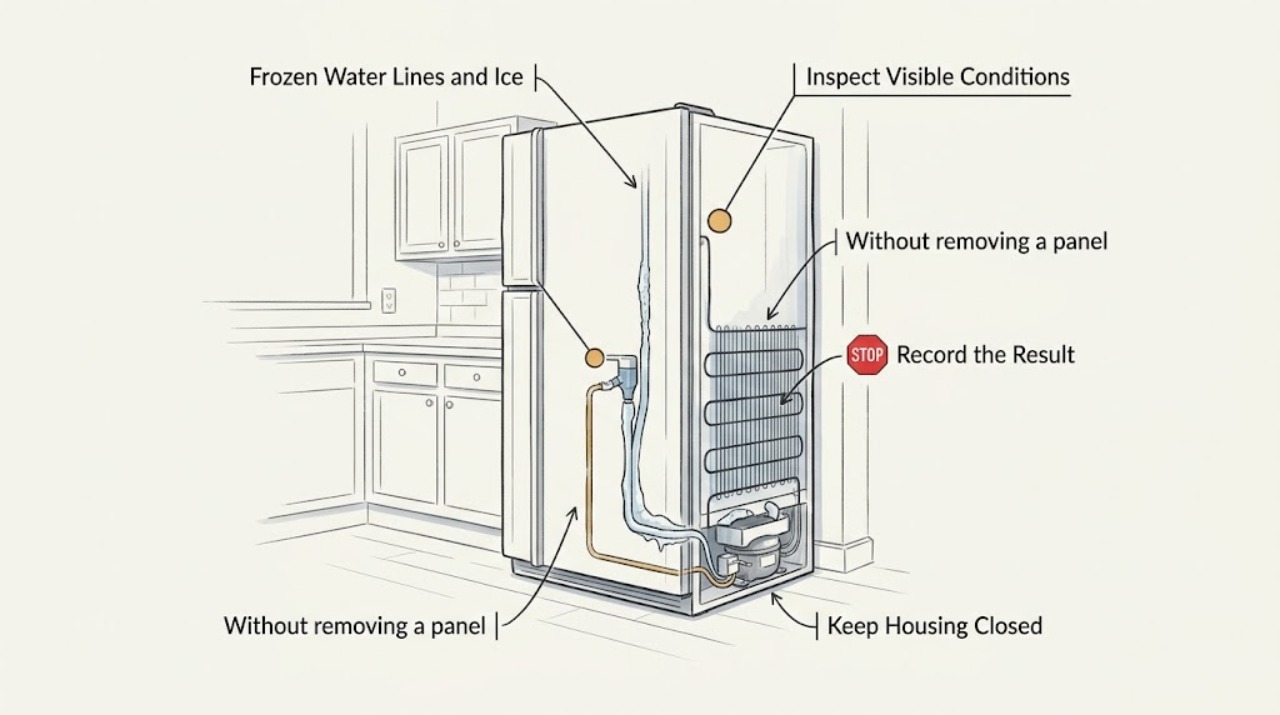
Frozen water lines plus a large ice or rusted area on the back of a Frigidaire LFHB2741PF5A should not be labeled either a simple dispenser blockage or an automatically unrepairable refrigerator. First stop the water and ice features, protect the floor and food, and identify whether the first abnormal point is an accessible rear connection, an internal filter or dispenser path, or ice on the cabinet back. Frigidaire documents ordinary causes such as loose rear connections, a mis-seated or cracked filter, door-seal and airflow problems, and frost-related meltwater; the exact model scenario also needs qualified inspection if the ice is on an inaccessible cabinet or cooling area. Do not chip the ice, apply direct heat, drill or foam the cabinet, seal over rust, disconnect a water line, or decide to replace the refrigerator from a photograph alone.
Before you begin
Safety first
- Do not open the rear cabinet, access the sealed cooling system, disconnect tubing, use direct heat, chip frost, drill, inject foam, apply a heating pad, or seal over rust.
Work through in order
Diagnostic checks
Use only checks that match the exact appliance or system and its official guide.
-
Check 1
Turn off the refrigerator's dispenser and ice-making water features using the normal user controls, keep the doors closed as much as practical, and make a low-risk visual record of the first abnormal location. Look for water on the floor or at a rear connection, ice under the ice maker or in the dispenser area, and ice or rust on the outside back of the cabinet. Do not pull the refrigerator by its water line or cord.
Expected result: The first wet or icy point is an accessible rear fitting, the filter or dispenser path, the inside or underside of the ice-maker area, or the cabinet back; the refrigerator may also be warm, making food safety a separate concern.
Next step: Keep the water and ice features off for an active leak or water near electrical parts. Move perishable food to a known-safe cold appliance if cooling is not being maintained, and continue only with the matching external check.
Why this matters
Why: Location separates a pressurized water-path problem from frost or meltwater and from a cabinet or cooling-area condition. A back-of-cabinet ice pattern is not proof that the water tube itself is the source, and it is not proof that the appliance cannot be repaired.
-
Check 2
Without removing a panel or disconnecting tubing, inspect the accessible rear water line, fittings, and valve with a dry paper towel. Check only whether the line is visibly kinked or strained because the refrigerator was pushed back; do not move the appliance if the line, floor, or cord would be stressed.
Expected result: The towel becomes wet at a fitting or valve, a tube is visibly kinked or pinched, the accessible rear water path is dry, or the ice is on a sealed or inaccessible section of the cabinet back.
Next step: If an accessible shutoff operates normally, close it before service for a pressurized leak; otherwise leave it alone. Do not tighten unfamiliar fittings, disconnect tubing, open the rear cover, or try to melt the cabinet ice.
Why this matters
Why: Frigidaire says loose rear connections can put water on the floor, while a dry accessible connection shifts the problem toward the filter, dispenser, frost meltwater, or an internal line. Ice on an inaccessible cabinet is outside a safe user repair and should not be treated as a loose fitting.
-
Check 3
If the water path inside the refrigerator is affected, check the filter area and dispenser chute from normal access. Note whether the filter was recently changed, is visibly cracked or wet, is not seated, or is frozen in place; also look for accessible frost or ice in the chute and whether the dispenser tip keeps dripping. Do not pry or heat a stuck filter or chute.
Expected result: The filter is newly installed, loose, cracked, wet, or frozen; the chute has frost; the dispenser tip is wet; or the filter and dispenser remain dry while the rear cabinet continues to ice.
Next step: Use only the exact model's filter and dispenser instructions for an accessible reseat or cleanup. Stop the water feature and arrange service for a cracked or stuck filter, continued dripping, or any water reaching wiring or food storage.
Why this matters
Why: Frigidaire identifies an incorrectly installed or cracked filter as a possible cabinet leak and links chute ice or air in the line to dispenser symptoms. A dry filter and chute do not explain persistent back-of-cabinet ice, so that pattern needs a different service assessment.
-
Check 4
Check the ordinary frost contributors without opening the cabinet: confirm both doors close fully, inspect the door gaskets for visible gaps or obstructions, make sure the ice chute is closing, and make sure stored items are not blocking interior vents. Record whether the rear ice appeared after a door was left open or whether it returns with normal closure.
Expected result: A door was left open, a gasket does not seal, the chute remains open, vents are blocked, or all of those user-side conditions look normal while the rear ice persists.
Next step: Remove only an accessible obstruction and close the doors normally. Do not chip frost or apply a heater; if the pattern returns or cooling is unstable, arrange qualified refrigerator service.
Why this matters
Why: Frigidaire explains that warm air entering a cold compartment can form frost and that door seals, an open chute, low settings, and blocked airflow can contribute. Correcting an obvious seal or obstruction may address ordinary frost, but recurring ice on the cabinet back is not cleared as a diagnosis by closing the door once.
-
Check 5
If the refrigerator was recently installed or the filter was recently changed and the accessible water path is dry, use the model-authorized priming procedure only when there is no active leak: dispense into a container until flow is established, purge as the manual directs, and stop if water appears where it should not. Do not use priming as a test of the iced cabinet.
Expected result: Flow becomes even and the water symptom stops, air continues to interrupt flow, the dispenser still drips, or the water feature remains inactive while back-of-cabinet ice and rust remain.
Next step: Keep the water and ice features off if the symptom continues, record the installation or filter history and first wet or icy point, and arrange qualified service for the internal water path or cabinet condition.
Why this matters
Why: Frigidaire says air in newly connected plumbing can cause uneven dispenser flow and early empty ice-maker cycles. That explanation does not account for persistent cabinet ice or corrosion, so a continuing rear pattern cannot be dismissed as air in the line.
-
Check 6
Before deciding between repair and replacement, document the exact LFHB2741PF5A model from the refrigerator's label, the location and extent of ice and rust, whether cooling temperatures are stable, whether the dispenser and ice maker are both affected, whether the rear water path was wet, and whether the pattern returns after normal user-side checks. Keep the back panel and cabinet untouched.
Expected result: The rear ice is a one-time surface event with stable cooling, or it is extensive or recurring with frozen water lines, rust, poor cooling, floor damage, or an inaccessible cabinet source.
Next step: Request a qualified Frigidaire refrigerator diagnosis and ask the technician to identify the source, whether the repair addresses the cause rather than only the ice, and what safety or water-damage risk remains. Do not install improvised foam, foil tape, sealant, heating pads, or drilled access holes.
Why this matters
Why: A one-time frost or water-path event may lead to a model-guided serviceable repair. Recurring ice on a cabinet or cooling area, corrosion, water damage, or unstable temperatures can indicate a more consequential cabinet or sealed-system assessment. Neither outcome can be selected reliably from the phrase "not fixable" or from a visible patch alone.
Use your observations
Decision map
Find the observation that best matches what you see, then follow the next safe action.
-
PATH 01Next step
What you see
A dry paper towel becomes wet at an accessible rear line, fitting, or valve, and the cabinet back is not the first source of ice.
Do this next
Keep the water and ice features off, close the accessible shutoff only if it operates normally, and arrange qualified appliance or plumbing service. Do not disconnect or retighten the line by guesswork.
Why this path and its safety boundary
Why it matters: A supply connection, valve, damaged line, or strain-related water-path issue is more likely than a sealed cabinet condition.
-
PATH 02Next step
What you see
The filter, dispenser tip, or chute is the only wet or icy area, while the rear connections and cabinet back are dry.
Do this next
Follow the exact model's accessible filter, chute, or priming guidance once; stop the water feature and seek service if it leaks, is frozen in place, or keeps dripping.
Why this path and its safety boundary
Why it matters: A filter installation problem, chute frost, or air in the line is more likely than a back-of-cabinet cooling or insulation issue.
-
PATH 03Next step
What you see
Large or recurring ice and rust are on the outside back or an inaccessible cabinet section, with frozen water lines and no wet accessible connection.
Do this next
Leave the cabinet and sealed cooling area closed, keep the water and ice features off, protect the floor, and request qualified service to assess the cause and repair-versus-replacement options.
Why this path and its safety boundary
Why it matters: The observation is not enough to call the refrigerator unrepairable, but it is also not a safe DIY water-line repair. A cabinet cold spot, insulation issue, internal water path, defrost-related condition, or cooling-system problem remains possible and must be inspected.
-
PATH 04Next step
What you see
The ice follows a clearly open door, visible gasket gap, open chute, or blocked interior vent and does not recur after the accessible condition is corrected.
Do this next
Monitor cooling and moisture without applying heat or removing panels; arrange service if the ice returns, the gasket cannot seal, or food storage temperatures are not maintained.
Why this path and its safety boundary
Why it matters: Frigidaire's documented warm-air and airflow explanation is more plausible than a permanent cabinet failure, although continuing frost would change the decision.
-
PATH 05Next step
What you see
Cooling is unstable, water reaches electrical parts or the floor, corrosion is spreading, the rear source is inaccessible, or the technician cannot verify that an improvised patch addresses the cause.
Do this next
Stop using the water and ice features and arrange prompt qualified appliance service; do not chip, heat, drill, foam, seal, or continue operating an active leak near electrical parts.
Why this path and its safety boundary
Why it matters: This is a safety and property-damage escalation, not a routine frozen-line thaw. The appliance may need a deeper refrigerator or cooling-system assessment before any repair-versus-replacement decision.
Helpful context
Understand the symptom
This exact model scenario combines two different observations: a water path that no longer flows and ice or rust visible behind the cabinet. They can be related, but they are not the same diagnosis. An accessible tube or connection can be checked from the normal user side; ice on the cabinet back may instead indicate a cold-surface, airflow, door-seal, insulation, or cooling-system condition that cannot be safely diagnosed by removing the rear cover.
Anecdotal reports about this exact model contain conflicting explanations, including a water-related leak theory and an insulation-void theory. That disagreement is a reason to document the location and cooling symptoms, not a reason to copy a home-made foam, sealant, heater, or drilling repair. A technician should decide whether the appliance is repairable after inspecting the actual cabinet and cooling circuit.
When checks do not resolve it
Need a professional?
Provide LFHB2741PF5A, the exact location and photographs of ice or rust, whether the water dispenser and ice maker are affected, the rear connection towel result, recent filter or installation history, door-seal observations, cooling symptoms, and any floor or electrical damage.
Safety scope: Do not open the rear cabinet, access the sealed cooling system, disconnect tubing, use direct heat, chip frost, drill, inject foam, apply a heating pad, or seal over rust.
Common questions
FAQ
Does ice on the back mean the LFHB2741PF5A cannot be repaired?
No. It means the source must be identified. A rear connection, water path, frost condition, cabinet cold spot, or cooling-area issue can lead to different service decisions; visible ice and rust alone do not establish replacement as the only option.
Can I thaw the frozen water lines with a hair dryer or heater?
Do not apply direct heat or chip ice around the cabinet, filter, tubing, or cooling area. Keep the water and ice features off and have an inaccessible or recurring condition assessed by qualified service.
What should I record before calling for service?
Record LFHB2741PF5A, the exact first wet or icy location, the extent of rust, whether the rear connection was wet, whether cooling is stable, whether the dispenser and ice maker are affected, and any recent filter or installation work.
Read the exact guide
Official sources
- Refrigerators / Freezer - Frost Build UpFrigidaire · Frigidaire refrigerator support guidance on door seals, chute closure, temperature settings, and airflow
- Where can I find my model and serial number?Frigidaire · Frigidaire refrigerator model-number location guidance used to confirm the assigned LFHB2741PF5A identity
- Refrigerators - What does it mean to "Prime the Water Supply System" and why is it important for my refrigerator?Frigidaire · Frigidaire refrigerator support guidance for air in new plumbing, uneven dispenser flow, and early ice-maker cycles
- Frigidaire Refrigerator LFHB2741PF5A with frozen water lines and ice buildup on back of unit - repair guy says it's not fixable?Reddit r/appliancerepair · Exact LFHB2741PF5A user report with frozen rear water lines, rear ice, rust, and disputed explanations; used only to preserve the uncertainty and symptom identity
- Refrigerator Water LeaksFrigidaire · Frigidaire refrigerator support guidance for rear connections, filters, doors, chutes, and dispenser leaks
- Delivery and Installation Guide - RefrigeratorFrigidaire · Frigidaire refrigerator installation guidance for appliances with an ice maker or water dispenser
Community feedback
Share a repair observation
Share a plain-text repair observation. Accepted observations are published automatically; this page may take a moment to update.