
On this page
Start here
Quick answer
First verify whether the display truly says H1 or HI. The Frigidaire LFSS2612TF family owner's guide uses HI for a high-temperature alarm, and says the alarm sounds when the freezer is above 26°F or the refrigerator is above 55°F; it does not define a separate H1 code. A room that reached about 81°F can make the refrigerator work harder, but it does not prove that the freezer alarm is caused by the home's air conditioner or by a refrigerator refrigerant leak. Keep the doors closed, measure the freezer and refrigerator with appliance thermometers, and record the alarm, settings, door/seal condition, and cooling sounds. Protect food immediately: FDA guidance uses 0°F for a freezer and 40°F or below for a refrigerator; frozen food is safe to refreeze or cook when it still has ice crystals or is 40°F or below, while uncertain warm food should be discarded. Repair the separate AC problem with an HVAC professional, but arrange refrigerator service if the freezer remains warm after the room is comfortable, HI returns, cooling is abnormal, or the display is actually an undocumented H1.
Work through in order
Diagnostic checks
Use only checks that match the exact appliance or system and its official guide.
-
Check 1
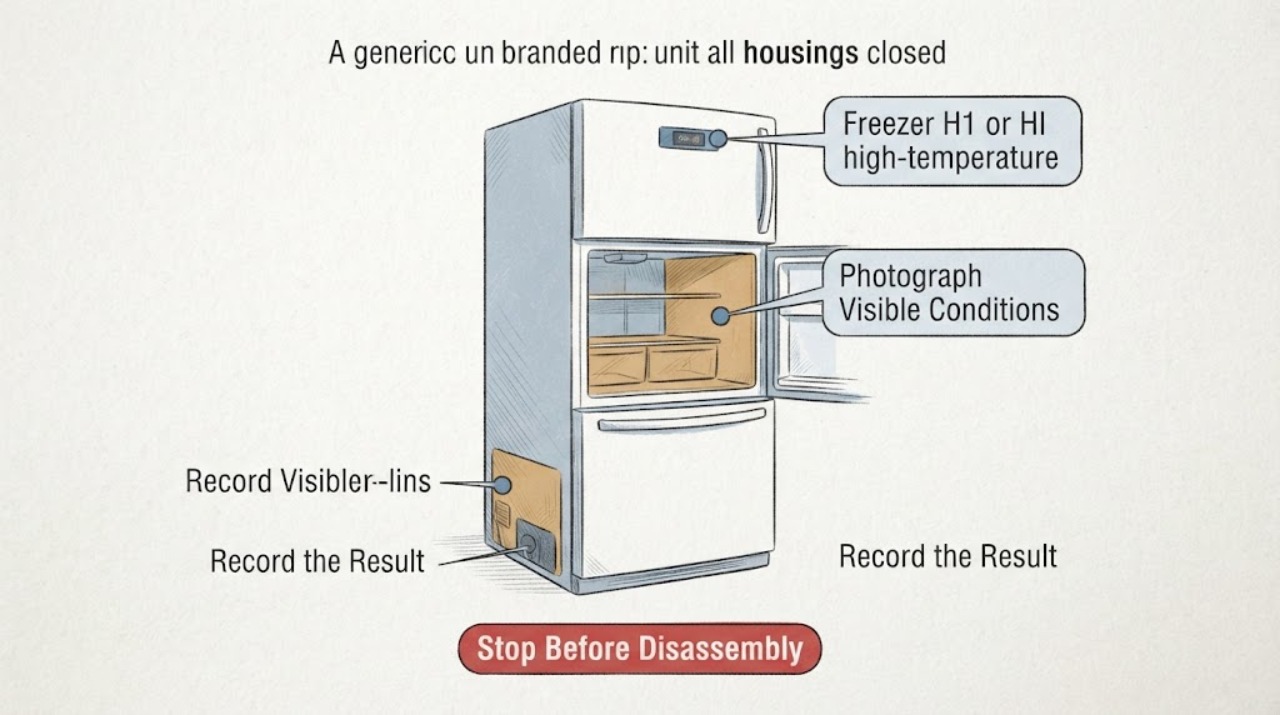
Before acknowledging the alarm, photograph and transcribe the display exactly: H1 or HI, which compartment is flashing, whether the text is solid or blinking, the alarm sound, and the highest temperature shown after acknowledgement. Confirm the rating label says LFSS2612TF0, including the final suffix.
Expected result: The display clearly says HI in the freezer, the display clearly says H1, only a partial character is visible, or the model suffix cannot be confirmed.
Next step: Use the HI branch only when the display is confirmed as HI and the family/model match is adequate. If it is literal H1 or the identity is uncertain, keep the photo and request Frigidaire or qualified service rather than applying a different code table.
Stop if: Do not clear the alarm, press random key combinations, or copy an H1 meaning from another Frigidaire appliance before recording the display.
Why this matters
Why: The opened LFSS2612TF owner guide defines HI as high temperature and does not define H1. The official product page identifies the LFSS2612TF family, but the final model suffix still matters when matching documents and controls.
-
Check 2
Check food and compartment temperatures without opening covers. Place an appliance thermometer in the freezer and another in the refrigerator, close both doors, and record the readings and the time. Keep the doors closed as much as practical while the unit recovers.
Expected result: The freezer is at or below 0°F, above 0°F but still has ice crystals, above 26°F, or near refrigerator temperature; the refrigerator is above 40°F; or the readings are unknown.
Next step: Move perishable or uncertain food to a known-safe freezer/cooler. Treat a warm freezer or refrigerator as a cooling problem requiring service if it does not recover; do not use the alarm acknowledgement as proof that food is safe.
Stop if: Do not taste questionable food, rely on smell or appearance, or leave food in a warming freezer while repeatedly testing the appliance.
Why this matters
Why: Frigidaire recommends 0°F for the freezer and its family guide triggers the high-temperature alarm when the freezer is above 26°F. FDA says 0°F is the freezer target, 40°F or below is the refrigerator target, and ice crystals or a measured 40°F or below can support safe refreezing of frozen food.
-
Check 3
Separate the room condition from the appliance condition. Record the room temperature near the refrigerator, whether the failed AC left the room at about 81°F, whether the refrigerator is in direct sun or beside a heat source, and whether the front toe grille and visible surrounding clearance are unobstructed. Do not remove panels or attempt to access the sealed system.
Expected result: The room is now comfortable and the refrigerator cools normally, the room is still hot, the toe grille/airflow area is blocked, or the freezer remains warm despite a normal room.
Next step: Restore reasonable room cooling through the separate HVAC repair, clear only an obvious external obstruction, and recheck the appliance temperature with doors closed. If the freezer remains warm, arrange refrigerator service.
Stop if: Do not spray, wash, scrape, or open the condenser area, and do not declare a refrigerator refrigerant leak from room temperature or compressor sound alone.
Why this matters
Why: Frigidaire says hot room conditions can make the refrigerator run more, and the owner guide warns that the appliance cannot maintain proper temperatures if installed where the temperature rises above 110°F or if the toe grille is blocked. An 81°F room can add workload, but persistent high freezer temperature after the room normalizes is not explained by the AC context alone.
-
Check 4
Inspect only the visible door and gasket contact: close the refrigerator and freezer doors normally, check that no package prevents closure, and look for a gasket that is visibly folded, dirty, or not contacting the cabinet. Keep food away from visible cold-air paths without dismantling the liner.
Expected result: A door was left ajar, a package blocks closure, the gasket visibly fails to contact, vents are blocked by food, or the doors and seals appear normal.
Next step: Correct only the visible loading or closure problem and allow the temperatures to stabilize with the doors closed. If HI returns or the measured freezer temperature remains high, stop user-level troubleshooting and call service.
Stop if: Do not remove the gasket, door hinges, liner, fan cover, sensor, or control panel to improve the seal or airflow.
Why this matters
Why: The LFSS2612TF guide identifies frequent or slightly open doors, poor gaskets, and blocked air circulation as user-observable reasons for warm or long-running operation. A normal visible seal does not rule out an internal cooling fault.
-
Check 5
Observe the appliance from outside for normal cooling activity: note whether the compressor or fan runs, cycles, stops after a short attempt, or is accompanied by clicking, burning odor, smoke, water near electrical parts, or a damaged cord. Do not touch hot electrical components or perform electrical tests.
Expected result: The unit runs continuously while temperatures fall, runs but temperatures do not fall, repeatedly clicks and stops, is silent with a warm freezer, or has an electrical/water hazard.
Next step: Keep the doors closed and record the pattern for service. For smoke, burning odor, water near electrics, cord damage, or repeated breaker operation, isolate power only from a safe dry position and seek qualified appliance/electrical help.
Stop if: Do not remove the rear cover, touch the compressor or wiring, bypass a control, connect a substitute power source, or keep cycling power to reproduce the alarm.
Why this matters
Why: Frigidaire documents that high room temperature and certain normal cycles can increase run time, but a persistent warm compartment or abnormal power symptom needs diagnosis. Sound alone cannot distinguish a compressor, fan, control, or sealed-system problem.
-
Check 6
After preserving the original evidence, use only the exact model guide's normal alarm acknowledgement if it matches the display and controls. If the alarm is HI, pressing a control key may silence or acknowledge it, but continue to track compartment temperature rather than treating a cleared display as a repair.
Expected result: The alarm clears and both compartments return to safe temperatures, it clears but HI returns, the display will not clear, the display is actually H1, or cooling does not recover.
Next step: Keep the model/code photo and temperature timeline. Request refrigerator service for recurrence, no recovery, an undocumented H1, or any service-oriented display; repair the separate home AC issue independently.
Stop if: Do not repeatedly acknowledge or reset the alarm, change hidden settings, or replace a thermostat, sensor, compressor, or control based on the alarm alone.
Why this matters
Why: The family guide says the HI alarm can be acknowledged while the appliance continues monitoring the high-temperature condition and says to contact service if the alarm continues. Acknowledgement changes the display state, not the underlying cooling capacity or food safety.
Use your observations
Decision map
Find the observation that best matches what you see, then follow the next safe action.
-
PATH 01Next step
What you see
The photographed display is HI, the freezer is above the LFSS2612TF guide's 26°F alarm threshold, and the alarm appeared during or shortly after the room reached about 81°F.
Do this next
Keep doors closed, protect food, restore comfortable room conditions through HVAC service, and monitor with an appliance thermometer. Call refrigerator service if the freezer does not return toward 0°F or HI returns.
Why this path and its safety boundary
Why it matters: This confirms a high-temperature condition, but the warm room is only a contributing context; it does not establish whether the refrigerator can recover or which cooling component is involved.
-
PATH 02Next step
What you see
The room has returned to a reasonable temperature, the doors and visible gasket are normal, but the freezer remains warm or HI repeatedly returns.
Do this next
Keep food in known-safe cold storage and arrange qualified Frigidaire refrigerator service with the temperatures, alarm photo, model suffix, and cooling-behavior timeline.
Why this path and its safety boundary
Why it matters: The environmental explanation is no longer sufficient to account for the measured condition. The pattern needs model-specific refrigerator diagnosis; it does not identify a refrigerant leak, compressor, fan, or sensor by itself.
-
PATH 03Next step
What you see
The display is actually H1, the final model suffix is uncertain, or the characters cannot be distinguished between H1 and HI.
Do this next
Preserve a clear photo and rating-label details and ask Frigidaire or a qualified technician to identify the display for the exact model before using a reset or buying a part.
Why this path and its safety boundary
Why it matters: The opened Frigidaire family guide and current support article define HI/H, not a distinct H1. The code meaning is therefore not safely established for this exact display.
-
PATH 04Next step
What you see
Frozen food still has ice crystals or measures 40°F or below, while the freezer is being moved to known-safe storage; refrigerated food is verified at 40°F or below.
Do this next
Keep the doors closed, continue monitoring with thermometers, and still arrange appliance service if HI persists; food safety and fault diagnosis are separate decisions.
Why this path and its safety boundary
Why it matters: FDA identifies those temperature/ice-crystal observations as supporting safe refreezing or cooking of frozen food and safe refrigerator storage at 40°F or below.
-
PATH 05Next step
What you see
Food temperature or time is unknown, the freezer has been above 40°F without reliable timing, or perishable food has been held above 40°F for an unsafe interval.
Do this next
When in doubt, discard the affected perishable food and keep replacement food in a known-safe appliance or cooler while refrigerator service is arranged.
Why this path and its safety boundary
Why it matters: FDA says not to rely on appearance or odor when evaluating warm food and to discard food when the time or temperature cannot establish safety.
-
PATH 06Next step
What you see
Smoke, burning odor, arcing, a damaged cord, water near electrical parts, or repeated breaker operation accompanies the alarm or loss of cooling.
Do this next
Stop using the refrigerator, isolate power only from a safe dry position, keep clear of wet electrical areas, and obtain qualified appliance/electrical service; keep food in safe cold storage.
Why this path and its safety boundary
Why it matters: This is an electrical, water, or fire-safety escalation, not a temperature-setting or AC-context question.
Helpful context
Understand the symptom
The first issue is the character on the display. The LFSS2612TF owner's guide says a high-temperature condition displays HI in the affected compartment after the temperature has been above its threshold for 20 minutes. Frigidaire's current support article also calls the alarm H or HI. If the display really reads H1, photograph it rather than silently converting the last character to I; a literal H1 is not defined by the opened Frigidaire sources for this model family.
An 81°F room and a failed home air conditioner are relevant operating context, not a refrigerator diagnosis. Frigidaire says hot surroundings can make the appliance run harder, while the owner guide lists room heat, frequent or slightly open doors, a poor gasket, and a dirty condenser as possible reasons for long running. The air-conditioner refrigerant problem belongs to HVAC service; it cannot be used to name the refrigerator compressor, sealed system, or refrigerant circuit as the cause of the alarm.
Food safety comes before repeated testing. The FDA recommends 0°F for the freezer and 40°F or below for the refrigerator, and says frozen food with ice crystals or a measured temperature of 40°F or below may be refrozen or cooked. Do not taste food to decide whether it is safe; move vulnerable food to a known-safe appliance or cooler while the temperature and service decision are being made.
Only after diagnosis
Potential parts
- LFSS2612TF0-compatible temperature-sensing, control, or airflow component
Only if a qualified diagnosis for the exact suffix confirms a failed sensor, control, fan, or airflow path after temperature and external-condition checks; HI/H1 alone does not identify a part.
- LFSS2612TF0-compatible compressor or sealed-system service
Only after a qualified refrigeration diagnosis confirms inadequate cooling capacity with normal door, room, airflow, and control conditions; the household AC refrigerant leak is a separate system and is not evidence of a refrigerator refrigerant leak.
When checks do not resolve it
Need a professional?
Arrange Frigidaire or qualified refrigerator service when the freezer remains warm after the room returns to a reasonable temperature, HI repeatedly returns, the display is actually H1 or cannot be matched to the exact model, cooling does not recover, or the unit runs without reducing compartment temperature. Repair the separate home AC refrigerant leak with HVAC service; do not treat that repair as proof of a refrigerator sealed-system diagnosis. Protect food first with known-safe cold storage. Stop immediately for smoke, burning odor, arcing, damaged cord, water near electrical parts, repeated breaker operation, or any unsafe condition; isolate power only from a safe dry position. Do not open the rear or control panels, handle refrigerant, perform electrical tests, bypass controls, or replace a compressor, sensor, thermostat, fan, or control from H1/HI alone.
Common questions
FAQ
Does Frigidaire LFSS2612TF0 use H1 or HI for a freezer high-temperature alarm?
The opened LFSS2612TF family guide documents HI in the affected compartment and does not define a separate H1 code. Photograph the display and confirm the final model suffix before applying any code meaning; a literal H1 should be treated as unresolved until Frigidaire identifies it.
Can an 81°F room cause the freezer HI alarm?
A hot room can make the refrigerator run harder, and Frigidaire lists hot conditions as a possible reason for longer operation. It can contribute to a high-temperature event, but it does not prove the refrigerator is healthy or identify a refrigerator refrigerant leak. Check the freezer temperature and whether it recovers after the room is comfortable.
What should I do with food after a freezer high-temperature alarm?
Use appliance thermometers and move food to known-safe cold storage. FDA guidance uses 0°F for a freezer and 40°F or below for a refrigerator; frozen food with ice crystals or at 40°F or below may be refrozen or cooked, but do not rely on smell or appearance when temperature or time is uncertain.
Read the exact guide
Official sources
- Refrigerator Runs Too MuchFrigidaire Owner Support · Official Frigidaire support article opened for environmental context; it supports the distinction between hot-room workload and a confirmed refrigerator part fault.
- Frigidaire LFSS2612TF Complete Owner's Guide A07198504Frigidaire · Official owner guide linked from Frigidaire's LFSS2612TF product-support page; it is used for the exact family controls, HI alarm, freezer threshold, external checks, and safety, with LFSS2612TF0 suffix confirmation still required.
- Refrigerators - What is the recommended temperature settings for my refrigerator?Frigidaire Owner Support · Official Frigidaire temperature guidance opened for refrigerator/freezer setpoint context; it does not define H1 and should not replace a measured compartment temperature.
- Product Support for Frigidaire 25.5 Cu. Ft. Side-by-Side Refrigerator-LFSS2612TFFrigidaire · Official Frigidaire product-support page opened for the assigned LFSS2612TF0 family; it presents the base model LFSS2612TF and links the complete owner's guide, installation instructions, and specifications. The final factory suffix remains a rating-label identity check.
- Refrigerator Thermometers - Cold Facts about Food SafetyU.S. Food and Drug Administration · Official FDA food-safety source opened for measured temperature and thawed-food decisions, not for diagnosing the refrigerator mechanism.
- Food and Water Safety During Power Outages and FloodsU.S. Food and Drug Administration · Official FDA emergency food-safety source opened for temperature/time decisions after a high-temperature event; it does not diagnose Frigidaire hardware.
- Refrigerator Error Code H or HI - High TemperatureFrigidaire Owner Support · Official Frigidaire support article opened for the H/HI interpretation; it applies broadly to refrigerators and explicitly warns that reset/clear steps depend on the model, so it does not define a separate H1 for LFSS2612TF0.
Community feedback
Share a repair observation
Share a plain-text repair observation. Accepted observations are published automatically; this page may take a moment to update.