
On this page
Start here
Quick answer
Separate a Frigidaire high-temperature alarm from a measured temperature problem. Frigidaire says an H/HI high-temp alarm can follow a door left open, a changed setting or a poor door seal; its alarm page also says the display may show the highest temperature when the alert is acknowledged. Check the actual compartment temperature with an appliance thermometer, keep the doors closed, verify the gasket and vents are not obstructed, and confirm the model's settings. Frigidaire's general guidance uses 37°F for the refrigerator and 0°F for the freezer, but controls vary by model and a newly installed unit can take about 24 hours to stabilize. FDA guidance says the refrigerator should be at or below 40°F and the freezer at or below 0°F; protect or discard perishable food according to measured temperature and time. If the actual temperature stays high, the alarm returns after the external checks, or the unit has electrical, burning or leaking hazards, keep it closed and arrange qualified service.
Before you begin
Safety first
- Keep doors closed, protect perishable food, do not remove rear or control covers, do not open the sealed refrigeration system, do not bypass safety devices and do not repeatedly run a unit with smoke, burning odor, electrical damage or leaking fluid.
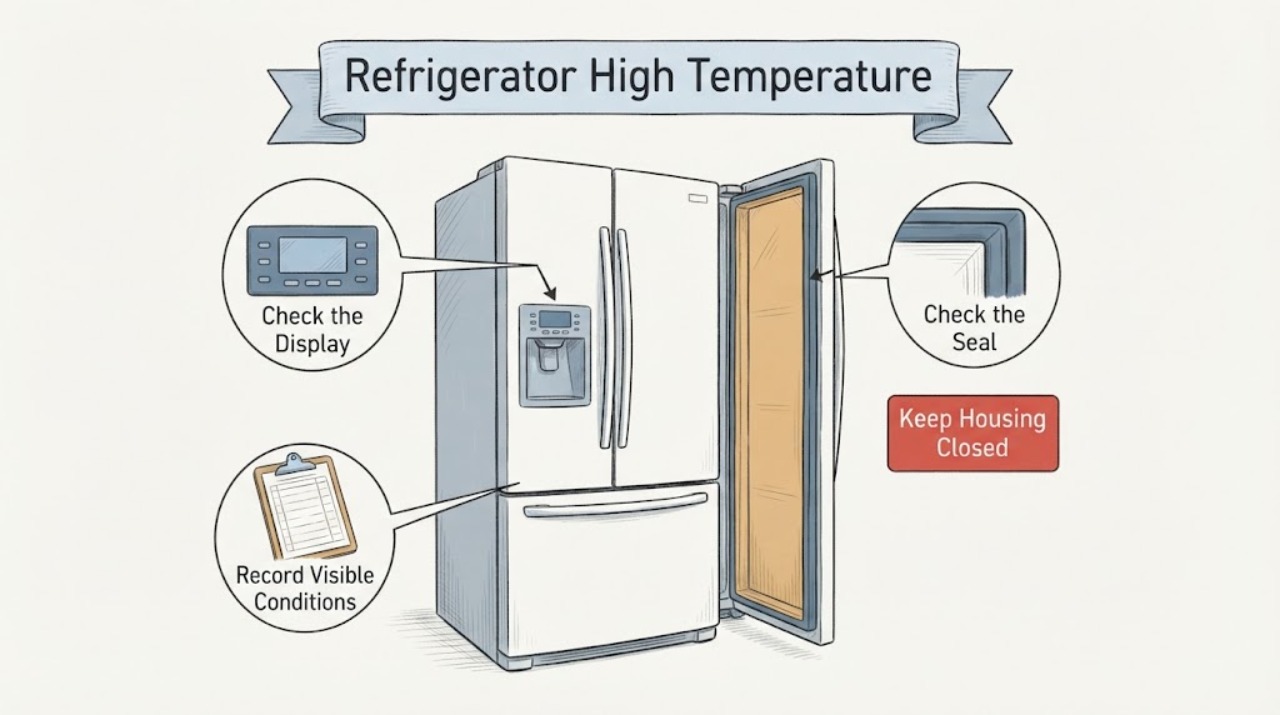
Work through in order
Diagnostic checks
Use only checks that match the exact appliance or system and its official guide.
-
Check 1
Place an appliance thermometer in the refrigerator compartment and another in the freezer if available, then record the readings, time and whether the display shows High Temp/H/HI or another alert. Keep the doors closed as much as possible while measuring.
Expected result: The refrigerator is at or below 40°F and the freezer is at or below 0°F, or one or both readings are above those food-safety targets.
Next step: If the reading is high, protect perishables in a known-safe refrigerator or cooler and continue only the external checks below. Do not use the display alone to decide that food is safe.
Why this matters
Why: An alert can remain after a temporary warm event, while a measured temperature above the FDA targets is an active food-safety concern regardless of whether the display has cleared.
-
Check 2
Check from outside that each refrigerator and freezer door or drawer closes fully, no container prevents closure, and the gasket is seated without a visible gap, tear or obstruction. Do not pull the gasket apart or remove door panels.
Expected result: A door was left open, a package blocks closure, or the gasket does not seal evenly; alternatively, the doors close and the gasket appears intact.
Next step: Close the door and leave it closed while monitoring the thermometer. If the gasket cannot seal or the temperature remains high, use the model manual/service path rather than adjusting hinges or removing panels.
Why this matters
Why: Frigidaire lists an extended open door and a poor door seal as high-temperature causes. A visually good seal does not prove the refrigeration system is working, but it removes one obvious external cause.
-
Check 3
Compare the displayed temperature settings with the exact Owner's Manual, and make sure food is not packed against visible interior air passages. For many electronically controlled Frigidaire models, the recommended starting settings are 37°F refrigerator and 0°F freezer; do not change settings repeatedly while the unit is stabilizing.
Expected result: The setting was changed, vents are blocked by food, or the model's settings and interior air path match the manual.
Next step: Restore only the setting and loading arrangement permitted by the manual, then allow the unit to stabilize while keeping the doors closed. If the measured temperature remains high, proceed to service escalation.
Why this matters
Why: Frigidaire identifies changed settings as a high-temp trigger and explains that blocked circulation or model-specific settings can affect temperature; the published values are guidance, not a substitute for the exact manual.
-
Check 4
Record whether the refrigerator was newly installed, recently lost power, or is in unusually hot surrounding conditions. Confirm the appliance has power and leave the doors closed while it recovers; do not unplug repeatedly or remove rear covers.
Expected result: The unit was installed within about 24 hours, recently lost power, is in a hot environment, or none of these conditions apply.
Next step: Allow the documented stabilization period with minimal door opening while protecting food. If the temperature does not recover or the alarm returns, arrange qualified service.
Why this matters
Why: Frigidaire says a new unit may take about 24 hours to stabilize, may take 8–12 hours to cool completely after power loss, and may work harder in hot surroundings. Those conditions can explain a temporary alarm but do not excuse a persistently high measured temperature.
-
Check 5
If the thermometer remains above a safe target, move perishable food to a known-safe cold location and record how long it may have been warm. Use the exact model manual for clearing the alert; Frigidaire documents Clear Alerts or a 30-second reset depending on model.
Expected result: Temperature returns to target and the alarm stays cleared, or the temperature remains high/alarm returns after the external checks.
Next step: Discard food according to FDA guidance when safety duration is uncertain, keep the refrigerator closed, and contact the installer or Frigidaire service for persistent high temperature. Do not open the sealed system or diagnose a compressor, refrigerant charge or control board yourself.
Why this matters
Why: A cleared alarm does not prove the cabinet is safe; persistent measured warmth indicates an unresolved cooling problem. FDA says not to rely on appearance or odor when the duration above safe temperature is unknown.
Use your observations
Decision map
Find the observation that best matches what you see, then follow the next safe action.
-
PATH 01Next step
What you see
The refrigerator was newly installed or recently lost power, the doors were kept closed, and the measured temperature is falling during the manufacturer's stabilization window.
Do this next
Keep the doors closed, monitor with an appliance thermometer and protect perishables. Arrange service if the measured temperature fails to recover or the alarm returns after stabilization.
Why this path and its safety boundary
Why it matters: Frigidaire says a new unit can take about 24 hours to stabilize and a unit after power loss normally takes 8–12 hours to cool completely; an alarm may persist until safe temperature returns.
-
PATH 02Next step
What you see
A door was left open, the gasket has a visible sealing problem, the temperature setting was changed, or food blocks an interior air passage.
Do this next
Correct the accessible cause according to the manual, keep the doors closed and verify with a thermometer. Move or discard food according to FDA temperature and time guidance.
Why this path and its safety boundary
Why it matters: These are external causes Frigidaire identifies for a high-temperature alarm or poor cooling, but a corrected door or setting does not guarantee that food was safe during the warm period.
-
PATH 03Next step
What you see
The display alarm can be acknowledged or cleared, but the measured refrigerator or freezer temperature remains above the food-safety target.
Do this next
Keep the doors closed, move perishables to a safe cold location and arrange service for the refrigerator. Do not repeatedly reset or open the sealed system.
Why this path and its safety boundary
Why it matters: The alert state and actual cabinet temperature disagree; clearing the display is not proof of safe cooling.
-
PATH 04Next step
What you see
The temperature remains high after external checks and stabilization, the high-temp alert returns, or there is burning odor, smoke, electrical damage, leaking fluid or repeated breaker tripping.
Do this next
Keep the unit out of service when a hazard is present, protect food, and contact qualified appliance service or the installer. Do not remove covers, bypass safety devices or work on the sealed refrigeration system.
Why this path and its safety boundary
Why it matters: The condition is beyond a user-level temperature or door check and may require model-specific refrigeration or electrical diagnosis.
Helpful context
Understand the symptom
Treat the alarm and the measured temperature as separate facts
Frigidaire's H/HI article says the high-temperature alert can show the highest temperature when first acknowledged. An alarm may follow a door left open or a setting change, but the display alone does not tell you whether food is still outside a safe storage temperature. Place an appliance thermometer in the refrigerator and freezer, record the reading and the time, and avoid opening the doors while the unit recovers.
Allow for model and installation differences
Frigidaire says a newly installed refrigerator can take about 24 hours to stabilize and recommends 37°F for the refrigerator and 0°F for the freezer for many electronically controlled models. The high-temperature alarm article also says settings and alert-clearing steps vary by model. Do not judge a refrigerator by compressor run time alone or borrow button sequences from another Frigidaire design.
Protect food while the cause is unresolved
FDA guidance recommends keeping the refrigerator at or below 40°F and the freezer at or below 0°F, using appliance thermometers and keeping doors closed during a power or cooling event. If you do not know how long perishables were above a safe temperature, do not rely on smell or appearance; follow the FDA discard guidance and move food to a safe refrigerator or cooler when possible.
When checks do not resolve it
Need a professional?
Contact the installer or Frigidaire service if the measured temperature remains high after the applicable stabilization period and external checks, the high-temperature alarm returns, the gasket cannot seal, or any next step requires a cover, electrical diagnosis or sealed-system work. Protect or discard food according to FDA temperature and time guidance.
Safety scope: Keep doors closed, protect perishable food, do not remove rear or control covers, do not open the sealed refrigeration system, do not bypass safety devices and do not repeatedly run a unit with smoke, burning odor, electrical damage or leaking fluid.
Have this ready
- Provide the full model and serial, refrigerator and freezer thermometer readings with times, display/alarm text, installation age, recent power loss, door/gasket findings, setting changes and any odor, smoke, leak or breaker symptoms.
Common questions
FAQ
What temperature should a Frigidaire refrigerator and freezer be?
Frigidaire commonly recommends 37°F for the refrigerator and 0°F for the freezer for electronically controlled models. FDA recommends keeping the refrigerator at or below 40°F and the freezer at or below 0°F for food safety; use an appliance thermometer because a control setting is not an actual temperature reading.
Can I clear a Frigidaire high-temperature alarm?
Depending on the model, Frigidaire says to press Clear Alerts or disconnect power for 30 seconds. Clearing the alert does not prove that the cabinet or food has returned to a safe temperature, so verify with an appliance thermometer and follow the exact Owner's Manual.
How long should a new Frigidaire refrigerator take to cool?
Frigidaire says a newly installed refrigerator can take about 24 hours to stabilize; after a power loss it normally takes 8–12 hours to cool completely and can take up to 24 hours to stabilize. Keep the doors closed and monitor actual temperature, then arrange service if it does not recover.
What should I do with food if the refrigerator was too warm?
Use an appliance thermometer and record the temperature and duration. FDA says not to rely on appearance or odor when the time above 40°F is uncertain; move food to a safe cold location and discard perishable food when the applicable temperature/time guidance is exceeded.
Read the exact guide
Official sources
- Refrigerator Error Code H or HI - High TemperatureFrigidaire · Opened Frigidaire's official high-temperature article. It applies to all refrigerators and supports the alarm behavior, open-door/setting/gasket causes, model-dependent alert clearing or 30-second reset, and installer/service boundary.
- Food and Water Safety During Power Outages and FloodsU.S. Food and Drug Administration · Opened FDA food-safety guidance. It supports appliance thermometers, keeping refrigerator doors closed, moving food to cold storage and discard decisions based on measured temperature and time.
- Refrigerator Runs Too MuchFrigidaire · Opened Frigidaire's official refrigerator run-time article. It supports 8–12 hour post-power cooling, up to 24-hour stabilization, hot-environment effects, open-door effects and temperature-setting context; it does not diagnose an internal part.
- Refrigerator Thermometers - Cold Facts about Food SafetyU.S. Food and Drug Administration · Opened FDA consumer food-safety guidance. It recommends appliance thermometers, refrigerator temperature at or below 40°F and freezer at or below 0°F, and says not to rely on appearance or odor when warm duration is uncertain.
- What do the alarms or error messages mean on my French-Door refrigerator?Frigidaire · Opened Frigidaire's official refrigerator alarm guide. It covers French Door, Side by Side and Top Freezer refrigerators, warns that manuals vary by model, and describes high-temperature thresholds and door/power causes.
- Refrigerators - What is the recommended temperature settings for my refrigerator?Frigidaire · Opened Frigidaire's official temperature-settings article. It covers refrigerator families, says a new unit can take about 24 hours to stabilize, and gives model-family setting guidance including 37°F/0°F and a multi-door 39°F fresh-food setting.
Community feedback
Share a repair observation
Share a plain-text repair observation. Accepted observations are published automatically; this page may take a moment to update.