
On this page
Start here
Quick answer
White particles that look like calcium or minerals in ice from a Frigidaire FGHB2868TD do not, by themselves, prove that the ice maker has failed. This model's Frigidaire support page identifies a fresh-food ice maker and the EPTWFU01C water-and-ice filter. First discard the suspect ice, compare a fresh glass of dispenser water with ice made in a clean, dry bin, and note whether the particles follow the water or stay on the bin and chute. If the filter was recently changed or the water system sat unused, use Frigidaire's prime-and-purge procedure and discard the specified initial water and ice. Do not mix cleaning chemicals, disconnect the water line, or make a health diagnosis from the appearance alone; if particles persist, the water quality is unknown, or there is a leak, stop consuming the ice and arrange filter, water-source, or appliance-service verification.
Before you begin
Safety first
- Do not consume suspect water or ice, mix cleaning chemicals, disconnect a pressurized water line, open the cabinet, reach into moving ice-maker parts, or perform electrical or sealed-system testing.
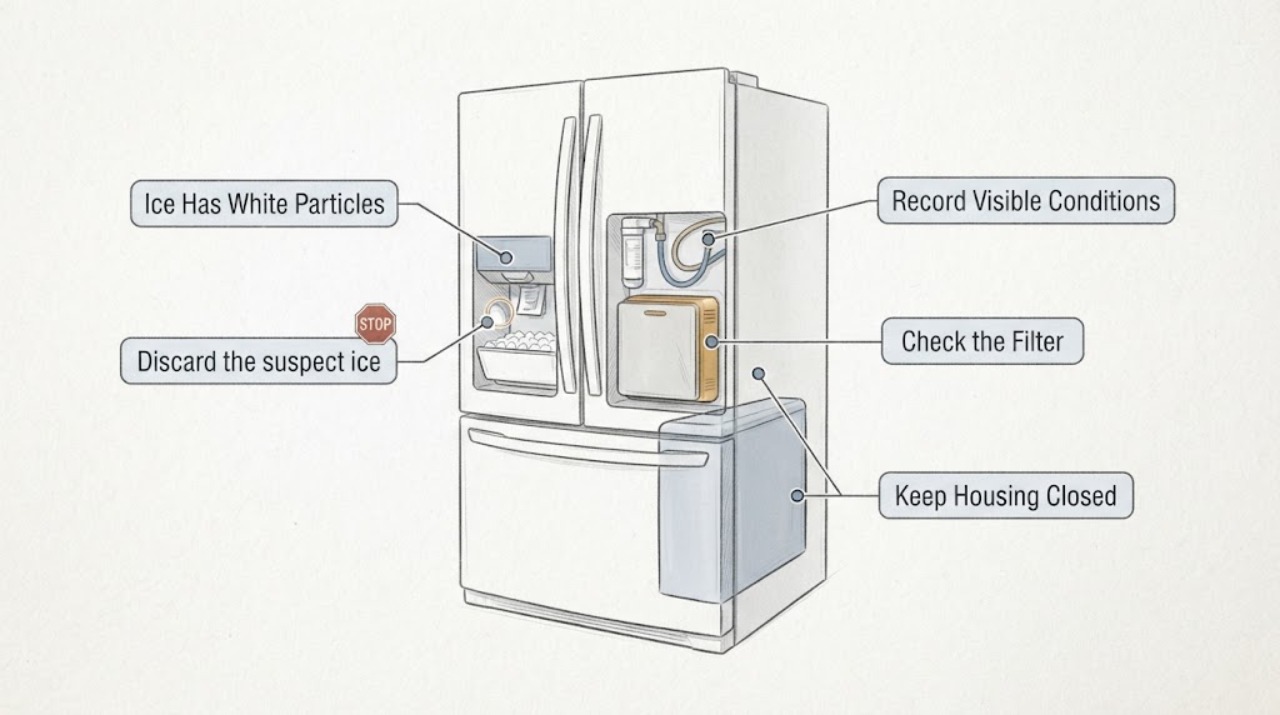
Work through in order
Diagnostic checks
Use only checks that match the exact appliance or system and its official guide.
-
Check 1
Confirm the rating-plate identity as FGHB2868TD and record the filter marking before following model-specific instructions; do not substitute a different Frigidaire model because the cabinet looks similar.
Expected result: The label matches FGHB2868TD, the installed filter is marked EPTWFU01C or its exact approved replacement, and the ice maker is in the fresh-food section; or the model/filter identity does not match.
Next step: If the identity matches, continue with the water-versus-bin comparison. If it does not, stop model-specific conclusions and obtain the complete model and local-market guide.
Why this matters
Why: The opened Frigidaire support page ties this model to its fresh-food ice maker and EPTWFU01C filter. A mismatch means the exact manual and filter path must be re-established before interpreting particles or changing a filter.
-
Check 2
Discard the suspect ice and dispense fresh water into a clean, clear glass; compare a small sample of that water with newly made ice from a clean, dry bin, without tasting either sample.
Expected result: The white material is visible in the dispenser water and the ice, or the water is clear while particles appear only on ice, the bin, or the chute.
Next step: Keep suspect ice discarded. If the water is also affected or its quality is unknown, stop consuming refrigerator water and ice until the filter and water source are verified; if only the bin is affected, clean the accessible bin path before judging new ice.
Why this matters
Why: Material in both samples points the investigation toward the incoming water, filter path, or water-system residue; material only on the ice side makes removable bin or chute residue and old ice more plausible. Appearance alone does not establish calcium content, contamination, or an appliance failure.
-
Check 3
If the refrigerator was newly installed, the filter was changed, or the water system sat unused, prime and purge it using Frigidaire's opened guide: dispense until water arrives, continue until flow is steady, and discard the guide's initial amount rather than saving it for drinking.
Expected result: Water initially sputters or flows unevenly and the particles or appearance change diminishes after purging; or steady flow and fresh batches remain affected.
Next step: For a new installation, discard at least the guide's one-gallon amount; for a new filter, discard the guide's stated 3–5 tall glasses, then discard the first one or two ice containers after installation or filter change. If particles persist, do not repeatedly cycle the maker; arrange filter or water-source verification.
Why this matters
Why: Frigidaire says trapped air after installation or a filter change can cause uneven flow, discoloration, odd flavor, and two or three empty ice cycles. Persistence after a correct purge is not proof of a failed ice-maker component; it keeps filter, source-water, and service checks in scope.
-
Check 4
With the refrigerator operating normally and no need to reach into moving parts, remove only the accessible ice bin as the model instructions permit; wash the bin and accessible chute surfaces with warm soapy water and a soft cloth, then dry completely before reinstalling.
Expected result: A white film or granules are found on the bin or chute and disappear after cleaning, or the bin and accessible surfaces are clean while fresh ice remains affected.
Next step: Discard old or suspect ice and monitor only fresh batches from the dry, correctly seated bin. Do not put removable items in a dishwasher unless the exact model guide allows it, and do not use bleach, ammonia, mixed chemicals, knives, heat, or cabinet disassembly.
Why this matters
Why: Residue limited to the bin or chute supports a local ice-storage or dispensing-path explanation rather than proving a water-system fault. A clean bin with recurring particles in fresh ice shifts attention back to water, filter, or source verification.
-
Check 5
Visually check the filter label, seating, indicator status, and any externally visible water-line kink or damp connection; do not disconnect the line, pull the refrigerator beyond its tubing, or bypass the filter as a diagnostic experiment.
Expected result: The filter is overdue, not seated, visibly damaged, or recently replaced; the external line is kinked or wet; or the filter and visible line appear sound.
Next step: Use only the exact FGHB2868TD filter instructions for reseating or replacement, then perform the official purge. For a damaged filter, leak, or unresolved particles after a correct filter and purge, stop consuming the affected water and ice and arrange service or water-source verification.
Why this matters
Why: Filter history and visible water-path conditions can explain changed water or ice appearance, but none of these observations identifies a valve, ice-maker assembly, or other internal part. A wet connection is a leak risk, not a reason to keep testing.
-
Check 6
Check the context of the ice itself: compare a freshly made batch with old ice and note whether uncovered food, a stale bin, or refrigerator odors are present; do not treat taste or smell as a medical finding.
Expected result: Only old ice or ice stored near uncovered food has an odd taste or odor, or the issue is present in fresh ice and dispenser water as well.
Next step: Discard stale or suspect ice, cover food, and follow the exact purge guidance after a filter change. If the fresh water sample remains affected, do not consume it while arranging verification.
Why this matters
Why: Frigidaire notes that ice can absorb odors from uncovered food and that old ice can taste stale; it also notes initial plastic-line or new-filter effects. A persistent visible-particle issue in fresh water and ice needs source/filter review rather than an odor explanation.
Use your observations
Decision map
Find the observation that best matches what you see, then follow the next safe action.
-
PATH 01Next step
What you see
Particles are present in both freshly dispensed water and fresh ice, especially after a filter change or long idle period, and diminish after the model-appropriate purge and initial discard.
Do this next
Use only clear water and fresh ice after the official purge/discard amounts. If the issue returns, stop consuming it and have the filter and source water checked.
Why this path and its safety boundary
Why it matters: A water-system or filter-history explanation is more consistent than a failed ice-maker conclusion, while the particle composition remains unconfirmed.
-
PATH 02Next step
What you see
The water sample is clear, but particles are found on the old ice, removable bin, or chute and disappear after the bin is washed, dried, and correctly seated.
Do this next
Discard the old ice, keep the bin dry and clean, and monitor a new batch. Escalate if particles recur in fresh ice despite a clean bin.
Why this path and its safety boundary
Why it matters: Local storage or dispensing-path residue is more likely than material entering through the water supply.
-
PATH 03Next step
What you see
Particles remain in fresh water and ice after an exact purge, initial ice discard, clean dry bin, and correct filter seating, or the filter is damaged or a connection is wet.
Do this next
Stop consuming the affected refrigerator water and ice, protect the area from leaks, and contact the water provider/filter support or a qualified appliance technician with the model and samples/photos. Do not disassemble the water path.
Why this path and its safety boundary
Why it matters: The safe next question is filter/source-water or appliance-service verification; the observation does not justify naming a failed valve, ice maker, or control.
-
PATH 04Next step
What you see
Only an odd taste or odor is present, with no visible particles in fresh water or ice, and the refrigerator or filter is new or food has been left uncovered.
Do this next
Follow the purge and discard guidance, discard old ice, cover food, and check the accessible air-filter condition if equipped. Stop consuming it and seek water verification if the issue persists or the source is unknown.
Why this path and its safety boundary
Why it matters: Frigidaire's guidance makes initial line/filter effects, stale ice, or food odor plausible without establishing an appliance fault.
-
PATH 05Next step
What you see
There is a leak, a cracked or loose filter, water near electrical controls, an exposed/damaged tube, or the water source is unknown or not confirmed suitable for drinking.
Do this next
Stop using the dispenser and ice maker; isolate water or power only if it can be done safely without moving covers or touching wet electrical areas, and arrange qualified service or water-source assistance.
Why this path and its safety boundary
Why it matters: This is a water-damage and safety boundary, not a routine ice-quality adjustment.
Helpful context
Understand the symptom
What this model-specific symptom means
Frigidaire lists FGHB2868TD as a Gallery French-door refrigerator with a fresh-food ice maker and an EPTWFU01C water-and-ice filter. The report of white particles is an observation, not a confirmed mineral composition or an appliance diagnosis. The useful first separation is whether the same material is visible in freshly dispensed water, or only on old ice, the removable bin, or the accessible chute.
Use the water and ice history
A recent filter change, first use after installation, or long idle period can leave air or initial taste and appearance changes that Frigidaire addresses with priming, purging, and discarding early water or ice. If clear water and a clean dry bin still produce fresh particles after that procedure, keep the distinction open: check the filter and water source rather than assuming the ice maker or a particular internal part is defective.
Keep cleaning within the manual's boundary
Clean only removable, accessible bin surfaces with warm soapy water and a soft cloth, then dry them fully. Keep water away from controls and electrical areas, do not mix bleach, ammonia, or other cleaners, and do not disconnect a pressurized water line or open the refrigerator cabinet. Suspect ice or water should not be consumed while the source remains unresolved.
When checks do not resolve it
Need a professional?
Arrange appliance service or filter/water-source verification when particles persist in fresh water or ice after the exact purge and clean-bin check, when the filter is damaged or will not seat, when an external connection leaks, or when the refrigerator has an unresolved water or electrical safety condition.
Safety scope: Do not consume suspect water or ice, mix cleaning chemicals, disconnect a pressurized water line, open the cabinet, reach into moving ice-maker parts, or perform electrical or sealed-system testing.
Have this ready
- Provide the complete model FGHB2868TD, local market, filter label and change history, whether particles appear in dispenser water or only ice, photos of the material and bin/chute, purge amount completed, and any leak or water-quality observations.
Common questions
FAQ
Do white particles prove that the ice maker is broken?
No. For FGHB2868TD, first determine whether the same material appears in dispenser water or only on the ice bin and chute. The appearance alone does not confirm mineral composition or an appliance failure.
Should I keep using the ice while I investigate?
No—discard suspect ice. If fresh dispenser water is also affected or the water source is unknown, stop consuming refrigerator water and ice until the filter and source are verified.
What cleaning is supported without opening the refrigerator?
Frigidaire's care guidance supports warm soapy water and a soft cloth for accessible bin and interior surfaces, with thorough drying. Do not mix cleaners, use heat or sharp tools, disconnect water tubing, or remove electrical covers.
Read the exact guide
Official sources
- Refrigerator Taste and Odor GuideFrigidaire · Frigidaire consumer guidance for new-line, new-filter, stale-ice and food-odor observations; it does not identify the composition or health significance of visible particles.
- Refrigerator Clean and Care GuideFrigidaire · Frigidaire refrigerator cleaning guidance for accessible interior, bins, gaskets and surfaces; do not extend it to cabinet or water-line disassembly.
- Refrigerator Prime and Purge GuideFrigidaire · Frigidaire refrigerator consumer guide; exact FGHB2868TD controls and filter instructions remain controlling where they differ.
- Product Support: Frigidaire Gallery 26.8 Cu. Ft. French Door Refrigerator Black Stainless Steel-FGHB2868TDFrigidaire Canada · Exact FGHB2868TD product-support page in the Canada market; use the complete rating-plate identity and local guide before applying model-specific instructions.
Community feedback
Share a repair observation
Share a plain-text repair observation. Accepted observations are published automatically; this page may take a moment to update.