
On this page
Start here
Quick answer
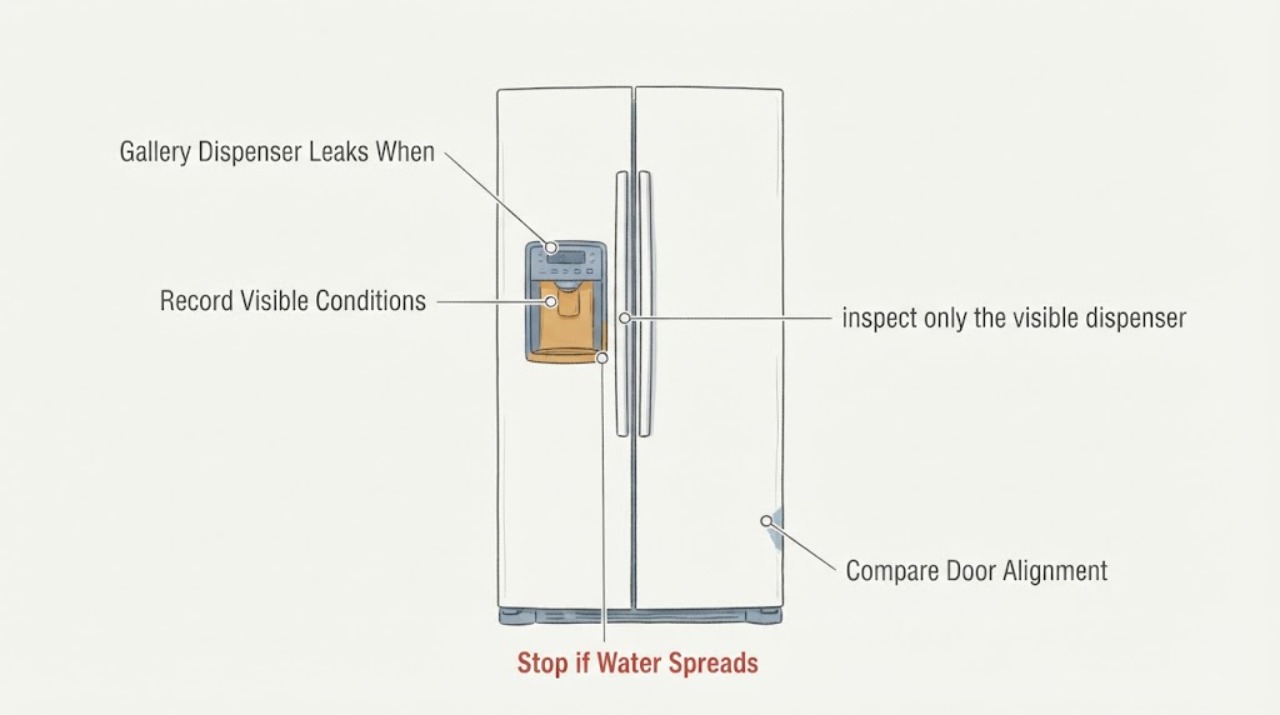
A Frigidaire dispenser that leaks only when its door opens past halfway is a door-movement-triggered leak, not the same decision as a dispenser that drips continuously. This pattern makes the dispenser tip, chute, door-area water path, or a line that is stressed as the door moves more likely, but it does not prove which part is cracked. Keep the water feature off while you inspect, photograph the first wet point, compare the symptom at closed, slightly open, and fully open positions without removing hinge covers, and check only visible frost, filter, door alignment, and rear connections. Frigidaire says ice or frost in the chute and air in the water line can cause dispenser leaks, and directs owners to service when the accessible checks do not resolve the issue. Do not pull the door apart, disconnect tubing, or order a door water line by appearance alone.
Before you begin
Safety first
- Owner checks are limited to disabling the water feature, drying the visible area, observing the leak angle, inspecting the visible tip/chute, checking the door's ordinary movement, verifying a model-approved filter/prime procedure, and checking accessible rear connections. Do not remove hinge or dispenser covers, disconnect tubing, pull the refrigerator by its water line, or open door panels.
Work through in order
Diagnostic checks
Use only checks that match the exact appliance or system and its official guide.
-
Check 1
Stop dispensing water and making ice using the model-authorized control if it is safe to do so. Wipe the visible spill and place a dry towel under the dispenser area. Record whether the leak appears with the door closed, slightly open, or only after the dispenser door reaches a wide-open position; do not repeatedly trigger the leak to measure it.
Expected result: The dispenser tip is already wet with the door closed; water appears only during a wide door opening; water runs from the chute or door edge; or no new water appears after the area is dried.
Next step: Keep the water feature off and continue with the matching external check. If the first wet point is inside the door, behind trim, or inaccessible, document it and arrange qualified Frigidaire service rather than opening the door.
Stop if: Stop immediately if water reaches wiring, the outlet, a hot cabinet, or another electrical area.
Why this matters
Why: A closed-door drip fits Frigidaire's dispenser-tip or water-line checks. A leak that begins only with door travel is a movement-dependent clue for the door/dispenser path, but the visible water may still originate higher in the door or inside the dispenser assembly.
-
Check 2
With the door in its normal closed position, inspect only the visible dispenser tip, drip area, and chute opening for a droplet, frost, or ice. Look from outside; do not insert tools or reach into the chute. If frost is plainly accessible, follow the exact model manual's safe chute-care instruction without applying direct heat.
Expected result: Ice or frost is visible in or around the chute; the dispenser tip remains wet with the door closed; or the chute and tip are dry until the door opens wide.
Next step: Use only the model manual's accessible chute or dispenser care. If the tip drips while closed, the chute remains blocked, or the leak returns, keep the water feature off and arrange service.
Stop if: Do not push ice into the dispenser, pry the chute flap, use a heat gun or hair dryer, or touch dispenser wiring or a moving auger.
Why this matters
Why: Frigidaire says ice in the door or chute can melt and leak down the chute, while droplets at the dispenser tip can result from air in the water line. A dry tip and chute until wide door travel makes a door-movement water-path issue more likely, but does not identify the exact tube or assembly.
-
Check 3
Move the dispenser door slowly through its ordinary range without removing any cover. From outside, check whether the refrigerator door is level, rubs the upper hinge, binds, or has a damaged or obstructed gasket; compare the exact opening angle at which the leak starts. Do not adjust hinge screws unless the exact manual explicitly covers the model.
Expected result: The door contacts or binds near full opening; the opening angle is repeatable; the door and gasket move freely; or the leak occurs at a different angle each time.
Next step: Do not force the door or attempt to realign an unknown Gallery model. Photograph the hinge/door area and provide the trigger angle to service; keep water and ice features off if the door movement produces water.
Stop if: Do not remove hinge covers, pull the door, disconnect a tube, or reach near door wiring.
Why this matters
Why: Frigidaire's door-alignment guidance requires checking the door through full movement and confirming it does not contact the upper hinge. A repeatable angle strengthens the inference that door travel stresses a dispenser or door-area water path; an inconsistent angle weakens that inference and keeps other dispenser causes open.
-
Check 4
If the filter was recently changed or the refrigerator was newly installed, verify only from the exact manual that the filter is seated and not visibly cracked. If the model's manual permits priming, complete that procedure with a container under the dispenser, then dry the tip and reassess without opening the door unusually wide.
Expected result: The filter is loose, cracked, or newly installed; the dispenser flow is uneven or full of air; priming stops the drip; or the door-angle leak remains after filter and priming conditions are normal.
Next step: Use only an exact compatible filter and the model's priming instructions. If the filter leaks, cannot seat, or the door-angle trigger remains, stop the water feature and schedule service; do not substitute a generic tube or valve.
Stop if: Do not force a stuck filter, disconnect the water line, dispense into an active leak, or use an unconfirmed replacement part.
Why this matters
Why: Frigidaire says an incorrectly installed or cracked filter can leak and that air in new plumbing can cause uneven dispenser flow. A leak that survives a correct filter and documented prime, while still tracking door angle, is less consistent with trapped air alone.
-
Check 5
From a dry, safe position, inspect the accessible rear water connections and valve with a dry paper towel only if doing so does not require pulling the refrigerator through the door leak or straining its line. Also note whether water reaches the floor or cabinet base. Do not disconnect tubing or open a rear panel.
Expected result: The rear towel becomes wet; the rear area stays dry while the dispenser door area wets at a repeatable angle; water pools below the cabinet; or water is near an outlet, cord, or control.
Next step: For a wet rear connection or floor leak, close the accessible water shutoff only if it operates normally and arrange appliance or plumbing service. For a dry rear area with the door-angle pattern, keep the water feature off and arrange Frigidaire service with photos and the exact model.
Stop if: Do not pull the refrigerator by its water line, retighten an unfamiliar fitting, touch wet electrical parts, or continue a pressurized leak.
Why this matters
Why: Frigidaire identifies loose rear connections as a source of floor leaks. A dry rear area combined with a door-angle-only dispenser leak makes a door/dispenser path more likely, but internal tubing and dispenser components still require model-specific diagnosis.
Use your observations
Decision map
Find the observation that best matches what you see, then follow the next safe action.
-
PATH 01Next step
What you see
The rear connections stay dry, the dispenser tip and chute are dry with the door closed, and water begins at a repeatable point only when the dispenser door opens past halfway.
Do this next
Keep water and ice features off, do not remove hinge or dispenser covers, and arrange qualified Frigidaire service. Provide the exact model, opening angle, first wet point, and photographs.
Why this path and its safety boundary
Why it matters: The door-angle trigger makes a movement-dependent door/dispenser water path more likely than a simple rear connection or continuous tip drip. This is a symptom inference, not proof of a cracked tube or a specific door assembly.
-
PATH 02Next step
What you see
The dispenser tip is wet or dripping with the door closed, or the symptom began after a filter change or new installation and the flow is uneven.
Do this next
Check the exact model filter installation and complete the documented priming procedure if applicable. Stop and arrange service if the tip still drips, the filter leaks, or the water path cannot be confirmed.
Why this path and its safety boundary
Why it matters: Frigidaire's guidance makes air in the water line, an improperly seated or cracked filter, or a dispenser-path issue more likely than a door-angle-only fault.
-
PATH 03Next step
What you see
Ice or frost is visible in the chute or door area, and water follows the chute rather than appearing from a rear connection.
Do this next
Follow only the exact manual's accessible chute or ice-bin care, keep the area dry, and arrange service if frost, dripping, or door closure problems return.
Why this path and its safety boundary
Why it matters: Frigidaire identifies ice or frost in the door/chute as a possible source of meltwater that runs through the dispenser path.
-
PATH 04Next step
What you see
A rear connection or valve is wet, water pools below the refrigerator, the door movement is abnormal, or water reaches an electrical area.
Do this next
Stop using the water feature, close the accessible water shutoff only if safe, and arrange qualified appliance or plumbing service. Isolate electrical power only from a dry safe position and obtain qualified electrical help for wet or damaged connections.
Why this path and its safety boundary
Why it matters: This is an external supply, plumbing, door-alignment, or electrical-safety path; a dispenser-only adjustment cannot certify it safe.
Helpful context
Understand the symptom
A leak that appears only after the dispenser door swings past halfway is valuable timing information. It points to a component or water path affected by door movement more than to a rear supply connection that would normally leak regardless of door angle. That is an inference from the symptom, not a confirmed diagnosis: the wet point could still be the dispenser tip, chute, trapped water, filter-related line pressure, or a door-area tube on the exact model. Frigidaire's public leak guidance does not authorize opening the door or hinge to identify it.
Start with the water feature off and the floor dry. Observe where water first appears, whether the dispenser tip is wet with the door closed, whether frost or ice is visible in the chute, and whether the door contacts or binds at full travel. If the rear connections stay dry but the dispenser area wets only at a wide opening, preserve that pattern for service rather than installing a generic tube, valve, filter, or door assembly.
Only after diagnosis
Potential parts
- door-dispenser water line or dispenser assembly
The door-angle-only trigger makes a movement-dependent door/dispenser path plausible, but the opened official guidance does not confirm a universal component or fit for Gallery models.
Use the complete model and serial and a technician's diagnosis. Do not order a tube, valve, filter, or door assembly by appearance or symptom alone.
When checks do not resolve it
Need a professional?
Contact Frigidaire or qualified appliance/plumbing service for a repeatable door-angle leak, an inaccessible door water path, wet rear connections, a damaged filter, persistent chute drip, abnormal door alignment, or any active leak near electrical parts.
Safety scope: Owner checks are limited to disabling the water feature, drying the visible area, observing the leak angle, inspecting the visible tip/chute, checking the door's ordinary movement, verifying a model-approved filter/prime procedure, and checking accessible rear connections. Do not remove hinge or dispenser covers, disconnect tubing, pull the refrigerator by its water line, or open door panels.
Have this ready
- Provide the complete model and serial, Gallery or other series identification, side/door containing the dispenser, exact angle at which water starts, first wet point, whether the tip drips with the door closed, filter and prime history, photographs, rear-connection result, and any water near electrics.
Common questions
FAQ
Why does my Frigidaire water dispenser leak only when the door opens wide?
The repeatable door-angle trigger makes a movement-dependent door or dispenser water path more likely than a rear connection, but it does not identify a specific cracked tube or door assembly. Keep the water feature off, document the first wet point and angle, and arrange model-specific service if the tip and rear checks are dry.
Could air in the Frigidaire water line cause this leak?
Frigidaire says air in the water line can cause dripping at the dispenser tip, especially after installation or water-system work. If the tip stays dry with the door closed and the leak starts only at a wide opening after correct priming, air alone is less consistent with the observed pattern and service is the safer next step.
Should I replace the water line or inlet valve first?
No. Frigidaire's public guidance supports checking the filter, dispenser tip/chute, priming, and rear connections, but the door-angle symptom does not prove a line or valve. Confirm the exact model and have the leak reproduced and diagnosed before ordering a part.
Can I remove the top hinge cover to inspect the tube?
Do not remove the hinge or door trim as a first user check. Observe the door's ordinary travel and visible alignment only. A water path inside the door or behind trim should be inspected by qualified service with the water feature disabled.
Read the exact guide
Official sources
- Refrigerator Water LeaksFrigidaire · The opened official refrigerator guide supports checking rear connections, filter installation/cracks, door-open frost, dispenser chute ice/frost, dispenser-tip droplets, and service escalation. It does not identify a universal door-angle-specific part.
- Refrigerators - How to align doorsFrigidaire · The opened official door-alignment guide applies to supported side-by-side, French-door, and four-door refrigerators and supports observing full door travel and upper-hinge contact; it does not authorize opening a dispenser water path.
- Refrigerators - What does it mean to ‘Prime the Water Supply System’ and why is it important for my refrigerator?Frigidaire · The opened official guide supports model-appropriate priming for trapped air and uneven initial dispenser flow; it does not establish that priming repairs a door-angle leak.
Community feedback
Share a repair observation
Share a plain-text repair observation. Accepted observations are published automatically; this page may take a moment to update.