
On this page
Start here
Quick answer
On the Bosch B36CL80SNS, do not assume well water is the cause of a leaking dispenser. First stop dispensing, dry the area, and determine whether the water appears only immediately after dispensing or continues while idle. Bosch's B36CL.. manual identifies trapped air after a filter change or connection, a blocked filter, low or high supply pressure, a kinked hose, and a loose water connection as different paths. Use the model-approved filter and flush procedure, but stop using the water system and close the accessible shut-off valve if a joint, filter housing, door tube, base, floor, or electrical area stays wet. A leak that cannot be located safely needs service.
Before you begin
Safety first
- Do not treat well water as a diagnosis, change pressure settings, disconnect pressurized tubing, force a filter, pull door tubing, move the refrigerator, remove panels, or work near live electrical parts. Keep dispensing and ice production off while leaking.
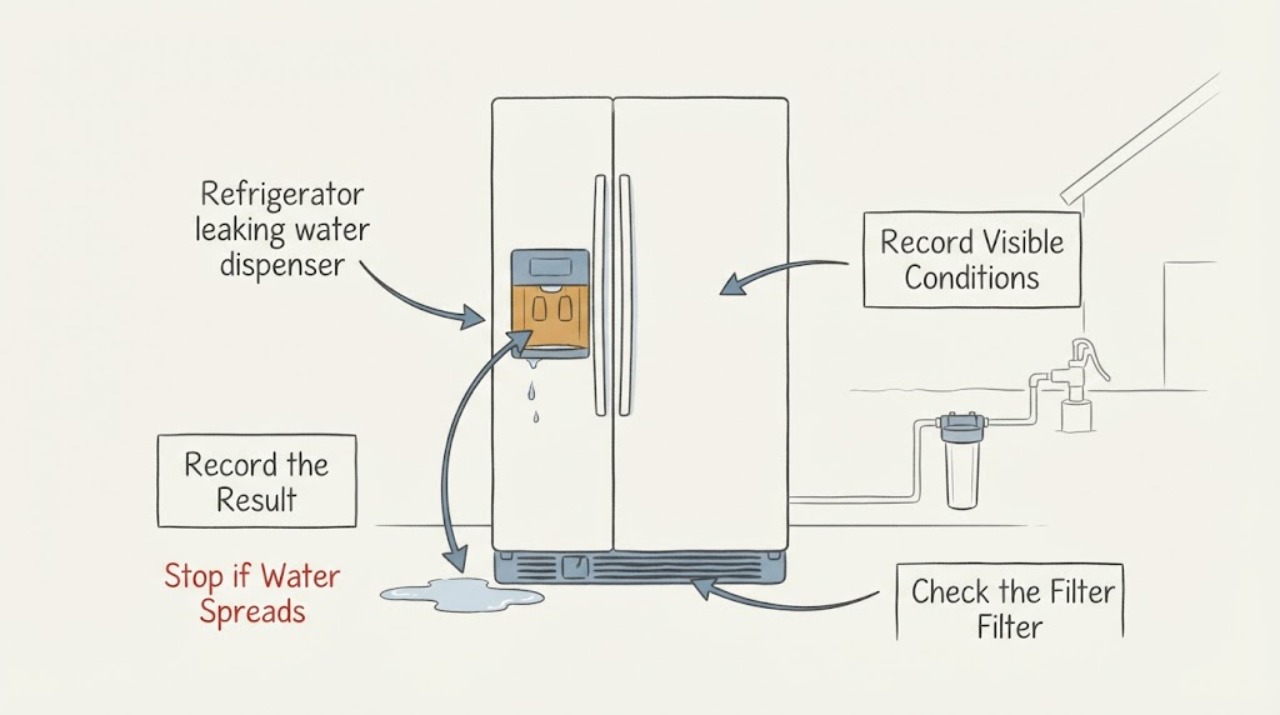
Work through in order
Diagnostic checks
Use only checks that match the exact appliance or system and its official guide.
-
Check 1
Stop the water dispenser and ice maker, dry the accessible dispenser area and floor, and place a dry towel or shallow container where a new drop can be seen without moving the refrigerator. Record whether water returns while idle, only after dispensing, after ice production, or after a filter change.
Expected result: Only a few drops appear immediately after dispensing, a steady drip returns while idle, water appears at the filter or door area, or the floor becomes wet without dispenser use.
Next step: Keep the water system off until the source is clear. Treat a continuing drip, base leak, or unexplained floor water as a service boundary rather than continuing dispenser tests.
Stop if: Do not touch wet electrical areas, pull the refrigerator, or continue dispensing onto a wet floor.
Why this matters
Why: Timing separates residual water or air in the dispenser path from a continuing supply, filter, door-tube, drain, or concealed leak. Well water alone does not distinguish these causes.
-
Check 2
From a dry, well-lit position, inspect the visible filter housing, dispenser outlet, door water-tube area, and accessible supply connection for moisture, a displaced filter, a kink, or damage. Do not loosen a fitting, pull tubing, or remove a panel.
Expected result: Moisture appears at the filter or connection, the filter was recently changed, a hose is kinked or damaged, or all visible connections remain dry.
Next step: Close the accessible water shut-off valve if it moves normally and a connection is leaking. Keep the water system off and arrange service for damaged tubing, a hidden leak, or any connection that cannot be safely inspected.
Stop if: Do not disconnect pressurized tubing, overtighten a fitting, force the filter, or pull the door water tube.
Why this matters
Why: A wet filter or connection supports a seating or supply-path problem; a recent filter change can also leave air in the water system. A dry exterior shifts the issue toward a concealed path, but does not prove an internal part failure.
-
Check 3
If the filter was recently replaced and no connection is actively leaking, follow the B36CL.. manual's filter procedure: confirm the filter or bypass cap is fully seated, wipe drips dry, and dispense until air bubbles are gone. Discard the flush water as the manual directs; do not substitute an unverified cartridge.
Expected result: Air bubbles and a brief drip stop after the approved flush, the filter remains wet or will not seat, or dripping continues after air is gone.
Next step: Stop dispensing if the filter housing remains wet or the drip continues. Use the Bosch model lookup for the full E-Nr and arrange service rather than forcing or modifying the cartridge.
Stop if: Do not use an incompatible filter, remove a pressurized filter carelessly, or keep flushing a visible leak.
Why this matters
Why: Bosch says air can remain after a new filter or connection and that a blocked filter can reduce output. A continuing leak after air removal points away from ordinary post-filter air and toward seating, hose, pressure, or concealed leakage.
-
Check 4
Treat the well-water and filtration setup as a pressure and filtration variable, not as a confirmed fault. Without opening the water line, note whether an external filter or reverse-osmosis system is upstream, whether dispenser flow is weak as well as wet, and whether the leak began after filter maintenance or a supply change.
Expected result: Flow is weak with the leak, an external filter or reverse-osmosis system is present, water pressure has recently changed, or the leak occurs with normal flow and no recent change.
Next step: Have the well-water filtration and refrigerator pressure checked by an installer or appliance technician. Do not alter a pressure regulator or bypass filtration merely to keep using a leaking dispenser.
Stop if: Do not change pressure settings, disconnect the external filter, or work on the supply line while it is pressurized.
Why this matters
Why: Bosch states that water pressure and an external filter system can impair water output, while a blocked internal filter can also reduce flow. These observations cannot identify a valve, filter head, or tubing part by themselves.
-
Check 5
If the leak continues while idle, appears at the base or behind the cabinet, reaches the floor or electrical area, or cannot be located from the outside, document the B36CL80SNS model, timing, filter history, water-system setup, and photos from a dry position.
Expected result: The source remains hidden or several areas become wet, or the leak stops after a clearly approved filter flush with no recurring moisture.
Next step: Keep dispensing and ice production off, close the water supply if safe, protect the floor and nearby electrical equipment, and arrange Bosch-authorized or qualified service. Do not move the refrigerator or remove panels.
Stop if: Do not operate a refrigerator with water reaching electrical parts, cut tubing, open sealed refrigeration areas, or restore power to a wet outlet.
Why this matters
Why: A hidden or recurring leak has reached the ordinary-access boundary; the water could involve a concealed connection, valve, pan, door tube, or internal water path. A one-time dry result after the exact filter procedure is different from a continuing leak.
Use your observations
Decision map
Find the observation that best matches what you see, then follow the next safe action.
-
PATH 01Next step
What you see
Only a small amount of water appears immediately after dispensing, stops after the approved air-removal flush, and no moisture returns while idle.
Do this next
Keep the area dry and monitor. Escalate if the amount increases, continues after dispensing, or appears at the filter, door, base, or floor.
Why this path and its safety boundary
Why it matters: Residual water or air in the dispenser path is more likely than a continuous supply leak, and well water is not established as the cause.
-
PATH 02Next step
What you see
The filter housing or visible connection becomes wet after a filter change, the filter will not seat, or a hose is kinked or damaged.
Do this next
Stop dispensing, close the water valve if safe, and use the full E-Nr in Bosch's filter/service lookup. Arrange service for a damaged hose or recurring wet joint; do not force the filter or fitting.
Why this path and its safety boundary
Why it matters: Filter seating or the visible supply path is more likely than a well-water quality issue, but the exact compatible filter and connection still need confirmation.
-
PATH 03Next step
What you see
Dispenser flow is weak and an external well-water filter or reverse-osmosis system is present, but there is no continuing leak at the refrigerator connection.
Do this next
Have the supply pressure and filtration system checked by an installer or qualified technician. Do not bypass or modify the system solely to increase flow.
Why this path and its safety boundary
Why it matters: Reduced pressure or filtration restriction is plausible, but the external system and the refrigerator filter must be assessed separately; neither is proven by the leak report alone.
-
PATH 04Next step
What you see
Water returns while the refrigerator is idle, appears behind the cabinet or base, reaches electrical equipment or flooring, or remains after the filter procedure.
Do this next
Keep the water system off, close the accessible shut-off valve, protect the floor, isolate power only from a dry safe position if necessary, and arrange Bosch-authorized service. Do not move or disassemble the refrigerator.
Why this path and its safety boundary
Why it matters: A concealed water-path, connection, valve, pan, or tubing fault remains possible and is outside safe dispenser troubleshooting.
Helpful context
Understand the symptom
Well water is a clue, not a diagnosis
A well-water or external-filtration setup can change pressure and sediment exposure, but it does not prove that the refrigerator or filter is defective. The deciding observation is where and when the water starts: a few drops at the dispenser after use, a leak after filter work, a continuous drip while idle, or water appearing at the base or inside the cabinet.
When checks do not resolve it
Need a professional?
Arrange Bosch-authorized or qualified appliance service when the B36CL80SNS dispenser continues to drip after the approved filter and air check, when water appears at the base, door, rear connection, floor, or electrical area, or when the source requires moving the refrigerator or opening a panel.
Safety scope: Do not treat well water as a diagnosis, change pressure settings, disconnect pressurized tubing, force a filter, pull door tubing, move the refrigerator, remove panels, or work near live electrical parts. Keep dispensing and ice production off while leaking.
Common questions
FAQ
Is well water itself causing the Bosch dispenser leak?
Not necessarily. Bosch points to pressure, external filtration, blocked or recently changed filters, trapped air, hose condition, and water connections as separate possibilities. Treat well water as context and check when and where the leak occurs.
How many drops after dispensing are normal?
The B36CL.. manual specifically addresses air in the water system and says to dispense until there are no more air bubbles after a connection or filter installation. A continuing drip, puddle, or water away from the dispenser is not something to keep testing; stop the water system and arrange service.
Can I install a different filter or bypass the filter to test the leak?
Use only the filter or bypass cap identified for the full Bosch E-Nr. Do not force a cartridge or disconnect a pressurized filter; Bosch's filter finder requires the complete model number before compatibility can be established.
Read the exact guide
Official sources
- B36CL80SNS French Door Bottom Mount Refrigerator | BOSCH USBosch · Confirms exact model and dispenser presence; troubleshooting details come from the B36CL.. manual.
- Use and Care Manual B36CL.. | Bosch, Manuel d'utilisation B36CL.. | Bosch, Manual del usuario B36CL.. | BoschBosch · Direct B36CL-family owner guidance for the assigned B36CL80SNS; does not attribute well water as a cause.
- Bosch Refrigerators | Water Filter Replacement Guide | BoschBosch · Supports safe filter-related observations without asserting a replacement filter is compatible with B36CL80SNS.
- Bosch Water Filter FinderBosch · Supports withholding filter compatibility claims until the full B36CL80SNS E-Nr is confirmed.
Community feedback
Share a repair observation
Share a plain-text repair observation. Accepted observations are published automatically; this page may take a moment to update.