
On this page
Start here
Quick answer
First contain the leak and identify where the water starts: inside the refrigerator under drawers, at the dispenser or door, or at the rear/base water connection. Bosch says water that does not drain from a refrigerator is commonly related to a contaminated defrost drain or drainage hole, and its refrigerator guidance separately calls out water-connection leaks, dispenser tubing, hoses, filters, and a kinked supply line. Clean only a visibly accessible drain opening as the exact Bosch manual allows, and inspect dry, visible connections without forcing them. Stop using the dispenser and ice maker if the leak is active. If water reaches electrical parts, the leak is behind the cabinet, food safety is affected, or the leak persists after the model-approved check, disconnect service safely and arrange Bosch-authorized or qualified appliance repair.
Before you begin
Safety first
- This article supports containment, location mapping, dry visible inspection, and only model-approved cleaning of an accessible drain or filter. Water-line disassembly, panel removal, electrical work, sealed-system work, and contaminated-water cleanup require qualified service.
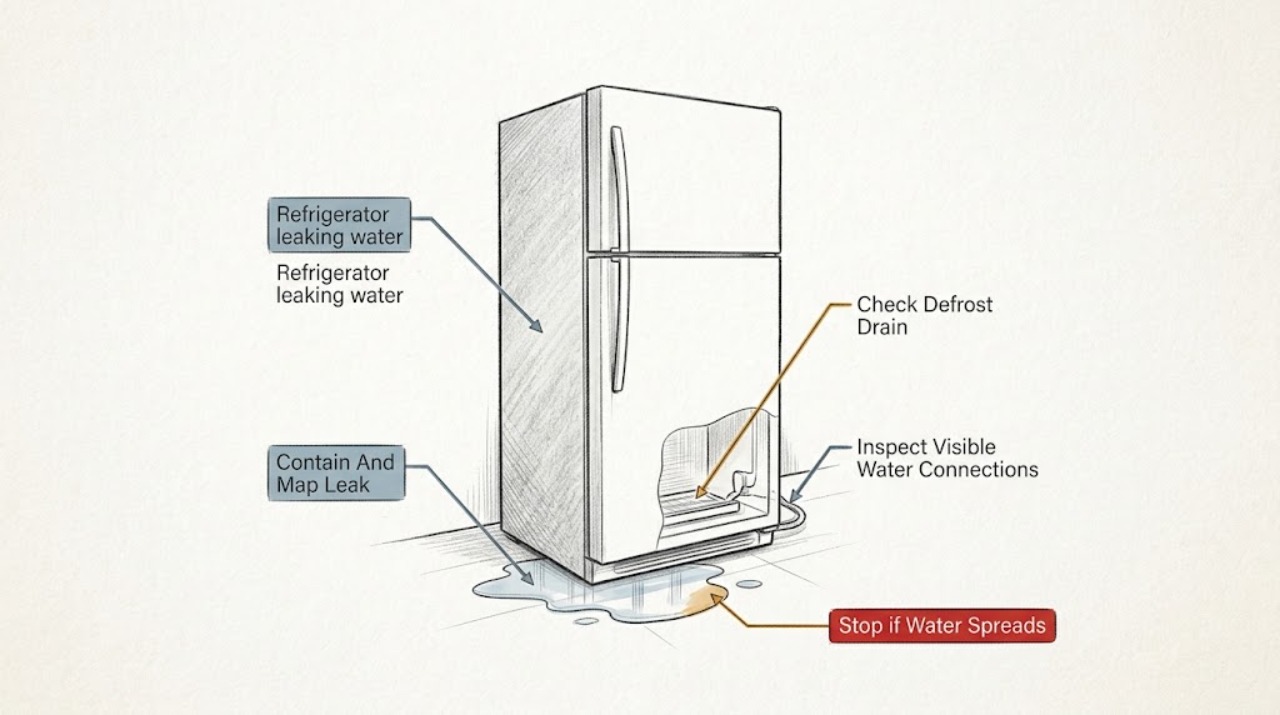
Work through in order
Diagnostic checks
Use only checks that match the exact appliance or system and its official guide.
-
Check 1
Stop the water dispenser and ice maker, dry the accessible floor and cabinet, and place a towel where the next drip can be observed without moving the refrigerator or removing covers.
Expected result: Record whether water reappears while the appliance is idle, only after dispensing or ice production, after a defrost cycle, or only when a door is opened; note whether it is inside the cabinet, at the front base, at a door, or behind the appliance.
Next step: Use the location and timing to select the matching branch, and keep the dispenser and ice maker off until the source is identified.
Stop if: Do not touch wet electrical areas, tilt or pull a water-connected refrigerator alone, or keep operating a leak that can reach wiring, an outlet, flooring, or stored food.
Why this matters
Why: An idle leak points toward stored water, a drain path, pan, filter housing, or supply connection; a use-linked leak makes the dispenser, ice maker, door tube, or filter path more likely. A leak near electrical parts is a safety stop rather than a diagnosis.
-
Check 2
From a dry, well-lit position, inspect the visible supply hose, shutoff connection, filter housing, and dispenser or door tubing for a kink, a wet joint, a displaced filter, or visible damage; do not loosen a fitting or remove a panel.
Expected result: Record whether the hose is kinked, a connection becomes wet during a controlled dispenser test, the filter was recently changed, the filter housing drips, or all visible water connections remain dry.
Next step: If a filter was recently changed, stop dispensing and use the exact Bosch filter-installation and flushing instructions; if a hose or connection is visibly damaged or leaks, shut off the water supply only if the valve moves normally and arrange service.
Stop if: Do not force the shutoff, overtighten a compression fitting, disconnect pressurized tubing, or operate the dispenser while a connection is visibly leaking.
Why this matters
Why: Bosch manuals associate leaks with water connections or an undamaged hose and separately identify filter and dispenser tubing issues. A dry exterior shifts suspicion toward an internal drain or concealed water path.
-
Check 3
If water is collecting inside the refrigerator or freezer and the exact Bosch manual identifies an accessible defrost drain or drainage hole, inspect that opening for visible contamination and clean only the model-approved accessible area with a soft, non-sharp method.
Expected result: Observe whether the drain opening is visibly blocked, whether water is pooled around it, and whether the interior remains dry after the approved cleaning step; do not probe beyond the opening.
Next step: Reassemble only what the manual identifies as user-accessible and monitor one normal cooling or defrost period; arrange service if water remains, returns, or requires panel removal.
Stop if: Do not chip ice, insert a sharp object, pour unapproved chemicals into the drain, remove evaporator covers, or work near live wiring.
Why this matters
Why: A visibly contaminated drain supports Bosch's defrost-drain explanation for internal water. A clear opening with continued water, ice, or a leak under the cabinet points toward a concealed drain, pan, heater, door seal, or water-supply fault.
-
Check 4
With the floor dry and a container positioned safely, perform only a brief normal dispenser operation if no connection is leaking, then stop and observe the dispenser tip, door tube area, filter housing, and base grille without removing the door or tubing.
Expected result: Record whether there are only a few drops immediately after dispensing, a continuing stream or puddle, water around the filter or door, or no water at the dispenser while the floor still becomes wet.
Next step: Follow the exact model manual for filter seating or dispenser cleanup; stop using the water system and arrange service for a continuing leak, wet door tubing, or a source that cannot be seen safely.
Stop if: Do not remove a door panel, pull tubing, force a filter, or continue dispensing into a wet electrical or cabinet area.
Why this matters
Why: A small post-dispense drip can be normal on some Bosch designs, while a continuing leak or water at the base makes tubing, filter seating, or a hidden connection more likely. A floor leak with no dispenser response shifts suspicion toward defrost drainage or another source.
-
Check 5
If the source is not resolved by the visible checks, record the Bosch model or E-Nr., leak location and timing, filter or water-line history, interior temperature or food exposure, and photos taken from a dry position for Bosch support or a qualified appliance technician.
Expected result: The service diagnosis may identify an internal defrost drain, drain pan or tube, water inlet valve, filter housing, dispenser tube, ice-maker line, door seal, or a concealed leak; do not treat any one cause as proven without the model-specific assessment.
Next step: Keep the appliance and water system in the safest stopped state, protect the floor, and arrange Bosch-authorized or qualified appliance repair; handle food according to its temperature and contamination status.
Stop if: Do not remove covers, access sealed refrigeration circuits, cut tubing, bypass a water valve, or work on live electrical parts.
Why this matters
Why: Persistent or hidden water means the ordinary-access boundary has been reached. Continuing to run the dispenser, moving the refrigerator, or opening sealed panels can worsen water damage or electrical risk.
Use your observations
Decision map
Find the observation that best matches what you see, then follow the next safe action.
-
PATH 01Safety boundary
What you see
Water appears inside the refrigerator or freezer, the visible supply connections are dry, and the model-approved drain opening is blocked or surrounded by pooled water.
Do this next
Clean only the accessible drain area as the exact Bosch manual allows and monitor the result; request service if water remains or returns.
Why this path and its safety boundary
Why it matters: A contaminated defrost drain or drainage hole is the leading supported explanation, but a clear opening with continued pooling suggests a concealed drain or pan fault.
Safety stop: Do not chip ice, probe deeply, remove evaporator covers, or use chemicals in the drain.
-
PATH 02Safety boundary
What you see
Water starts at the rear hose, filter housing, dispenser tubing, door connection, or base grille, especially after dispensing, ice production, or a filter change.
Do this next
Stop the dispenser and ice maker, use the exact model instructions for filter seating, and shut off the water supply only from a safe accessible valve before qualified service if the leak continues.
Why this path and its safety boundary
Why it matters: A water-supply, hose, filter-seating, dispenser, or ice-maker path is more likely than a defrost drain blockage.
Safety stop: Do not disconnect pressurized tubing, overtighten fittings, pull door tubing, or operate the water system while leaking.
-
PATH 03Safety boundary
What you see
Only a small amount of water appears immediately after dispensing, the connection stays dry, and no puddle forms while the appliance is idle.
Do this next
Follow the exact Bosch dispenser guidance, keep the area dry, and escalate if the amount increases, continues, or appears away from the dispenser.
Why this path and its safety boundary
Why it matters: A brief dispenser residual may be normal for that model, unlike a continuing drip or water that travels to the base.
Safety stop: Stop using the dispenser if water reaches the door, controls, floor, or an electrical area.
-
PATH 04Safety boundary
What you see
The leak continues while idle, returns after an approved drain check, appears behind the cabinet, affects several paths, or cannot be located without moving or disassembling the appliance.
Do this next
Stop the water system, protect the floor and food, and arrange Bosch-authorized or qualified appliance repair with the model and leak history.
Why this path and its safety boundary
Why it matters: A concealed drain, pan, valve, tubing, seal, or structural issue remains possible and is outside safe ordinary-access troubleshooting.
Safety stop: Do not pull the refrigerator, remove panels, cut tubing, open sealed refrigeration components, or work near live wiring.
-
PATH 05Safety boundary
What you see
Water reaches an outlet, power cord, controls, compressor area, floor damage, or food, or the appliance has lost safe temperature control.
Do this next
Keep people away from the wet area, isolate power only from a dry safe position when possible, preserve the model and incident details, and arrange qualified appliance or electrical assessment.
Why this path and its safety boundary
Why it matters: Electrical shock, property damage, or food-safety risk takes priority over identifying the exact leak source.
Safety stop: Do not touch wet electrical parts, restore power into a wet area, or consume food exposed to contaminated water or unsafe storage conditions.
Helpful context
Understand the symptom
Find the starting point before choosing a repair
A puddle at the front does not prove that the dispenser caused it. Water may travel from an internal defrost drain, a drain pan, a filter housing, a door tube, or a rear supply connection before reaching the floor. Dry the visible area, place an absorbent towel under the suspected location, and observe the next appearance without moving a wet refrigerator or opening panels.
Bosch manuals separate drainage from water-supply faults
Bosch's refrigerator support guidance says a contaminated defrost drain or drainage hole can prevent water from draining. Bosch refrigerator manuals also list water-connection and hose leaks, filter fit, dispenser behavior, and kinked lines as separate checks. Because Bosch models differ, use the E-Nr. or model number to find the matching manual before removing a filter, cover, door tube, or internal part.
Protect food and electrical areas while checking
Move food away from standing water and discard food that has been contaminated or held outside safe storage conditions. Keep hands, plugs, and tools dry. If water is near a receptacle, cord, control, compressor area, or other electrical connection, do not reach into the wet area; isolate power only from a dry, safe position or arrange qualified service.
Safety boundary
Stop conditions
- Stop the dispenser and ice maker when water is actively leaking or reaching the floor, door, controls, or electrical area.
- Do not touch wet electrical parts, move a water-connected refrigerator alone, or work on live wiring.
- Do not chip ice, probe a drain with sharp objects, pour chemicals into a drain, or remove concealed covers without model-specific qualified guidance.
- Do not disconnect pressurized water tubing, cut a hose, bypass a water valve, or open sealed refrigeration circuits.
- Stop and arrange qualified appliance service for a hidden, recurring, or behind-cabinet leak, water damage, or food-safety concern.
Only after diagnosis
Potential parts
- Bosch refrigerator water filter
Consider this category only when the exact Bosch model uses a filter and the leak or dispenser symptom began after filter service or a qualified diagnosis identifies a damaged or incorrectly seated filter.
Confirm the complete Bosch E-Nr. and the manufacturer's filter information; do not assume a filter fits because it looks similar. - refrigerator water supply hose or connector
Consider this category only when inspection confirms a kinked, cracked, or leaking external hose or connector and the water supply can be safely isolated.
Confirm the exact model, connection type, tubing specification, and installation procedure with Bosch or a qualified technician before ordering.
When checks do not resolve it
Need a professional?
Arrange Bosch-authorized or qualified appliance service when an approved accessible drain check does not stop the leak, water appears behind the cabinet, a hose, filter housing, valve, dispenser tube, ice-maker line, pan, or seal needs disassembly, the leak recurs, water reaches electrical parts or flooring, or food safety is uncertain.
Safety scope: This article supports containment, location mapping, dry visible inspection, and only model-approved cleaning of an accessible drain or filter. Water-line disassembly, panel removal, electrical work, sealed-system work, and contaminated-water cleanup require qualified service.
Common questions
FAQ
Why is my Bosch refrigerator leaking water inside?
Bosch says water that does not drain is commonly linked to a contaminated defrost drain or drainage hole. If the accessible opening is clear or the water returns after model-approved cleaning, an internal drain, pan, or another concealed path may need service.
What if water is leaking from the back or base of the Bosch refrigerator?
Check only from a dry, visible position for a kinked or damaged hose, wet water connection, filter housing, or dispenser tube. Bosch manuals treat these as separate water-system checks. Stop the dispenser and ice maker and arrange service for a continuing or inaccessible leak.
Is a small drip from a Bosch water dispenser normal?
Some Bosch guidance notes that a small amount of water immediately after dispensing can be normal for a model. A continuing drip, puddle, water at the door or base, or a leak that appears while idle is not a reason to keep dispensing; use the exact manual and arrange service if it persists.
Should I pull my Bosch refrigerator out to find the leak?
Not as an ordinary first step. Moving a water-connected refrigerator can strain tubing and expose electrical or floor hazards. Record the visible location and model, keep the water system stopped, and have a qualified technician inspect behind the cabinet when the source cannot be reached safely.
Read the exact guide
Official sources
- Get Support - RefrigerationBosch Home Appliances · Bosch official refrigeration support hub; it routes users to model-specific manuals and service resources rather than diagnosing every leak remotely.
- Bosch Refrigerator Use and Care GuideBosch Home Appliances · Bosch refrigerator manual hosted on Bosch's official document domain; use the matching model guide for a particular refrigerator.
- Fridge water does not drainBosch · Bosch refrigerator support guidance; use the exact model manual for the safe access and cleaning method.
- Information for Use KFD96..Bosch Home Appliances · Bosch KFD96-series information-for-use document; it illustrates model variation and is not a universal procedure for every Bosch refrigerator.
Community feedback
Share a repair observation
Share a plain-text repair observation. Accepted observations are published automatically; this page may take a moment to update.