
On this page
Start here
Quick answer
Start by identifying where the water appears: on the floor, under the fresh-food drawers, around the filter, in the ice bucket, or at the rear water connection. Turn off the icemaker and refrigerator water supply before moving a leaking unit or inspecting a loose line. GE says floor water can come from the refrigerator water valve, the home supply line, or the plastic fill line to the icemaker; ice-maker leaks can also involve fittings, a fill-tube extension, a clogged defrost drain, or leveling. Water under fresh-food drawers can indicate a leaking water tank or tubing. Check only accessible connections and the exact model's filter instructions. Stop for a split or pressurized line, a stuck valve, a leak inside the cabinet, exposed electricity, or water that returns after the accessible checks.
Before you begin
Safety first
- A qualified technician or plumber should handle a stuck or leaking valve, split pressurized line, internal water tank or tubing, defrost drain behind panels, electrical wetness, or any repair requiring force or cabinet disassembly.
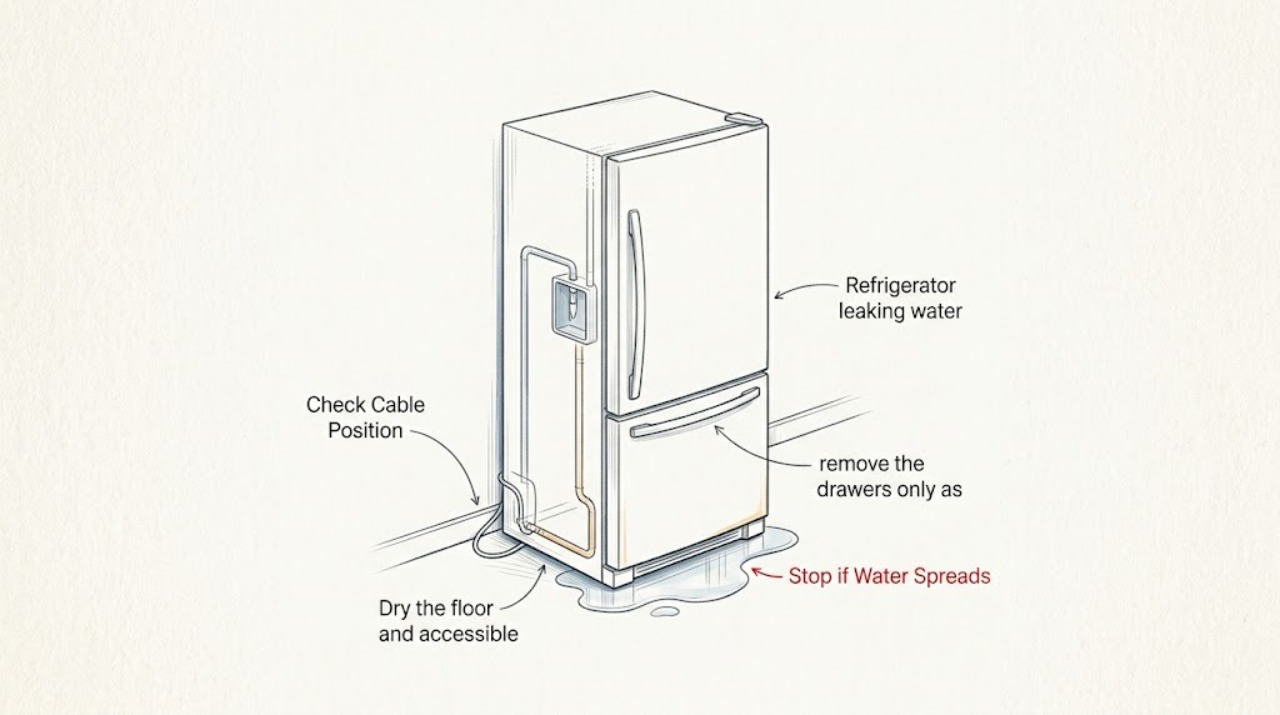
Work through in order
Diagnostic checks
Use only checks that match the exact appliance or system and its official guide.
-
Check 1
Turn off the icemaker if applicable, close the refrigerator's water-supply shutoff, unplug only if the model procedure requires it and the plug is dry, and wipe up standing water before moving the appliance.
Expected result: The water stops, the shutoff will not close or leaks, water is near the outlet or cord, or water continues with the refrigerator supply closed.
Next step: Leave the water off and arrange appliance or plumbing service for an unsafe electrical area, a failed shutoff, or water that continues. Otherwise proceed to locate the first wet point.
Why this matters
Why: A controllable leak can be localized safely; an inaccessible or leaking shutoff, wet electrical area, or continuing water source needs a broader response.
-
Check 2
Dry the floor and accessible rear connections, then inspect the water valve, household copper or plastic line, and plastic line from the valve toward the icemaker without disconnecting tubing.
Expected result: The valve body is wet, the household line is loose or split, the icemaker fill line is loose or split, or all accessible connections remain dry.
Next step: Keep the supply off. A visibly loose accessible connection may be corrected only as the model instructions allow; do not repair split tubing or a leaking valve with improvised parts. If connections are dry, continue to the location-specific checks.
Why this matters
Why: A wet valve or appliance line supports an appliance water-system leak; a split copper or household line is a plumbing issue; dry connections shift attention to filter, drain, internal tubing, or defrost water.
-
Check 3
If water is under the fresh-food drawers, remove the drawers only as the owner's manual permits and dispense water into a glass while watching the accessible water tank or tubing.
Expected result: Water appears from the tank or tubing during dispensing, the area is wet without dispensing, or the tank and tubing remain dry.
Next step: Do not patch or remove internal tubing. Close the supply and arrange service for a leaking tank or tubing; if the area is dry, inspect the filter, icemaker area, or defrost path instead.
Why this matters
Why: A visible tank or tubing leak supports an internal water-system failure. Water without dispensing can indicate another internal source, while a dry reservoir shifts the problem toward a different location or configuration.
-
Check 4
If the leak is around the filter or a leak-detected message appears, inspect the filter area for wetness and confirm the filter orientation and seating from the exact GE model instructions; do not use a sharp tool in the housing.
Expected result: The filter is visibly wet, the filter or bypass plug is not fully seated or is backward, the model uses RPWFE and still displays a leak warning, or the filter area is dry.
Next step: Reinstall only the correct model-approved filter or bypass component, restore water slowly, and watch for seepage. If a leak warning or physical leak remains, keep the supply off and arrange service.
Why this matters
Why: On applicable RPWFE bottom-freezer models, filter placement and the leak-detection system can affect water flow and warnings. A dry or correctly seated filter does not rule out a valve, line, or internal leak.
-
Check 5
If the water appears in the ice bucket, freezer floor, or near the icemaker, inspect accessible fittings and the fill-tube extension for wetness, and note whether the leak follows an icemaker fill or defrost cycle.
Expected result: A fitting or fill-tube extension is wet, the defrost drain appears clogged or overflowing, water is on the case exterior, or the source is not visible.
Next step: Keep the icemaker and water supply off. Clear only removable surface ice or debris allowed by the exact manual; do not probe a drain or fill tube with a sharp object or remove panels without model guidance. Escalate if the source is hidden or recurring.
Why this matters
Why: A wet icemaker line supports a fill-path leak; timing with defrost and no wet supply fitting makes a drain problem more likely. An unseen source may be inside the cabinet or behind a panel.
-
Check 6
After an allowed accessible correction, restore water slowly and check the valve, filter, icemaker line, floor, and cabinet through one complete use or fill event; verify the refrigerator is level if an icemaker leak was involved.
Expected result: No water returns, a slow seep reappears, the refrigerator is not level, or water returns from an internal or hidden location.
Next step: Shut the water off again for any seepage or hidden leak and arrange qualified appliance service. A line leaking on the house side should be handled by a plumber.
Why this matters
Why: A dry retest supports a corrected external connection or filter seating. A recurring or hidden leak indicates a valve, tank, tubing, drain, or control issue that an external check cannot prove repaired.
Use your observations
Decision map
Find the observation that best matches what you see, then follow the next safe action.
-
PATH 01Next step
What you see
The leak stops when the refrigerator water supply is closed and a valve, household line, or icemaker fill line is visibly wet.
Do this next
Keep the supply off, correct only a clearly accessible model-approved connection, and arrange service for split tubing, a leaking valve, or a line that requires disassembly.
Why this path and its safety boundary
Why it matters: The water system is the leading source rather than condensation alone; the exact wet component determines appliance versus plumbing responsibility.
-
PATH 02Next step
What you see
Water is under the fresh-food drawers and appears from the reservoir or tubing while water is dispensed.
Do this next
Close the water supply and arrange appliance service; do not attempt to patch internal tubing or continue dispensing to reproduce the leak.
Why this path and its safety boundary
Why it matters: An internal water tank or tube leak is more likely than a rear supply-line leak.
-
PATH 03Next step
What you see
Water is in the ice bucket or freezer area, line fittings are dry, and the leak follows a defrost or icemaker event.
Do this next
Keep water and icemaker functions off, follow only the exact model's accessible drain or level instructions, and arrange service if the source is not visible or returns.
Why this path and its safety boundary
Why it matters: A clogged defrost drain, fill-tube extension, icemaker valve, or leveling issue is more likely than a simple filter seating problem.
-
PATH 04Next step
What you see
A bottom-freezer model with an RPWFE filter shows a leak warning or wetness at the filter area after a filter change.
Do this next
Turn off water, reseat only the correct filter or bypass component according to the model instructions, and arrange service if the warning or leak remains.
Why this path and its safety boundary
Why it matters: Incorrect filter seating or a filter-area leak is plausible, but the leak-detection system and filter compatibility are model-specific.
-
PATH 05Next step
What you see
Water continues with the supply off, the source is behind an interior panel, the tank or tubing is cracked, electricity is wet, or the floor leak returns after accessible checks.
Do this next
Keep the appliance water supply off, avoid wet electrical parts and further panel removal, and arrange appliance service or a plumber based on whether the source is inside the refrigerator or in the house line.
Why this path and its safety boundary
Why it matters: The problem may involve a hidden drain, internal tubing, reservoir, valve, or an outside plumbing connection beyond safe owner checks.
Helpful context
Understand the symptom
Contain the leak before diagnosing it
Turn off the icemaker if applicable and close the refrigerator water-supply shutoff before pulling the appliance out. Mop standing water and keep the plug, outlet, and power cord dry. Move the refrigerator only far enough to see the connection without kinking the line. If the shutoff is inaccessible or the water continues, stop and get appliance or plumbing help.
The location narrows the source
Water in front of the refrigerator points first to the water valve, household supply line, or icemaker fill line. Water under the fresh-food drawers points toward the internal water tank or tubing on models equipped with them. Water in the ice bucket or near the icemaker may come from fittings, the fill-tube extension, a defrost drain, or a level problem. Do not assume every GE refrigerator has the same reservoir, filter, or drain layout.
Inspect external water connections only
With the water off, look for a wet valve body, loose fitting, split tubing, or a line that has been pulled tight behind the cabinet. A copper line leaking from the house side is plumbing work; a cracked appliance fill line or stuck refrigerator valve is an appliance-service boundary. Do not disconnect a pressurized line or tighten a fitting that requires force.
Filter and display warnings need the exact model
On bottom-freezer models that use GE's RPWFE filter system, GE says a leak-detected message can be related to the filter area or an incorrectly installed filter, and the dispenser can shut off when a leak is detected. Check the filter's seating and the model instructions; do not insert sharp tools into the filter housing or infer that another GE model uses RPWFE.
A drain or level issue can mimic a supply leak
If the leak occurs during or after defrosting and no water-line connection is wet, a clogged or overflowing defrost drain becomes more plausible. GE also advises checking that the refrigerator is level for an icemaker leak. Drain-pan and internal defrost work varies by configuration, so stop before removing interior panels unless the exact manual clearly permits it.
Safety boundary
Stop conditions
- Stop and isolate the refrigerator water supply if water reaches an outlet, power cord, wall, cabinet, or flooring faster than it can be contained.
- Do not disconnect a pressurized water line, pull the refrigerator farther than the tubing permits, or tighten a split line or valve with force.
- Do not insert a sharp tool into a filter housing, icemaker fill tube, or defrost drain, and do not remove interior panels unless the exact GE manual permits the step.
- Stop when a tank, internal tube, valve, electrical component, or sealed cabinet area is visibly cracked, flooded, or inaccessible.
- Arrange service when the leak returns after a correct accessible filter or connection check, a leak-detected warning persists, or the water source cannot be localized.
Only after diagnosis
Potential parts
- GE refrigerator water filter
Consider this only when the exact model uses a filter, the filter area leaks or flow changes after installation, and the model instructions identify filter replacement as the remedy.
Match the exact refrigerator model and filter system; an RPWFE filter and its leak-detection features apply only to models designed for that system. - refrigerator water inlet valve
Consider this only when the valve body leaks, remains stuck, or fails model-specific testing after the external supply line and filter checks.
Match the exact GE model, valve ports, tubing connections, electrical connector, and service procedure; do not infer fit from appearance. - refrigerator water tank or tubing
Consider this only when water appears under the fresh-food drawers and dispensing visibly exposes a leak at the reservoir or internal tubing.
Confirm the exact configuration and routing; internal reservoir and tubing work should be performed with the water isolated and model-specific instructions.
When checks do not resolve it
Need a professional?
Use appliance service for a leaking refrigerator valve, internal reservoir or tubing, recurring filter-area leak, hidden drain or icemaker leak, wet electrical area, or any leak that returns after model-approved external checks; use a plumber for a leaking house-side copper line.
Safety scope: A qualified technician or plumber should handle a stuck or leaking valve, split pressurized line, internal water tank or tubing, defrost drain behind panels, electrical wetness, or any repair requiring force or cabinet disassembly.
Common questions
FAQ
Why is my GE refrigerator leaking water onto the floor?
GE says to check the refrigerator water valve, the household copper or plastic supply line, and the plastic line from the valve to the icemaker. Turn off the icemaker and refrigerator water supply before moving the unit or handling a leak.
What does water under the fresh-food drawers mean?
On models with a water storage tank, GE says water or ice under the drawers may indicate a leaking tank or tubing. Watching the tank while dispensing can make the leak visible; service is recommended when it is leaking.
Can a clogged defrost drain cause a GE refrigerator to leak?
Yes. GE's icemaker leak guidance includes a clogged or overflowing defrost drain among possible causes, especially when the line fittings and valve are dry. The drain location and safe access depend on the refrigerator configuration.
What should I do if my GE refrigerator shows Leak Detected?
For applicable bottom-freezer models with the RPWFE system, inspect the filter area and confirm the filter is oriented and seated correctly according to the model instructions. If the warning or physical leak remains, keep water off and arrange service.
When should I stop troubleshooting a leaking GE refrigerator?
Stop for water near electricity, a split or pressurized line, a stuck valve, a cracked tank or internal tube, a hidden leak, or a leak that returns after the accessible checks. Isolate the water supply and use appliance service or a plumber based on where the leak starts.
Read the exact guide
Official sources
- Refrigerator - Leak Detected Message on DisplayGE Appliances · Only applicable bottom-freezer models with the described LCD/RPWFE system
- Refrigerator - Water Leaking Onto The FloorGE Appliances · GE refrigerators; exact water-line routing and valve locations vary by model
- Refrigerator - Icemaker Leaking or Dripping WaterGE Appliances · GE refrigerator icemaker configurations; exact drain, valve, and fill-tube designs vary by model
- Refrigerator - Water Under the Fresh Food DrawersGE Appliances · GE refrigerator models with an accessible water storage tank or tubing behind the drawers
- Refrigerator – RPWFE Operation and TroubleshootingGE Appliances · Only GE refrigerator models designed for the RPWFE system; do not generalize to other filter families
Community feedback
Share a repair observation
Share a plain-text repair observation. Accepted observations are published automatically; this page may take a moment to update.