
On this page
Start here
Quick answer
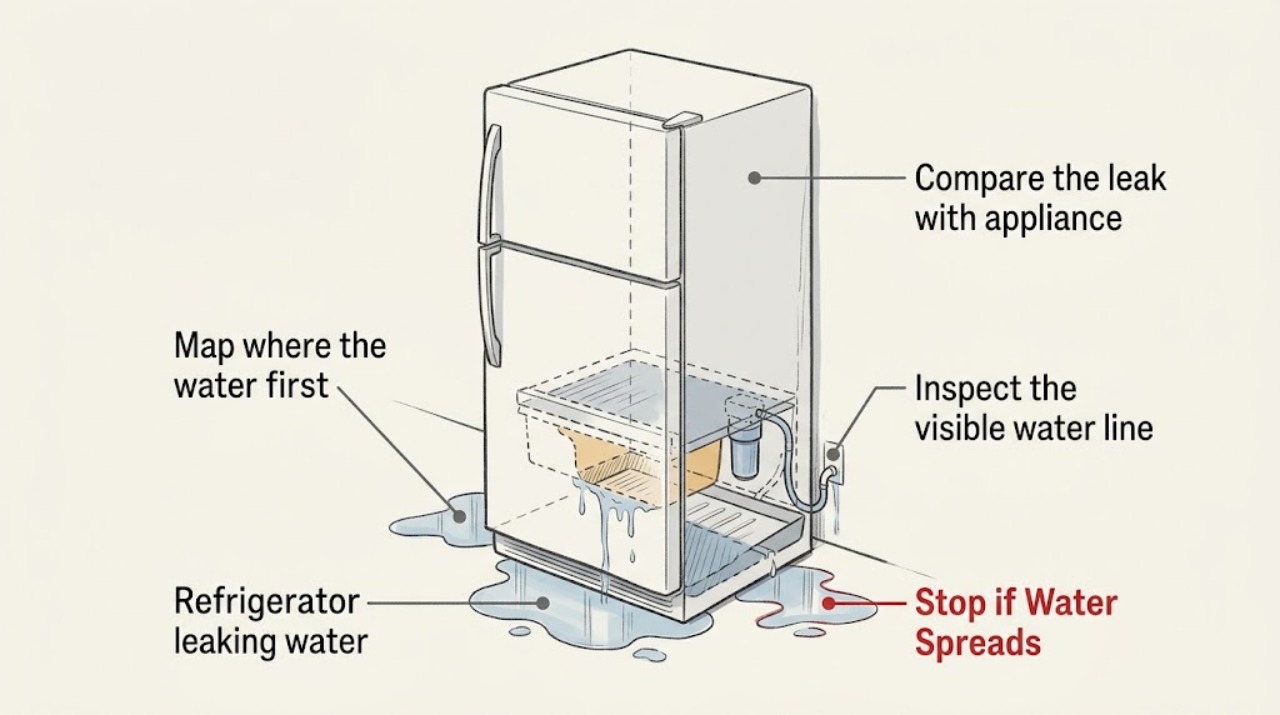
A Kenmore refrigerator leaking water can have an interior defrost or condensation path, a filter or dispenser connection, a drain pan, or a household water line as the source. First dry the area and map whether water is inside the freezer, under the front, behind the refrigerator, near the filter, or only after dispensing or making ice. Keep the refrigerator connected only while safe, move it no farther than you can safely manage, and inspect accessible tubing, fittings, filter seating, and drain-pan clues without removing panels. Kenmore directs owners to use the complete model number for the correct manual and parts information. Shut off the water supply and arrange appliance service for a cracked line, persistent leak, inaccessible drain, damaged pan or filter housing, water near electrical parts, or a leak that returns after a safe external correction.
Work through in order
Diagnostic checks
Use only checks that match the exact appliance or system and its official guide.
-
Map where the water first appears
Dry the floor, cabinet edges, shelves, and freezer floor. Place a dry towel or tissue at separate accessible points and note whether water begins inside the freezer or refrigerator, under the front, behind the cabinet, at the filter area, or below the dispenser.
Expected result: Water starts inside a compartment, under the front, behind the refrigerator, near the filter, or only at the dispenser or ice maker.
Next step: Photograph the first wet point and select the matching branch before pulling the refrigerator out or removing any cover.
Stop if: Keep water away from outlets and electrical components; shut off the water supply if a pressurized line is actively leaking.
Why this matters
Why: Interior water favors condensation, a drain path, or an internal water assembly. Front-under-cabinet water favors a pan or drainage path. Rear water favors supply tubing or a valve connection, while filter or dispenser timing narrows the water-system path.
-
Compare the leak with appliance events
After drying the area, note whether water returns after dispensing, ice making, a recent filter change, a defrost period, loading warm food, or simply while the refrigerator sits. Do not repeatedly dispense water or cycle the ice maker to provoke a leak.
Expected result: The leak follows dispensing or ice making; follows a filter change; appears after frost or defrost; follows a warm container; or has no clear event.
Next step: Use the event pattern to guide an accessible check and give it to the technician if the source remains hidden.
Stop if: Do not keep operating a water dispenser or ice maker when water is reaching electrical parts or the floor.
Why this matters
Why: Water-system events favor a filter, dispenser, inlet, or supply-line issue. Frost or defrost timing favors a drain or pan path. A shelf leak after a warm container can be condensation, while unexplained recurrence needs service diagnosis.
-
Inspect the visible water line and rear fittings
If the leak is behind or near the lower rear area, turn off the household refrigerator water supply and inspect only the visible tubing, supply valve, shutoff, and cabinet connection. Look for a crack, kink, wet fitting, or tubing that is not fully inserted; do not loosen a fitting that is under pressure.
Expected result: The line is cracked or wet, a fitting is leaking, the tubing appears secure and dry, or the line cannot be reached safely.
Next step: Leave the water supply off for an active line leak and arrange appliance or plumbing service. Do not move a heavy refrigerator alone to reach the back.
Stop if: Do not cut tubing, disassemble a valve, or work behind the appliance near energized wiring.
Why this matters
Why: A cracked line or wet fitting can account for a rear or floor puddle independently of the refrigerator's internal drain. A dry accessible line makes an internal valve, filter, pan, or drain path more likely.
-
Check filter seating and housing condition
If water is near the filter housing or the leak began after filter work, follow the Kenmore model manual to remove and reseat the filter only if the design allows an accessible owner check. Inspect the filter and visible housing for a crack or displaced seal; keep the water supply off while handling a wet connection.
Expected result: The filter is not fully seated, its seal or housing is damaged, the filter area is dry, or the model manual shows a different filter arrangement.
Next step: Reseat only as the exact manual describes. Replace a damaged filter or housing only after confirming the model; call service for a cracked housing or persistent leak.
Stop if: Do not force a filter, bypass a damaged housing indefinitely, or remove internal panels to reach the filter head.
Why this matters
Why: Incorrect seating or damage can cause water to escape from the filter area. A dry filter area shifts concern to tubing, dispenser, drain, pan, or another model-specific water assembly.
-
Separate interior condensation from a drain problem
Inspect shelves, crisper areas, and the freezer floor for a spill, cracked container, frost buildup, or water returning from a drain opening. Keep food away from visible air paths and wipe the area dry; do not poke a blocked drain with a wire or sharp object.
Expected result: Water is limited to a shelf or container; the freezer has frost or water near its rear floor; water returns under the cabinet; or no interior source is visible.
Next step: Follow the model manual for any accessible drain-care step. If water returns or the drain is hidden behind a panel, arrange appliance service.
Stop if: Do not remove an evaporator cover, chip ice, pour unapproved chemicals into a drain, or use heat near plastic and wiring.
Why this matters
Why: A container or condensation can explain shelf water. Frost or water at the freezer drain area makes a blocked or frozen drain more likely; water under the cabinet can also involve the drain pan. An unseen internal source needs model-specific service.
-
Check the model manual before moving or servicing
Record the complete Kenmore model number and use the official manual to identify the refrigerator configuration, filter location, drain access, pan location, and movement instructions. Compare the manual's water-system layout with the observed leak rather than assuming all Kenmore units share the same parts.
Expected result: The manual identifies an accessible filter or drain check; the leak source is behind a panel; the model has no water dispenser; or the layout does not match the suspected path.
Next step: Use only the documented low-risk check. Give the manual model and photographs to a technician when the source is hidden or the appliance must be moved.
Stop if: Do not tip or move a large refrigerator alone, remove rear or interior panels, or disconnect sealed-system components.
Why this matters
Why: Kenmore manuals are model-specific. A refrigerator without a dispenser cannot have a dispenser leak, and a hidden drain or pan should not be accessed by guessing from another layout.
-
Escalate a persistent or unsafe leak
If water returns after a safe filter or accessible connection correction, the source is inside the cabinet, the drain or pan cannot be reached, the floor is being damaged, or water is near electrical parts, shut off the refrigerator water supply and arrange qualified appliance repair.
Expected result: The leak stops after an external correction; it returns from the same location; the line or housing is cracked; or no safe external cause is found.
Next step: Provide the full Kenmore model, leak location, event timing, photos, water-system status, filter history, frost observations, and checks already performed.
Stop if: Do not run the refrigerator with an active line leak, open energized panels, or attempt sealed-system or internal drain repairs as a homeowner.
Why this matters
Why: Resolution after a filter or accessible fitting correction supports that external water path. Recurrence, hidden water, a damaged pan or housing, or an internal drain issue needs model-specific diagnosis rather than repeated drying.
Use your observations
Decision map
Find the observation that best matches what you see, then follow the next safe action.
-
PATH 01Next step
What you see
The first wet point is behind the refrigerator or at the household connection, and the leak follows dispensing or ice making or remains active while the water supply is open.
Do this next
Shut off the refrigerator water supply, avoid moving the appliance alone, and arrange appliance or plumbing service for the wet line or fitting.
Why this path and its safety boundary
Why it matters: A cracked supply line, loose fitting, shutoff, or inlet connection is more likely than a defrost drain.
-
PATH 02Next step
What you see
Water is concentrated at the filter housing or began after the filter was installed, while the rear tubing remains dry.
Do this next
With the supply off, reseat only according to the Kenmore manual and inspect for visible damage. Arrange service for a cracked housing or continued leakage.
Why this path and its safety boundary
Why it matters: Filter seating, a displaced seal, or damaged filter housing is more likely.
-
PATH 03Next step
What you see
Water appears in the freezer or refrigerator interior, follows frost or defrost timing, or pools under the cabinet while external water lines are dry.
Do this next
Use the model manual for an accessible care step only. If the drain or pan is hidden, blocked, or leaking again, schedule appliance diagnosis.
Why this path and its safety boundary
Why it matters: A drain path, drain pan, or internal water assembly is more likely than a rear supply fitting.
-
PATH 04Next step
What you see
Water is limited to a shelf or container and does not return after the container is removed and the area is dried.
Do this next
Correct the container or loading condition and monitor the dry compartment. Reclassify as an appliance leak if water returns without that event.
Why this path and its safety boundary
Why it matters: A spill, cracked container, or condensation from a warm item is more likely than a refrigerator plumbing leak.
-
PATH 05Safety boundary
What you see
The leak returns despite dry accessible tubing and filter, the source is behind a panel, or water is reaching flooring or electrical components.
Do this next
Shut off the water supply, protect food and flooring, and arrange qualified appliance service with the model number and leak evidence.
Why this path and its safety boundary
Why it matters: An internal drain, pan, valve, housing, or tubing fault needs model-specific diagnosis.
Safety stop: Do not remove panels, tip the refrigerator, or continue using an active water connection while the source is unknown.
Helpful context
Understand the symptom
Trace the first wet point before moving the refrigerator
A puddle at the front can travel from the rear line, filter housing, drain pan, or an interior channel. Dry the floor and the visible cabinet, then note whether water reappears inside a crisper or freezer, beneath the front, behind the cabinet, or near the dispenser. Timing also matters: a leak after dispensing or ice making points toward the water path, while a leak after a defrost event or with heavy frost points toward drainage. Kenmore's support site provides model manuals and repair resources, so record the full model before selecting a procedure.
Filter and tubing checks are limited to accessible parts
A filter that is not seated or has a damaged seal can leak at its housing. A cracked supply line or loose accessible fitting can leak behind the refrigerator. Manufacturer guidance supports inspecting visible tubing and filter seating, but a wet cabinet interior, a cracked housing, or a line that cannot be reached safely is a service boundary rather than a reason to remove covers.
Interior water and floor water follow different paths
Water on a shelf may be condensation from a warm container or a spill, while water in the freezer or under the cabinet can involve a drain path or pan. Do not assume a filter is at fault just because the refrigerator has a dispenser. Compare the leak with filter changes, dispensing, ice production, door openings, and defrost-related frost so service can start with the right subsystem.
The model manual controls the next repair step
Kenmore sells refrigerator families with different layouts, water systems, and drain access. Its manuals page asks for the complete model number and provides use-and-care information for refrigerators and parts. Use that document to identify the filter, drain access, pan location, and safe movement instructions; do not copy a procedure from a different Kenmore layout.
Safety boundary
Stop conditions
- Shut off the refrigerator water supply for an active leak, and disconnect power only when the model instructions require it and it can be done safely.
- Do not remove interior or rear panels, chip ice, poke a drain with wire, or work near energized wiring to reach a hidden leak.
- Stop using the dispenser or ice maker when water reaches electrical parts, the floor, or the cabinet base, and protect flooring and stored food.
- Arrange appliance service for a cracked line, filter housing, drain pan, inaccessible drain, recurring leak, or water damage that persists after an accessible external correction.
Only after diagnosis
Potential parts
- refrigerator water filter or filter-head seal
Consider this category only when a filter-area leak follows installation and inspection confirms incorrect seating, a damaged filter, or a failed seal.
Confirm the complete Kenmore model and filter design before ordering; do not select a filter or seal by appearance alone. - refrigerator water supply tubing or inlet connection
Consider this category only when a qualified diagnosis confirms a cracked tube, leaking fitting, or defective inlet connection after the water supply is isolated.
Verify the model, tubing route, connector style, and water-system configuration before selecting a component. - defrost drain or drain-pan component
Consider this category only when water returns from the freezer or under the cabinet and diagnosis confirms a blocked drain, damaged pan, or related internal drainage fault.
Drain and pan designs vary by Kenmore model and underlying platform; confirm the exact model and diagnosed component before ordering.
When checks do not resolve it
Need a professional?
Arrange qualified appliance repair when the leak returns after a safe filter or fitting check, water appears inside the cabinet or from an inaccessible drain or pan, a line or filter housing is cracked, water reaches electrical parts or flooring, or the source cannot be traced. Provide the complete Kenmore model, leak location, timing, photos, filter history, dispenser or ice-maker status, and frost or drain observations.
Have this ready
- Provide the complete Kenmore model, refrigerator configuration, first wet point, event timing, filter and dispenser history, visible line or fitting condition, interior frost or drain observations, photos, and whether the water supply has been shut off.
Common questions
FAQ
Why is my Kenmore refrigerator leaking water onto the floor?
Trace the first wet point before assuming one cause. Water under the front can come from a drain pan or interior drainage path; water behind the refrigerator can come from supply tubing or fittings; and filter-area leaks often follow filter seating or damage. Use the full Kenmore model manual for the layout and shut off the water supply for an active line leak.
Can a Kenmore refrigerator water filter cause a leak?
Yes. If the leak is near the filter or began after filter work, check seating and visible damage using the model instructions. A damaged housing or persistent filter-area leak needs service; do not force the filter or remove internal panels.
How do I know whether a refrigerator leak is from the water line?
A wet rear line, supply connection, or shutoff, especially when dispensing or making ice, points toward the water system. Turn off the refrigerator water supply and inspect only visible tubing and fittings. If a line is cracked or the source is inaccessible, arrange service.
Should I pull a Kenmore refrigerator out to find the leak?
Only follow the movement instructions in the exact Kenmore manual and get help for a large or difficult appliance. Do not tip the unit, remove panels, or work near energized wiring to reach a hidden drain, pan, valve, or tube. Shut off the water supply and call for service if the rear source cannot be reached safely.
Read the exact guide
Official sources
- Customer Care & SupportKenmore · Kenmore customer care, product manuals, parts and literature, recalls, and repair-service routing
- Leaking from Behind - Top Freezer RefrigeratorWhirlpool Product Help · Manufacturer refrigerator rear-leak checks for water lines, fittings, supply valves, and qualified service
- Leaking at the Bottom - Bottom Freezer RefrigeratorWhirlpool Product Help · Manufacturer refrigerator leak checks for supply lines, fittings, shutoff valves, water filters, and service escalation
- Water Inside of RefrigeratorWhirlpool Product Help · Manufacturer refrigerator interior-water checks for filter seating, dispenser drips, warm-container condensation, and service escalation
- Find Your Manual | Kenmore Appliance Manuals & GuidesKenmore · Kenmore model-specific refrigerator manuals, use-and-care instructions, and parts information
Community feedback
Share a repair observation
Share a plain-text repair observation. Accepted observations are published automatically; this page may take a moment to update.