
On this page
Start here
Quick answer
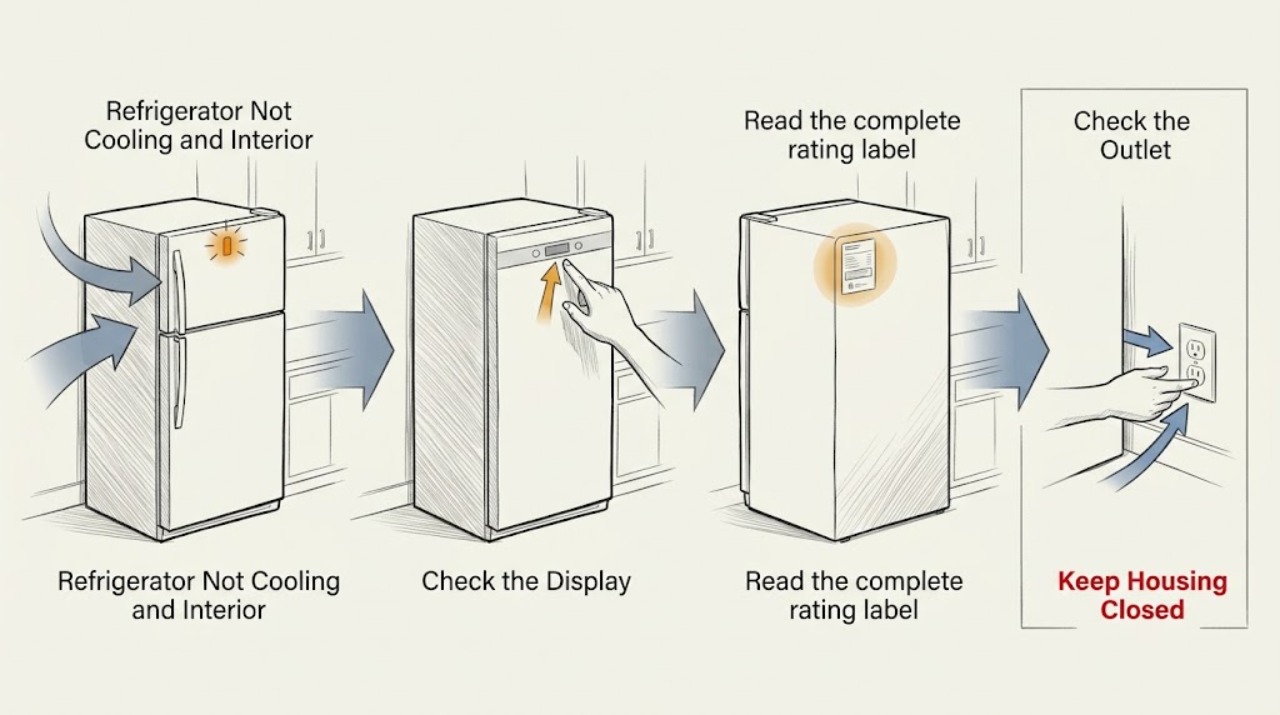
If a Frigidaire FFHT1817LS4 is intermittently not cooling and its interior light is also out, first separate a power event from a light-only failure. Frigidaire says control or interior lights are useful signs that a refrigerator has power, and it directs owners to check the dedicated outlet, breaker or fuse, and any GFI outlet without opening the cabinet. If the light alone is out but the compressor or fans still run, the bulb or light circuit is a different branch; if the light, cooling, and other signs of operation disappear together, treat it as a power or control interruption. Protect perishable food while temperature is uncertain. Check only the accessible plug, breaker, GFI, control state, door closure, vents, and gasket allowed by the exact manual. Do not remove covers, probe wiring, bypass a control, or replace a thermostat, board, compressor, or light assembly from the combined symptom alone. If power is present but cooling repeatedly stops, arrange qualified refrigerator service.
Before you begin
Safety first
- Do not remove refrigerator covers, probe energized wiring, bridge a door switch, bypass controls, force a fan or compressor, chip frost, or select a thermostat, board, compressor, light assembly, or sealed-system part from the symptom alone. Stop immediately for smoke, burning odor, a hot or damaged cord or outlet, water near electrical parts, repeated breaker operation, or food temperatures that are unsafe.
Work through in order
Diagnostic checks
Use only checks that match the exact appliance or system and its official guide.
-
Check 1
Without opening any cabinet, note the exact time and sequence: did the interior light go out before, after, or at the same time as cooling stopped; are the control or display lights also dark; can you hear a compressor or fan; and are any food temperatures rising? Keep the doors closed as much as practical.
Expected result: The interior and control lights are both dark with no operation signs, the interior light alone is dark while the refrigerator runs, or operation and light return intermittently.
Next step: Record the sequence and protect perishable food. Continue only with safe external power and temperature checks; do not repeatedly open the door or cycle the refrigerator to reproduce the fault.
Stop if: Stop and isolate power only from a dry, safe position for smoke, burning odor, a hot or damaged cord or outlet, water near electrical parts, or repeated breaker operation.
Why this matters
Why: A light and cooling loss together prioritizes an intermittent power or control interruption. A light-only loss leaves a bulb or light-circuit issue possible, so it does not prove the cooling system failed.
-
Check 2
Read the complete rating label and confirm FFHT1817LS4, including the final suffix and serial information. Use Frigidaire's model and manual route for the exact document; do not substitute FFHT1817LS, another suffix, or a different top-freezer platform.
Expected result: The label matches FFHT1817LS4 and the matching document is available, or the suffix or manual match is uncertain.
Next step: Follow only the exact manual for any permitted reset, light replacement, or setting. If identity remains uncertain, keep the advice at safe external checks and arrange service rather than borrowing model-specific instructions.
Stop if: Do not choose a light assembly, thermostat, board, compressor, or wiring procedure from the FFHT1817 prefix alone.
Why this matters
Why: Frigidaire says model identifiers vary by appliance type and uses the full model to route support and manuals. Similar-looking refrigerator families can have different light, control, and defrost arrangements.
-
Check 3
From outside the appliance, check that the plug is fully seated in its dedicated outlet, the refrigerator breaker or fuse is not open, and any GFI outlet has not tripped. If the outlet itself is suspect, use only the external test allowed by Frigidaire and do not open the receptacle or refrigerator wiring.
Expected result: The breaker or GFI is tripped, the plug or outlet is loose or suspect, power appears normal, or the light and cooling return after an external power correction.
Next step: Correct only an obvious accessible outlet or breaker condition without repeated resets. If the breaker or GFI trips again, stop and arrange qualified electrical or appliance service; allow the refrigerator to stabilize according to the exact manual after a confirmed power restoration.
Stop if: Do not repeatedly reset a breaker, use an extension cord, remove the outlet cover, or touch live wiring.
Why this matters
Why: Frigidaire lists a dedicated grounded supply, breaker or fuse, and GFI status as power checks. A corrected power event can explain both a dark light and lost cooling; recurrence or normal power with a dark light needs a different branch.
-
Check 4
If the refrigerator has power and the light alone remains out, inspect only the user-accessible light area described by the exact manual. Note whether the bulb is visibly failed, the door switch changes the light when the door is opened and closed normally, and whether fans or cooling continue. Do not remove a light housing or touch wiring unless the manual explicitly makes that a user step.
Expected result: The light source appears failed, the light changes with normal door operation, the light stays out while cooling continues, or the light is out together with no cooling.
Next step: Use only the exact manual's light replacement or cleaning instruction if the refrigerator otherwise operates normally. If the light is coupled to cooling loss or remains out after the permitted check, arrange service and do not open the cabinet.
Stop if: Do not bridge a door switch, bypass a light control, pull on wiring, or use a non-specified bulb.
Why this matters
Why: Frigidaire says a failed bulb can account for a dark light, while a dark light with no electrical operation may indicate no electricity. Light behavior alone does not identify a switch, harness, control, or cooling component.
-
Check 5
With power status documented, perform the refrigerator's safe external cooling checks: keep vents clear, confirm doors close and the gasket seals, note whether the unit was recently installed or lost power, and check for unusual frost, water, or a blocked airflow path without removing covers. Keep the door closed after inspection.
Expected result: A blocked vent, door obstruction, poor gasket seal, recent power event or installation, frost pattern, or no visible external issue is found.
Next step: Correct only a plainly visible loading, door, gasket-cleaning, or accessible airflow issue. If cooling does not return after the exact manual's stabilization period, or if frost and warm sections persist, arrange qualified service.
Stop if: Do not chip frost, remove the evaporator cover, add heat, or move the refrigerator to access internal parts.
Why this matters
Why: Frigidaire identifies blocked airflow, a door that does not close, a poor seal, installation, and a recent power event as cooling factors. These observations can explain warm temperatures but do not prove a fan, defrost, thermostat, compressor, or sealed-system fault.
-
Check 6
Document the recurrence for service: whether the light and cooling fail together, the duration of each episode, freezer and fresh-food temperature readings if safely available, compressor or fan sounds, breaker history, door and frost observations, and what returns first. Do not keep cycling power or wait through unsafe food temperatures.
Expected result: The refrigerator recovers after an external power event, the light remains normal while cooling fails, both symptoms recur together with normal power, or the provider cannot reproduce the problem.
Next step: Keep the refrigerator out of service if temperatures are unsafe or the combined failure returns. Give the exact model, timeline, temperatures, and external checks to qualified appliance service and request a written diagnosis.
Stop if: Do not remove panels, test energized circuits, force the compressor or fan, replace parts by elimination, or continue operation after smoke, odor, water near electrics, or repeated trips.
Why this matters
Why: Recovery after power correction supports an interruption branch; normal power with cooling failure shifts toward appliance diagnosis. Recurrence of both symptoms is evidence for a system or control interruption but still does not select a board, thermostat, compressor, or harness.
Use your observations
Decision map
Find the observation that best matches what you see, then follow the next safe action.
-
PATH 01Next step
What you see
The interior light, control indicators, and cooling disappear together, or the refrigerator repeatedly loses operation while the outlet appears normal.
Do this next
Protect food, record the time and what returns first, stop repeated resets, and arrange qualified electrical or refrigerator service if the event recurs or power cannot be confirmed.
Why this path and its safety boundary
Why it matters: This pattern makes an intermittent supply, GFI, breaker, cord, connection, or control interruption more important than a light-bulb-only explanation, but it does not identify the failed electrical part.
-
PATH 02Next step
What you see
The interior light is out but the refrigerator has stable power, the compressor or fans operate, and temperatures remain safe.
Do this next
Use only the exact FFHT1817LS4 manual's permitted light check or replacement instruction. Arrange service if the light remains out, other indicators fail, or cooling later stops.
Why this path and its safety boundary
Why it matters: A bulb, door-switch, light socket, or light-control issue can be independent of cooling. The dark light does not prove that the cooling system is failing.
-
PATH 03Next step
What you see
Power and light are normal, but one or both sections remain warm after the exact manual's stabilization period, with vents, doors, and gasket appearing normal.
Do this next
Arrange qualified refrigerator service and provide the exact suffix, temperature readings, sounds, frost observations, and timeline. Do not open the rear or evaporator compartments.
Why this path and its safety boundary
Why it matters: The user-level power, airflow, and sealing checks have not explained the cooling failure. A fan, defrost, thermostat, control, compressor, or sealed-system cause is possible, but the symptom does not select one.
-
PATH 04Next step
What you see
A blocked vent, door obstruction, poor gasket seal, or recent power event is found and cooling improves after the permitted external correction.
Do this next
Continue monitoring temperatures without repeatedly changing settings. If the light and cooling fail again, document the recurrence and arrange service.
Why this path and its safety boundary
Why it matters: The observed change supports an airflow, sealing, installation, or power branch rather than proving an internal component failure.
-
PATH 05Safety boundary
What you see
There is smoke, burning odor, a hot or damaged cord or outlet, water near electrical parts, repeated breaker operation, or food is reaching unsafe temperatures.
Do this next
Keep clear, isolate power only if safe, protect or discard food according to applicable food-safety guidance, and obtain qualified appliance or electrical service. Do not recreate the failure.
Why this path and its safety boundary
Why it matters: This is a safety or food-protection escalation, not an ordinary light or cooling adjustment.
Safety stop: No repeated reset, panel removal, wiring test, compressor access, or continued operation through a hazardous or unsafe-temperature event.
Helpful context
Understand the symptom
Why the light-out detail changes the first check
A dark interior light does not prove that the refrigerator has stopped cooling, because a bulb or light circuit can fail independently. But when the light goes out at the same time as cooling and other operation stop, it is stronger evidence of a power interruption or control-state change than of a sealed-system part by itself. Frigidaire's general refrigerator guidance tells owners to use control or interior lights to check for power, then check the outlet, breaker or fuse, and GFI status. The combined timing should be recorded rather than turned into a compressor or control-board diagnosis.
Keep the exact suffix and food safety in view
FFHT1817LS4 must be matched to its own rating label and manual before using model-specific controls or temperature procedures. While cooling is uncertain, keep doors closed, move food to known-safe cold storage when needed, and do not wait through repeated warm periods merely to see whether the light returns. A stable light with no cooling and a light that disappears with all operation are different diagnostic paths.
When checks do not resolve it
Need a professional?
Arrange qualified refrigerator service when FFHT1817LS4 repeatedly loses cooling with normal external power, when the interior light and cooling fail together, when cooling remains poor after the exact manual's stabilization and external checks, or when diagnosis would require internal electrical, fan, defrost, compressor, or sealed-system access. Use qualified electrical service when the outlet, breaker, GFI, cord, or household supply is suspect.
Safety scope: Do not remove refrigerator covers, probe energized wiring, bridge a door switch, bypass controls, force a fan or compressor, chip frost, or select a thermostat, board, compressor, light assembly, or sealed-system part from the symptom alone. Stop immediately for smoke, burning odor, a hot or damaged cord or outlet, water near electrical parts, repeated breaker operation, or food temperatures that are unsafe.
Have this ready
- Provide FFHT1817LS4 and serial details, the full timeline of light and cooling loss, what returns first, freezer and fresh-food temperature readings, compressor or fan sounds, breaker or GFI history, door and gasket observations, vent and frost observations, recent installation or outage history, and all permitted checks performed.
Common questions
FAQ
Does a dark refrigerator light mean the compressor is bad?
No. Frigidaire says a dark light can be a failed bulb, while a dark light together with no control indicators or cooling can point first to power or a control interruption. The combined symptom does not select a compressor or board.
Can I reset the breaker to see whether the refrigerator starts cooling again?
Check the breaker or GFI only from a safe external position and do not repeatedly reset it. If it trips again, or the cord or outlet is hot or damaged, stop and obtain qualified electrical or appliance service. Allow the refrigerator to stabilize only as the exact manual permits after a confirmed restoration.
What should I do with food while the light and cooling are intermittent?
Keep the door closed, use a suitable thermometer if safely available, and move or discard perishable food when safe temperature cannot be maintained. Do not keep opening the refrigerator or waiting through repeated warm periods to reproduce the light failure.
Read the exact guide
Official sources
- Freezers - What should I do if the light bulb in the freezer is off?Frigidaire · Official Frigidaire guidance applying to refrigerators and freezers; used only to distinguish a failed bulb from absent appliance power, not to identify the FFHT1817LS4 light circuit.
- Where can I find my model and serial number?Frigidaire · Official Frigidaire model-label guidance used to preserve the complete FFHT1817LS4 suffix before selecting a manual or model-specific repair step.
- Refrigerator No PowerFrigidaire · Official Frigidaire refrigerator power troubleshooting used for the external plug, dedicated outlet, breaker, fuse, and safe outlet checks.
- Refrigerators - Not CoolingFrigidaire · Official Frigidaire support page applying to all refrigerators; used for power indicators, outlet, GFI, stabilization, vents, doors, gasket, and service boundary, not for an internal FFHT1817LS4 component diagnosis.
Community feedback
Share a repair observation
Share a plain-text repair observation. Accepted observations are published automatically; this page may take a moment to update.