
On this page
Start here
Quick answer
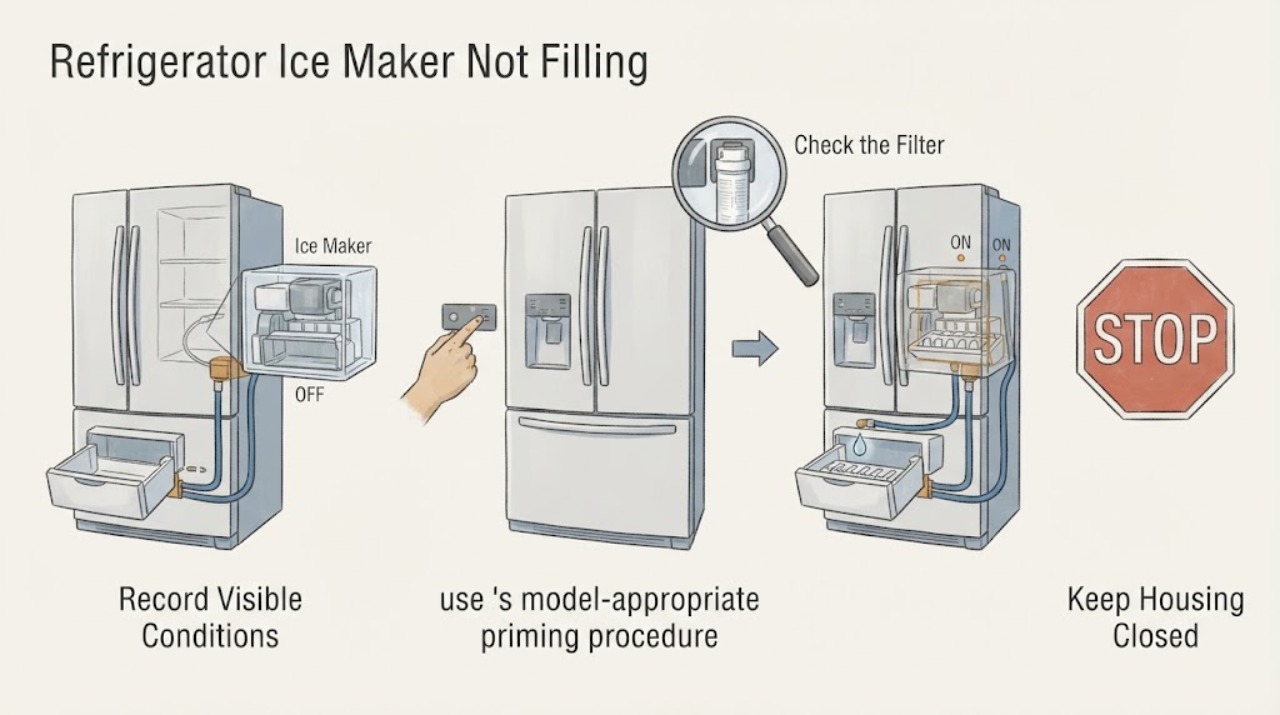
First separate a new-installation delay from a failed water path. Frigidaire's official guidance says to confirm the ice maker is on, prime the water system after installation, and allow the refrigerator to cool; trapped air can produce two or three empty ice cycles, and initial ice production can take up to 24 hours. Then confirm that the refrigerator has water, the display is not locked, and any model-approved filter is seated and not frozen or cracked. These checks do not prove a failed inlet valve, ice-maker motor, thermostat, or control. Do not force a harvest, energize a valve, disconnect tubing, or use a filter part without the exact model manual. If water leaks, the supply cannot be safely checked, or the ice maker remains dry after the model-supported checks, stop the ice maker and arrange Frigidaire service.
Before you begin
Safety first
- This no-model guide is limited to confirming the ice-maker state, priming a newly connected water system according to official guidance, checking accessible supply/lock/filter/bin conditions, and observing visible leaks. Do not force an ice-maker harvest, energize a valve, disconnect water lines, move the refrigerator, open panels, or test wiring.
Work through in order
Diagnostic checks
Use only checks that match the exact appliance or system and its official guide.
-
Check 1
Record the complete refrigerator model and whether it was installed, reconnected, or had its water filter changed recently. Confirm the ice maker's model-specific On/Off indication and that the bin is correctly positioned without forcing a wire arm, tray, or control.
Expected result: The refrigerator is newly installed or reconnected, the ice maker is off or locked, the bin is not seated, or the unit has been operating long enough that these conditions do not explain the dry ice maker.
Next step: Correct only a clearly identified On/Off, lock, or bin condition allowed by the exact manual. For a new installation, continue to the priming branch; otherwise check the water path.
Why this matters
Why: New plumbing air and an off or incorrectly positioned ice maker can produce no fill without a failed part. Frigidaire says initial ice production may take up to 24 hours after installation and cooling; other controls vary by family.
-
Check 2
If the refrigerator is newly installed or the water system was opened, use Frigidaire's model-appropriate priming procedure: dispense water into a container until flow starts, continue flushing as the official guidance directs, and discard the flush water.
Expected result: Water begins flowing and the ice maker later fills, water flow never starts, or the dispenser works but the ice maker remains dry after the initial air-clearing period.
Next step: Allow the refrigerator to cool for the manufacturer-stated period and monitor the first cycles. If there is no flow, a leak, or no fill after the model-supported period, stop testing and arrange service.
Why this matters
Why: Air in new plumbing can account for two or three empty ice cycles. A working dispenser with a dry ice maker narrows the issue to the ice-maker branch but does not prove a valve or control failure.
-
Check 3
Without disconnecting tubing, confirm the refrigerator has power and an accessible water supply, verify the display is not locked, and check that the exact model's filter is seated and not visibly frozen or cracked.
Expected result: The supply is unavailable, the display is locked, the filter is loose, frozen, cracked, or mismatched, or all accessible conditions appear normal.
Next step: Correct only an obvious supply, lock, or model-approved filter seating issue. If a filter leaks or the ice maker remains dry, leave the ice maker off and contact service; do not order a generic cartridge or valve.
Why this matters
Why: Frigidaire's no-water guidance treats these as prerequisites for water and ice output. A normal visible check does not rule out an internal water-path or ice-maker fault.
-
Check 4
Inspect only visible areas for water at the filter housing, dispenser, rear connection, floor, or ice-maker area. Record whether water is leaking even when the ice maker is not cycling.
Expected result: There is a visible or recurring leak, water is near electrical areas, the ice maker remains dry with a working supply, or diagnosis would require hidden access.
Next step: Stop using the ice maker and close the water supply only if safely accessible; keep away from wet electrical areas and arrange qualified Frigidaire service. Do not force a harvest, energize a valve, remove panels, or disconnect hidden hoses.
Why this matters
Why: A leak is a water-damage and electrical-safety branch, while a dry ice maker after supply checks needs model-specific service diagnosis. Neither observation identifies a component by itself.
Use your observations
Decision map
Find the observation that best matches what you see, then follow the next safe action.
-
PATH 01Next step
What you see
The refrigerator was just installed or its water system was recently reconnected, the ice maker is on, and the dispenser has not yet been primed.
Do this next
Prime and flush the water system using the official procedure, allow the model-supported cooling time, and monitor the first cycles. Turn the ice maker off if no water supply is connected.
Why this path and its safety boundary
Why it matters: Frigidaire says trapped air can cause two or three empty ice cycles and that production can take up to 24 hours after installation and cooling.
-
PATH 02Next step
What you see
The display is locked, the ice maker is off, the bin is not seated, or the filter is visibly loose, frozen, cracked, or mismatched.
Do this next
Correct only the condition identified by the exact manual. If the filter leaks or the ice maker stays dry, leave it off and arrange service rather than forcing a cycle.
Why this path and its safety boundary
Why it matters: An accessible enable, filter, or bin condition can prevent water or ice output without proving an internal component failure.
-
PATH 03Next step
What you see
The dispenser works but the ice maker does not fill after priming and the initial installation period has passed.
Do this next
Use the exact model manual for permitted external checks and give the service provider the dispenser result, model, and timing. Do not energize or force internal ice-maker parts.
Why this path and its safety boundary
Why it matters: The supply to the refrigerator may be available while the ice-maker path remains unresolved; this does not identify an inlet valve, mold, motor, or control fault.
-
PATH 04Next step
What you see
Water is leaking from the filter area, dispenser, rear connection, floor, or near an electrical area.
Do this next
Stop the ice maker, close the supply only when safely accessible, keep away from wet electrical areas, and arrange qualified service. Do not pull out the refrigerator or disconnect tubing.
Why this path and its safety boundary
Why it matters: The priority is water damage and electrical safety, not continuing ice-production tests.
Helpful context
Understand the symptom
An ice maker that is not filling can be waiting for water, still clearing air after installation, turned off, blocked by a locked control or incorrectly seated filter, or affected by a model-specific fault. Frigidaire's opened support article applies across several refrigerator families and says that new plumbing can cause two or three empty ice cycles. It does not support choosing an inlet valve, mold thermostat, motor, or control board from this symptom alone.
Start with the least invasive split: is the refrigerator newly installed or recently reconnected, does the dispenser supply water, and is the ice maker visibly enabled? For a new installation, prime the water system using the exact Frigidaire instructions and allow the refrigerator to cool. If the water supply is not connected, turn the ice maker off rather than letting its fill valve chatter.
For an established unit, check only accessible water, lock, filter, and bin conditions that the exact manual supports. A cracked filter or visible leak changes the priority to stopping water and service. Do not force an ice-maker harvest or reach into hidden tubing and wiring; the model number is needed before any part or internal procedure is considered.
When checks do not resolve it
Need a professional?
Call Frigidaire service when the ice maker remains dry after the model-supported supply, priming, lock, filter, and bin checks; when water leaks or the supply cannot be safely checked; or when diagnosis would require moving the refrigerator, disconnecting tubing, opening panels, or touching wiring.
Safety scope: This no-model guide is limited to confirming the ice-maker state, priming a newly connected water system according to official guidance, checking accessible supply/lock/filter/bin conditions, and observing visible leaks. Do not force an ice-maker harvest, energize a valve, disconnect water lines, move the refrigerator, open panels, or test wiring.
Common questions
FAQ
How long should a newly installed Frigidaire refrigerator take to make ice?
Frigidaire says the refrigerator should cool for several hours and the ice maker can produce ice within 24 hours. Air in new plumbing can cause two or three empty ice cycles, so prime the water system first.
Why is the ice maker dry when the refrigerator's water dispenser works?
That comparison shows that some water reaches the refrigerator but does not identify the ice-maker cause. Confirm the ice maker is enabled and use the exact model manual; do not assume an inlet valve or control-board failure.
Can a water filter stop a Frigidaire ice maker from filling?
A filter that is not seated, frozen, cracked, or mismatched can interfere with water delivery on applicable models. Frigidaire says to check correct installation and visible condition, but the exact model determines filter type and replacement procedure.
Should I force the ice maker to cycle or test its fill valve?
No. Do not force a harvest, energize a valve, disconnect tubing, or open the refrigerator. If accessible checks do not restore filling, leave the ice maker off and arrange Frigidaire service with the model and dispenser results.
Read the exact guide
Official sources
- Refrigerators - No WaterFrigidaire · Opened Frigidaire's official support article. It applies to refrigerators and checks power, water supply, display lock, filter seating, freezing/cracking, priming, and service escalation.
- Refrigerator Water LeaksFrigidaire · Opened Frigidaire's official water-leak support article. It distinguishes external connections, internal filter leaks, and dispenser leaks and directs unresolved cases to service; it is not used to infer an ice-maker part.
- What does it mean to Prime the Water Supply System?Frigidaire · Opened Frigidaire's official priming article. It explains air in new plumbing and provides a dispenser-based prime and flush sequence; it is used only for newly connected systems.
- My refrigerator was just installed and the ice maker is not working, how do I fix it?Frigidaire · Opened Frigidaire's official support article. It applies to refrigerators including French Door, Side by Side, and Top Freezer families; it discusses the On/Off state, new-line air, water connection, initial cooling, and first ice production.
Community feedback
Share a repair observation
Share a plain-text repair observation. Accepted observations are published automatically; this page may take a moment to update.