
On this page
Start here
Quick answer
This guide is for a Frigidaire refrigerator that is equipped with an automatic ice maker. First separate two symptoms: no new ice is being produced, or ice is already in the bin but will not dispense. Confirm that the ice-maker feature is enabled using the exact model's controls or owner's guide, and check that the freezer is cold enough for the model. Frigidaire publishes 37°F for the fresh-food section and 0°F for the freezer as suggested settings for referenced electronically controlled models; a newly installed unit needs about 24 hours to stabilize. If the freezer is warm, vents are blocked, a door is not sealing, or the unit recently lost power, correct only the accessible condition and allow stabilization. If water is slow or absent, check the accessible supply connection, filter seating, filter age, and model-specific priming instructions; Frigidaire generally recommends changing the water filter every six months. If ice is already present, inspect the accessible bin, chute, and visible clumping instead of replacing the ice maker. A locked display, open door, three-minute dispenser shutoff, melted-and-refrozen ice around the auger, or an ice jam can stop dispensing even while the ice maker is working. Do not force an auger, open panels, bypass a sensor, test live wiring, disconnect internal water tubing, or work on the valve, ice-maker module, sealed system, or control. Persistent failure after these safe checks needs qualified service.
Before you begin
Safety first
- The user may identify the symptom, read model controls, check documented settings, inspect accessible vents and seals, check an accessible water line and filter, follow model-authorized priming, and clear loose accessible ice when the guide permits. Internal water valves, fill paths, ice-maker modules, auger drives, controls, wiring, live electrical tests, sealed refrigeration work, and panel removal belong to qualified service.
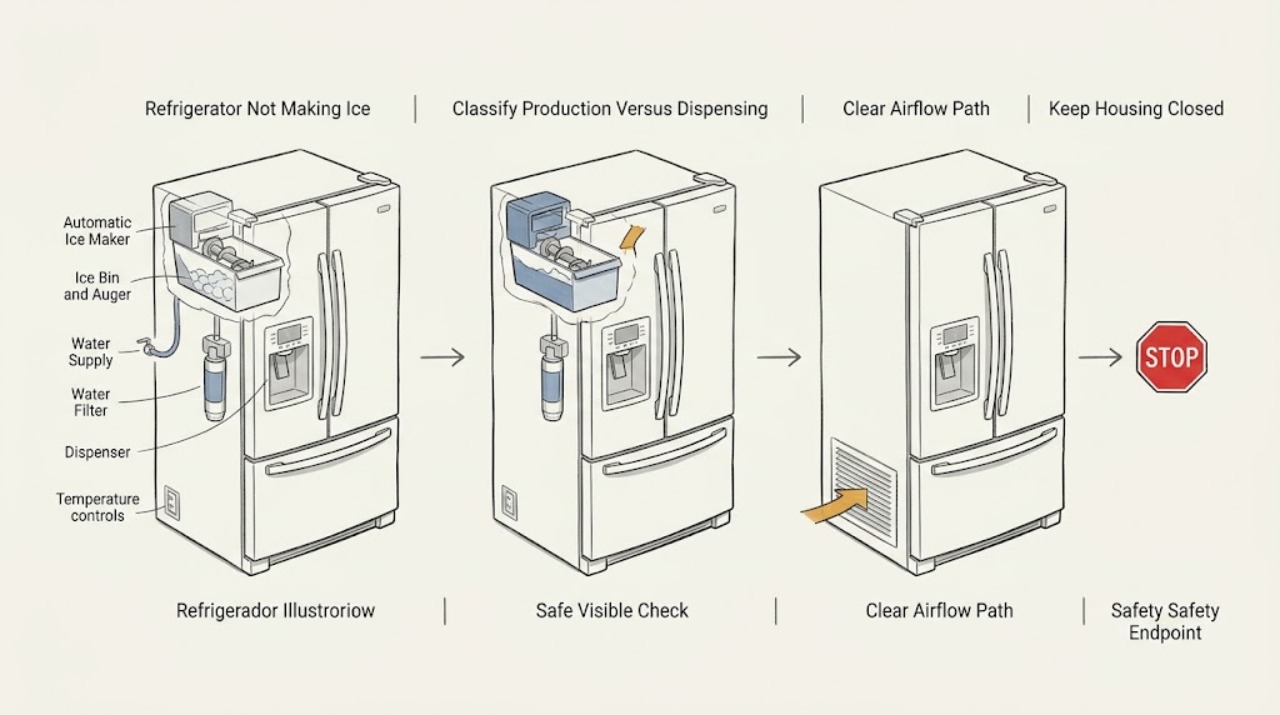
Work through in order
Diagnostic checks
Use only checks that match the exact appliance or system and its official guide.
-
Check 1
From a safe position, identify whether the automatic ice maker is producing no new cubes, making fewer cubes than usual, or has ice already in the bin that will not come out. Note the refrigerator architecture, ice-maker location, dispenser presence, and exact model number for the owner's guide.
Expected result: The mold or collection area is empty, the bin contains cubes, the water dispenser is also affected, or only the dispenser fails while ice is visible.
Next step: For no new ice, continue to the control and freezer checks. For ice in the bin, continue to the delivery-path check. Do not order a part from this symptom alone.
Stop if: Do not remove covers, reach into an auger or ice-maker mechanism, or continue if smoke, burning odor, damaged wiring, or water is near electrical parts.
Why this matters
Why: An empty mold or absent new cubes starts the enablement, temperature, water, and production branch. A bin with cubes starts the lock, door, chute, clump, auger, and dispenser branch. Water behavior helps separate a shared supply problem from an ice-maker-only fault.
-
Check 2
Use the exact owner's guide and the visible control panel, switch, or documented ice-maker control to verify that the automatic ice maker is enabled. Check for a display lock, demo or temporary mode, and any model-specific status indicator; do not force an arm, sensor, or tray.
Expected result: The ice maker is off, the display is locked, a mode prevents normal operation, the control shows active operation, or the model has no user-accessible enable control.
Next step: Correct only the documented user setting or unlock procedure, then observe for the model's normal production period. If the setting is active or the issue returns, continue to the temperature and water checks.
Stop if: Do not enter an undocumented service mode, bypass an arm or sensor, remove the ice-maker cover, or make a live electrical measurement.
Why this matters
Why: An off or locked control can stop ice production or dispensing without a failed component. A displayed active state only shows the selected mode; it does not prove that the water valve, ice-maker assembly, or control is working.
-
Check 3
Read the current refrigerator and freezer settings and any high-temperature alert. Check only accessible vents, door closure, and the visible gasket for a food obstruction or obvious gap. Compare the setting with the exact manual; for the referenced electronic models, Frigidaire suggests 37°F fresh food and 0°F freezer.
Expected result: The freezer is warmer than the model condition, a high-temperature alert is present, vents are blocked, the door or gasket does not seal, or the freezer appears normal.
Next step: Clear only an accessible obstruction, close the door, clean the visible gasket as the manual permits, or return to the model's documented setting. Allow the documented stabilization period before judging production; arrange service if the freezer stays warm or alarms persist.
Stop if: Do not chip frost, remove an evaporator or fan cover, force a damper, or continue operating if food is thawing, water reaches electrical parts, or an electrical hazard is present.
Why this matters
Why: Ice production slows when the freezer is too warm or the cabinet cannot maintain its condition. Blocked airflow, an open door, or poor sealing can cause that pattern. A normal visible temperature and seal make the water, filter, bin, or internal ice-maker branch more likely, but do not prove a part.
-
Check 4
If the refrigerator has a water dispenser or filtered water path, check whether water flows normally. From an accessible dry position, verify that the external supply is turned on as applicable and the line is not visibly kinked; check that the model-specific filter is seated, not cracked or frozen, and not overdue.
Expected result: Water is absent or slow, the filter is loose, cracked, frozen, or past the general six-month interval, the external line is kinked, or water flows normally.
Next step: Use the exact model instructions to reseat or replace the filter with the same specified type, correct only an accessible kink, and prime and purge after a new filter or installation as Frigidaire directs. If water remains absent or a connection leaks, arrange service.
Stop if: Do not disconnect tubing, open an internal valve, bypass the filter, force a housing, or work around water and energized electrical parts.
Why this matters
Why: No or slow water makes a shared supply, filter, or priming problem more likely and can explain no ice. Normal water flow makes an ice-maker-only, temperature, bin, or internal control problem more likely. A filter interval is general guidance, not proof of a specific filter failure.
-
Check 5
Record whether the refrigerator was newly installed, the water filter was just replaced, or a power outage or reset occurred. Follow the model's startup and prime-and-purge instructions, keep the doors closed as practical, and wait for the manufacturer's stabilization or production guidance before judging the result.
Expected result: The symptom began immediately after installation, filter replacement, or an outage; water flow is uneven; or the unit had a normal operating history before the event.
Next step: Complete only the documented priming and purge steps, discard water or ice as directed, and reassess after stabilization. If the model's recovery period has passed with no new ice, return to the service branch rather than repeatedly resetting the appliance.
Stop if: Do not repeatedly cycle power, alter the breaker rating, force a harvest cycle, or open the water or electrical compartments.
Why this matters
Why: Air in new plumbing can cause empty ice-maker cycles, and a new installation or outage can leave the freezer temperature unsettled. A failure that persists after the documented recovery period is less likely to be a transient startup condition.
-
Check 6
If cubes are already in the bin, verify that the display is unlocked, the refrigerator doors close fully, and the chute is not visibly blocked. If the owner's guide permits bin removal, remove it carefully, clear loose clumps, wipe and dry it, and reinstall it without rotating the auger; release the dispenser paddle if it was held continuously.
Expected result: The bin is empty, cubes are melted and refrozen, cubes bridge the maker and bin, the auger is visibly out of alignment, the chute is blocked, or the bin and path are clear but dispensing still fails.
Next step: Clear only loose accessible ice, dry and correctly reseat the bin, and retry after the motor-protection reset if applicable. If alignment, access, or the mechanism is uncertain, stop and arrange model-specific service.
Stop if: Do not pry frozen ice, rotate or force the auger, reach into a moving dispenser, use sharp tools or direct heat, or remove the dispenser housing.
Why this matters
Why: A bin or chute obstruction can prevent delivery even when the ice maker produced cubes. Frigidaire also describes display lock, open doors, and a three-minute dispenser shutoff as non-part causes. A clear bin with persistent failure points toward the dispenser drive, wiring, or control and needs service.
-
Check 7
If the ice maker is enabled, the freezer meets the model condition, water and filter checks are satisfactory, recovery is complete, and the bin or dispenser path is clear, record the model, symptom split, settings, water behavior, filter history, outage or installation history, and any sounds or alerts for service.
Expected result: Ice production resumes after an accessible correction, ice is present but delivery remains dead, or no new ice appears after all documented user checks.
Next step: Arrange qualified Frigidaire or appliance service for internal diagnosis. Keep the refrigerator out of service for smoke, burning odor, damaged cord, repeated breaker trips, water near electrical parts, or a freezer that cannot keep food safely frozen.
Stop if: Do not open panels, test live circuits, handle refrigerant, disconnect internal water lines, bypass sensors, or replace a component without model-specific diagnosis.
Why this matters
Why: Recovery after a setting, water, filter, or bin correction supports that external branch. Persistent no-production can involve the inlet valve, fill path, ice-maker assembly, sensor, control, wiring, or refrigeration system; persistent no-dispense with ice present can involve the auger drive or dispenser control. The symptom cannot safely identify one part.
Use your observations
Decision map
Find the observation that best matches what you see, then follow the next safe action.
-
PATH 01Safety boundary
What you see
The automatic ice-maker feature is off, the display is locked, or a documented mode prevents ice or dispensing.
Do this next
Use the exact model guide to enable the feature or unlock the display, then allow the model's normal production period. If the feature is already active, continue to temperature and water checks.
Why this path and its safety boundary
Why it matters: A user control state is more likely than a failed ice-maker part at this stage.
Safety stop: Do not bypass a sensor or enter an undocumented service mode.
-
PATH 02Safety boundary
What you see
The freezer is warm, has a high-temperature alert, blocked accessible vents, an open door, a poor visible gasket seal, or the appliance recently started or recovered from an outage.
Do this next
Correct only the accessible obstruction or documented setting, protect food, and allow the specified stabilization period. Persistent warmth, alarms, or frost behind a cover needs service.
Why this path and its safety boundary
Why it matters: Unstable freezer conditions are more likely to suppress ice production than an isolated ice-maker failure.
Safety stop: Do not chip frost, apply heat, remove panels, or keep using the appliance if food is thawing or water reaches electrical parts.
-
PATH 03Safety boundary
What you see
The water dispenser is also slow or empty, the external line is kinked, the filter is loose, cracked, frozen, overdue, or the issue started after a new filter or installation.
Do this next
Verify the model-specific filter and accessible supply condition, then follow Frigidaire's prime-and-purge guidance after installation or filter replacement. Arrange service for persistent no water, leaks, or inaccessible connections.
Why this path and its safety boundary
Why it matters: A shared water path, filter, or trapped air is more likely than a dispenser-only or ice-maker-only mechanism.
Safety stop: Do not disconnect tubing, open the internal valve, bypass the filter, or work near energized electrical parts.
-
PATH 04Safety boundary
What you see
The bin contains ice, but the dispenser does not deliver it; the display is unlocked, doors are closed, or melted-and-refrozen cubes and a chute or auger jam are visible.
Do this next
Clear only loose accessible ice, dry and correctly reseat the bin as the manual permits, and retry after letting go of an over-held paddle. Persistent failure with a clear bin needs service for the drive or control.
Why this path and its safety boundary
Why it matters: The ice maker may be producing normally; bin position, clumping, the chute, auger alignment, or the dispenser motor-protection state is more likely.
Safety stop: Do not force or rotate the auger, pry frozen ice, reach into the dispenser, or remove the dispenser housing.
-
PATH 05Safety boundary
What you see
The feature is enabled, the freezer and water path meet the documented conditions, recovery is complete, and no accessible bin or chute issue explains the missing ice or delivery failure.
Do this next
Arrange qualified model-specific service and provide the exact model, architecture, settings, water and filter history, bin condition, and any alerts or unusual sounds.
Why this path and its safety boundary
Why it matters: An ice-maker assembly, inlet valve, fill path, sensor, dispenser drive, control, wiring, or refrigeration fault becomes more likely, but the symptom cannot select a replacement part.
Safety stop: Do not open panels, live-test wiring, handle refrigerant, disconnect internal water lines, or continue operation with smoke, burning odor, water near electrical parts, or repeated breaker trips.
Helpful context
Understand the symptom
Start by identifying which ice symptom you have
A refrigerator that is not making ice has a different first check from one that has a full bin but will not deliver cubes. Look at the ice-maker mold or collection area, the bin, and the dispenser without removing covers. No new cubes points toward enablement, freezer temperature, water supply, filtration, or the ice-maker mechanism. A bin containing cubes points toward display lock, door closure, chute, clumping, auger alignment, or the dispenser motor-protection state. This distinction prevents a dispenser repair from being mistaken for an ice-production failure.
Check the model controls and freezer conditions
Ice-maker controls differ among Frigidaire French Door, Side-by-Side, Top Freezer, and other refrigerator configurations. Use the exact owner's guide to confirm that the automatic ice maker is enabled and that no lock or temporary mode prevents operation. For referenced electronic controls, Frigidaire suggests 37°F in the fresh-food section and 0°F in the freezer, but those values are not a substitute for the model guide. A recently installed or power-restored unit needs its documented stabilization period; a freezer that remains warm, has blocked vents, a poor door seal, or a high-temperature alarm needs a cooling diagnosis before an ice-maker diagnosis.
Use water and filter behavior to choose the next branch
An automatic ice maker needs the refrigerator's water path. If the water dispenser is also slow or empty, check only the accessible supply connection and line for an obvious kink, then verify that the model-specific water filter is seated, not cracked or frozen, and not overdue. Frigidaire recommends a six-month filter interval in general and says a newly installed filter or refrigerator should be primed and purged according to its guidance. Do not disconnect tubing, open a valve, or infer a particular replacement part from a no-ice symptom.
If ice exists, inspect the bin and delivery path
Ice already in the bin means production may be normal even if the cup stays empty. Frigidaire identifies a locked display, incompletely closed doors, a dispenser paddle held too long, melted ice refrozen around the auger, and cubes jammed between the ice maker and bin as common checks. Remove the bin only as the owner's guide permits, clear loose accessible ice, wipe and dry the bin, and reinstall it in the correct position. Avoid rotating the auger; if it has moved, use only the model's documented alignment method. Do not pry at a frozen mechanism or reach into a moving auger.
Know when the ice-maker mechanism is a service job
When the feature is enabled, the freezer is at the model's documented condition, water and filter checks are satisfactory, and the bin is clear, persistent absence of new ice can involve the inlet valve, fill path, ice-maker assembly, sensor, wiring, control, or a refrigeration problem. The visible symptom cannot identify which component failed. Stop user troubleshooting at that point. Smoke, a burning smell, water near electrical parts, a damaged cord, repeated breaker operation, or a freezer that cannot maintain a safe temperature is an immediate stop condition.
Only after diagnosis
Potential parts
- refrigerator water filter
Consider a replacement only when the exact model filter is overdue, damaged, frozen, incorrectly seated, or water flow remains poor after the documented seating and prime-and-purge checks.
Use the complete refrigerator model and the manufacturer's filter information; Frigidaire says the filter type is model-specific. - ice bin or auger assembly
Consider this only when ice is present but a qualified diagnosis finds a damaged bin, persistent auger alignment problem, or delivery obstruction that is not a loose accessible ice jam.
Bin and auger arrangements vary by French Door, Side-by-Side, and other configurations; confirm the model before ordering. - automatic ice maker assembly
Consider this only after enablement, freezer condition, water, filter, startup, and bin checks pass and qualified service identifies the ice-maker assembly as the failed component.
The no-ice symptom alone does not identify an ice-maker assembly or prove fit; verify the complete model and service diagnosis. - water inlet valve or fill-path component
Consider this only when a qualified technician confirms a supply-side internal fault after external line, filter, water-flow, and installation checks are satisfactory.
Internal water components and connections are model-specific and require professional diagnosis; do not disconnect or test them as a user. - dispenser drive or control component
Consider this only when the bin contains usable ice, the chute and bin are correctly positioned, and a qualified diagnosis confirms a drive, control, or wiring fault.
Dispenser mechanisms differ by refrigerator architecture; confirm the complete model and diagnosis before any part selection.
When checks do not resolve it
Need a professional?
Arrange qualified Frigidaire or appliance service when the automatic ice maker remains inactive after enablement, documented freezer and water checks, filter and prime-and-purge steps, startup recovery, and bin inspection; when ice is present but the delivery path remains clear and nonfunctional; or when diagnosis would require a valve, fill path, ice-maker assembly, auger drive, control, wiring, panel, or sealed refrigeration access. Stop using the refrigerator and isolate power only from a dry, safe disconnect for smoke, burning odor, damaged cord, repeated breaker operation, water near electrical parts, or a freezer that cannot keep food safely frozen.
Safety scope: The user may identify the symptom, read model controls, check documented settings, inspect accessible vents and seals, check an accessible water line and filter, follow model-authorized priming, and clear loose accessible ice when the guide permits. Internal water valves, fill paths, ice-maker modules, auger drives, controls, wiring, live electrical tests, sealed refrigeration work, and panel removal belong to qualified service.
Common questions
FAQ
Why is my Frigidaire refrigerator not making ice even though it is running?
Check the exact model's ice-maker enable control, freezer condition, water flow, filter seating and age, and whether the refrigerator recently started or recovered from an outage. A running compressor or lit display does not prove that the ice maker is enabled or receiving water.
What temperature should a Frigidaire refrigerator use to make ice?
Frigidaire publishes 37°F for the fresh-food section and 0°F for the freezer as suggested settings for referenced electronically controlled models. Use the exact owner's guide for your configuration and allow the documented stabilization period after installation or a change.
Can a water filter stop a Frigidaire refrigerator from making ice?
Yes, a loose, cracked, frozen, clogged, or overdue filter can restrict the shared water path. Frigidaire generally recommends changing the water filter every six months, matching the model's filter type, and priming and purging after a new filter.
Why is there ice in the bin but nothing comes out of my Frigidaire dispenser?
This is usually a delivery-path symptom rather than proof that the ice maker failed. Check the display lock, door closure, chute, bin position, melted-and-refrozen clumps, and visible ice between the maker and bin. Do not force the auger; persistent failure with a clear bin needs service.
How long should I wait after installing a Frigidaire refrigerator before judging the ice maker?
Frigidaire says a newly installed refrigerator needs about 24 hours for temperature stabilization and that air in new plumbing can cause empty ice-maker cycles. Follow the exact model's startup and prime-and-purge guidance before treating the symptom as a persistent failure.
Read the exact guide
Official sources
- Refrigerator Error Code DI SP or DISP - Ice JamFrigidaire · Frigidaire refrigerators with the DI SP or DISP ice-jam condition
- Refrigerators - What is the recommended temperature settings for my refrigerator?Frigidaire · Refrigerators, French Door Refrigerators, Side by Side Refrigerators, and Top Freezer Refrigerators
- Refrigerator Prime and Purge GuideFrigidaire · Frigidaire refrigerators after installation or water-filter replacement
- Refrigerator Error Code H or HI - High TemperatureFrigidaire · Frigidaire refrigerators displaying the H or HI high-temperature condition
- Delivery and Installation Guide - RefrigeratorFrigidaire · Frigidaire refrigerators installed with an ice maker or ice-and-water dispenser
- Refrigerator Error Codes and Alarms GuideFrigidaire · Frigidaire refrigerators with the listed alarms or error conditions
- Refrigerators - Not CoolingFrigidaire · Frigidaire refrigerators
- Refrigerators - How often should I change my water filter?Frigidaire · Refrigerators, French Door Refrigerators, Side by Side Refrigerators, and Top Freezer Refrigerators
- What should I do if the dispenser on my refrigerator is not dispensing ice?Frigidaire · Refrigerators, French Door Refrigerators, Side by Side Refrigerators, and Top Freezer Refrigerators
- What should I do if my ice maker is not making enough ice in my refrigerator?Frigidaire · Refrigerators, French Door Refrigerators, Side by Side Refrigerators, and Top Freezer Refrigerators
- Refrigerators - No WaterFrigidaire · Frigidaire refrigerators with a water and ice supply path
- Refrigerators - How do I use the features and functions on my French-Door refrigerator display?Frigidaire · Frigidaire French Door, Side by Side, and Top Freezer refrigerator displays where the listed controls are fitted
Community feedback
Share a repair observation
Share a plain-text repair observation. Accepted observations are published automatically; this page may take a moment to update.