
On this page
Start here
Quick answer
If a Frigidaire FGHD2368TF2 ice-maker tray receives water but no ice forms and a cooling fan is not heard, the water-fill observation does not prove that the freezer or ice compartment is cold enough, that the ice maker is enabled, or that the fan itself has failed. Confirm the ice maker is ON, the refrigerator has had time to stabilize, the water filter is seated and the line is not kinked, and that the freezer is actually near the manufacturer’s recommended setting with vents unobstructed. Observe the refrigerator without touching a fan or removing a cover. If the freezer is warm, the fan remains absent during a documented cooling complaint, or the tray still does not freeze after the external checks and one full stabilization period, stop trying to force a harvest and arrange Frigidaire service; do not infer a fan, board or ice-maker part from sound alone.
Before you begin
Safety first
- Do not remove rear covers, probe live wiring, touch fan blades, bypass a door switch, force an ice-maker harvest, puncture frost, release refrigerant or select a fan, control board or ice-maker part from the symptom alone. Protect food if freezer temperature is unsafe and use an authorized service path.
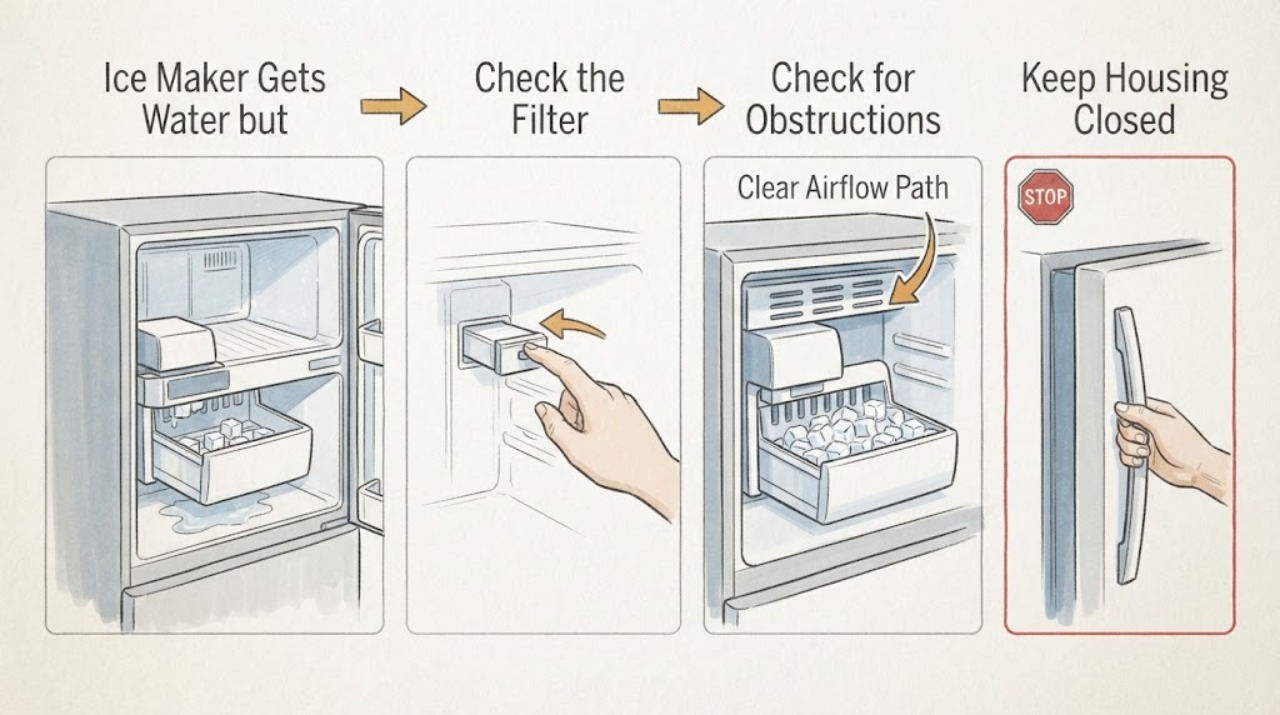
Work through in order
Diagnostic checks
Use only checks that match the exact appliance or system and its official guide.
-
Check 1
Confirm the exact model display or control setting has the ice maker ON, the doors are closing, and the refrigerator has remained powered long enough to stabilize. If it was newly installed, recently powered off or fitted with a new water line/filter, complete the manufacturer’s prime-and-purge guidance and allow the documented stabilization period before judging production.
Expected result: The ice maker is OFF/locked, the unit has not had a full stabilization period, or the ice maker is ON and the unit has been cold and powered for at least the required period.
Next step: Correct only the documented ON, lock, installation or priming condition and wait one complete stabilization period. If the model has been cold and operating normally but still makes no ice, continue to the water/filter and temperature checks instead of repeating a forced harvest.
Why this matters
Why: Frigidaire says a newly installed refrigerator may take up to 24 hours for temperature and ice production, and trapped air can cause two or three empty cycles. An ON indicator and a tray fill do not establish that the ice-making cycle has finished.
-
Check 2
With the refrigerator off only when the exact manual requires it, inspect the household water connection, visible line for kinks and the water filter for correct seating, cracks or freezing. Test the dispenser only as an external water-flow observation; do not disconnect a pressurized line or open the rear valve assembly.
Expected result: Water dispensing is slow or absent, the filter is not fully seated/frozen/cracked, the supply line is kinked, or water flow is normal and the tray still receives its fill.
Next step: Reinstall or replace the filter only with the model-approved cartridge and prime/purge as directed; straighten only an accessible line without moving the refrigerator unsafely. If dispenser flow and tray fill are normal, do not keep replacing filters—move to the cooling and airflow checks.
Why this matters
Why: Frigidaire says the refrigerator needs water to make ice and identifies a mis-seated, clogged, frozen or cracked filter and a restricted line as causes of no or low ice. Normal tray fill makes a total supply failure less likely but does not rule out a temperature or harvest problem.
-
Check 3
Read the freezer temperature with a reliable appliance thermometer or the model display and clear food from internal vents and the freezer air path. Compare the result with Frigidaire’s recommended freezer setting/range and allow 24 hours after a temperature change before evaluating ice production.
Expected result: The freezer is warmer than the recommended range, frost or food blocks airflow, or the freezer is within the recommended range with clear vents.
Next step: Restore clear airflow and use the exact model controls; do not scrape frost with a sharp tool or disassemble the evaporator area. If temperature remains warm after the stabilization period, arrange cooling service and protect perishable food.
Why this matters
Why: Frigidaire states that ice production can fall when the freezer is too warm, airflow is blocked or frost reduces circulation. A cold compartment with no ice after stabilization points toward an unresolved ice-maker/fan/control condition, but it still does not identify a part.
-
Check 4
Observe the refrigerator from outside the guarded airflow areas during a normal cooling period and record whether you hear airflow, compressor operation or only the water-fill event. Do not open a cover, touch a fan blade, bypass a door switch or enter a technician diagnostic mode.
Expected result: The compartment is warm and no cooling airflow is apparent, the refrigerator is cold but the fan remains consistently absent, or normal cooling sounds/temperatures are present.
Next step: If the unit is warm, has heavy frost, or remains without expected cooling after stabilization, stop using the ice maker and schedule service. If it is cold but the tray still does not freeze after the external checks, document the fan observation and model number for service rather than ordering a fan or board.
Why this matters
Why: Frigidaire identifies evaporator/condenser airflow and ice-maker sounds as normal operating observations, while its cooling guidance treats persistent no-cool after stabilization as a service condition. Silence alone does not distinguish a stopped fan from a door/defrost/control state.
-
Check 5
After the external checks and one full stabilization period, inspect only the accessible ice bin and tray area for an obvious obstruction or ice jam; do not pry frozen parts or force the ice-maker ejector. If water entered the tray but remains liquid or no cubes are released, stop testing.
Expected result: The bin/auger is visibly jammed, the tray contains frozen cubes that are not released, the tray is empty after the fill event, or the area is clear but no ice is produced.
Next step: Use only warm water for an accessible bin jam as described by the manual, dry the bin completely and reinstall it correctly. For a liquid tray, failed harvest or repeated no-ice condition, leave the refrigerator operating only if temperatures are safe and arrange Frigidaire service.
Why this matters
Why: A dispenser jam is different from a tray that never freezes or harvests. Frigidaire warns against sharp tools around the ice bin and directs unresolved ice production problems to service; the observation does not prove a particular motor, fan, thermostat or control failure.
Use your observations
Decision map
Find the observation that best matches what you see, then follow the next safe action.
-
PATH 01Next step
What you see
The refrigerator is newly installed or recently had a filter, water line or power change, and the ice maker is ON but has been observed for less than the full stabilization period.
Do this next
Prime and purge the water system as directed, keep the ice maker ON, and wait one full stabilization period without forcing a harvest.
Why this path and its safety boundary
Why it matters: Frigidaire allows empty cycles while air leaves new plumbing and requires time for the refrigerator to cool before ice production is judged.
-
PATH 02Next step
What you see
The dispenser is slow or absent, the filter is mis-seated/frozen/cracked, or the visible water line is kinked, even though the tray received some water.
Do this next
Correct the documented filter or accessible line issue, prime/purge after a filter change, and observe one normal cycle. Escalate if water flow is normal but ice still does not form.
Why this path and its safety boundary
Why it matters: A partial fill event does not rule out restricted flow; Frigidaire identifies the filter and water line as common no-ice checks.
-
PATH 03Next step
What you see
The freezer is warmer than the recommended range, vents are blocked, or frost is reducing airflow; the fan is also not heard.
Do this next
Clear only accessible airflow obstructions, keep doors closed and allow the manufacturer’s stabilization period. If temperature does not recover or frost is excessive, stop relying on the ice maker and schedule cooling service.
Why this path and its safety boundary
Why it matters: The cooling condition takes priority over the ice maker. A warm compartment can prevent freezing regardless of a successful water fill, and a silent fan is not enough to identify which cooling component is involved.
-
PATH 04Next step
What you see
The freezer is at the recommended temperature, water flow and filter are normal, the tray receives water, but no ice forms or the cooling fan remains consistently absent after stabilization.
Do this next
Record the temperature, fill observation, fan observation, display status and timing, then request Frigidaire service. Do not remove panels, touch wiring or order a fan, board or ice-maker assembly from this symptom alone.
Why this path and its safety boundary
Why it matters: The external checks have not established a safe user repair. The remaining possibilities include an ice-maker, airflow or control condition that Frigidaire’s consumer pages do not identify by sound alone.
Helpful context
Understand the symptom
Water in the tray is only one part of the ice cycle
Seeing water enter the FGHD2368TF2 ice-maker tray confirms that a fill event occurred; it does not show that the tray reached freezing temperature or that the mold will harvest. Frigidaire’s guidance points first to the ON state, water filter and supply, freezer temperature, airflow and the 24-hour stabilization period. The manufacturer’s family support page provides the FGHD2368TF Gallery guide, but the guide itself notes that features vary by model, so the suffix-specific manual and service path remain controlling.
A quiet fan is an observation, not a component diagnosis
Frigidaire’s noise guidance identifies evaporator and condenser airflow sounds and says the ice-maker fan and water valve can create sounds during ice-making operation. A door-open observation, a defrost interval or a warm compartment can change what is heard. Do not reach through a grille, remove a rear cover or force a fan to run to prove a fault; use measured compartment temperature and the manufacturer’s service boundary instead.
Do not confuse making ice with dispensing ice
If cubes exist but cannot leave the bin, that is an auger or dispenser path issue. This task describes water entering a tray and no ice forming, so the relevant branch is freezing and ice-maker operation. Frigidaire’s no-ice guidance still makes the water filter, door/lock and bin checks useful before service, but an empty tray after a fill event is not fixed by repeatedly working the dispenser.
When checks do not resolve it
Need a professional?
Arrange Frigidaire service when the freezer remains warm, has persistent frost or lacks expected cooling airflow after stabilization; when the tray receives water but remains liquid or does not harvest after the external water/filter/temperature checks; or when the fan is consistently absent and the condition cannot be explained by a documented operating state.
Safety scope: Do not remove rear covers, probe live wiring, touch fan blades, bypass a door switch, force an ice-maker harvest, puncture frost, release refrigerant or select a fan, control board or ice-maker part from the symptom alone. Protect food if freezer temperature is unsafe and use an authorized service path.
Common questions
FAQ
Does water entering the FGHD2368TF2 ice-maker tray prove the ice maker is working?
No. It confirms a fill event, but the tray still must freeze and harvest. Check the ice-maker ON state, freezer temperature, airflow, filter and stabilization period before service; do not infer a failed fan or control board from the water fill alone.
How long should I wait before calling it a no-ice problem?
Frigidaire says a newly installed or recently disturbed refrigerator may need up to 24 hours to stabilize, and new plumbing can cause two or three empty ice cycles. After that period, a cold freezer with normal water flow but no ice warrants service if the external checks do not change the result.
Can a quiet fan be the reason there is no ice?
It can be relevant if the freezer is warm or cooling airflow is absent, but silence is not a diagnosis. Frigidaire lists evaporator, condenser and ice-maker fan sounds as operating observations and directs persistent no-cooling after stabilization to service. Do not access the fan or bypass a safety switch.
Should I replace the ice-maker fan or control board?
Not from this symptom alone. The official guidance supports checking temperature, airflow, water/filter condition and the ice-maker setting, then using service for an unresolved cold-but-no-ice condition. Exact part fit and internal testing require the model-specific service procedure.
Read the exact guide
Official sources
- Refrigerators - Not CoolingFrigidaire Owner Support · Opened Frigidaire support article for all refrigerators. It supports external power, temperature, vent, door-seal and stabilization checks; persistent no-cool leads to service rather than a fan diagnosis.
- Freezer - Not Freezing or Not CoolingFrigidaire Owner Support · Opened Frigidaire support article for freezers and refrigerators with freezers. It supports the reported cooling fan not running observation only as a symptom-level cooling check: temperature, airflow, frost and expected fan/compressor sounds. It does not define this phrase as a diagnostic code, authorize live fan testing or support internal part selection.
- Product Support: Frigidaire Gallery 21.7 Cu. Ft. Counter-Depth French Door Refrigerator Stainless Steel-FGHD2368TFFrigidaire Canada · Opened Frigidaire’s official product-support page for the FGHD2368TF Gallery family. It identifies the refrigerator family and exposes the official Complete Owner’s Guide, installation documents and ice-maker/no-cooling support links. The task model suffix is FGHD2368TF2, so the family guide is used with suffix-specific model documentation as the controlling reference.
- What should I do if my ice maker is not making enough ice in my refrigerator?Frigidaire Owner Support · Opened Frigidaire support article applying to refrigerators including French-door models. It supports the temperature, filter, line and airflow/usage checks but does not diagnose the assigned cooling fan.
- Refrigerators - No IceFrigidaire Owner Support · Opened Frigidaire support article for refrigerators not producing ice. It supports temperature stabilization, display/lock, water supply, filter seating/condition, bin and service checks; it does not identify a fan or control-board failure.
- Refrigerators - No WaterFrigidaire Owner Support · Opened Frigidaire support article for refrigerators with no dispenser water. It is used only for external water/filter checks because the task reports a tray fill and therefore does not establish a total water failure.
- Refrigerators Noise GuideFrigidaire Owner Support · Opened Frigidaire noise guide for all refrigerators. It identifies normal fan and ice-maker sounds without providing a consumer procedure to test a fan or select a replacement part.
- All about the Use & Care of your Refrigerator (A05947004, May 2018)Frigidaire · Opened from the official Frigidaire product-support page. The guide covers the Gallery family and states that features vary by model; it supports the assigned FGHD2368TF2 family-level external checks, ice-maker ON state, water/filter/temperature guidance, normal fan sounds and service boundary without claiming a suffix-specific internal diagnosis.
- My refrigerator was just installed and the ice maker is not working, how do I fix it?Frigidaire Owner Support · Opened Frigidaire support article applying to French-door refrigerators and other refrigerator types. It supports the new-installation and recent-plumbing branch only; it is not used to infer that the assigned unit is newly installed.
- Refrigerators - What does it mean to “Prime the Water Supply System” and why is it important for my refrigerator?Frigidaire Owner Support · Opened Frigidaire support article for refrigerators. It supports priming/purging as a conditional step after installation or water-system work and does not support any internal ice-maker or fan repair.
Community feedback
Share a repair observation
Share a plain-text repair observation. Accepted observations are published automatically; this page may take a moment to update.