
On this page
Start here
Quick answer
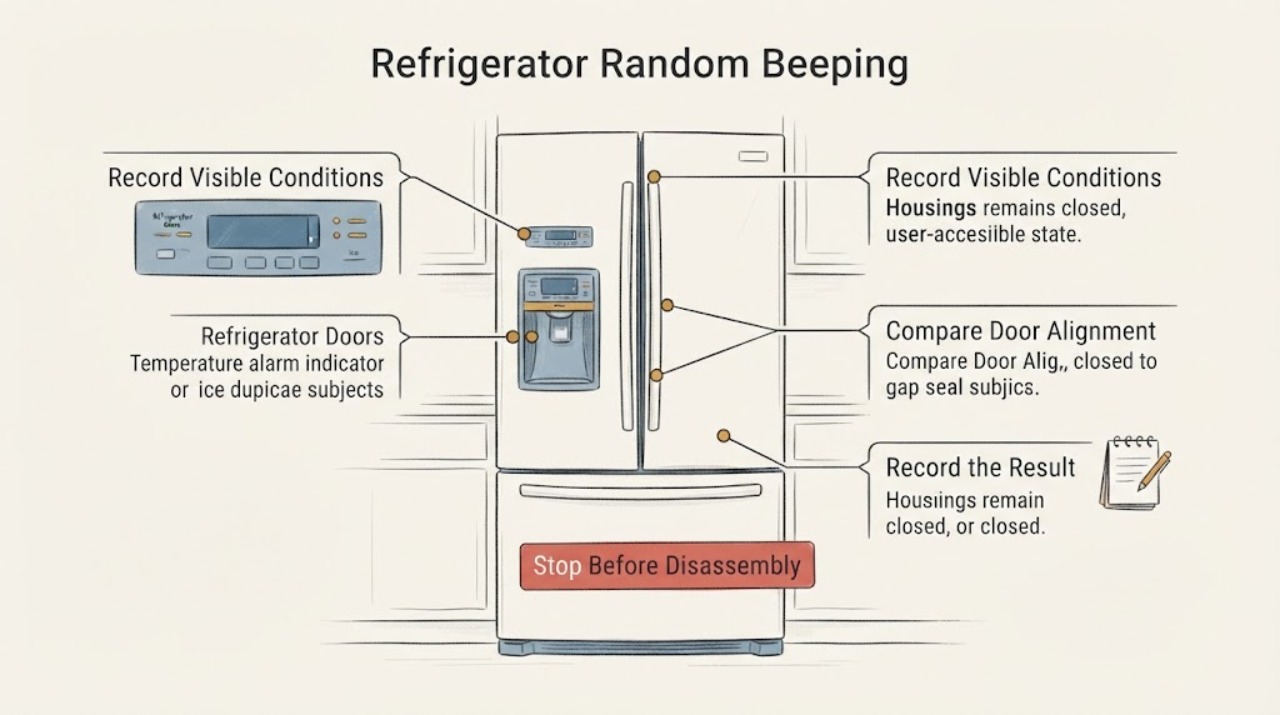
A Frigidaire refrigerator that beeps at random should first be treated as an alarm signal, not as proof of a failed control board. Frigidaire's opened guidance separates a door-ajar alarm, a high-temperature H/HI alarm, a power-failure PF indication, and an ice-chute DI SP alarm; the exact display and control behavior varies by model. Check that every door closes without an obstruction, inspect the visible gasket and hinge area, note any H/HI, PF, Door Ajar or DI SP message, and measure the refrigerator with an appliance thermometer. Keep the doors closed if the refrigerator is warm, and do not use a generic button combination or disconnect the speaker. If the doors seal, the temperature is safe, no documented alarm is shown, and the random beeping persists, record the pattern and request Frigidaire or qualified service rather than guessing a sensor or board.
Work through in order
Diagnostic checks
Use only checks that match the exact appliance or system and its official guide.
-
Check 1
Stand at the refrigerator and record the beep pattern without repeatedly opening doors or pressing unlabeled controls. Note whether the display shows Door Ajar, H or HI, PF, DI SP, another code, or no message; also note whether the interior light and control display remain powered.
Expected result: A documented alarm label appears, only the display or lights are active, or the beep occurs with no visible message.
Next step: Follow the exact model's owner manual for the displayed condition. If no message is present, continue with the door, temperature and visible dispenser checks instead of using a cross-model reset.
Why this matters
Why: Frigidaire assigns different meanings to Door Ajar, H/HI high temperature, PF power failure and DI SP ice-chute conditions. A silent display with random beeps is not enough to select one meaning or a replacement part.
-
Check 2
Close each refrigerator and freezer door normally and inspect the accessible gasket, hinge-side edge and door opening for a container, shelf, ice buildup or packaging that prevents full closure. Do not slam the door or remove the door switch.
Expected result: A door was obstructed or not fully sealing, or every door closes and the gasket contacts evenly with no visible obstruction.
Next step: Remove only the accessible obstruction, close the door and observe whether the alarm clears. If the gasket is torn, the door is misaligned, or the alarm returns with a closed door, request model-specific service rather than adjusting the hinge or switch.
Why this matters
Why: Frigidaire says a door left open for five minutes or more can sound the Door Ajar alarm and says a non-sealing door can cause unstable temperature. A closed-looking door does not prove the seal or switch is working, but a corrected obstruction is a distinct external result.
-
Check 3
Place an appliance thermometer in the refrigerator and, if available, read the freezer thermometer without leaving the doors open. Record the reading and whether the compressor is maintaining cold; do not judge food safety from the beep, smell or appearance alone.
Expected result: The refrigerator is at or below 40°F, or it is above 40°F, rising, or the duration above 40°F is unknown.
Next step: If warm or rising, keep doors closed, avoid repeated test cycles and move or discard perishable food using FDA guidance. Arrange service for the refrigerator and do not treat an alarm mute as proof that cooling is restored.
Why this matters
Why: FDA uses 40°F or below as the refrigerator target. Frigidaire's H/HI guidance describes a high-temperature alarm that may remain active until temperature returns to normal; the temperature branch takes priority over silencing the sound.
-
Check 4
If the display shows PF or the refrigerator recently lost power, inspect the accessible plug and dedicated receptacle from a dry position and check whether the outlet's protective device has tripped. Do not repeatedly reset a tripping circuit or open electrical covers.
Expected result: PF or a recent power interruption is shown, the outlet is restored and the refrigerator is cooling, or the supply remains interrupted or trips again.
Next step: Use only the exact manual's documented acknowledgement after power is stable. If the receptacle will not stay powered, the cord is damaged, or the breaker/GFCI trips again, leave the refrigerator safely disconnected and arrange qualified electrical or appliance service.
Why this matters
Why: Frigidaire says PF indicates a power failure or surge and that a prolonged outage can also produce a high-temperature alarm. Repeated electrical interruption is a supply or appliance safety issue, not a random-beep setting.
-
Check 5
Look only at the accessible ice chute and dispenser area if the display shows DI SP or if beeping occurs while using the dispenser. Do not insert tools into the chute or dismantle the dispenser; if safe and the manual permits, remove only a visible loose blockage or follow the model's bin instructions.
Expected result: DI SP is displayed or a visible ice blockage is present, or the chute is clear and no dispenser condition matches.
Next step: Use the exact model's ice-dispenser guidance for a visible blockage. If no blockage is visible or the alarm returns, stop manipulating the dispenser and request service.
Why this matters
Why: Frigidaire documents DI SP as an ice cube jammed in the chute for too long. A clear chute and random beeping do not establish a dispenser motor or control-board fault.
Use your observations
Decision map
Find the observation that best matches what you see, then follow the next safe action.
-
PATH 01Next step
What you see
The beep occurs after a door has been open or a gasket/obstruction check finds that a door was not sealing, and the alarm stops after the door is correctly closed.
Do this next
Monitor the seal and door closure. If the alarm returns with a visibly closed, unobstructed door, obtain the exact model manual and arrange service instead of slamming or adjusting the door.
Why this path and its safety boundary
Why it matters: This pattern is consistent with Frigidaire's Door Ajar behavior, but it does not prove the door switch or hinge is defective.
-
PATH 02Next step
What you see
H or HI appears, the refrigerator or freezer is above its safe target, or the alarm remains after an extended door opening or power interruption.
Do this next
Keep the doors closed, document temperatures and the time course, protect or discard perishable food as applicable, and call appliance service if cooling does not recover.
Why this path and its safety boundary
Why it matters: The priority is temperature recovery and food safety, not muting the beeper. Frigidaire describes H/HI as high temperature, while FDA sets 40°F or below for the refrigerator and says uncertain warm-food exposure should be treated cautiously.
-
PATH 03Next step
What you see
PF is shown or the refrigerator has just regained power, the temperature is recovering, and the beep follows the documented power-failure state.
Do this next
After stable power, use only the exact model's documented acknowledgement. If the circuit trips again or the temperature remains unsafe, leave the appliance for qualified service.
Why this path and its safety boundary
Why it matters: The alarm can be a power-failure history or a related high-temperature condition; it is not evidence of a failed control board.
-
PATH 04Next step
What you see
The doors seal, the refrigerator is at or below 40°F, no documented display alarm or dispenser blockage is present, and beeping continues randomly.
Do this next
Record when the beep occurs, the display state and thermometer readings, then request Frigidaire or qualified service. Do not disconnect the speaker, open the control panel, or order a board based on the symptom.
Why this path and its safety boundary
Why it matters: The opened official guidance does not identify a universal cause for this pattern. A sensor, control, door switch or other internal diagnosis cannot be selected safely from the sound alone.
Helpful context
Understand the symptom
A random beep is a symptom until its display and temperature are known
The task names Frigidaire but does not provide a refrigerator model, door layout, display type, or code. Frigidaire's support pages cover several refrigerator families and explicitly say that owner-manual behavior can vary by model. Use the beep together with the visible display, door position, temperature and ice-dispenser condition. Do not transfer a Sabbath-mode, alarm-reset, or two-button sequence from another refrigerator.
Protect food while deciding whether the sound is a door alarm or a temperature alarm
A quiet refrigerator can still be unsafe if the compartment is warm. Place an appliance thermometer in the refrigerator and record the actual temperature while keeping the doors closed as much as practical. Frigidaire identifies H/HI as a high-temperature condition and FDA guidance uses 40°F or below as the refrigerator safety target; a beep that stops after closing a door is a different branch from a beep that continues with rising temperature.
When checks do not resolve it
Need a professional?
Immediately for smoke, a burning smell, damaged cord or plug, water near electrical parts, repeated breaker/GFCI trips, or another electrical hazard., Promptly when the refrigerator is above 40°F, the freezer is warming, H/HI persists, or food exposure time is unknown., When the door cannot close or seal, the gasket or hinge area is damaged, or a Door Ajar alarm returns with an apparently closed door., When beeping continues with normal temperature, sealed doors, no visible ice blockage and no documented display condition; use model-specific Frigidaire service rather than opening controls or disconnecting the buzzer.
Common questions
FAQ
Is random beeping proof that the Frigidaire control board failed?
No. Frigidaire documents several alarm causes, including door-ajar, high temperature, power failure and an ice-chute jam. If those external observations do not explain the sound, the symptom needs model-specific service; it does not identify a board or sensor by itself.
Can I use a two-button reset or disconnect the speaker?
Do not transfer a button combination from another Frigidaire model, and do not disconnect the speaker. Use the exact owner manual for any alarm acknowledgement; persistent unexplained beeping should be documented and serviced.
How can I tell whether the beep is a high-temperature alarm?
Look for H or HI and measure the compartment with an appliance thermometer. Frigidaire describes H/HI as temperature above its threshold, while FDA recommends keeping the refrigerator at or below 40°F. A mute action does not prove that food is safe or that cooling has recovered.
What should I do with food while the refrigerator keeps beeping?
Keep the doors closed and use an appliance thermometer. FDA says food is safer when the refrigerator remains at or below 40°F; if the temperature has been above 40°F for an uncertain period, do not take a chance with perishable food.
Read the exact guide
Official sources
- Refrigerator Thermometers - Cold Facts about Food SafetyU.S. Food and Drug Administration · Official food-safety source for evaluating a warm or alarming refrigerator; it does not diagnose Frigidaire hardware.
- What do the alarms or error messages mean on my French-Door refrigerator?Frigidaire · Opened official source applies to the listed Frigidaire refrigerator families, but the task has no model; used to distinguish alarm categories and preserve model scope.
- Frigidaire Refrigerator Random Beeping, Will not StopReddit r/appliancerepair · Exact Reddit post used only as a mixed anecdotal case; user reports are not used to establish a Frigidaire-wide diagnosis or procedure.
- What does the alarm or ‘buzzer sound’ mean?Frigidaire · Supports the model-dependent temperature-alarm and door-seal checks only; it does not define random beeping for every Frigidaire model.
- Refrigerators - Not CoolingFrigidaire · Supports external checks for an unidentified Frigidaire refrigerator; it does not identify an internal beep cause or authorize control-panel repair.
- Refrigerator Error Codes and Alarms GuideFrigidaire · Official Frigidaire family-level alarm guidance for refrigerators; exact controls and messages remain model-dependent.
Community feedback
Share a repair observation
Share a plain-text repair observation. Accepted observations are published automatically; this page may take a moment to update.