
On this page
Start here
Quick answer
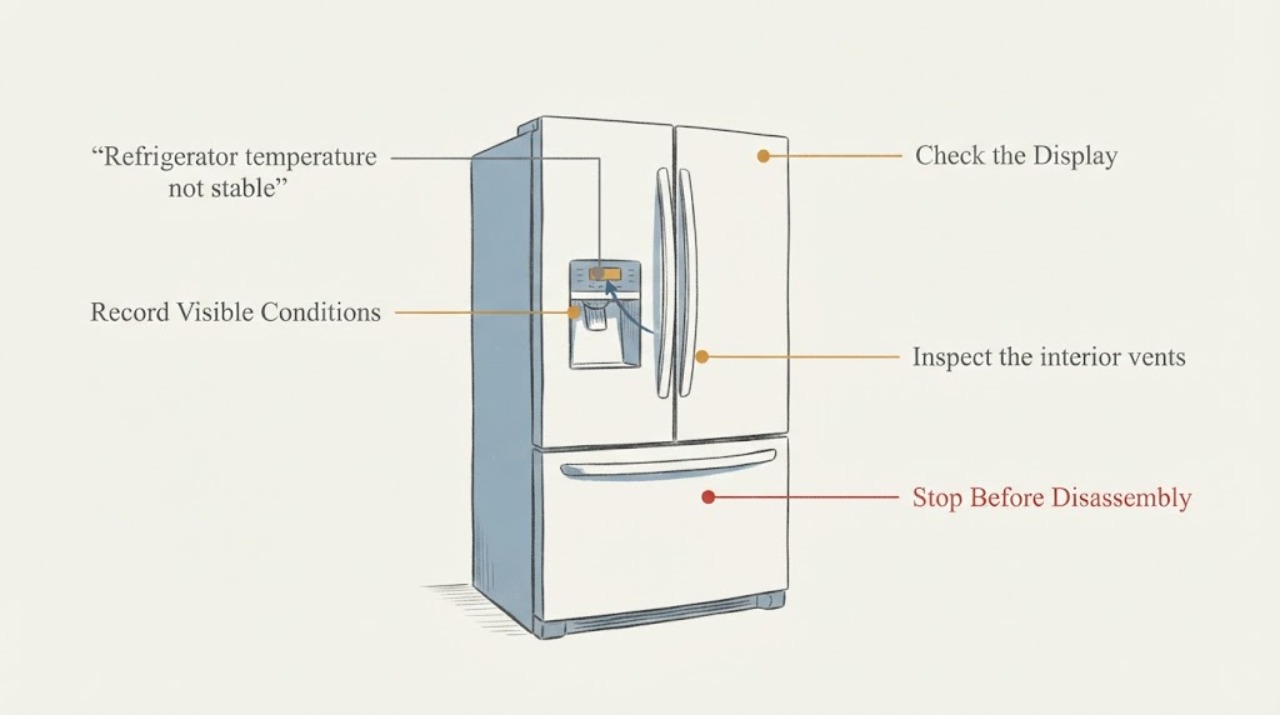
Measure the refrigerator and freezer temperatures, confirm the settings, then allow up to 24 hours after installation, a power interruption, or an adjustment for temperatures to stabilize. Frigidaire's family guidance uses 37°F for the refrigerator and 0°F for the freezer as suggested settings, says blocked vents or a door that does not seal can cause unstable temperature, and says a warm room or restricted rear airflow can make the compressor work harder. If the temperature remains outside the model's acceptable range after the door, vent, power, setting, and clearance checks, use the exact manual and arrange service; do not infer a failed compressor, fan, damper, or sealed system from temperature swings alone.
Work through in order
Diagnostic checks
Use only checks that match the exact appliance or system and its official guide.
-
Check 1
Measure the refrigerator and freezer compartments with a suitable appliance thermometer and record the time, settings, door openings, and whether the unit was recently installed, unplugged, or adjusted.
Expected result: The unit is within the model manual's range, the refrigerator is around Frigidaire's suggested 37°F and freezer around 0°F, or the temperature is still outside range after 24 hours.
Next step: If recently installed, restored, or adjusted, leave settings unchanged while it stabilizes. If measured temperature remains outside the model range after stabilization, continue the external checks and prepare the exact model number for service.
Why this matters
Why: Frigidaire says a new unit or a unit after a power interruption needs time to stabilize; suggested settings are 37°F refrigerator and 0°F freezer, with acceptable ranges varying by product and support guidance.
-
Check 2
Check the temperature controls and make sure the selected settings have not been changed, then make only small adjustments described in the owner's manual and allow the full stabilization period before judging the result.
Expected result: The settings are unusually cold or warm, were changed recently, or already match the model guidance but the measured temperature swings persist.
Next step: Restore the model-recommended setting and wait for stabilization. If the measured temperature remains unstable, stop changing settings and use model-specific service rather than guessing a part.
Why this matters
Why: Frigidaire identifies settings as a cause of too-cold or high-temperature conditions, but a correct setting with persistent swings does not identify a compressor, sensor, damper, or sealed-system fault.
-
Check 3
Inspect the interior vents and move food or containers that touch or block them; do not remove the vent covers or cabinet panels.
Expected result: An item blocks a vent, the airflow path is clear, or the refrigerator compartment is cold while another area remains warm or freezes food.
Next step: Clear only the visible blockage and allow the appliance to stabilize. If temperatures remain uneven with clear vents, record the pattern and arrange model-specific service.
Why this matters
Why: Frigidaire says blocked vents disrupt airflow and can prevent proper cooling or cause food to freeze. A clear visible vent path does not prove an internal airflow component is defective.
-
Check 4
Check the doors and gaskets externally: make sure each door closes without obstruction, was not left open, and the gasket contacts the cabinet evenly. Clean the gasket with warm soapy water if the manual permits.
Expected result: A door was obstructed or open, the gasket has a dirty or visibly weak section, or a paper bill slides out with little resistance at the seal.
Next step: Remove the obstruction and clean the visible gasket, then allow stabilization. If the gasket does not seal or the temperature remains unstable, use the exact model manual or service; do not glue, reshape, or replace a seal without fitment evidence.
Why this matters
Why: Frigidaire says an open or non-sealing door can cause unstable temperature and provides a paper-resistance check for the gasket. A failed seal can explain warm air entry without proving any internal refrigeration part failed.
-
Check 5
Check the external installation conditions: confirm power and any GFI protection, keep the refrigerator out of an excessively cold location, and inspect the visible rear vent cover and wall clearance without moving a heavy appliance unsafely.
Expected result: Power was interrupted, the outlet or GFI is off, the unit is in a room below the documented ambient limit, the rear vent is dusty, or the cabinet is pushed too close to the wall.
Next step: Correct only safe visible conditions and allow stabilization. If power protection trips again, do not keep resetting it; arrange electrical or appliance service. If the conditions are normal but temperature remains out of range, arrange model-specific refrigerator service.
Why this matters
Why: Frigidaire says power events require stabilization, does not recommend installation below 55°F, and explains that restricted rear airflow makes the unit work harder. Longer compressor runtime alone can still be normal for variable-speed models or warm environments.
-
Check 6
Read any alarm or display message and record whether it is High Temp, Door Ajar, PF, Sabbath mode, or a model-specific code before acknowledging it.
Expected result: The alarm clears after the door is closed or temperature recovers, returns repeatedly, or matches a listed high-temperature or power-failure condition.
Next step: Address the visible door or power condition and follow the exact manual for clearing the alarm. If the alarm returns after the unit stabilizes or a service code remains, stop resetting it and arrange service.
Why this matters
Why: Frigidaire says alarms can reflect an open door, high temperature, or power failure and that meanings vary by model; some listed codes can indicate authorized service.
Use your observations
Decision map
Find the observation that best matches what you see, then follow the next safe action.
-
PATH 01Next step
What you see
The refrigerator was installed, powered on, or adjusted within the last 24 hours and the temperature is gradually moving toward the setting.
Do this next
Avoid repeated setting changes and allow stabilization while monitoring with a thermometer. Escalate if it remains outside the model range afterward.
Why this path and its safety boundary
Why it matters: Frigidaire says a refrigerator may need about 24 hours to stabilize after installation, power interruption, or related changes.
-
PATH 02Next step
What you see
The measured temperature is unstable and a vent is blocked, a door was open, or the gasket does not seal evenly.
Do this next
Clear only the visible obstruction, close the door correctly, or clean the gasket as directed, then allow stabilization. Arrange service if the seal or temperature problem persists.
Why this path and its safety boundary
Why it matters: Frigidaire identifies blocked airflow and a non-sealing door as conditions that can prevent proper cooling or cause unstable temperature.
-
PATH 03Next step
What you see
The compressor runs frequently but measured temperatures remain in range, especially in a warm room or on a variable-speed French-door model.
Do this next
Judge the refrigerator by measured temperature and food condition rather than runtime alone. Service is appropriate if temperatures are out of range, noise changes, or an alarm persists.
Why this path and its safety boundary
Why it matters: Frigidaire says longer or continuous compressor operation can be normal for some models, warm environments, frequent door openings, or extra-cold settings.
-
PATH 04Next step
What you see
A high-temperature alarm remains active, measured temperatures stay outside range after stabilization and external checks, power protection repeatedly trips, or there is water/electrical damage.
Do this next
Protect perishable food, stop repeated resets, and arrange qualified service with the complete model number. Do not open the sealed system or replace a compressor, fan, damper, sensor, or control board based on temperature swings alone.
Why this path and its safety boundary
Why it matters: The public family checks have not resolved the condition and continued operation may risk food loss or an electrical/water safety problem; the family pages do not prove an internal component cause.
Helpful context
Understand the symptom
Start with a measured temperature and a stabilization period
A display setting or a compressor that runs often does not by itself prove an unstable refrigerator. Frigidaire says a newly installed unit may need about 24 hours to stabilize and that a power interruption or setting change also needs time. Compare measured refrigerator and freezer temperatures with the exact model manual, then use the external checks below before considering a component diagnosis.
Protect food and avoid internal refrigeration work
Keep perishable food in a safe cold appliance while temperatures are outside the model's safe operating range. Do not remove panels, handle refrigerant, probe live wiring, or force a fan or damper. If the cabinet is warm, a high-temperature alarm remains active, or there is water or electrical damage, use the model manual and qualified service rather than repeatedly resetting the refrigerator.
Interpret the pattern before calling a part defective
A new installation or recent power loss can explain a temporary swing. A blocked internal vent or weak door seal can explain uneven or unstable temperatures. A warm room or dusty rear vent can explain longer compressor operation. If those conditions are clear and the measured temperature still remains out of range, the public family guidance does not identify an internal part; schedule model-specific service.
When checks do not resolve it
Need a professional?
Arrange qualified service if measured temperature remains outside the exact model's range after 24 hours and the visible setting, vent, door-seal, power, and clearance checks are complete; if the high-temperature alarm returns, a service code remains, power protection trips repeatedly, or there is water or electrical damage. Do not infer a failed compressor, fan, damper, sensor, or sealed system from temperature swings alone.
Common questions
FAQ
How long should a Frigidaire refrigerator take to stabilize after installation or a power outage?
Frigidaire says it can take about 24 hours after installation, a power interruption, or related changes. Keep the settings at the model-recommended values during that period and judge the result with measured temperature.
What temperature should I use while checking an unstable Frigidaire refrigerator?
Frigidaire's family guidance suggests 37°F for the refrigerator and 0°F for the freezer, but the owner's manual controls for the exact model. Its published acceptable ranges are product-dependent and should not be used to diagnose an internal part.
Can a blocked vent or bad door seal cause unstable temperature?
Yes, Frigidaire identifies blocked vents and a non-sealing door as conditions that disrupt airflow or allow warm air in. Clear visible obstructions and check the gasket externally; persistent instability needs model-specific service.
Does a refrigerator running most of the time mean the compressor is failing?
Not necessarily. Frigidaire says variable-speed compressors may run continuously except during defrost, and warm rooms, frequent door openings, settings, or restricted rear airflow can increase runtime. Use measured temperature and alarms to decide whether service is needed.
What does a Frigidaire high-temperature alarm mean?
Frigidaire says a high-temperature alarm can follow an open door, changed settings, or a poor door seal, and the alarm may remain active until the temperature recovers. Follow the exact model manual and arrange service if it returns after stabilization and external checks.
Read the exact guide
Official sources
- Refrigerator Error Code H or HI - High TemperatureFrigidaire · All Frigidaire refrigerators: high-temperature alarm, door/settings/seal causes, model-dependent clearing, and service escalation
- Refrigerators - Not CoolingFrigidaire · All Frigidaire refrigerators: power, ambient location, settings, vent, door, gasket, stabilization, and service checks for warm or unstable temperature
- Refrigerators - What is the recommended temperature settings for my refrigerator?Frigidaire · Frigidaire refrigerators, French-door, side-by-side, and top-freezer units: initial stabilization time and suggested temperature settings
- Refrigerators - Why does my refrigerator run most of the time? Is this normal?Frigidaire · Frigidaire refrigerator compressor runtime, variable-speed operation, warm-room conditions, door use, settings, and rear airflow
- Refrigerator Too ColdFrigidaire · Frigidaire refrigerators: temperature settings, internal vent blockage, airflow and service boundary
- What do the alarms or error messages mean on my French-Door refrigerator?Frigidaire · Frigidaire refrigerator-family alarms: power failure, high temperature, door ajar, Sabbath mode, ice chute, and service-code routing
Community feedback
Share a repair observation
Share a plain-text repair observation. Accepted observations are published automatically; this page may take a moment to update.