
On this page
Start here
Quick answer
A temperature problem does not prove that the thermostat has failed. First measure the refrigerator and freezer temperatures, record the settings, confirm power, clear blocked vents, and check that the door gasket seals. Frigidaire lists 37°F for the refrigerator and 0°F for the freezer as factory suggested settings, with acceptable ranges of 33–47°F and -6–6°F; a model-specific manual or service diagnosis is needed before calling the thermostat defective.
Before you begin
Safety first
- Do not remove covers, probe wiring, bypass a control, open the sealed refrigeration system, or perform live electrical measurements. Stop immediately for damaged wiring, hot electrical odor, water near electrical parts, or unsafe power conditions.
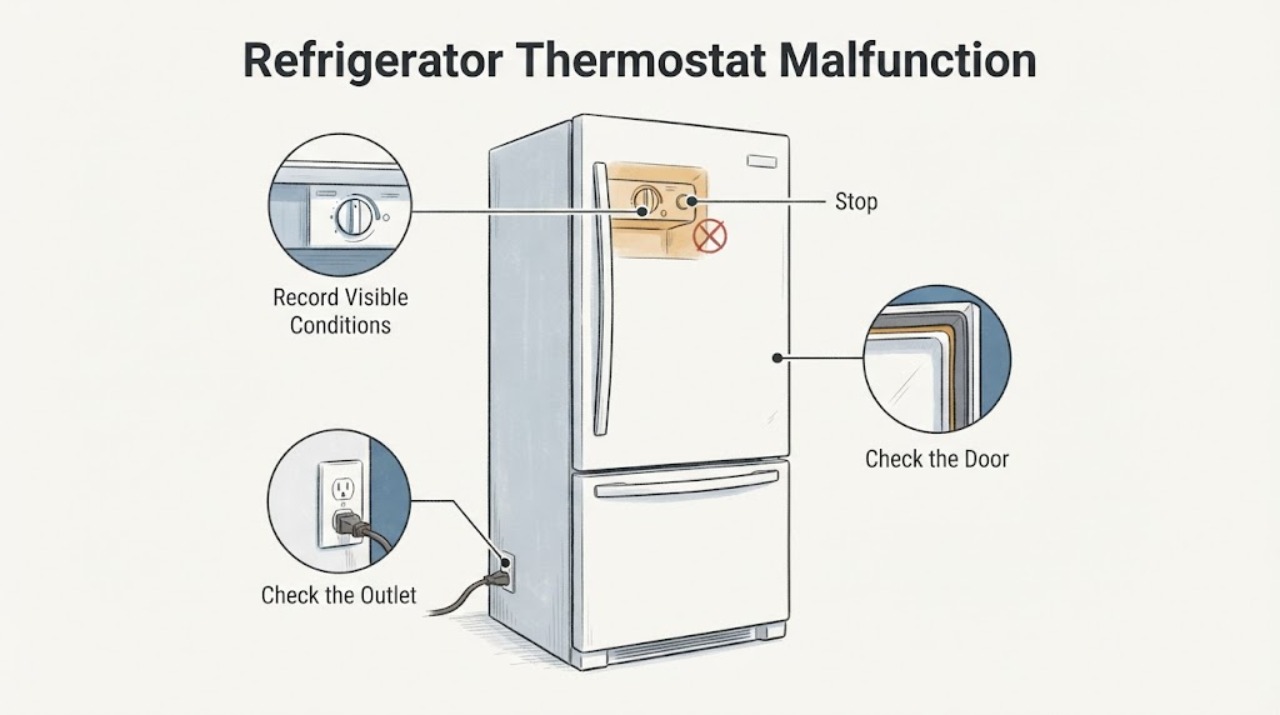
Work through in order
Diagnostic checks
Use only checks that match the exact appliance or system and its official guide.
-
Check 1
With the doors closed for a consistent period, measure the refrigerator and freezer compartments separately and record the control settings, recent installation or power interruption, and whether the appliance is cooling at all.
Expected result: The refrigerator and freezer readings are within or outside Frigidaire's family ranges, or the temperature has not had time to stabilize.
Next step: Use the matching temperature branch and allow the documented stabilization period before judging the result.
Why this matters
Why: A measured temperature and time context distinguishes a setting or stabilization issue from a persistent cooling complaint; neither reading by itself proves thermostat failure.
-
Check 2
Verify the refrigerator has power from its accessible dedicated outlet and check whether an accessible GFI outlet has tripped; do not open the cabinet or test internal wiring.
Expected result: Interior/control lights are off, the outlet or GFI is reset and the refrigerator powers up, or the appliance remains without power.
Next step: If power cannot be restored safely at the outlet or breaker, stop and arrange qualified electrical/appliance service; if power is present, continue to airflow and seal checks.
Why this matters
Why: No power can prevent any temperature control from operating and should be resolved as an external supply issue first; visible lights only show that some power is present.
-
Check 3
Inspect the interior without removing panels and move food away from the refrigerator's visible air vents; note any frost that blocks a vent or unusual accumulation around the door opening.
Expected result: A vent is blocked, frost is present, or air paths are visibly clear.
Next step: Clear only movable items and follow the exact model care guide for frost; escalate if frost returns or an internal panel would need removal.
Why this matters
Why: Frigidaire says blocked vents and poor airflow can impair cooling, while frost can be associated with airflow or sealing problems; this does not identify a thermostat or defrost part.
-
Check 4
Close the door on a clean dollar bill at several accessible gasket points, pull gently, and inspect whether the gasket is dirty, folded, cracked, or visibly not contacting the frame.
Expected result: There is slight resistance, or the bill slides out freely at one or more points and the gasket is dirty or visibly mis-seated.
Next step: Remove obstructions and clean the gasket with warm soapy water, then close the door and remeasure; do not reshape or replace a gasket without model-specific fit information.
Why this matters
Why: A freely sliding bill or visible gap supports an air-seal problem that can destabilize temperature; it does not prove a thermostat problem.
-
Check 5
Look around the rear of the refrigerator from a safe standing position for visibly blocked ventilation or the cabinet pushed tightly against the wall; do not reach into fans, compressors, wiring, or refrigerant tubing.
Expected result: Rear airflow is visibly restricted or the area is clear while the appliance still runs excessively or fails to hold temperature.
Next step: Follow the model's care and clearance instructions for any cleaning or repositioning; if the measured temperature remains abnormal, arrange model-specific service.
Why this matters
Why: Restricted airflow can increase runtime and reduce performance, but a clear exterior with persistent temperature error leaves multiple possible causes and cannot identify the thermostat.
Use your observations
Decision map
Find the observation that best matches what you see, then follow the next safe action.
-
PATH 01Next step
What you see
The refrigerator and freezer temperatures are within the applicable family ranges after stabilization, and the door seal and vents are clear.
Do this next
Keep the settings steady and monitor measured temperatures. Use the exact model manual if a display alarm or repeat temperature excursion appears.
Why this path and its safety boundary
Why it matters: The available evidence does not support calling the thermostat defective; runtime or a subjective feeling of warmth may reflect normal control or loading conditions.
-
PATH 02Next step
What you see
A reading is outside the family range and the controls, vents, door closure, or gasket check identifies a correctable external condition.
Do this next
Correct the accessible condition, allow the documented stabilization period, and measure again. Stop if correction would require a panel, wiring, or refrigerant-system operation.
Why this path and its safety boundary
Why it matters: The observed condition can explain unstable temperature without proving thermostat failure.
-
PATH 03Next step
What you see
Frost returns, the gasket remains unable to seal, or the refrigerator remains outside the measured range after power, setting, airflow, and door checks.
Do this next
Use the model's Use and Care manual and arrange Frigidaire or qualified appliance service; provide the model, readings, settings, and observations.
Why this path and its safety boundary
Why it matters: The complaint is persistent, but the family-level sources do not identify a thermostat as the cause and do not justify a parts diagnosis without the model.
-
PATH 04Next step
What you see
The outlet cannot safely restore power, there is a damaged cord or hot electrical smell, or water is contacting electrical areas.
Do this next
Stop using the refrigerator, keep clear of the hazard, and use qualified electrical/appliance service. Do not open the cabinet or perform live tests.
Why this path and its safety boundary
Why it matters: This is an electrical or water-safety condition, not a thermostat troubleshooting step.
Helpful context
Understand the symptom
The label “thermostat malfunction” is a hypothesis, not an external diagnosis. The same temperature complaint can come from an incorrect setting, a recent power interruption or installation, blocked internal vents, a door that is not closing, a leaking gasket, frost, or restricted airflow around the cabinet. Begin with observations that apply to Frigidaire refrigerators as a family.
Use a refrigerator thermometer or other reliable temperature measurement and write down the refrigerator and freezer readings separately. Compare them with the controls and with Frigidaire's family guidance. Do not change the setting repeatedly while trying to judge the result; a newly installed refrigerator can need about 24 hours to stabilize.
A normal-looking display or interior light shows that some power is present, but it does not prove that cooling control is correct. Frigidaire also tells owners to check the dedicated outlet and whether a GFI outlet has tripped. Use only a normal external reset that is accessible without opening the appliance.
Look inside for containers or food pressing against supply or return vents. Blocked airflow can prevent proper cooling, and Frigidaire also links poor airflow and a door seal problem with frost. Move items without removing panels or probing a duct.
Check the door gasket and the door edge visually. Frigidaire's dollar-bill check calls for slight resistance when the closed gasket grips the bill; if it slides out freely, clean the gasket with warm soapy water and recheck the closure. This result points to air leakage, not automatically to a thermostat.
If the refrigerator runs for long periods, do not infer a failed thermostat from runtime alone. Frigidaire says variable-speed compressors on many French-door models may run continuously, and warm surroundings or restricted rear airflow can increase runtime. A rear cover may be observed for visible dust only; use the model's care instructions for cleaning and preserve the required clearance.
Food-safety decisions should follow the measured food temperature and time out of refrigeration, not a guess about which component failed. If temperatures remain out of range after the external checks and stabilization period, keep the model and serial information ready for Frigidaire support or an appliance technician.
When checks do not resolve it
Need a professional?
Arrange model-specific Frigidaire or qualified appliance service when the measured temperature remains outside the applicable range after the external checks and stabilization period, when frost or a failed gasket persists, or when the suspected thermostat would require opening the cabinet. Do not order a thermostat from the symptom alone.
Safety scope: Do not remove covers, probe wiring, bypass a control, open the sealed refrigeration system, or perform live electrical measurements. Stop immediately for damaged wiring, hot electrical odor, water near electrical parts, or unsafe power conditions.
Have this ready
- Exact model number, refrigerator and freezer readings, control settings, time since installation or power loss, power status, visible frost, vent clearance, gasket result, and whether the problem is too warm, too cold, or unstable.
Common questions
FAQ
How can I tell whether the Frigidaire thermostat is bad?
You cannot confirm a thermostat failure from a warm or cold compartment alone. First record the actual refrigerator and freezer temperatures, settings, power, vent clearance, and door-seal result. If the readings remain abnormal after those checks, a model-specific service diagnosis is needed.
What temperature should a Frigidaire refrigerator reach?
Frigidaire lists 37°F for the refrigerator and 0°F for the freezer as factory suggested settings. Its all-refrigerators troubleshooting guidance lists acceptable ranges of 33–47°F for the refrigerator and -6–6°F for the freezer; the exact manual controls the individual model.
Can blocked vents or a bad gasket look like a thermostat problem?
Yes. Frigidaire says blocked vents prevent proper cooling and that a non-sealing door causes unstable temperature. Its frost guidance also links blocked airflow and gasket or door-seal problems with frost.
Does a refrigerator running most of the time prove the thermostat failed?
No. Frigidaire says many French-door models use variable-speed compressors that may run continuously, and warm surroundings or restricted rear airflow can increase runtime. Judge the condition with measured temperatures and the model's guidance.
Read the exact guide
Official sources
- Refrigerators / Freezer - Frost Build UpFrigidaire · The opened Frigidaire article applies to refrigerators and is used only for external frost, gasket, ice-chute, and vent observations.
- Refrigerators - Why does my refrigerator run most of the time? Is this normal?Frigidaire · The opened page applies to Frigidaire refrigerator families and supports runtime interpretation; it does not diagnose an individual thermostat.
- Refrigerators - What is the recommended temperature settings for my refrigerator?Frigidaire · The opened page lists refrigerator family types and gives family-level recommended settings; the exact model manual controls model-specific features.
- Refrigerators - Not CoolingFrigidaire · The opened Frigidaire support article explicitly applies to all refrigerators; model-specific controls and repair procedures still require the owner's manual.
Community feedback
Share a repair observation
Share a plain-text repair observation. Accepted observations are published automatically; this page may take a moment to update.