
On this page
Start here
Quick answer
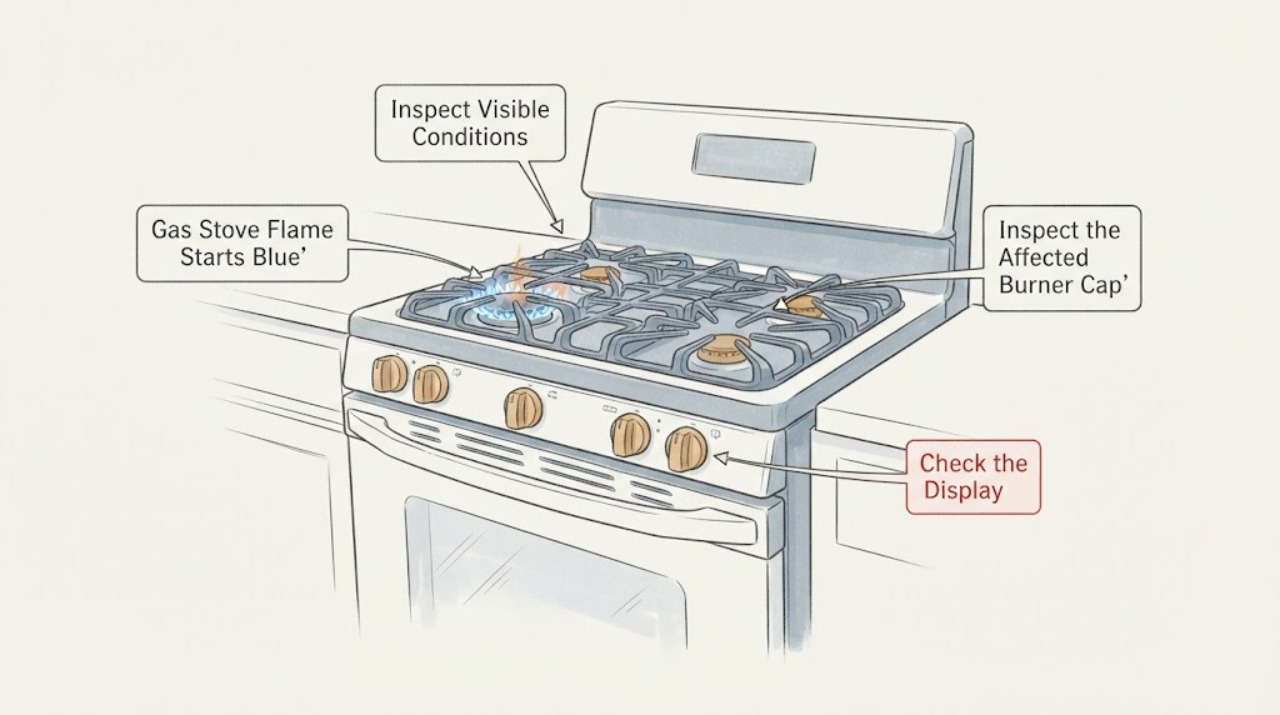
A brief orange change after cleaning can be associated with moisture, a burner cap that is not seated, blocked burner ports, or an incorrect control setting; Frigidaire's gas-range guidance says to check those visible conditions. A flame that stays yellow or orange, becomes lazy or uneven, appears on several burners, or is accompanied by soot, yellow-brown staining, condensation, a pilot going out, a carbon-monoxide alarm, or illness is a combustion-safety warning, not a reason to keep testing. Turn the controls off, stop using the stove, ventilate or leave when appropriate, and contact local gas or emergency service from a safe location. Do not adjust an orifice, regulator, air shutter, or gas valve yourself. Confirm the exact model and fuel type before any model-specific service.
Before you begin
Safety first
- Do not adjust orifice size, gas pressure, regulator, air shutter, gas valve, fuel-conversion hardware, or internal wiring. Do not remove the manifold or cabinet, bypass protection, use the stove as a heater, or repeatedly relight an orange flame to reproduce it. Disconnect or isolate power only when the exact manual permits and only from a safe, dry position; gas isolation and emergency response belong to the appropriate qualified service.
Work through in order
Diagnostic checks
Use only checks that match the exact appliance or system and its official guide.
-
Check 1
Turn all stove controls to OFF using only normal hand movement and step back to observe. Look for gas odor, smoke, fire, a flame that continues after OFF, a carbon-monoxide alarm, headache, dizziness, nausea, unusual tiredness, soot, yellow-brown staining, or condensation; do not touch a hot burner or operate switches near a gas odor.
Expected result: There is no odor, smoke, alarm, symptom, visible soot, abnormal heat, or continuing flame, or one of those hazards is present.
Next step: For gas odor, smoke, fire, a continuing flame, a CO alarm, or symptoms, leave the area when appropriate, open doors or windows only if this can be done without creating risk, and contact local gas or emergency service from a safe location. If someone has symptoms, seek medical advice or emergency help. Otherwise continue only after the stove is cool and safe to inspect.
Stop if: Do not use flames, electrical switches, phones, or other equipment near a gas odor; do not relight, keep cooking, or repeatedly turn a hazardous control.
Why this matters
Why: A persistent orange flame can reflect incomplete combustion, while an alarm or symptoms can indicate a potentially dangerous combustion product even when the flame is the only visible problem. A continuing flame or gas odor is an immediate stop condition, not a burner-cleaning experiment.
-
Check 2
From a safe position, characterize when the color changes: note whether it is only a short transition after ignition or cleaning, whether it affects one burner or every burner, whether the flame is crisp and stable or lazy and uneven, and whether the control is at the normal cooking setting. Do not hold the ignition position or stare at a flame that has any hazard sign.
Expected result: The color returns to a stable blue flame after a brief transition, only one burner is affected, or orange/yellow color persists across one or several burners and the flame is lazy, lifting, or uneven.
Next step: If the flame remains orange or becomes unstable, stop using the affected burner; if several burners are affected, stop using the stove and arrange qualified gas-appliance service. Record the burner, timing, fuel type, and whether the change followed cleaning before moving to the external checks.
Stop if: Do not continue operating a burner to compare colors when the flame is persistent orange/yellow, produces soot, lifts from the ports, or changes with a gas odor or other hazard.
Why this matters
Why: A short-lived change after moisture or a spill is different from a persistent pattern. One-burner persistence makes a local cap, head, or port issue plausible; several-burner persistence raises concern about a shared fuel, conversion, pressure, air, or ventilation condition. The color alone does not identify the failed component.
-
Check 3
After the burner is fully cool and the stove is not being used, inspect the affected burner cap and burner head from above. Confirm that the cap is seated in its intended position, that no visible moisture remains, and that the visible slots or ports are not blocked; compare only with the exact Frigidaire manual and do not remove a gas manifold or panel.
Expected result: The cap is visibly shifted, wet, or the accessible slots/ports contain residue, or the cap is seated and the visible openings are clear.
Next step: If the cap is misseated, reseat it only as the exact model manual shows; if it is wet, let it dry completely. If the cap is damaged, warped, or the flame remains orange after the visible condition is corrected, stop using that burner and arrange service.
Stop if: Do not force the cap, enlarge ports, remove a valve, alter a burner orifice, or test the flame while a part is wet or damaged.
Why this matters
Why: Frigidaire specifically lists cap seating, moisture after cleaning, and clogged burner slots or ports among checks for uneven or overly high flames. A correctly seated, dry cap with clear openings makes a simple external obstruction less likely but cannot establish that combustion adjustment or gas pressure is correct.
-
Check 4
If the exact Frigidaire manual permits ordinary cleaning, clean only the accessible burner head and slots after the stove is cool and gas controls are OFF. Use a soft-bristle brush and the manual's permitted tool for an accessible ignition port, wipe the area clean, and let it dry fully; do not use abrasive cleaners, oven cleaner, steel wool, a flame, or compressed force to clear a passage.
Expected result: The residue clears and the cap can be seated dry, or the passage remains blocked, the part is damaged, or the flame stays orange after cleaning and drying.
Next step: After the burner is completely dry and the cap is seated, make at most one controlled observation from a safe position. If orange color persists, returns immediately, or affects multiple burners, stop using the stove and request qualified gas-appliance service rather than ordering a part from the color alone.
Stop if: Do not poke deeply into a gas passage, disassemble the burner base, use an improvised tool that can enlarge an opening, or keep relighting a burner to test it.
Why this matters
Why: Frigidaire's ignition-port guide supports gentle cleaning and correct cap seating, but a clean exterior does not prove a safe fuel-air mixture. Persistence after a careful cleaning moves the problem beyond a routine residue check.
-
Check 5
Record the exact model number, market, fuel type (natural gas or LP), affected burner or oven burner, color pattern, recent cleaning or spill, cap condition, and any soot or CO-alarm event. Check only from outside that the range hood or prescribed ventilation path is unobstructed; do not adjust an air shutter, regulator, conversion fitting, or gas valve.
Expected result: The model and fuel identity are confirmed and the flame becomes stable after the permitted external check, or the fuel/model is uncertain or the orange pattern persists.
Next step: For a persistent change, all-burner pattern, unknown fuel/model, soot, staining, condensation, or any other warning sign, keep the stove out of service and give the record to Frigidaire or a qualified gas-appliance technician. Ask for combustion and installation checks before any component is selected.
Stop if: Do not open the cabinet, change gas pressure, swap or drill orifices, alter air shutters, bypass safety devices, or use the stove as a heater.
Why this matters
Why: Fuel type, conversion, installation, pressure, ventilation, and model-specific burner design can change the correct diagnosis. EPA says burners should be properly adjusted and directs users to the gas company for a persistent yellow-tipped flame; visual similarity is not fitment or adjustment evidence.
Use your observations
Decision map
Find the observation that best matches what you see, then follow the next safe action.
-
PATH 01Next step
What you see
The flame changes color only briefly after cleaning or ignition, the burner is dry, the cap is correctly seated, the visible ports are clear, and there is no odor, soot, alarm, symptom, or unstable flame.
Do this next
Monitor the next normal use from a safe position and stop if the orange color persists or returns. Use the exact model manual if the condition recurs.
Why this path and its safety boundary
Why it matters: A transient moisture or accessible burner-condition explanation is more plausible than a confirmed gas-system failure, but the opened guidance does not guarantee every Frigidaire model or installation is safe.
-
PATH 02Next step
What you see
One burner remains yellow or orange, lazy, lifting, or uneven after the cap is dry, correctly seated, and the accessible ports are clean.
Do this next
Stop using that burner, keep the stove out of service if the symptom recurs, and arrange Frigidaire or qualified gas-appliance service with the model, fuel type, and observations.
Why this path and its safety boundary
Why it matters: A local burner-cap, burner-head, port, or delivery problem remains possible, but the color does not prove which part is at fault and the symptom has crossed the safe user-cleaning boundary.
-
PATH 03Next step
What you see
Several burners or the oven burner remain orange/yellow, or the pattern is accompanied by soot, yellow-brown staining, condensation, a pilot going out, poor ventilation, or an unknown natural-gas/LP setup.
Do this next
Stop using the stove, ventilate or leave when appropriate, and contact local gas or emergency service from a safe location if there is any concern about CO or gas safety. Otherwise arrange qualified gas-appliance service before using it again.
Why this path and its safety boundary
Why it matters: The combined pattern is consistent with a possible combustion, adjustment, fuel-conversion, pressure, or ventilation issue. HSE treats yellow/orange rather than blue as a sign of incomplete combustion, and EPA warns of increased pollutant emissions from persistent yellow-tipped flames.
-
PATH 04Next step
What you see
A gas odor, CO alarm, headache, dizziness, nausea, unusual tiredness, smoke, fire, or a flame that remains after OFF occurs at any point.
Do this next
Leave the area when appropriate, avoid switches and ignition sources near gas odor, call local emergency or gas service from a safe location, and seek medical help for symptoms. Do not return the stove to service until it has been made safe by qualified help.
Why this path and its safety boundary
Why it matters: This is an emergency or urgent safety condition, not a routine color-change diagnosis. Carbon monoxide cannot be detected by smell, and a control or combustion fault can remain dangerous even if the flame later appears normal.
-
PATH 05Next step
What you see
The model, market, fuel type, burner design, or exact manual cannot be confirmed, or the flame remains orange after the documented external checks.
Do this next
Keep the appliance unused and provide the rating-label information and the observed pattern to Frigidaire or qualified gas-appliance service. Do not borrow an adjustment or part specification from another model or brand.
Why this path and its safety boundary
Why it matters: The public evidence supports symptom-level checks and a safety boundary, not a universal Frigidaire adjustment, error meaning, or replacement part.
Helpful context
Understand the symptom
Treat a flame that starts blue and then turns orange as a pattern to characterize, not as a code that identifies one replacement part. Frigidaire's gas-range and gas-cooktop guidance supports external checks for a seated cap, moisture left after cleaning, clear burner slots or ports, and a control that is not set too high. Those checks can explain a short-lived change after a spill or cleaning, but they do not certify the gas pressure, fuel conversion, air adjustment, ventilation, or combustion of an appliance that remains orange.
Persistent yellow or orange flames are a safety boundary. The HSE lists yellow or orange rather than blue flames among signs of incomplete combustion, and EPA guidance says a persistent yellow-tipped flame generally indicates maladjustment and increased pollutant emissions. Carbon monoxide is odorless and colorless, so the absence of a gas smell does not make continued operation safe. Do not open the gas system or repeatedly relight a burner to reproduce the color.
When checks do not resolve it
Need a professional?
Call Frigidaire or qualified gas-appliance service for persistent or recurring orange/yellow flame, a flame on multiple burners, soot or staining, a pilot that goes out, an uncertain natural-gas/LP setup, or any condition that remains after the model-approved cap, moisture, and port checks. Use local emergency/gas service for odor, smoke, fire, CO alarm, symptoms, or a flame that will not stop.
Safety scope: Do not adjust orifice size, gas pressure, regulator, air shutter, gas valve, fuel-conversion hardware, or internal wiring. Do not remove the manifold or cabinet, bypass protection, use the stove as a heater, or repeatedly relight an orange flame to reproduce it. Disconnect or isolate power only when the exact manual permits and only from a safe, dry position; gas isolation and emergency response belong to the appropriate qualified service.
Have this ready
- Provide the complete Frigidaire model and serial information, country or market, natural-gas or LP setup, burner or oven location, exact timing of the color change, whether it affects one or all burners, cap/port and cleaning observations, any soot or condensation, CO-alarm or symptom history, and photos only of cool exterior parts.
Common questions
FAQ
Is an orange flame on a Frigidaire gas stove always carbon monoxide?
An orange flame is not, by itself, proof of a measured carbon-monoxide leak. Persistent yellow/orange rather than blue is an official warning sign of possible incomplete combustion or maladjustment, however. Stop using the stove and arrange qualified service, especially if there is soot, staining, condensation, a CO alarm, or symptoms.
Why does the Frigidaire flame start blue and then turn orange?
Frigidaire's gas-range guidance points to visible checks for a cap that is not seated, moisture left after cleaning, blocked burner slots or ports, and an overly high setting. If the color change continues after the burner is dry, the cap is correctly seated, and the accessible openings are clear, do not infer a part from the symptom; arrange qualified service.
Can I adjust the air shutter or gas regulator to make the flame blue?
No. Do not adjust an air shutter, regulator, or gas valve without the exact model, fuel-conversion documentation, instruments, and qualified gas-appliance service. EPA says persistent yellow-tipped flames should be addressed by the gas company or qualified service, not by an improvised adjustment.
Can I keep cooking if only one burner turns orange?
Do not use the affected burner until it is cool and the exact Frigidaire guidance permits checking the cap, moisture, and accessible ports. If the flame remains orange, lazy, or uneven after those checks, stop using that burner and arrange service; if other burners are also affected, keep the whole stove out of service.
What should I do if a CO alarm sounds while the stove flame is orange?
Leave immediately when appropriate and follow local emergency guidance. Do not keep testing the stove or silence the alarm to continue cooking. Contact local emergency or gas service from a safe location and seek medical help for headache, dizziness, nausea, unusual tiredness, or other possible exposure symptoms.
Read the exact guide
Official sources
- Carbon monoxideHealth Canada · Government health guidance supporting the odorless CO and leave-on-alarm boundary; emergency procedures should follow the reader's local jurisdiction.
- Sources of Combustion ProductsU.S. Environmental Protection Agency · U.S. government indoor-air guidance supporting the persistent-yellow-flame and ventilation boundary; it is not a Frigidaire model manual.
- Gas Cooktop Ignition Port Cleaning GuideFrigidaire · Official Frigidaire cleaning guidance for accessible burner-head slots and ignition ports; exact model instructions control and the guide does not authorize gas-system disassembly.
- Carbon monoxide awarenessUK Health and Safety Executive · Government regulator guidance used for the combustion-safety warning and response boundary; the local emergency contact and appliance service route must follow the reader's jurisdiction.
- What should I do if my gas flames are uneven or too high?Frigidaire · Official Frigidaire support guidance for gas ranges/cooktops; it supports external cap, moisture, port, and knob-setting checks but does not establish a universal adjustment or part for every model.
Community feedback
Share a repair observation
Share a plain-text repair observation. Accepted observations are published automatically; this page may take a moment to update.