
On this page
Start here
Quick answer
Do not pull or pry a locked Frigidaire washer door or lid. If this is a top-load washer that was spinning, stop the washer and wait 1–3 minutes for the safety lock to release. For a front-load washer or laundry center, pause or cancel it using the normal controls, wait until the tub or drum stops, and follow the exact model manual for the release timing. Look for standing water, an active cycle, a trapped garment, a damaged latch or seal, or a control-lock indication without opening panels or bypassing the interlock. If the lock remains after the safe release and model-specific drain or control-lock checks, or there is a leak, smoke, burning odor, sparking, hot water, or a tripped breaker, leave the appliance off and arrange qualified service.
Work through in order
Diagnostic checks
Use only checks that match the exact appliance or system and its official guide.
-
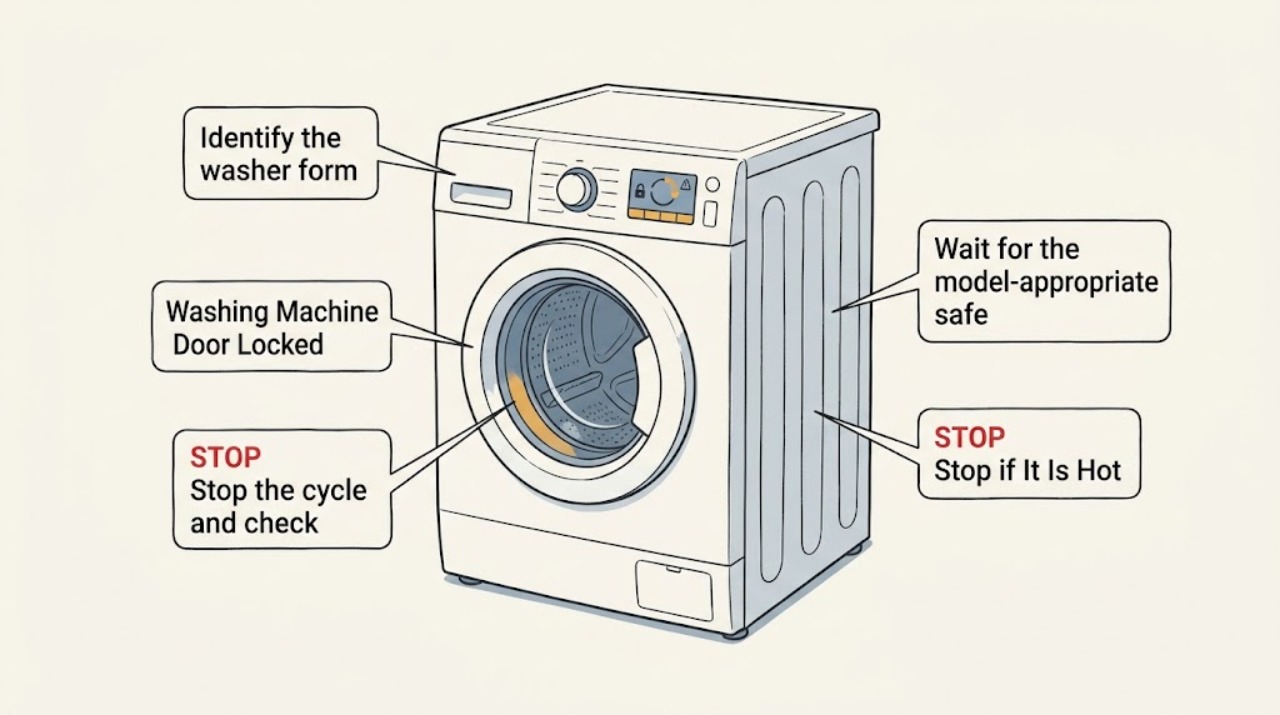
Stop the cycle and check for an immediate hazard
From a dry position, press Pause or Cancel using the normal Frigidaire control, then keep your hands away from the door or lid. Watch and listen until the tub or drum stops. Note any visible water, hot steam, leaking water, smoke, burning odor, sparking, damaged cord, or repeated breaker trip.
Expected result: The appliance stops normally with no hazard, the tub or drum is still moving, water or heat is present, or an electrical or burning symptom appears.
Next step: If there is any leak, smoke, burning odor, sparking, hot water, damaged cord, or repeated power trip, stop immediately, isolate water or power only when safe, and arrange qualified service. If the appliance is quiet and dry, continue without pulling the handle.
Stop if: Do not force the door or lid, reach into a moving tub, touch standing water near electrical parts, or run another cycle over a leak or burning symptom.
Why this matters
Why: A moving tub or drum is a reason for the interlock to remain engaged. Water, heat, leakage, or an electrical symptom makes opening or restarting unsafe and is more important than releasing the lock.
-
Identify the washer form and cycle state
Determine whether the appliance is a top-load washer with a lid, a front-load washer with a door, or a laundry center. Record whether it was washing, spinning, draining, paused, or finished, and record any lock symbol or code before resetting it.
Expected result: It is a top-load washer stopped during or just after spin, a laundry center or other washer, or the cycle and display state are unclear.
Next step: Use the top-load release window only for the matching top-load situation. Otherwise follow the exact model's pause, cancel, drain, and door-lock instructions rather than guessing a timing or emergency release.
Stop if: Do not use a top-load lid procedure on a front-load door or laundry center, and do not start an undocumented diagnostic or emergency-release procedure.
Why this matters
Why: Frigidaire's 1–3 minute instruction is specifically for a top-load lid that will not open during spin. Its laundry-center instructions use the tub or drum stopping and lock disengaging as the release condition; other models require their own manual.
-
Wait for the model-appropriate safe release
For a stopped top-load washer that was spinning, leave the lid closed and wait 1–3 minutes. For a laundry center or another washer form, leave the door or lid closed until the tub or drum has stopped and the lock indication has disengaged according to the exact model manual. Do not pull the handle to test it.
Expected result: The door or lid unlocks, the lock indicator remains active, or the appliance still shows an active cycle or fault after the appropriate waiting period.
Next step: If it unlocks, inspect the seal or lid area before the next load. If it remains locked, continue with the display, water, and visible closure checks without bypassing the interlock.
Stop if: Do not pry, strike, pull upward on a lid, or insert a tool or wire into the lock when the normal release does not occur.
Why this matters
Why: An unlock after the normal stop and wait is consistent with a protective interlock doing its job. A persistent lock after the appliance is stopped shifts attention to water, control lock, an obstruction, or a lock or control fault.
-
Check the visible water and closure path
Look through the front door or from above the tub without opening the locked appliance, and check for standing water. When the appliance is stopped and the area is safe, inspect only the visible door or lid edge, seal, glass, and latch area for a trapped garment or obvious damage. Remove only a loose, visible obstruction that does not require force.
Expected result: Water remains, clothing is caught at the closure, the seal, glass, latch, or hinge is visibly damaged, or the visible area is clear and dry.
Next step: For water, use only the exact model's documented drain procedure and prepare for residual water. For a loose obstruction, clear it and close the door or lid normally once. If damage is present or the lock remains active with a clear area, request service.
Stop if: Do not open a filter, hose, cabinet, or rear panel as an improvised release, and do not touch hot or electrically exposed water.
Why this matters
Why: Water or an incomplete drain can keep the safety condition active. A trapped garment or damaged closure can prevent correct locking and sealing. A clear, dry closure area makes an internal lock, drain, sensor, or control issue more likely.
-
Resolve a control-lock indication without guessing
If a top-load display shows CL or a lock symbol, switch the appliance off and use the exact model manual to deactivate Control Lock. Do not infer a button sequence from another Frigidaire model. After the documented control-lock step, observe whether the lock indication clears and the door or lid releases.
Expected result: The CL or lock indication clears, it returns immediately, or the appliance remains locked or unresponsive.
Next step: If the indication clears, close the door or lid normally and run only a supervised test permitted by the manual. If it returns or the lock remains, leave the appliance off and arrange qualified service.
Stop if: Do not repeatedly reset around water, a leak, or an electrical symptom, and do not bypass the lid or door interlock to clear a control code.
Why this matters
Why: Frigidaire identifies CL as Control Lock being active after the lid was open too long. A cleared indication supports a control state as the cause; a recurring indication or no response needs model-specific diagnosis.
-
Use a model-specific drain or service handoff
If water remains or the lock does not release after the normal wait, consult the exact Frigidaire model manual for its user-accessible drain or reset procedure. Record the complete model number, cycle stage, time since stopping, water level, display code, and any visible damage before contacting service. Do not attempt an undocumented emergency release.
Expected result: The documented procedure safely removes the water and releases the lock, the procedure is unavailable or unsafe, or the door remains locked after draining and the model-approved reset.
Next step: If the lock releases, close all covers and follow the manual's verification before using the washer. Otherwise leave it off and provide the recorded observations to a qualified appliance technician.
Stop if: Stop before any step involving cabinet access, live electrical testing, hot water, a spill that cannot be controlled, or a lock bypass.
Why this matters
Why: A safe drain can restore the condition that permits an unlock. An unavailable or unsuccessful procedure points to a drain, lock, sensor, or control fault that cannot be identified from a locked door alone.
Use your observations
Decision map
Find the observation that best matches what you see, then follow the next safe action.
-
PATH 01Next step
What you see
A top-load washer was spinning, stops normally, and its lid unlocks after the 1–3 minute safety-release window with no water or hazard.
Do this next
Inspect the visible lid area before the next load and monitor whether the delay becomes persistent.
Why this path and its safety boundary
Why it matters: The safety interlock likely completed its normal release.
-
PATH 02Next step
What you see
A laundry center or other washer has been paused or cancelled, the tub or drum has stopped, and the model's lock-release condition is satisfied.
Do this next
Follow the exact manual for the remaining door or lid step; do not substitute the top-load timing.
Why this path and its safety boundary
Why it matters: The appliance can release the lock according to its model-specific control sequence.
-
PATH 03Next step
What you see
Water remains or the cycle did not complete its drain stage.
Do this next
Use only the exact model's documented drain procedure. If draining is unsafe, unavailable, or unsuccessful, leave the appliance off and arrange service.
Why this path and its safety boundary
Why it matters: The water level may be keeping the door or lid secured.
-
PATH 04Next step
What you see
The display shows CL or a lock symbol and the top-load closure is not damaged.
Do this next
Power off and deactivate Control Lock using the exact model manual. If the indication returns or the door stays locked, request service.
Why this path and its safety boundary
Why it matters: Control Lock may be active rather than the door hardware being the primary fault.
-
PATH 05Next step
What you see
The closure area is clear but the lock remains active after the safe wait and model-approved drain or control-lock check.
Do this next
Leave the appliance off and provide the model, code, cycle stage, water state, and timing to a qualified technician.
Why this path and its safety boundary
Why it matters: An internal lock, drain, sensor, or control fault is possible.
-
PATH 06Next step
What you see
There is a leak, smoke, burning odor, sparking, repeated breaker trip, hot water risk, damaged closure, or an unsafe moving tub or drum.
Do this next
Stop using the appliance, isolate water or power only when safe, keep clear of wet electrical areas and the locked closure, and obtain qualified service.
Why this path and its safety boundary
Why it matters: This is an immediate water, electrical, heat, or mechanical safety stop.
Helpful context
Understand the symptom
A lock can be a normal safety state
A Frigidaire washer keeps its door or lid secured when the tub or drum is moving and may keep it secured briefly after stopping. The correct waiting step depends on the appliance form: Frigidaire gives a 1–3 minute release window for a top-load lid after spin is stopped, while its laundry-center instructions say to wait for the tub or drum to stop and the lock to disengage after pausing or cancelling. Do not apply a top-load timing assumption to a different model.
Use the display and water state to choose the next check
A lock indicator, CL display, active cycle, or visible water changes the diagnosis. A top-load CL condition points to Control Lock, while water that remains in the washer can mean the cycle has not reached a safe empty state. Use only the normal controls and the exact model manual for draining or releasing a lock. A door or lid that remains locked after those safe checks may have a lock, control, or drain fault that needs service.
Safety boundary
Stop conditions
- Never force, pry, strike, or bypass a Frigidaire washer door or lid, and never insert a tool or wire into the lock.
- Stop immediately for a leak, smoke, burning odor, sparking, damaged cord, repeated breaker trip, hot water, or a moving tub or drum with an unsafe closure.
- Do not open cabinet panels, perform live electrical tests, or use an undocumented emergency release; arrange qualified service when safe user checks do not restore the lock.
- Do not restart the appliance until an active leak, electrical hazard, or damaged seal, latch, glass, or lid has been assessed.
Only after diagnosis
Potential parts
- door or lid lock assembly
Consider this category only when the closure area is clear and a qualified diagnosis confirms that the lock does not detect or release the door or lid correctly.
Confirm the complete appliance model and manufacturer's fit information before ordering; a locked door or lid alone does not identify this assembly. - drain pump or drain-path component
Consider this category only when water remains after the exact model's safe drain procedure and service confirms a drain-path or pump fault.
Verify model-specific compatibility and safe access through qualified service; retained water may be hot or heavy. - door or lid seal and closure hardware
Consider this category only when inspection confirms a torn seal, misaligned closure, damaged latch, or hinge problem that prevents safe locking or causes a leak.
Confirm the complete model and manufacturer's fit information before ordering; do not use a washer with a damaged closure or seal.
When checks do not resolve it
Need a professional?
Call qualified appliance service when the door or lid remains locked after the model-appropriate wait and safe drain or Control Lock checks, when a lock or drain indication returns, when the latch, seal, hinge, glass, or lid is damaged, or when an undocumented release would be required. Stop immediately for a leak, smoke, burning odor, sparking, repeated power trips, hot water, or an unsafe moving tub or drum.
Common questions
FAQ
How long should a Frigidaire top-load washer lid stay locked after spinning?
After stopping a top-load washer during spin, Frigidaire says to wait 1–3 minutes for the safety lock to release. If it remains locked, check the display and water state without forcing the lid and follow the exact model manual or arrange service.
Why is my Frigidaire washer door still locked with water inside?
The washer may be keeping the door or lid secured until the water reaches a safe state. Do not force it. Use only the exact model's documented drain procedure, and request qualified service if water will not leave or draining is not safe.
What does CL mean on a Frigidaire top-load washer with a locked lid?
Frigidaire uses CL for a lid opened for more than 20 seconds while Control Lock is active. Power the appliance off and use the exact model manual to deactivate Control Lock; if the indication or lock returns, leave it off and arrange service.
Can I force open a locked Frigidaire washing-machine door or lid?
No. Pulling, prying, inserting tools, or bypassing the interlock can cause injury, flooding, or damage. Wait for the model-appropriate release, clear only a loose visible obstruction, and call qualified service when the lock remains active.
Read the exact guide
Official sources
- What do the display options on your top load washer mean?Frigidaire · Frigidaire top-load washer display options and the model-specific support articles associated with lid, code, drain, and start conditions
- Laundry Top Loading Washer Displaying Error Code CL - Lid Opened More Than 20 Seconds with Control Lock ActivatedFrigidaire · Frigidaire top-loading washers showing CL when Control Lock is active, including power-off and model-manual steps
- Top Load Washer - What should I do if my Frigidaire Top Load washer lid will not open?Frigidaire · Specific to Frigidaire top-load washers, including the lid behavior during spin and the safe wait for release
- Laundry Centers - How do I use my display or select cycles on my Frigidaire Laundry Center?Frigidaire · Frigidaire laundry centers, including pause or cancel controls and waiting for the tub or drum to stop and the lock to disengage
Community feedback
Share a repair observation
Share a plain-text repair observation. Accepted observations are published automatically; this page may take a moment to update.