
On this page
Start here
Quick answer
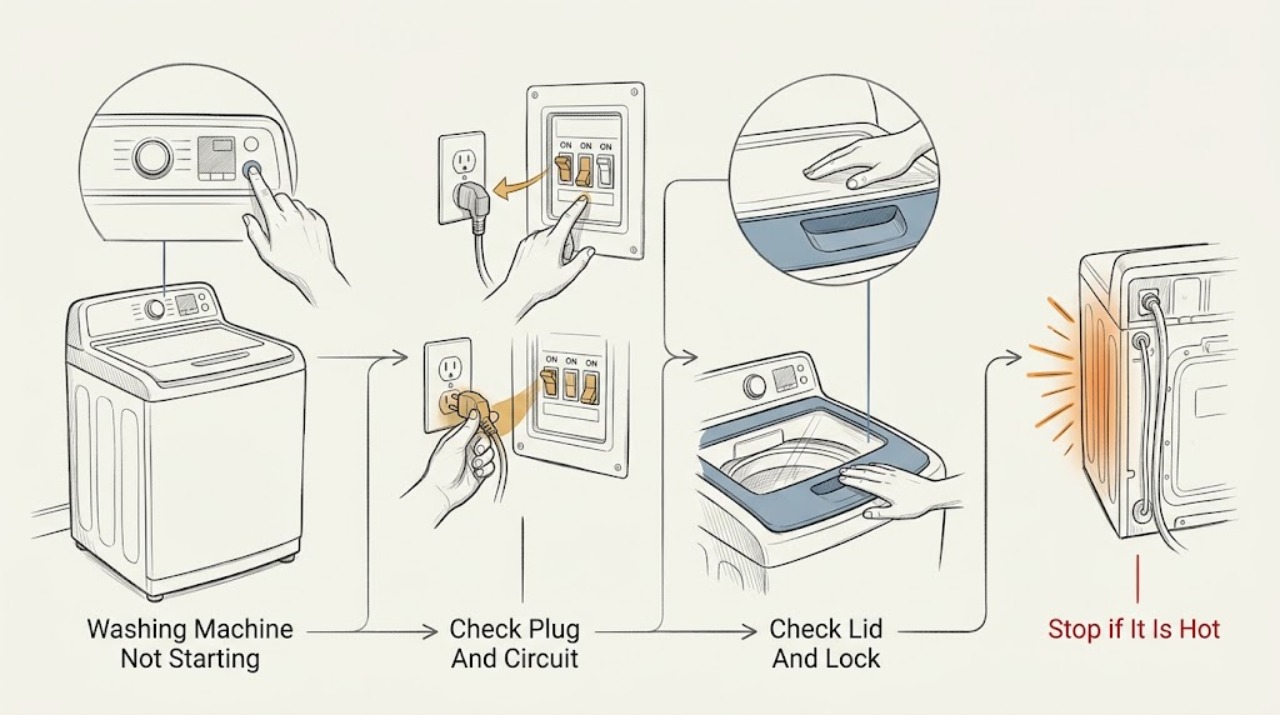
If a Frigidaire washing machine will not start, first check whether the display has power and whether the cycle is actually paused or sensing the load. Confirm the plug fits tightly, the breaker or fuse is sound, the washer is level, both water valves are on, the lid is fully closed, and Start or Start/Pause was pressed after choosing the cycle and options. Cancel an unintended Delay Start and use the exact model instructions before changing settings. Frigidaire notes that a washer may pause between Wash and Spin and that a laundry-center washer can spend its initial stage sensing the load. If the lid will not lock, water is unavailable, the breaker trips again, the display stays dead, or the machine leaks, smells burned, shows an error, or still will not begin after these external checks, stop and arrange qualified appliance service.
Work through in order
Diagnostic checks
Use only checks that match the exact appliance or system and its official guide.
-
Check 1
From outside the washer, press the normal Power or control command once and observe whether the display is blank, the panel lights but ignores input, the lid locks and the cycle senses, or the cycle has started but appears paused.
Expected result: Record display indicators, error messages, lid-lock behavior, selected cycle, tub movement, water level, and any leak, odor, noise, or recent power interruption.
Next step: Use the power check for a blank panel, the lid and control checks for a powered no-start, and allow one documented sensing or pause stage before cancelling an active cycle.
Stop if: Stop immediately for smoke, burning smell, sparks, flooding, violent movement, damaged cord, or a lid that cannot safely unlock.
Why this matters
Why: A blank panel points toward power; an active panel with no response points toward lid, settings, lock, or control; a quiet active cycle may be normal sensing or a pause. A leak, odor, or error changes the path to service.
-
Check 2
If the display is blank or the washer has no response, check that the power plug fits tightly in the wall outlet and that the household fuse or circuit breaker has not blown or tripped; do not use an extension cord.
Expected result: Record whether the plug is loose, the breaker or fuse is abnormal, the breaker trips again, or the washer remains dead with the external supply apparently normal.
Next step: Restore an external breaker only once if safe and permitted; arrange qualified electrical or appliance service for a repeated trip or persistent no-power condition.
Stop if: Do not increase fuse capacity, alter wiring, use an extension cord, open the washer, or repeatedly reset a tripping circuit.
Why this matters
Why: Frigidaire identifies a loose plug, blown fuse, or tripped breaker as possible no-start causes. A recurring trip or normal external supply with a blank panel indicates an electrical or appliance fault.
-
Check 3
Close the washer lid fully and check that no clothing or object is caught at the rim; press Start or Start/Pause after the cycle and options are selected, without inserting anything into the lid lock.
Expected result: Record whether the lid closes and locks, the washer beeps, the cycle begins sensing, or the lid stays open or the control shows a lock-related state.
Next step: Use only the exact model's lid and start instructions once; arrange service if the lock, lid switch, or controls remain unresponsive.
Stop if: Do not bypass, tape, force, or manually hold the lid lock, and do not reach into a tub that could begin moving.
Why this matters
Why: Frigidaire says the washer will not operate with the lid open and that Start must be pressed after selections. A lid that cannot close or lock can block the complete start sequence.
-
Check 4
Review the selected cycle, temperature and options, and check that Delay Start or another intentional pause is not active; if settings must be changed after a cycle began, cancel it only as the model manual directs and then reselect the cycle.
Expected result: Record whether the cycle is delayed, paused, missing a required selection, or starts normally after a documented re-selection.
Next step: Run one correctly selected cycle and observe its initial sensing stage; do not keep cancelling and restarting a cycle with water or an error present.
Stop if: Stop for an error, standing water, leak, burning odor, abnormal movement, or a control that changes settings on its own.
Why this matters
Why: Frigidaire says an unintended Delay Start, a pause stage, or failure to press Start after selections can look like a no-start. A correct selection with no response points toward the lid, power, water, or control system.
-
Check 5
Confirm from the utility area that the hot and cold water faucets are on, the washer hoses are not kinked or reversed, and water is available at sufficient household pressure; do not disconnect a hose while the washer is powered or the faucet is open.
Expected result: Record whether a faucet is closed, a hose is pinched, the supply is weak, the washer has no fill, or both supplies and hoses appear normal.
Next step: Correct only an obvious external faucet or hose condition, restore water slowly, check for leaks, and retry one cycle; request service for persistent no-fill or valve symptoms.
Stop if: Stop for flooding, a leaking or bulging hose, water near electricity, a seized shutoff, or any need to open the water-valve assembly.
Why this matters
Why: Frigidaire says water valves must be on and available for the washer to operate properly, and lists hoses, pressure, and inlet screens as fill checks. A missing water supply can prevent a start or leave the washer waiting.
-
Check 6
Check that the washer is level and stable, then allow its initial load-sensing stage to complete without opening the lid or changing controls repeatedly.
Expected result: Record whether the cabinet rocks, the cycle advances after sensing, the lid unlocks or stays locked, or the washer remains stuck at the same stage.
Next step: Follow the installation instructions for a minor empty-washer leveling adjustment only when safe; otherwise leave the machine off and arrange service for a persistent stall.
Stop if: Do not tilt a loaded or stacked washer, defeat the lid lock, or continue if the cabinet walks, shakes violently, or the floor is unstable.
Why this matters
Why: Frigidaire lists level as a start check and explains that load sensing can delay water entry or make a cycle appear stopped. A stable washer that never advances after sensing points toward a lid, control, water, drain, or internal fault.
-
Check 7
After the external power, lid, cycle, water, and level checks are normal, run one supervised correctly selected cycle and watch the initial start and sensing sequence from outside the washer.
Expected result: Record whether the lid locks, the tub begins sensing or filling, the cycle advances, an error appears, or the washer remains idle with normal external power and water.
Next step: Leave the washer off and arrange qualified appliance service for a repeated no-start result; provide the model, display, lid, power, water, and cycle observations.
Stop if: Stop the test for smoke, burning smell, sparks, flooding, violent movement, abnormal noise, or a cycle that begins with the lid open.
Why this matters
Why: A normal start after correcting a setting, lid, supply, or level issue supports that external branch. Persistent no-start with all conditions normal suggests a lid-lock, control, motor, or other internal fault.
Use your observations
Decision map
Find the observation that best matches what you see, then follow the next safe action.
-
PATH 01Safety boundary
What you see
The display is blank and the plug, breaker, or fuse does not restore normal power, or the circuit trips again.
Do this next
Leave the washer off and arrange qualified electrical or appliance service.
Why this path and its safety boundary
Why it matters: The issue is in the household supply, installation, or washer power path rather than a cycle setting.
Safety stop: Do not use an extension cord, change fuse capacity, open the cabinet, or repeatedly reset the circuit.
-
PATH 02Safety boundary
What you see
The panel is powered but the lid will not close or lock, Start is ignored, or a control lock or error remains.
Do this next
Use the exact model's documented lid and Start procedure once; arrange service if the control or lock remains abnormal.
Why this path and its safety boundary
Why it matters: The washer cannot safely enter the cycle or has a lid-lock or control fault.
Safety stop: Do not bypass, tape, or force the lid lock.
-
PATH 03Safety boundary
What you see
The cycle is delayed, paused, or in initial load sensing and later advances normally.
Do this next
Allow the documented stage to finish and monitor one correctly selected cycle.
Why this path and its safety boundary
Why it matters: The apparent no-start is part of the configured or normal cycle sequence.
Safety stop: Request service if the stage never ends, repeats with an error, or leaves the washer full of water.
-
PATH 04Safety boundary
What you see
A faucet is closed, a hose is kinked or reversed, water pressure is inadequate, or the washer cannot begin filling.
Do this next
Correct only accessible external water conditions, restore water slowly, check for leaks, and retry once.
Why this path and its safety boundary
Why it matters: The washer may be waiting for the external water conditions required to start or advance.
Safety stop: Arrange plumbing or appliance service for persistent no-fill, a damaged hose, flooding, or an inlet-valve problem.
-
PATH 05Safety boundary
What you see
The washer has power, a correct cycle, a closed lid, available water, stable level, and still will not start after one supervised test.
Do this next
Leave the washer off and arrange qualified appliance service with the complete start sequence and observations.
Why this path and its safety boundary
Why it matters: A lid-lock, control, motor, or other internal fault may remain and cannot be safely isolated from outside.
Safety stop: Do not open the cabinet, test live wiring, bypass a safety device, or install a part based only on a no-start symptom.
Helpful context
Understand the symptom
First decide whether the washer is dead or waiting
A blank display, a powered panel that ignores Start, and a cycle that has begun but appears quiet are different symptoms. Frigidaire describes load sensing at the beginning of many laundry-center cycles and a normal pause between Wash and Spin. Record the display, lid-lock state, water level, selected cycle, and whether the tub has moved before cancelling a cycle.
Start conditions are intentionally strict
The washer needs power, water, a closed lid, and a valid cycle selection. Frigidaire says a washer will not operate when the lid is not closed properly and warns against extension cords. Water valves and sufficient household pressure are also part of the start path.
A lock or leak is a service boundary, not a workaround
If the lid will not lock, an error returns, the breaker trips, or the washer leaks, do not bypass the safety device or open the cabinet. Correct only safe external conditions such as a loose plug, an unintended delay, a closed faucet, or a visibly kinked hose. Persistent no-start behavior needs qualified diagnosis.
Safety boundary
Stop conditions
- Stop the washer for smoke, burning smell, sparks, flooding, water near electricity, a damaged cord, violent movement, or a lid that cannot safely unlock.
- Do not bypass the lid lock, use an extension cord, increase fuse capacity, open the cabinet, test live wiring, or repeatedly reset a tripping circuit.
- Arrange qualified appliance or electrical service when a powered, level washer with a closed lid, available water, correct settings, and one supervised test still will not start.
When checks do not resolve it
Need a professional?
Request qualified appliance service when the Frigidaire washer remains inactive after the plug, breaker or fuse, lid, cycle, Delay Start, water supply, level, and supervised start checks, or whenever it leaks, trips power, shows an error, smells burned, or has a damaged lid lock.
Have this ready
- Give the professional the exact model, display and error state, cycle and options, lid-lock response, breaker and plug result, water supply and hose observations, level, and supervised test result.
Common questions
FAQ
Why does my Frigidaire washer do nothing when I press Start?
Check the plug and breaker or fuse, close the lid fully, confirm the cycle and options, cancel an unintended Delay Start, and press Start after making selections. Also verify that water valves are on and the washer is level.
Is a quiet Frigidaire washer at the beginning of a cycle normal?
It can be. Frigidaire says many laundry-center washers spend an initial stage sensing the load and can pause between Wash and Spin. Request service if the stage never advances, an error appears, or water remains in the tub.
Can a closed lid or water-supply problem prevent a Frigidaire washer from starting?
Yes. The washer will not operate with the lid open, and Frigidaire says water valves must be on and water available. Check the lid, faucets, hose routing, pressure, and inlet screens without opening the cabinet.
Read the exact guide
Official sources
- Laundry Centers - How do I use my display or select cycles on my Frigidaire Laundry Center?Frigidaire · Frigidaire washer cycle selector, settings, Start/Pause, lid lock, and cancel-before-change guidance
- What should I do if my Frigidaire Laundry Center is not starting?Frigidaire · Frigidaire laundry-center washer power, lid, Start/Pause, level, load sensing, and pause behavior
- What should I do if my Frigidaire Top Load washer is not filling with water properly?Frigidaire · Frigidaire washer lid closure, faucets, hoses, pressure, and inlet-screen checks
- Laundry Water Supply GuideFrigidaire · Frigidaire washer hot and cold faucets, hose routing, flow, inlet screens, and connection checks
- What should I do if my washer does not start?Frigidaire · Frigidaire washer no-start, level, Start, Delay Start, pause, lid, power, water, and service checks
Community feedback
Share a repair observation
Share a plain-text repair observation. Accepted observations are published automatically; this page may take a moment to update.