
On this page
Start here
Quick answer
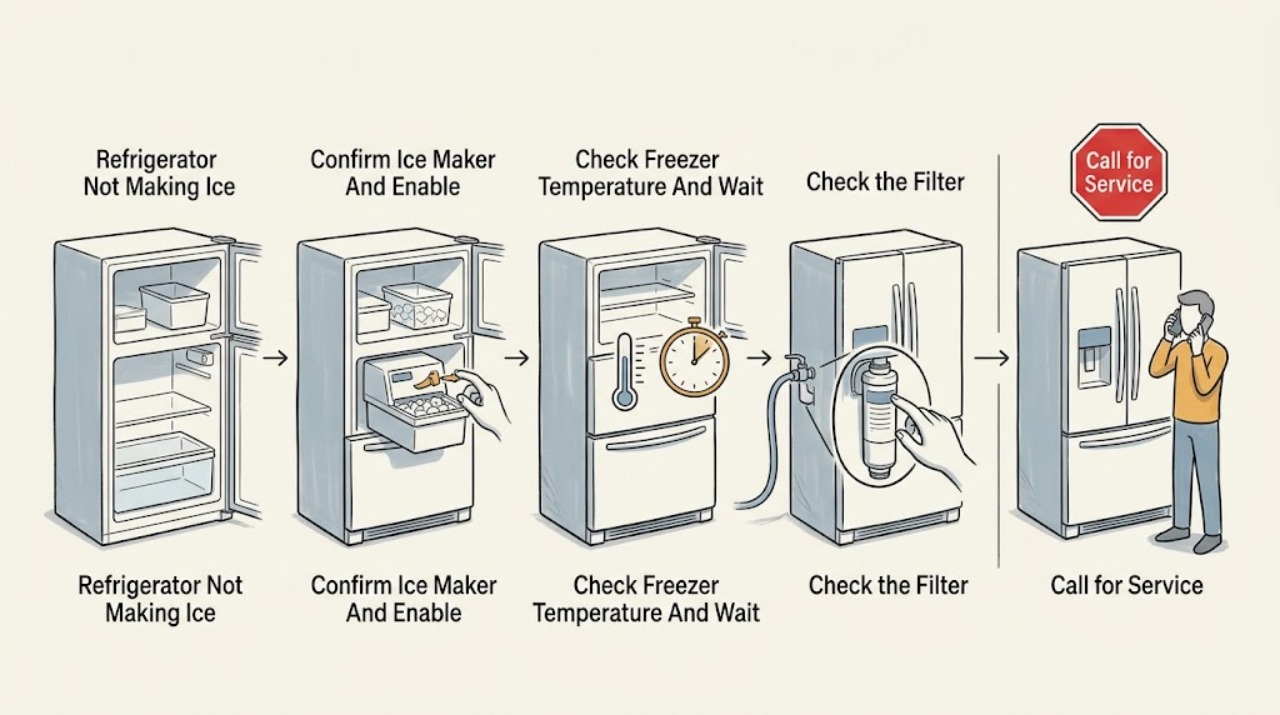
First confirm that the exact Gaggenau model actually has an automatic ice maker and that ice production is switched on. Check that the ice container is fully inserted and locked, the freezer has reached its set temperature, and the water supply valve is open with no visible kink in the inlet hose. Gaggenau manuals say production starts after the appliance reaches temperature, may take about 24 hours after a new start, stops when the container is full, and can be reduced by low water pressure, a used or blocked filter, a warm freezer, or ice stuck together in the container. On models with a water filter, use only the exact manual's filter procedure; an incompletely installed filter can allow escaping water. If the ice maker is enabled and correctly positioned but the freezer remains too warm, water does not arrive, the hose freezes, a leak appears, or no ice returns after the documented stabilization period, stop repeated tests, close the water shutoff if water is escaping, and arrange Gaggenau authorized or qualified appliance service. Do not open the ice-maker housing, bridge controls, probe a live valve, or repair the refrigeration or water system yourself.
Before you begin
Safety first
- The user may identify the model, check the documented ice-maker control and container seating, observe freezer temperature, inspect a dry accessible hose/filter, and close the water shutoff. Qualified service must handle filter heads, valves, fill tubes, motors, sensors, controls, wiring, refrigeration, pressure, and hidden mechanisms.
Work through in order
Diagnostic checks
Use only checks that match the exact appliance or system and its official guide.
-
Check 1
Identify the exact Gaggenau E-Nr. and confirm from its manual or product documentation that an automatic ice maker is installed. Check the ice-maker indicator/control and make sure production is enabled. Inspect that the ice container is present, fully inserted, and locked without storing food or bottles in it.
Expected result: The model has no automatic ice maker, production is switched off, the container is missing/not seated, the container is full, or the feature is enabled and correctly positioned.
Next step: If applicable, enable production and reseat the empty container exactly as the manual shows, then continue with the temperature and supply checks. Do not force the container or open the ice-maker housing.
Stop if: Do not store food in the ice container, bypass the ice-maker control, rotate internal mechanisms by force, or apply a procedure from another Gaggenau model.
Why this matters
Why: A model without the feature cannot make ice, and an off state or unseated/full container can stop production without an internal failure. An enabled maker with a correctly seated container moves the diagnosis to temperature, water, filter, or internal service branches.
-
Check 2
Record whether the appliance or ice maker was just installed, switched on, or restarted after a long period, and check the freezer temperature display against the exact manual. Do not open the door repeatedly while waiting for the documented stabilization period; note whether the freezer is warm, at its setting, or showing an alarm.
Expected result: The ice maker or appliance has just been started, the freezer is too warm, the documented startup period has not elapsed, or the freezer has reached its set temperature but no ice is made.
Next step: Allow only the exact manual's stabilization period with the door closed, then reassess once. If the freezer cannot reach or hold its setting, protect food and arrange refrigerator service rather than making the ice maker colder through undocumented settings.
Stop if: Do not repeatedly power-cycle, change unrelated temperature settings, place heat sources in the freezer, or remove interior covers to inspect cooling.
Why this matters
Why: Gaggenau's ice-maker guidance allows about 24 hours after a new start before production begins and identifies a warm freezer as a cause of no or low ice. Once the freezer is at temperature and the wait period has passed, temperature alone is less likely and the water/bin/internal branches become more important.
-
Check 3
For a water-connected ice-maker model, from a dry accessible position check that the household shutoff is open, the visible inlet hose is not kinked, and there is no water escaping at the connection. If the exact manual has a user-replaceable filter, verify that it is the correct model procedure and is fully seated; do not loosen a wet connection or reach behind a built-in appliance.
Expected result: The supply is off, the hose is kinked, a filter is blocked/used or not fully seated, water pressure is reported low, a connection leaks, or the accessible supply appears normal.
Next step: Close the water shutoff for a leak and contact Gaggenau service or a qualified plumber. Smooth only a safe visible hose kink if the exact manual allows it; handle filter replacement only as documented. If supply observations are normal, continue to the container/ice condition check without repeated fill tests.
Stop if: Do not force a filter, substitute an unverified cartridge, dismantle a filter head, open plumbing under pressure, or operate with a leak.
Why this matters
Why: No incoming water, a kink, low pressure, or filter condition can prevent the ice maker from filling. An incorrectly seated filter or leaking connection can create water damage and must be isolated. A normal visible supply shifts suspicion toward temperature, container, or internal ice-maker service.
-
Check 4
With the ice maker switched off if the matching manual requires it, inspect the accessible ice container for a full bin, cubes frozen together, ice accumulated against the rear panel, or a container that does not seat. Distribute loose cubes or loosen a clump only with the blunt, manual-approved method; do not pry into the maker or rotate an internal auger/drive by force.
Expected result: The container is full, cubes are clumped or stuck to the rear panel, the container is misaligned, the bin is empty with no visible obstruction, or the condition returns after correction.
Next step: Empty or distribute ice and reseat the container only as the exact manual directs, then allow the documented production interval. If the bin will not seat or the condition returns, leave the maker off and arrange service.
Stop if: Do not store food in the bin, use a sharp tool, disassemble the container, pry the ice maker, or run repeated harvest/dispense tests.
Why this matters
Why: A full or mechanically obstructed container can make the maker stop or prevent new cubes from being available even when the fill and cooling systems work. An empty correctly seated bin with no visible ice condition points back to water/temperature or an internal maker fault.
-
Check 5
Record the exact model/E-Nr., ice-maker enable state, container position, freezer temperature and alarm, time since startup, water shutoff/hose/filter observations, any leak, and the time of the last ice production. If the maker is enabled, seated, supplied, and at temperature but does not produce ice after the model's interval, stop testing.
Expected result: Ice returns after a documented correction, no ice persists despite normal external checks, the hose or filter leaks/freezes, the freezer remains warm, or an error/abnormal sound appears.
Next step: Keep the water shutoff closed for a leak and arrange Gaggenau authorized or qualified appliance service. Provide the recorded model and observations rather than ordering an ice-maker assembly from the symptom alone.
Stop if: Do not open the rear or ice-maker housing, test a valve or heater live, bypass a sensor/control, handle refrigerant, or repeatedly cycle the ice maker.
Why this matters
Why: A corrected setting, bin, startup, temperature, or water-path condition can explain a temporary no-ice report. Persistent no ice with those conditions normal makes an internal valve, fill tube, motor, sensor, control, wiring, or cooling fault more likely; the symptom does not identify the part.
Use your observations
Decision map
Find the observation that best matches what you see, then follow the next safe action.
-
PATH 01Safety boundary
What you see
The exact model has an ice maker but production is switched off, the container is absent/unseated, or the container is full or visibly jammed.
Do this next
Enable production and reseat, empty, or safely redistribute the container exactly as the matching manual directs, then allow the documented interval.
Why this path and its safety boundary
Why it matters: A control or container state is more likely than a failed water valve or compressor.
Safety stop: Do not force the bin, store food in it, pry ice with a sharp object, or open the maker housing.
-
PATH 02Safety boundary
What you see
The maker was just started/restarted or the freezer has not reached its set temperature; no water leak or electrical hazard is present.
Do this next
Keep the door closed and allow the exact manual's stabilization period, about 24 hours where the applicable Gaggenau manual says so. If the freezer remains warm, call service.
Why this path and its safety boundary
Why it matters: Normal startup delay or a freezer-temperature problem is more likely than an immediate ice-maker component failure.
Safety stop: Do not repeatedly power-cycle, force a colder undocumented setting, or remove cooling covers.
-
PATH 03Safety boundary
What you see
The ice maker is on and seated, the freezer is at temperature, but the supply is off, the hose is kinked, the filter is blocked/used/incorrectly seated, or water pressure is low.
Do this next
Close the shutoff for any leak and use only the exact manual's visible hose/filter procedure. Arrange plumber or Gaggenau service for low pressure, filter housing, valve, or connection work.
Why this path and its safety boundary
Why it matters: A water-fill problem is more likely than a container or temperature problem; an incorrectly seated filter can also cause escaping water.
Safety stop: Do not open pressurized plumbing, force a cartridge, substitute a filter, or keep the water supply open through a leak.
-
PATH 04Safety boundary
What you see
Ice is present but clumped, stuck at the rear of the container, or blocking proper container seating; the maker and water path otherwise appear normal.
Do this next
Empty or redistribute the ice and reseat the container using the manual-approved blunt method, then wait for the next production interval. Escalate if the clump returns or the bin will not seat.
Why this path and its safety boundary
Why it matters: The container/ice condition can prevent normal storage or signal full-bin behavior without proving that the maker cannot produce ice.
Safety stop: Do not pry the maker, use sharp tools, rotate internal drive parts, or run repeated harvest tests.
-
PATH 05Safety boundary
What you see
The maker is enabled, the container is correctly seated, the freezer is at temperature, the supply/filter/hose checks pass, and no ice returns after the model-specific interval, or a leak/error/abnormal sound persists.
Do this next
Keep the maker/water supply off as appropriate and arrange Gaggenau authorized or qualified appliance service with the observation record.
Why this path and its safety boundary
Why it matters: An internal ice-maker valve, fill tube, motor, sensor, control, wiring, or refrigeration fault is more likely and cannot be safely separated by user checks.
Safety stop: Do not open panels, bypass controls, probe wiring, handle refrigerant, or order an ice-maker assembly from no ice alone.
Helpful context
Understand the symptom
No ice is not always an ice-maker failure
An ice maker can be enabled but still wait for the freezer to reach its set temperature, refill slowly after startup, or stop because the container is full. A disconnected water supply, kinked hose, low pressure, filter condition, warm freezer, or a bin that is not seated creates a different next step. Start with the model and the observable state before selecting a part.
The water path is conditional on the model
Only a Gaggenau model with an installed automatic ice maker and water connection has the water-supply, filter, shutoff, and inlet-hose branches. A manual may specify an internal filter or bypass cartridge, while another configuration may differ. Do not insert a similar-looking filter or change a plumbing connection without matching the E-Nr. manual.
The safe boundary ends before the valve and ice-maker housing
Visible checks, model-documented controls, container seating, accessible hose routing, and a safe filter change are the user-level path. A valve, fill tube, sensor, motor, control, wiring, refrigeration system, or hidden filter head requires qualified diagnosis. If water is leaking or the freezer is not maintaining temperature, protect food and leave the unit out of service as appropriate.
Safety boundary
Stop conditions
- Close the accessible water shutoff and stop using the ice maker for a leak, escaping water, a frozen or damaged hose/filter, or water near electrical parts.
- Do not repeatedly cycle the ice maker, dispense or harvest to reproduce the symptom, or run it with an unseated container or leaking connection.
- Do not force a filter or bin, use sharp tools on ice, store food in the ice container, or apply an unverified procedure from another Gaggenau model.
- Do not open the ice-maker/rear/control housing, bypass a sensor or control, probe a live valve or heater, use electrical devices to defrost, or handle refrigerant.
- If no ice persists after the exact manual's enable, container, temperature, water, filter, and stabilization checks, arrange qualified service instead of selecting an internal part.
Only after diagnosis
Potential parts
- water filter or filter/bypass cartridge
Consider a filter only when the exact ice-maker model documents that filter and the check finds a used, blocked, incorrectly seated, or damaged cartridge; no ice alone does not identify a filter.
Confirm the exact Gaggenau model/E-Nr. and manufacturer's fit information. An incorrect or incompletely installed filter can cause water escape. - ice-maker inlet valve, fill tube, or ice-maker assembly
Consider these only after the maker is enabled, the bin is seated, the freezer reaches temperature, the water path is normal, and qualified diagnosis isolates an internal no-fill or no-harvest fault.
Do not order from the no-ice symptom alone. Verify the exact configuration, model/E-Nr., diagnosis, and manufacturer's fit information before professional replacement.
When checks do not resolve it
Need a professional?
Safety scope: The user may identify the model, check the documented ice-maker control and container seating, observe freezer temperature, inspect a dry accessible hose/filter, and close the water shutoff. Qualified service must handle filter heads, valves, fill tubes, motors, sensors, controls, wiring, refrigeration, pressure, and hidden mechanisms.
Common questions
FAQ
Why is my Gaggenau refrigerator not making any ice?
Confirm that the exact model has an automatic ice maker and that it is switched on. Then check the container position, freezer temperature, startup interval, water shutoff, visible hose, and model-documented filter. Gaggenau manuals identify all of these as separate causes; persistent no ice after the safe checks needs service.
How long does a Gaggenau ice maker take to start making ice?
The exact manual controls, but the official 9000741705 Gaggenau instructions state that about 24 hours may be needed after the appliance or ice maker is newly switched on. Production also depends on the freezer reaching its set temperature. Do not repeatedly cycle the maker during the stabilization period.
Can a water filter stop a Gaggenau ice maker?
Yes, on models equipped with a filter. Gaggenau identifies a used or blocked filter as a possible low/no-ice cause and warns that an incompletely installed filter can allow water to escape. Use only the exact E-Nr. manual's filter or bypass procedure, and close the water supply for a leak.
What if the ice container is full or the cubes are frozen together?
The maker may stop automatically when the container is full, and clumped cubes can prevent normal storage or seating. Empty or redistribute the cubes only with the exact manual's safe method and reseat the container. Do not use sharp tools, store food in the bin, or pry into the ice maker.
When should I stop troubleshooting a Gaggenau ice maker?
Stop for a water leak, frozen/damaged hose or filter, water near electrical parts, an unresponsive or erroring maker, a freezer that cannot hold temperature, or no ice after the exact manual's checks and stabilization period. Close the water shutoff as appropriate and arrange qualified service; do not open the maker or refrigeration system.
Read the exact guide
Official sources
- Gaggenau Instruction manualGaggenau · Official Gaggenau-hosted manual; its filter and ice-maker procedures apply to the documented model family and not automatically to all Gaggenau products.
- Gaggenau User manual RC 200Gaggenau · Official Gaggenau-hosted RC200 manual; safety principles are cited as model-manual guidance and exact model instructions remain controlling.
- The Gaggenau refrigeratorsGaggenau · Official Gaggenau US product-family page; feature statements apply to named families rather than every model.
- Gaggenau Operating instructionsGaggenau · Official Gaggenau-hosted operating instructions; the ice-maker and water procedures are model-family specific.
Community feedback
Share a repair observation
Share a plain-text repair observation. Accepted observations are published automatically; this page may take a moment to update.