
On this page
Start here
Quick answer
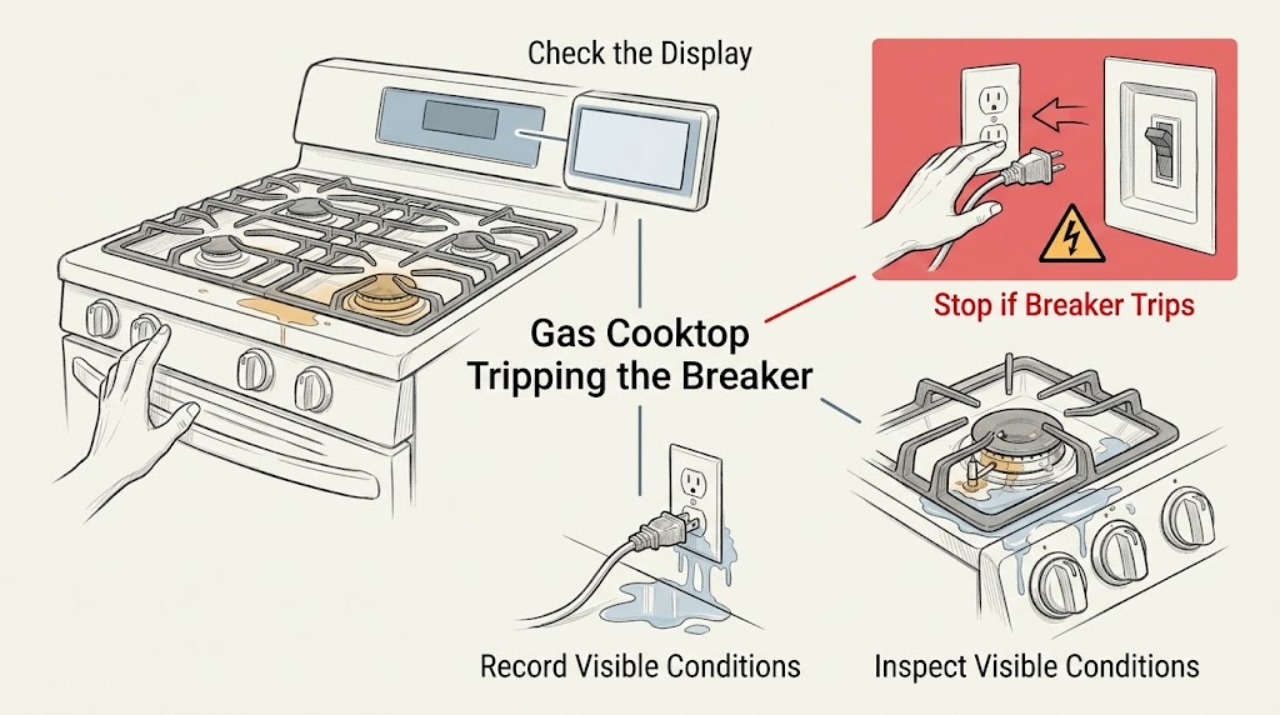
Do not keep resetting a breaker that trips with a gas cooktop. First record whether it trips as soon as the cooktop is connected, only when a burner is turned to Ignite, or after a spill or cleaning. From a dry position, look only at accessible parts of the cord, plug, and outlet. Stop for gas odor, smoke, burning odor, visible arcing, a hot or damaged connection, water near the power connection, or another trip. A clean, dry burner can explain continued clicking, but repeated electrical trips need qualified appliance or electrical service rather than an improvised repair.
Work through in order
Diagnostic checks
Use only checks that match the exact appliance or system and its official guide.
-
Check 1
Turn every burner control to Off and record the exact event that precedes the trip: connecting the cooktop, turning one control to Ignite, using any burner, or a recent spill or cleaning.
Expected result: The breaker opens immediately at connection, only during ignition, after a cleaning or spill, or with no repeatable trigger.
Next step: Keep the cooktop out of use after a repeat trip and use the matching branch below; do not make repeated ignition attempts or repeatedly close the breaker.
Stop if: Stop immediately for gas odor, smoke, burning odor, visible arc, a hot connection, or water near the power connection.
Why this matters
Why: Immediate trips point toward the supply or appliance input; an ignition-only trip points toward the ignition path or its wiring; and a post-cleaning pattern makes moisture a possible contributor without proving a safe repair.
-
Check 2
With the controls Off and only from a dry, safe position, look at the accessible plug, cord, outlet face, and nearby floor or counter for melting, discoloration, looseness, crushed insulation, water, or an unusual hot smell; do not remove covers or touch exposed conductors.
Expected result: The connection looks normal and dry, or there is visible damage, heat evidence, moisture, or an outlet that does not hold the plug firmly.
Next step: If any warning sign is present, stop using the cooktop and have a qualified electrician or appliance technician assess the connection. If the exterior is normal, continue only with the timing and burner observations.
Stop if: Stop for exposed metal, smoke, arcing, scorching, a hot outlet or plug, or water contacting the power connection.
Why this matters
Why: Damage, heat, moisture, or a loose connection can make the supply side unsafe; a normal-looking exterior does not clear hidden wiring or the appliance input.
-
Check 3
From the event record, distinguish one burner ignition from an all-burner or no-control event; note whether the burner normally clicks when its control is pushed and turned to Ignite, without starting another test cycle after a trip.
Expected result: Only one burner is associated with the trip, every burner is affected, or the breaker opens while all controls remain Off.
Next step: Provide the burner pattern and trip timing to the service provider. Do not remove burner switches, ignition modules, or wiring to compare circuits.
Stop if: Stop for continuous clicking with all controls Off when the cooktop remains connected, smoke, arc sounds, or a burning smell.
Why this matters
Why: A single-burner pattern can narrow the problem toward that burner switch, ignition lead, or related moisture; an all-burner or Off-position trip points more broadly toward shared ignition, input, or supply wiring.
-
Check 4
If the pattern began after cleaning or a spill, leave all controls Off and allow only accessible burner caps, heads, and surfaces to become fully dry according to the model manual; do not spray or pour liquid into controls and do not open the console.
Expected result: Clicking or the breaker event stops after the accessible area is dry, or the breaker still trips after the cooktop has dried.
Next step: If a breaker trip recurs after drying, stop using the cooktop and arrange qualified service; record what was cleaned and how long the appliance remained off.
Stop if: Stop for water near the plug or outlet, a wet control area, smoke, an arc, gas odor, or any repeated breaker trip.
Why this matters
Why: Whirlpool identifies moisture in switches or burner areas as a cause of continued clicking, but drying does not validate a cooktop that has tripped a protective device.
-
Check 5
Use the exact model manual to identify its supply arrangement, control-lock or ignition behavior, and approved cleaning method; do not substitute another brand's wiring or gas instructions.
Expected result: The manual confirms a normal electronic-ignition sequence and external care steps, or the model, installation, or supply details are unknown.
Next step: Give the technician the model, supply arrangement, trip timing, affected burner, cleaning history, and visible connection observations; leave internal electrical and gas work to qualified personnel.
Stop if: Stop for a missing or damaged manual label, exposed wiring, gas odor, smoke, scorching, or a breaker that will not remain closed.
Why this matters
Why: Manufacturer procedures can explain normal clicking and safe external care, but they cannot identify a hidden short, damaged lead, ignition module, or outlet fault from the symptom alone.
Use your observations
Decision map
Find the observation that best matches what you see, then follow the next safe action.
-
PATH 01Next step
What you see
The breaker opens as soon as the cooktop is connected or while all controls are Off.
Do this next
Record whether other equipment on the circuit is also affected, without moving the cooktop or opening the electrical panel.
Why this path and its safety boundary
Why it matters: Do not reconnect or repeatedly reset it. Keep the appliance out of use and arrange qualified electrical and appliance inspection, especially if the outlet, cord, or plug shows heat or damage.
-
PATH 02Next step
What you see
The breaker opens only when one burner is turned to Ignite or only during ignition.
Do this next
Tell the technician which burner and whether normal clicking was heard before the trip; do not remove the ignition module or test wiring.
Why this path and its safety boundary
Why it matters: Leave the cooktop unused; the event may involve the shared ignition supply, a burner switch, an ignition lead, or an internal fault that requires service.
-
PATH 03Next step
What you see
The problem began after cleaning or a spill and there is no gas odor, smoke, arc, or visible electrical damage.
Do this next
If the breaker opens again after drying, stop all use and arrange qualified inspection rather than adding more drying products or repeating ignition.
Why this path and its safety boundary
Why it matters: Leave controls Off and let accessible surfaces dry according to the manual. Moisture can cause continued clicking, but a repeated breaker trip still requires service.
-
PATH 04Next step
What you see
The plug, cord, outlet, or nearby surface is hot, wet, loose, discolored, melted, or visibly damaged.
Do this next
Have a qualified electrician assess the outlet and circuit and have appliance service assess the cooktop if needed.
Why this path and its safety boundary
Why it matters: Stop using the cooktop and keep clear of the connection. Do not bend plug blades, replace a breaker with a larger rating, or work inside the outlet.
-
PATH 05Next step
What you see
Gas odor, hissing, smoke, visible flame outside the burner, an arc, or a strong burning odor is present.
Do this next
Only qualified personnel should determine when the appliance and gas installation are safe to use again.
Why this path and its safety boundary
Why it matters: Stop operating the cooktop, leave the area, and use the local emergency or gas-safety route from a safe location. Do not operate switches or electrical equipment in the affected area.
-
PATH 06Next step
What you see
No external warning is visible, but the breaker trips again after one controlled observation or remains unable to stay closed.
Do this next
Provide the event sequence and model information; do not bypass the protective device or substitute a higher-rated one.
Why this path and its safety boundary
Why it matters: Treat the repeat trip as an unresolved fault, not as a nuisance reset. Keep the cooktop disconnected or switched off as safely possible and arrange qualified diagnosis.
Helpful context
Understand the symptom
Why the trip timing matters
A gas cooktop still uses electrical power for controls and electronic ignition. The same breaker symptom has different implications depending on when it occurs: at plug-in points toward the connection or appliance input; during Ignite points toward the ignition circuit or a burner switch; and after cleaning makes retained moisture a useful clue. Timing does not prove which part has failed, so use it to decide whether to stop immediately or continue with a limited external check.
Keep gas and electrical risks separate
Whirlpool describes clicking during an ignition attempt as normal, while damp parts can prolong clicking. That guidance does not make a breaker trip normal. If you smell gas, see smoke or an arc, notice scorching, or find water at the power connection, leave the cooktop off and arrange qualified help. Do not open a control panel, alter gas hardware, or defeat the breaker.
Safety boundary
Stop conditions
- Stop immediately for gas odor, hissing, smoke, visible arcing, a burning odor, or flame outside the intended burner area.
- Stop for a hot, melted, loose, wet, or discolored plug, cord, outlet, or nearby connection.
- Do not repeatedly reset a breaker, bypass a safety device, use a higher-rated protective device, or open live wiring.
- Stop if water may have reached a plug, outlet, control, ignition part, or other electrical connection.
- Stop ordinary troubleshooting when the breaker trips again; use qualified appliance or electrical service.
Only after diagnosis
Potential parts
- ignition module
Consider this category only if qualified diagnosis links an ignition-time trip to the module rather than the outlet, supply, switch, or wiring.
Confirm the exact model and manufacturer fit information before any part is selected. - burner ignition switch
Consider this category only when a qualified technician identifies one burner control or switch as the repeatable trigger.
Do not infer fit from appearance; use the full model information and approved service data. - power cord or connection component
Consider this category only after qualified inspection finds damage at the appliance connection and confirms the correct repair path.
Electrical connection work must follow the appliance installation instructions and local requirements.
When checks do not resolve it
Need a professional?
Arrange qualified appliance service and, when the outlet or branch circuit may be involved, a qualified electrician after any repeat trip or any visible connection warning. Give them the model, supply arrangement, exact trip timing, affected burner, cleaning or spill history, and visible observations. For gas odor, smoke, fire, or active arcing, leave the area and use the local emergency or gas-safety route from a safe location.
Have this ready
- model and installation type
- trip timing
- affected burner or all burners
- cleaning or spill history
- visible plug and outlet observations
Common questions
FAQ
Is a breaker trip normal when a gas cooktop clicks?
Clicking during an ignition attempt can be part of normal electronic ignition, but a breaker opening is not a normal operating result. Do not keep resetting the breaker; record the timing and arrange qualified diagnosis if it repeats.
What if the trip started after cleaning?
Moisture can cause continued clicking around burner or switch areas. Keep controls Off and allow only accessible surfaces to dry as the model manual directs. If the breaker opens again, stop using the cooktop and arrange service.
Should I use a larger breaker so the cooktop stays on?
No. Do not bypass or replace a protective device with a higher rating. A recurring trip needs qualified electrical or appliance diagnosis.
What should I do if the outlet or plug is hot or discolored?
Stop using the cooktop and keep clear of the connection. A hot, loose, melted, or discolored outlet or plug needs qualified electrical inspection.
Can I inspect the ignition module or wiring myself?
No. Internal ignition, switch, module, cord, and wiring diagnosis should be handled by qualified personnel, especially after a breaker trip. Provide the trip sequence and model information instead.
Read the exact guide
Official sources
- Clicking or Ticking - Gas Cooktop - Product HelpWhirlpool · Gas cooktop clicking after moisture, spills, drafts, or ignition
- Gas Burners are Clicking but Not Lighting - Product HelpWhirlpool · Gas cooktop burner clicking, moisture after cleaning, burner ports, and ignition observations
- CPSC Guide to Home Wiring HazardsU.S. Consumer Product Safety Commission · Residential circuit breakers, outlets, plugs, appliance electrical hazards, and qualified repair guidance
- Lighting the Burners - Electronic Ignition - Product HelpWhirlpool · Normal gas-cooktop electronic ignition sequence and clean burner-cap guidance
- What You Should Know About Gas Appliance SafetyU.S. Consumer Product Safety Commission · Household gas-appliance odor response and professional gas-connector safety
Community feedback
Share a repair observation
Share a plain-text repair observation. Accepted observations are published automatically; this page may take a moment to update.