
On this page
Start here
Quick answer
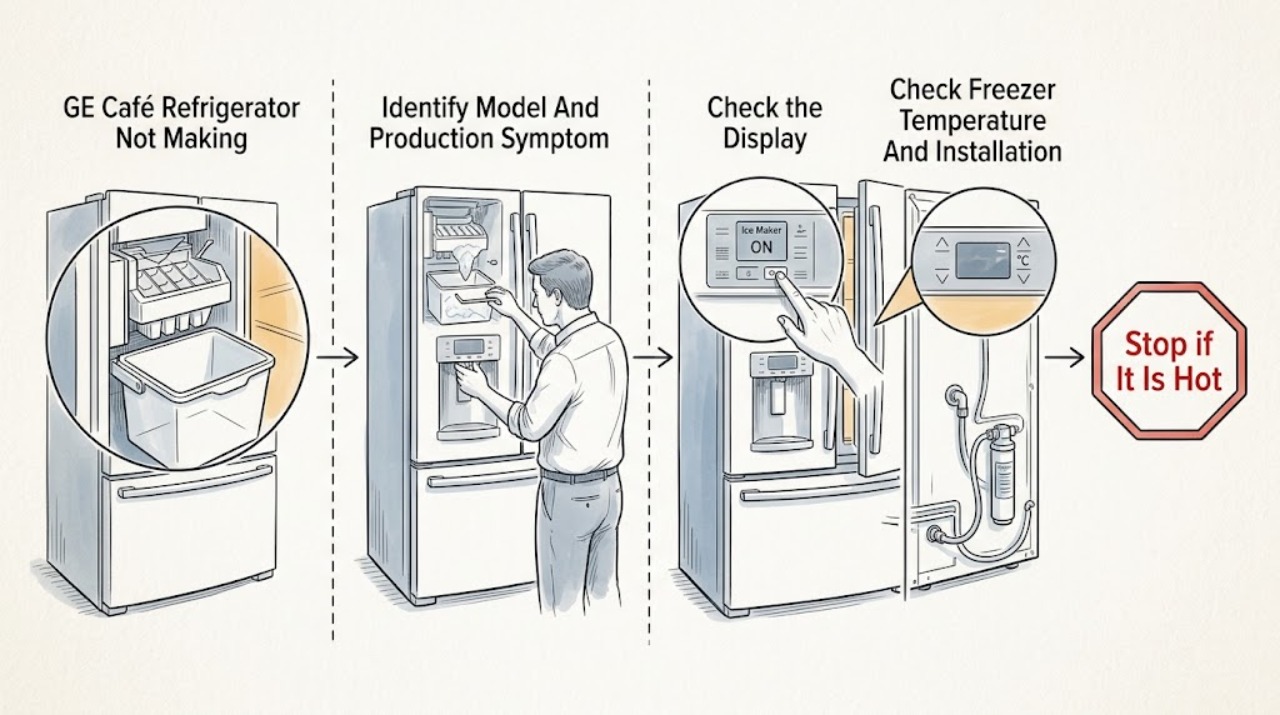
If a GE Café refrigerator is not making ice, first determine whether the icemaker is off, the freezer is too warm, the ice mold or ejector is blocked, or water flow is restricted. GE identifies Café French-door refrigerator models in its Owner Center and says the exact model manual controls the icemaker interface. On applicable GE refrigerators, ice production depends on a freezer near 0°F and an icemaker cold enough to cycle; a clogged filter, closed water supply, blocked paddle, or a newly installed unit can delay or stop filling. Check only the normal controls, visible ice bin and paddle, water shutoff, filter instructions, and model-approved reset. Do not remove the icemaker, probe a valve, touch a heater, or make live electrical tests. Arrange qualified service if the mold does not fill after external checks, a fill tube appears frozen, a diagnostic light remains flashing, or there is water near electrical parts, smoke, burning odor, heat, or repeated breaker tripping.
Before you begin
Safety first
- Do not remove the icemaker, touch its heater or motor, bypass the paddle or door controls, disconnect pressurized tubing, probe a water valve, use direct heat or sharp tools, or make live electrical measurements. Isolate power only when safe for a hazard condition.
Work through in order
Diagnostic checks
Use only checks that match the exact appliance or system and its official guide.
-
Check 1
Read the complete Café refrigerator model number from its accessible label or purchase record. Confirm whether the ice bin is empty, whether the mold contains frozen cubes, whether the water dispenser has normal flow if the model has one, and whether the unit is newly installed or restarted.
Expected result: The mold is dry, the mold contains frozen cubes, the dispenser also has poor flow, or the refrigerator is newly installed/restarted.
Next step: Use the exact model manual and the matching branch below. If the model cannot be identified without moving the appliance or removing a panel, give that information to service instead.
Stop if: Do not remove covers or move a built-in refrigerator to locate a model label.
Why this matters
Why: A dry mold makes a supply/fill or icemaker-state issue more likely; frozen cubes that remain in the mold make harvest trouble more likely. A new installation can need time to cool and purge air. Poor dispenser flow makes a shared supply/filter restriction more likely, but does not prove the valve is faulty.
-
Check 2
Using only the Café model's manual, check that the icemaker is enabled on the control panel or its labeled switch. If the model has a visible feeler arm or paddle, confirm it is not held in the stop/full position and can move freely without forcing it.
Expected result: The icemaker is off, the paddle/arm is blocked or held up, or the control is on and the paddle moves freely.
Next step: Enable the icemaker or clear only loose, accessible ice that prevents the paddle from moving, then allow the model's normal cycle time. If the control is correct but production does not resume, continue with temperature and water checks.
Stop if: Do not pry the paddle, bypass its sensor, remove the icemaker, or use another model's button sequence.
Why this matters
Why: GE says refrigerator icemakers can use different control-panel, toggle, slide-switch, or feeler-arm designs. An off state or blocked ice-level sensor can intentionally pause production; a correct state shifts attention to temperature, water, or harvest.
-
Check 3
Check the freezer temperature through the normal user display or a suitable independent thermometer, and note whether the refrigerator was recently installed, restarted, or loaded with warm food. Use the exact manual's recommended settings and wait through its stated stabilization period.
Expected result: The freezer is warmer than the model target, the unit is newly installed/restarted, or the freezer is at the target and has had time to stabilize.
Next step: Correct only the normal temperature setting and allow stabilization. If the freezer cannot reach or hold the model target, troubleshoot the refrigerator cooling problem or call service rather than changing the icemaker.
Stop if: Do not remove freezer panels, direct heat at frost, or alter a sealed-system control.
Why this matters
Why: GE states that ice production depends on freezer and icemaker temperature; its general guidance cites about 0°F for the freezer and about 16°F for an icemaker to begin a cycle. A recent installation or restart can temporarily delay ice, while a correctly cold freezer makes temperature less likely as the sole cause.
-
Check 4
Confirm the household refrigerator water shutoff is open, the visible supply line is not kinked, and the exact Café manual's filter is installed and seated. If the manual permits a filter replacement or bypass-plug comparison, use only the model-specified procedure and do not force a cartridge.
Expected result: The shutoff is closed, the line is kinked, the filter is overdue/incorrectly seated, dispenser flow improves with the model-approved bypass, or the external supply and filter appear normal.
Next step: Open the shutoff or correct an accessible kink, reseat or replace the filter as the exact manual directs, then allow the icemaker to cycle. If the mold remains dry, stop before valve or fill-tube diagnosis and arrange service.
Stop if: Do not disconnect a pressurized line, substitute an unverified filter, or test a water valve electrically.
Why this matters
Why: A closed or restricted supply and a clogged filter can prevent or reduce an icemaker fill. Improvement with a correct bypass comparison supports filter restriction; normal dispenser flow does not rule out a separate icemaker fill path or frozen tube.
-
Check 5
With the icemaker off if the model manual instructs it, look only at the accessible ice mold and ejector area for loose cubes visibly blocking the rake or mold. Do not touch the mold, heater, motor, or wiring; do not chip ice with a sharp tool.
Expected result: Loose ice visibly blocks the ejector, cubes are frozen in the mold with no safe accessible obstruction, the mold is empty, or the mold/assembly is damaged or leaking.
Next step: Clear only loose, reachable ice without force and restore the model-approved on state. For a stuck, damaged, leaking, or inaccessible mechanism, leave it alone and schedule service.
Stop if: Do not use a knife, hot water, hair dryer, jumper wire, or force on the ejector; do not remove the icemaker.
Why this matters
Why: GE says a stuck ejector/rake prevents the icemaker from completing its cycle and cautions that the mold can be hot. A frozen mold with no accessible obstruction, an empty mold after water checks, or visible damage requires model-specific service diagnosis rather than a guessed part.
-
Check 6
If the Café icemaker has a green LED and the exact model matches GE's documented LED diagnostic design, use only that model-appropriate reset sequence from the official guidance. Otherwise, record any light pattern and arrange service after the external checks; never repeat an undocumented reset.
Expected result: The LED returns solid and a harvest/fill occurs, it continues flashing, the model has no matching LED procedure, or no ice is produced after the external checks.
Next step: Monitor the next normal harvest if the documented reset succeeds. If the light remains flashing, the mold stays dry, or production does not resume, contact GE/Café or qualified appliance service with the model and observations.
Stop if: Do not touch the hot mold during harvest, repeat a reset outside the documented design, bypass safety controls, or make live measurements.
Why this matters
Why: GE's LED procedure is limited to icemakers with the specified on/off switch and LED. A flashing light can reflect a stuck rake, failed heater, or motor fault; those internal findings are not safely confirmed by a general Café page and may require service.
Use your observations
Decision map
Find the observation that best matches what you see, then follow the next safe action.
-
PATH 01Safety boundary
What you see
The Café refrigerator or icemaker was just installed, restarted, or connected to a water line, and the freezer is not yet at its model target.
Do this next
Use the exact manual's on state, water connection, and stabilization guidance, then recheck the mold and bin. Call service if the documented period passes with correct temperature and no fill.
Why this path and its safety boundary
Why it matters: Cooling and air purging can delay the first fill and first harvest; absence of ice immediately after installation is not proof of a failed icemaker.
Safety stop: Do not remove the icemaker or force water into it during installation troubleshooting.
-
PATH 02Safety boundary
What you see
The mold is empty/dry and the water dispenser is also slow or not flowing, or the shutoff, supply line, or filter shows a visible issue.
Do this next
Correct only the accessible shutoff, kink, or model-approved filter issue and allow a cycle. If the mold remains dry, service should check the fill path and valve without homeowner electrical testing.
Why this path and its safety boundary
Why it matters: A shared supply or filter restriction is more likely than a harvest jam, although the exact Café water architecture varies by model.
Safety stop: Do not disconnect pressurized tubing or probe the inlet valve.
-
PATH 03Safety boundary
What you see
The mold is dry but the dispenser has normal flow, the filter and supply appear correct, and the freezer is cold enough.
Do this next
Do not remove the icemaker. Give service the model, mold condition, dispenser result, temperatures, and filter history so the fill path can be diagnosed safely.
Why this path and its safety boundary
Why it matters: A separate icemaker fill tube, icemaker control, or valve path becomes more likely; GE says a frozen fill tube requires icemaker removal and technician inspection.
Safety stop: Do not disassemble the icemaker, thaw it with direct heat, or make live valve tests.
-
PATH 04Safety boundary
What you see
The mold contains frozen cubes but they remain in place, the ejector/rake is blocked, or a model-matched LED diagnostic remains flashing.
Do this next
Clear only loose accessible ice without force if the manual allows, or leave the assembly untouched and schedule service for a persistent jam, flashing light, heater, motor, or damage symptom.
Why this path and its safety boundary
Why it matters: The harvest mechanism is not completing its cycle; GE lists a jammed rake and, for the specified LED design, heater or motor faults as service-level causes.
Safety stop: Do not touch the heater or hot mold, force the rake, or jumper the motor or switch.
-
PATH 05Safety boundary
What you see
Water is near electrical parts, or there is smoke, burning/chemical odor, a hot or damaged cord, exposed damage, or repeated breaker tripping.
Do this next
Keep clear, isolate power only if safe, protect food without touching wet or damaged parts, and contact GE/Café or qualified appliance service.
Why this path and its safety boundary
Why it matters: This is a stop-use condition, not an icemaker adjustment. Water and electrical work needs qualified service.
Safety stop: Do not restore power to test the refrigerator, touch wet controls, remove covers, or continue operating it.
Helpful context
Understand the symptom
Identify the Café model and the kind of ice failure
Record the complete model number and whether the complaint is no ice at all, a slow or small harvest, or ice that is made but not dispensed. GE's Café Owner Center shows that a Café French-door refrigerator can have a model-specific manual and controls; do not assume another Café or GE refrigerator has the same icemaker location, button sequence, filter, or water path. Also note whether the refrigerator was newly installed, recently restarted, or has a working water dispenser.
Use the symptom pattern to separate temperature, water, and harvest causes
An empty dry mold points toward the icemaker state, water supply, filter, fill path, or valve circuit; a mold with frozen cubes that are not ejected points toward an obstructed or stalled harvest mechanism. A freezer that is warmer than its intended setting can prevent a cycle even when the refrigerator appears to run. A dispenser-only problem is a different intent: first verify whether the bin actually contains ice before treating it as an ice-production failure.
Stop before internal or electrical diagnosis
Do not remove the icemaker, reach around its heater or ejector, bridge contacts, probe wiring or a water valve, or test a live appliance. GE warns that the mold can become hot during harvest and says a frozen fill tube that requires icemaker removal should be checked by a service technician. Stop using the refrigerator and isolate power only when safe if there is smoke, burning or chemical odor, a hot or damaged cord, water near electrical parts, exposed damage, or repeated breaker trips.
When checks do not resolve it
Need a professional?
Contact GE/Café or qualified appliance service when the exact model's external checks and stabilization period do not restore production, when a dry mold persists despite normal water dispensing, when a fill tube may be frozen, when an LED remains flashing, or when internal temperature, valve, heater, motor, control, or wiring diagnosis is needed. Stop immediately for water near electrical parts, smoke, burning or chemical odor, a hot/damaged cord, exposed damage, or repeated breaker trips.
Safety scope: Do not remove the icemaker, touch its heater or motor, bypass the paddle or door controls, disconnect pressurized tubing, probe a water valve, use direct heat or sharp tools, or make live electrical measurements. Isolate power only when safe for a hazard condition.
Have this ready
- Complete Café model number, refrigerator style, ice symptom (dry mold versus frozen cubes), freezer temperature, installation/restart date, control state, paddle position, dispenser flow, water shutoff and filter observations, any LED pattern, and all hazard symptoms.
Common questions
FAQ
How long does a newly installed GE Café refrigerator take to make ice?
The first harvest can be delayed while the refrigerator and icemaker cool and the water line purges air. Use the exact Café model manual for its timing, confirm the icemaker is enabled and the freezer reaches its target, and call service if the documented period passes with a dry mold.
Why is my Café refrigerator's water dispenser working but the icemaker is not?
That pattern makes a whole-house supply or filter blockage less likely, but it does not rule out the icemaker's separate fill path or a frozen fill tube. GE says verifying a frozen fill tube requires removing the icemaker, so record the result and arrange service rather than dismantling it.
Should I pour water into the GE Café icemaker to test it?
Only follow a water-pour test if the exact model's official manual or support procedure explicitly permits it and describes the safe setup. Do not pour water into a powered assembly, touch a heater, or use the test as a substitute for service when the mold is inaccessible or damaged.
Is a flashing green light on a GE Café icemaker a reset problem?
GE's documented three-paddle reset applies only to icemakers with the specified on/off switch and LED. A persistent flash can indicate a stuck rake, heater, or motor issue. If the Café model does not match that design, or the light remains flashing, stop troubleshooting and use model-specific service.
Read the exact guide
Official sources
- Parts & Accessories for CYE22UP2MS1GE Appliances (CAFÉ) · Exact CYE22UP2MS1 model; use the exact Owner's Manual for other Café refrigerators because controls, filters, and icemaker architecture vary.
- Refrigerator - Icemaker Not Producing IceGE Appliances · GE refrigerator icemakers; exact Café model controls and mechanisms must be confirmed in the model manual.
- Refrigerator - Green Light on Icemaker Flashing (Icemaker Diagnostic)GE Appliances · Only matching GE icemakers with an on/off switch and LED; not a universal Café reset procedure.
- Refrigerator - On/Off Switch on the IcemakerGE Appliances · GE refrigerator icemakers; use the Café model manual to identify the installed control style.
- Refrigerator - Icemaker Doesn't Fill With WaterGE Appliances · GE refrigerator icemakers; supply lines, filter systems, and fill-tube access vary by Café model.
Community feedback
Share a repair observation
Share a plain-text repair observation. Accepted observations are published automatically; this page may take a moment to update.