
On this page
Start here
Quick answer
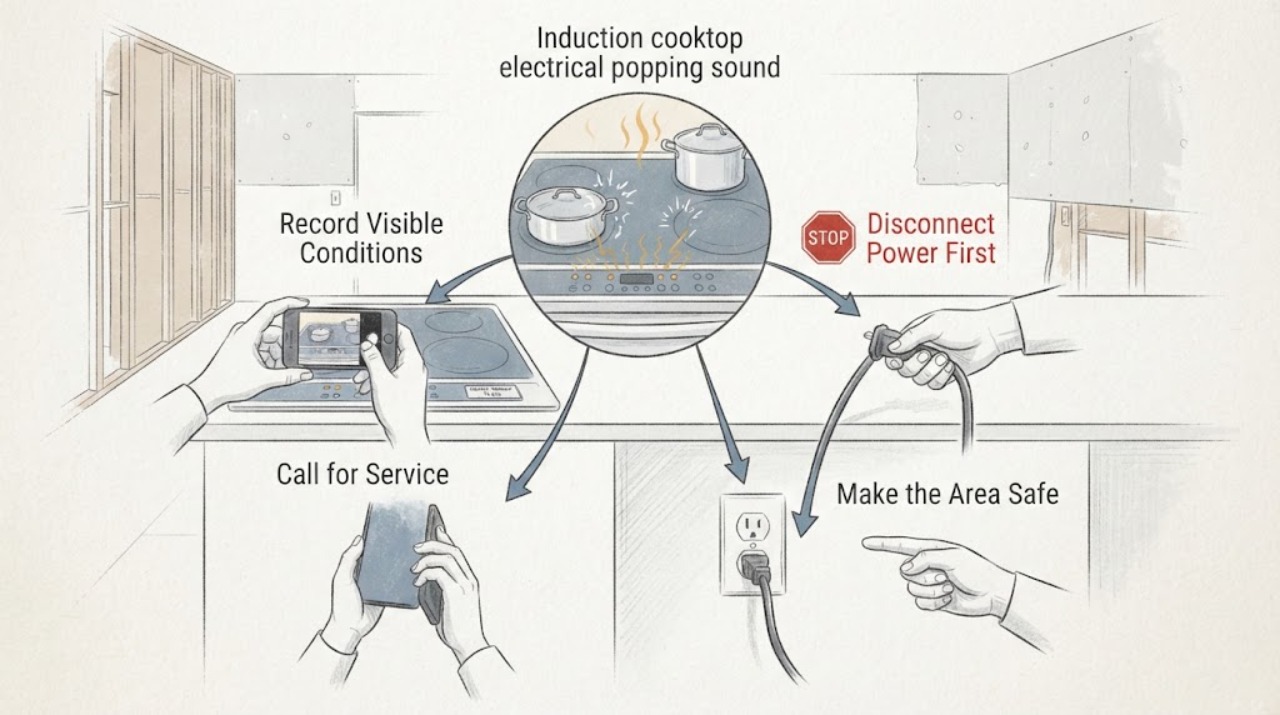
A loud pop followed by flashing lights and a burning smell on a GE Profile PHP900DM2BB induction cooktop is a stop-use event. Turn the controls off, keep clear of the glass and any smoke or heat, and switch off the cooktop's breaker only if you can do so safely. Do not turn it back on to see whether the E display clears, and do not open the cooktop to inspect a suspected board. After the surface is safe, record the displayed letter, sound, smell, visible glass or trim damage, and what changed during the kitchen remodel. GE's guidance supports checking the breaker and control or cookware conditions for ordinary flashing or no-heat symptoms, but a pop with a burning smell needs qualified appliance or electrical service.
Work through in order
Diagnostic checks
Use only checks that match the exact appliance or system and its official guide.
-
Check 1
Turn the cooktop controls off and stop using the PHP900DM2BB after the pop, flashing lights, and burning smell. Keep hands away from the glass, vents, controls, and any smoke or heat.
Expected result: The smell or smoke may fade, continue, or worsen; the glass may be intact, cracked, discolored, or visibly damaged.
Next step: If smoke, sparking, heat, or a worsening smell is present, leave the area clear and isolate the breaker only if safe. Do not re-energize the cooktop to repeat the symptom.
Why this matters
Why: A pop with a burning smell is outside an ordinary cookware or display check and may involve an electrical or heat-damaged part. A visual inspection cannot make the appliance safe to operate.
-
Check 2
After the immediate hazard is gone, record the exact display sequence, including whether the letter E appeared, which lights flashed, whether a pan was present, and where the pop and smell seemed to originate.
Expected result: The event may have started when an element was selected, when a pan was moved, during installation, or without a pan; the display may be blank, flashing, or show E.
Next step: Photograph visible damage from a safe distance and preserve the record. Do not remove trim, panels, or wiring to identify the source.
Why this matters
Why: Timing and location help a technician separate a control or cookware event from a supply or internal electrical event, but they do not prove a board or element failure.
-
Check 3
If there was no damage, smoke, pop, or burning smell and the issue is only an ordinary flashing burner display, check whether the pan is magnetic, flat, centered, and large enough for the element, and whether the control was set correctly.
Expected result: The burner may respond after the correct pan is centered, or it may continue flashing or remain off.
Next step: Use this branch only for a clean, undamaged, odor-free appliance. If the burner remains faulty, arrange service instead of opening the cooktop.
Why this matters
Why: GE lists pan type, size, position, contact with the glass, and control settings as ordinary reasons an induction burner may not activate. These explanations do not account for a pop or burning smell.
-
Check 4
Check the relevant breaker only from a safe position and without removing the cooktop or changing wiring. Note whether it is tripped and whether it trips again when the cooktop remains isolated.
Expected result: The breaker may be normal, may have tripped during the event, or may trip again when power is restored.
Next step: Do not repeatedly reset protection. Leave the cooktop isolated and arrange qualified appliance or electrical service if the breaker trips again or the event involved smoke, smell, or heat.
Why this matters
Why: A tripped breaker can explain ordinary no-power symptoms, while a repeat trip after a pop or burning smell keeps an electrical fault open. Breaker status cannot identify the failed internal component.
-
Check 5
Prepare a qualified service handoff with the exact model PHP900DM2BB, serial details, E display sequence, photos, pop and smell description, breaker result, pan status, and all remodel, installation, or wiring work near the cooktop.
Expected result: The technician may receive a complete transport, installation, supply, and symptom history, or only a partial description of the event.
Next step: Use the GE model support and service route or a qualified electrician for the installation supply. Keep the cooktop out of use until it has been assessed.
Why this matters
Why: The history can guide safe inspection of the supply, installation, controls, glass, and internal power electronics. It does not support selecting or replacing a PCB from the displayed letter alone.
Use your observations
Decision map
Find the observation that best matches what you see, then follow the next safe action.
-
PATH 01Next step
What you see
A loud pop was followed by a burning smell, flashing lights, smoke, heat, or visible glass, trim, or wiring damage.
Do this next
Stop using the cooktop, isolate power only if safe, keep clear of damaged parts, and arrange qualified appliance or electrical service. Do not open the cooktop.
Why this path and its safety boundary
Why it matters: This is an immediate electrical, fire, or physical-damage boundary. Ordinary pan and control checks cannot make continued use safe.
-
PATH 02Next step
What you see
The appliance is intact and odor-free, and a burner flashes only when cookware is absent, too small, off-center, or not induction-compatible.
Do this next
Correct the visible cookware or control condition according to the model instructions. Stop and arrange service if any pop, burning smell, damage, or repeat fault appears.
Why this path and its safety boundary
Why it matters: The pattern matches GE's ordinary induction cookware and control explanations rather than the reported electrical event.
-
PATH 03Next step
What you see
The breaker is tripped after the event or trips again when the cooktop is re-energized.
Do this next
Leave the circuit isolated and have the installation and cooktop assessed by qualified service. Do not change wiring or bypass protection.
Why this path and its safety boundary
Why it matters: The supply or cooktop electrical fault remains unresolved. Repeated resets could increase risk and do not identify a PCB.
-
PATH 04Next step
What you see
The display shows E or flashing lights but there is no reliable model-specific interpretation available from the visible symptom, especially after the pop and smell.
Do this next
Record the sequence and arrange service using the exact PHP900DM2BB model information. Keep the cooktop out of use until assessed.
Why this path and its safety boundary
Why it matters: The letter is an observation, not a confirmed component diagnosis. The accompanying sound and odor take priority over decoding the code.
Helpful context
Understand the symptom
Treat the pop and burning smell as a safety boundary
A normal induction hum or a display that flashes because cookware is missing is different from a loud electrical pop followed by flashing lights and a burning smell. Turn the controls off and stop using the PHP900DM2BB. If smoke, heat, sparking, or a worsening smell is present, leave the area clear and use the breaker only if it is safe to reach. Do not touch a damaged glass surface, remove the cooktop, or keep testing it.
Record the event without opening the cooktop
Once the area is safe, write down whether the sound came from beneath the glass or the control area, which lights flashed, whether the E display appeared before or after the pop, whether a pan was on the element, and whether the smell came from the cooktop, wall, cabinet, or breaker area. Photograph the glass, trim, controls, and any visible scorch or remodel-related damage from a safe distance. These observations help service triage; they do not identify a failed inverter, filter board, touch board, or other part.
Understand what ordinary flashing can mean
GE's induction guidance describes flashing power displays in ordinary cases such as cookware that is too small, not magnetic, off-center, or removed, and it also lists a tripped breaker as a possible no-power cause. Those checks apply only when the cooktop has no damage, pop, smoke, or burning smell. They must not be used to justify re-energizing a cooktop after an electrical event.
Include the remodel and supply history
Tell the technician whether the cooktop was newly installed, moved, disconnected, or reconnected during the kitchen remodel; whether the breaker or wiring was changed; and whether the first failure happened before or after that work. Do not loosen wiring, change a fuse, or access the underside yourself. The exact installation instructions and current model record should be checked by a qualified person.
Do not guess what E means
A single E on a flashing display is not enough to name a failed component. Different GE induction families use different display and alert behavior, and the reported pop and smell are more urgent than decoding the letter. Keep the cooktop isolated and give GE or a qualified technician the exact model, serial details, display sequence, sound, smell, and remodel history.
When checks do not resolve it
Need a professional?
Call qualified appliance or electrical service immediately after a loud pop with burning smell, smoke, sparking, heat, visible glass or trim damage, or a repeat breaker trip. Also arrange service when the PHP900DM2BB remains faulty after safe ordinary cookware checks. Do not open the cooktop, bypass protection, change wiring, or attempt PCB repair.
Common questions
FAQ
Can I keep using the GE PHP900DM2BB after it popped and smelled burnt?
No. Turn it off, keep it isolated, and arrange qualified service. A pop and burning smell are outside ordinary cookware troubleshooting, even if the display later returns.
Does the E display prove that the PCB is broken?
No. The letter is an observation and cannot identify a board or other component from outside. Record the complete display sequence and have the exact model assessed by qualified service.
Could a pan cause flashing on a GE induction cooktop?
For an intact, odor-free cooktop, GE lists an absent, too-small, off-center, or non-magnetic pan as an ordinary reason for a flashing power display. That explanation does not cover a loud pop or burning smell.
Read the exact guide
Official sources
- GE Electronic Induction Cooktop Owner's ManualGE Appliances · Official GE PHP900/PHP960 induction manual family used for the assigned PHP900DM2BB model, including its safety and service boundaries.
- User Manual & Care for PHP900DMBB | GE AppliancesGE Appliances · Official PHP900 model-family support page used to route the assigned PHP900DM2BB model and its exact manual or service assessment.
- Electric Range & Cooktop - Induction Burners Not Working or Flashing Power LevelGE Appliances · Official GE guidance for ordinary induction burner flashing, cookware, control, and power symptoms; it is not a clearance to operate after a pop or burning smell.
Community feedback
Share a repair observation
Share a plain-text repair observation. Accepted observations are published automatically; this page may take a moment to update.