
On this page
Start here
Quick answer
When a GE induction cooktop is not working, first separate a pan-detection issue from a control or power problem. Use a flat, magnetic pan that meets the element's size requirement, center it on the marked zone, and make sure it has full contact with the glass. A flashing F or power level often means the pan is missing, too small, off-center, not flat, or not magnetic. If the controls do not respond, clean and dry the glass touch area and check whether control lockout is active. Check only an obvious household breaker issue from the user-accessible side. If every suitable pan fails, WAIT returns, a burner remains dead, the glass is cracked, or there is smoke, a burning smell, or another electrical symptom, stop using the cooktop and arrange qualified service.
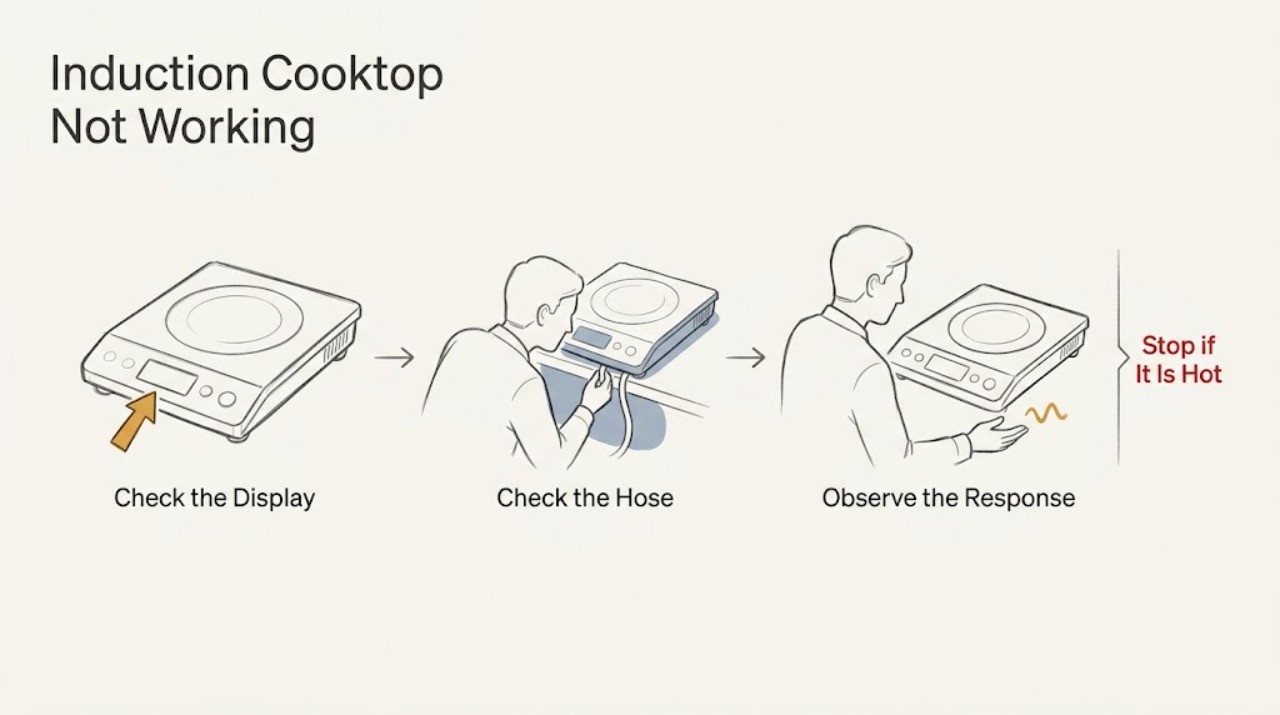
Work through in order
Diagnostic checks
Use only checks that match the exact appliance or system and its official guide.
-
Check 1
Press the cooktop's normal On control and note whether the entire display is dark, the controls light but a burner will not start, or a letter, WAIT message, or flashing power level appears. Note whether the problem affects one element or every element.
Expected result: The display is dark, the display works but one burner rejects a pan, the power level or F flashes, WAIT remains, or an FXX code appears.
Next step: Record the exact message and continue with the matching cookware, control, or power check. If an FXX code or recurring unlisted message appears, stop user-level diagnosis and arrange service.
Why this matters
Why: A dark display points toward power or control state; a flashing burner display often points toward pan recognition; WAIT is an initialization message on some models; FXX is a fault-code family.
-
Check 2
Remove the cookware and test the affected zone with a flat pan whose bottom attracts a magnet. Use a pan that meets the model's size requirement, center it inside the marked element, and confirm the bottom sits fully on the glass.
Expected result: The suitable pan is recognized and the power level stabilizes, or the cooktop still flashes or refuses to start.
Next step: If the suitable pan works, the original pan or its position was the cause. If the warning remains with suitable cookware, test the controls and power once and then arrange service if the burner remains abnormal.
Why this matters
Why: GE identifies non-magnetic, too-small, off-center, non-flat, or poorly contacting cookware as reasons an induction burner will not turn on or will flash its power level.
-
Check 3
With the glass cool, wipe spills from the touch-control area and dry it completely. Check the model manual for control lockout and use its normal unlock gesture if the panel appears locked; do not press multiple controls while the surface is wet.
Expected result: The controls respond after drying or unlocking, or the panel remains unresponsive and the display shows WAIT or no usable response.
Next step: If the controls recover, retry one suitable pan. If WAIT remains or the panel stays unresponsive after the model's documented control check, stop and arrange qualified service.
Why this matters
Why: GE describes control lockout as a feature that prevents unintended touch activation and identifies WAIT as an initialization state on some glass touch-button models. Moisture or a failed initialization can prevent normal operation.
-
Check 4
If the entire cooktop is dark, check for an obvious tripped household breaker or loss of power without opening the appliance. Restore a normal household breaker only when it is safe and clearly identified, then observe the display once; do not replace a fuse or inspect internal wiring yourself.
Expected result: Power returns and the display operates, the breaker trips again, or the display remains dark despite normal household power.
Next step: If power returns normally, test with one suitable pan. If the breaker trips again or the cooktop remains dark, stop using it and arrange qualified electrical or appliance service.
Why this matters
Why: GE lists a tripped breaker or fuse as a possible no-power cause. A breaker that trips again or a persistently dark cooktop suggests an electrical or appliance fault rather than a cookware issue.
-
Check 5
After the accessible pan, control, and power checks, note whether one burner or every burner remains unusable, whether an FXX or other fault returns, and whether the glass is cracked or there is smoke, burning odor, sparking, or abnormal heat.
Expected result: The cooktop operates normally, or a burner remains dead, a code returns, the glass is damaged, or an electrical safety symptom appears.
Next step: If normal operation returns, monitor the cooktop. If any fault or safety symptom remains, stop using it and arrange qualified service without removing panels or attempting internal repair.
Why this matters
Why: GE recommends service when induction burners remain abnormal after cookware, power, and control checks; its fault-code guidance says FXX messages should be handled by a trained technician.
Use your observations
Decision map
Find the observation that best matches what you see, then follow the next safe action.
-
PATH 01Safety boundary
What you see
The display works, but a burner flashes F or a power level until a flat magnetic pan is centered on it.
Do this next
Use suitable induction cookware that meets the element size requirement and keep it centered with full contact on the glass.
Why this path and its safety boundary
Safety stop: If the warning persists with suitable cookware, continue to the control and power checks rather than repeatedly changing pans.
-
PATH 02Safety boundary
What you see
The glass touch controls are unresponsive and the surface is wet or control lockout is active.
Do this next
Clean and dry the cool control area and unlock it with the exact model's documented gesture, then retry one suitable pan.
Why this path and its safety boundary
Safety stop: If the controls remain unresponsive or WAIT returns, stop resetting and arrange qualified service.
-
PATH 03Safety boundary
What you see
The entire display is dark and an obvious household breaker issue is found.
Do this next
Use only the normal user-accessible breaker reset described by the model guidance. If it trips again, leave the cooktop off and arrange service.
Why this path and its safety boundary
Safety stop: If household power is normal but the cooktop remains dark, treat the condition as an appliance or electrical fault requiring service.
-
PATH 04Safety boundary
What you see
A burner or the whole cooktop remains unusable with suitable cookware, an FXX code returns, the glass is cracked, or smoke, burning odor, sparking, or abnormal heat appears.
Do this next
Stop using the cooktop and arrange qualified service. Do not remove the glass, probe voltage, or attempt internal electrical repair.
Why this path and its safety boundary
Safety stop: If all zones operate normally after one controlled test, resume normal use and consult the manual if the symptom returns.
Helpful context
Understand the symptom
Induction heat is created in suitable cookware, so a silent or apparently dead burner is often a pan-recognition problem rather than a failed heating element. GE says the pan must contain iron, be flat, meet the element's minimum size, sit fully on the glass, and be centered within the marked circle. A flashing F or power level is a useful clue that the cooktop is waiting for that condition.
Touch controls add a second path: a wet or locked keypad can make a working cooktop appear unresponsive. Clean and dry the cool surface and use the model manual for the control-lockout sequence. Never remove the glass, expose wiring, probe voltage, or attempt to repair the electronic control or induction coil.
GE models do not all use the same messages. A WAIT display is a documented initialization state on some glass touch-button cooktops, while an FXX code is an electronic fault that generally requires trained service. Use the owner's manual for the exact model before repeating a reset.
When checks do not resolve it
Need a professional?
Escalate for a persistent or recurring fault code, failed burner with compatible cookware, dark display, repeated breaker trip, cracked glass, smoke, sparking, burning odor, or abnormal heat.
Have this ready
- Provide the model number, affected burner, exact display message, cookware type and position, whether the control area was wet or locked, any breaker event, and any crack, smoke, odor, spark, or heat symptom.
Common questions
FAQ
Why is my GE induction cooktop flashing F?
GE says a flashing F can mean the pan is absent, off-center, too small, not flat, or not suitable for induction. Try a flat magnetic pan that meets the element's size requirement and center it fully on the marked zone. If F remains, arrange service.
What should I do if my GE induction cooktop has no display?
Check for an obvious household power or breaker issue from the user-accessible side and follow the model manual. If power is normal but the display stays dark, or the breaker trips again, stop using the cooktop and arrange qualified service.
Why will the touch controls on my GE cooktop not respond?
The glass may be wet or control lockout may be active. With the surface cool, clean and dry the keypad and use the model's documented unlock gesture. A persistent WAIT message or unresponsive panel needs service.
When should a GE induction cooktop be serviced?
Arrange service for a burner that stays unusable with suitable cookware, an FXX code that returns, WAIT that returns, a dark display after normal power checks, a repeated breaker trip, cracked glass, smoke, sparking, burning odor, or abnormal heat. Do not open the appliance or probe voltage.
Read the exact guide
Official sources
- Electric Range & Cooktop - Induction Cooktop FAQsGE Appliances · Official GE Appliances induction-cooktop FAQ for compatible cookware, touch controls, and normal operating behavior.
- Electric Range & Cooktop - Induction Burners Not Working or Flashing Power LevelGE Appliances · Official GE Appliances guidance for induction cooktops and ranges when a burner does not work or a power level flashes.
- Cooktop - Error, Fault, or Function CodesGE Appliances · Official GE Appliances guidance for cooktops with digital electronic controls; exact code behavior varies by model.
- Electric Cooktop "Wait" MessageGE Appliances · Official GE Appliances guidance for models that display WAIT while the touch board initializes.
Community feedback
Share a repair observation
Share a plain-text repair observation. Accepted observations are published automatically; this page may take a moment to update.