
On this page
Start here
Quick answer
If a Samsung induction cooktop is not working, first stop if there is a cracked glass surface, smoke, burning smell, exposed wiring, or water near the controls. Otherwise confirm that the cooktop has power, Control Lock is off, and the dry control panel responds. For a single zone, center a flat, magnetic pan of a suitable size and test it with water; induction zones will not heat an empty or incompatible pan. If the panel stays dead, an error returns after the model-appropriate reset, or one zone still will not heat while the others work, stop troubleshooting and arrange qualified service.
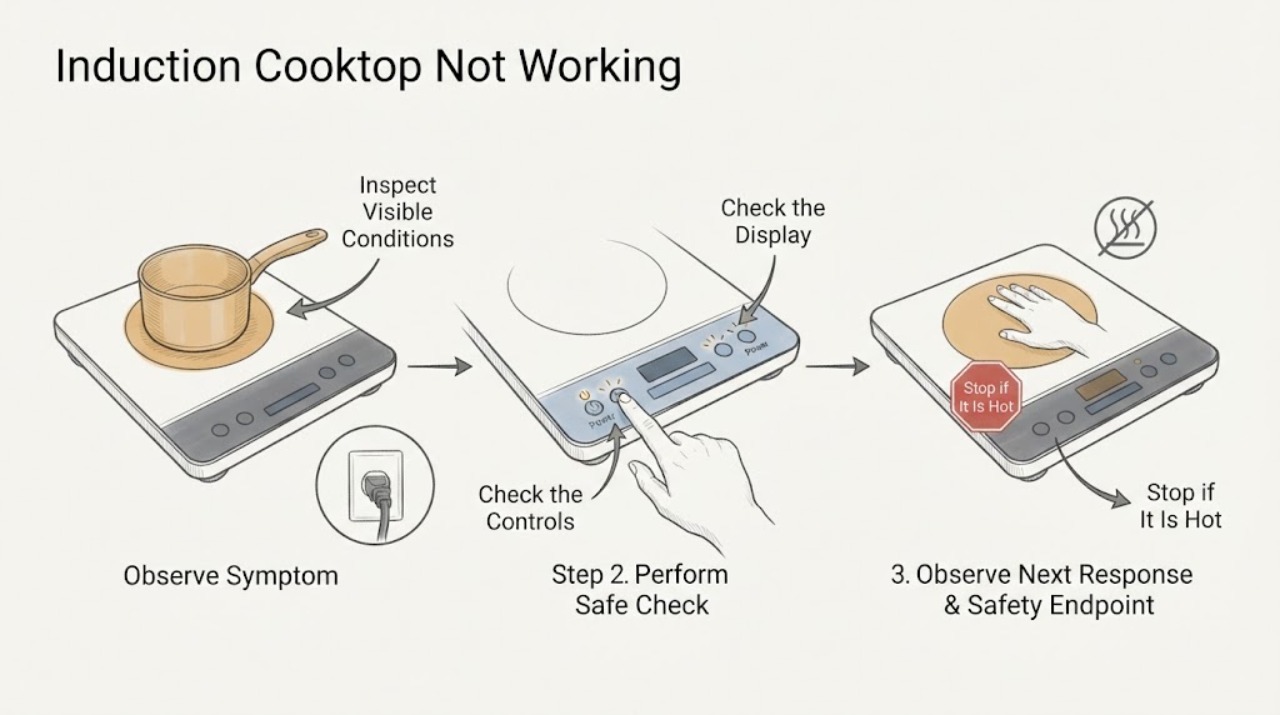
Work through in order
Diagnostic checks
Use only checks that match the exact appliance or system and its official guide.
-
Check 1
Stop and inspect the safe user-facing condition before touching the controls: look for a cracked cooktop, smoke, burning smell, exposed wiring, liquid entering the controls, or a damaged power connection.
Expected result: Any crack, smoke, burning smell, exposed wiring, active spill near controls, or electrical damage is present.
Next step: Stop using the cooktop. If there is smoke or fire, leave and contact emergency services. Otherwise keep power off when it is safe to do so and arrange qualified appliance or electrical service; do not wipe inside controls or open the unit.
Why this matters
Why: This is not a normal pan-detection or setting problem; continued operation could create shock, burn, or fire risk.
-
Check 2
Check whether the entire cooktop is powered: observe the display and touch response, verify the appliance is connected as specified by the model manual, and check whether its circuit breaker has tripped without removing any electrical cover.
Expected result: The display is blank, the cooktop has no response, or the breaker is tripped.
Next step: If there is no safety symptom, restore the breaker only once and follow the model installation guide. If it trips again or the display remains dead, leave the cooktop off and arrange qualified service rather than repeatedly resetting it.
Why this matters
Why: Samsung lists power connection and the circuit breaker among the first causes when a cooktop will not turn on.
-
Check 3
With the surface cool enough to clean safely, dry the control panel and remove moisture, grease, or debris. Check whether Control Lock or Child Lock is displayed, and use the model manual's unlock instruction rather than forcing the touch controls.
Expected result: The panel responds after drying/cleaning or unlocking, and the cooktop can be powered on.
Next step: Select the desired zone and heat level using the dry panel. If the panel remains unresponsive after the documented unlock and cleaning steps, request service.
Why this matters
Why: Samsung says a wet or dirty panel can reduce touch response and that Control Lock can prevent normal interaction.
-
Check 4
For a zone that powers on but does not heat, place a flat-bottomed pan that has a magnetic base in the center of the zone and make sure its size matches the zone guidance. Test with water in the pan; do not test an empty pan.
Expected result: The cooktop detects the pan and heats the water, or it displays a pan-detection indication with the original cookware.
Next step: Use compatible cookware centered on the zone. If the correct pan still is not detected, try the same pan on another zone only if the surface and controls are safe; do not continue if any abnormal heat or smell appears.
Why this matters
Why: Samsung explains that induction requires magnetic cookware of an appropriate size and that an empty pan can cause the zone to turn off; a detection indication points to cookware or placement rather than an immediately proven failed zone.
-
Check 5
Compare the affected zone with the other zones using the same compatible, water-filled pan and the model's normal controls; record whether only one zone fails or the whole cooktop behaves inconsistently.
Expected result: Other zones work normally but the same compatible pan does not heat on one zone.
Next step: Stop using the affected zone and arrange service. Do not remove the glass, swap internal wiring, or keep raising the power level to force a response.
Why this matters
Why: Samsung says a single induction element that still does not heat after the cookware check may need service, indicating a localized fault.
-
Check 6
If no safety symptom is present and the model instructions permit it, perform one documented power reset: turn the cooktop off, disconnect its power or switch off the circuit breaker for the manual's interval, then restore power and observe the display and controls.
Expected result: The cooktop recovers after the reset, or an error or blank panel returns immediately.
Next step: If it recovers, test only a compatible pan on one zone and monitor it. If the error, dead panel, inconsistent operation, or one-zone failure returns, stop using the cooktop and request qualified service with the model and displayed code.
Why this matters
Why: Samsung describes a power cycle as a way to clear some temporary control or information-code issues; a returning fault is not resolved by repeated resets.
Use your observations
Decision map
Find the observation that best matches what you see, then follow the next safe action.
-
PATH 01Next step
What you see
The cooktop is completely dead or the breaker has tripped
Do this next
Check the visible connection and reset the breaker only once if safe; if power does not return or trips again, arrange qualified electrical or appliance service.
-
PATH 02Next step
What you see
The panel is powered but locked, wet, dirty, or not responding
Do this next
Dry and clean the surface after it is safe to do so, disable the documented lock, and request service if the panel remains unresponsive.
-
PATH 03Next step
What you see
A zone does not detect the pan
Do this next
Use a flat, magnetic pan of the correct size, center it, and test with water rather than an empty pan.
-
PATH 04Next step
What you see
Other zones work but one zone still does not heat the compatible water-filled pan
Do this next
Treat it as a likely localized fault and arrange service for that zone; do not dismantle the cooktop.
-
PATH 05Next step
What you see
The fault returns after the documented power reset or the cooktop behaves inconsistently
Do this next
Stop using the cooktop and request qualified Samsung or appliance service with the model information and error display.
Helpful context
Understand the symptom
Decide whether this is a safety stop or a normal induction condition
Do not start with a pan test if the glass is cracked, the controls are wet from a spill, there is smoke or a burning smell, or electrical damage is visible. If the surface and installation look safe, distinguish a completely dead panel from a single zone that does not detect a pan. Induction zones can appear inactive when the cookware is empty, nonmagnetic, too small, or off-center.
Use the exact Samsung model instructions
Samsung cooktops differ in control layout, lock behavior, error messages, and power connections. Use the model manual for the correct cookware size, reset sequence, and installation details. The checks below are intended to identify the next branch, not to authorize cabinet removal or live electrical testing.
Why one dead zone matters
If the display and other zones work but one induction zone does not heat a correctly sized magnetic pan, Samsung treats that as a likely localized service issue after the cookware test. If every zone and the display are dead, the power, lock, control, or installation branch comes first.
Safety boundary
Stop conditions
- Stop immediately for a cracked glass surface, smoke, burning smell, exposed wiring, water entering the controls, or a damaged power connection.
- Stop after a breaker trips again, an error returns after the documented reset, or a compatible pan still will not heat on one zone while the others work.
- Do not remove the glass or cabinet, probe live wiring, bypass a control or temperature safety, or repeatedly reset a breaker to keep cooking.
When checks do not resolve it
Need a professional?
Arrange qualified Samsung or appliance service when the panel remains dead or unresponsive, a breaker trips again, an error persists, one induction zone fails with compatible cookware, or the cooktop behaves inconsistently after the model-specific reset. Use an electrician for an installation or supply concern.
Common questions
FAQ
Why is my Samsung induction cooktop on but not heating?
Check that Control Lock is off and the panel is clean and dry, then use a correctly sized magnetic pan centered on the zone and test it with water. An empty or incompatible pan may not be detected. If a compatible pan still does not heat on one zone while the others work, the zone may need service.
Why does a Samsung induction cooktop keep turning off?
Induction zones can turn off when cookware is not magnetic, is too small, is off-center, or is empty. Check those conditions first. If the cooktop shuts off completely, behaves inconsistently, or displays an error after the documented reset, arrange service.
Should I keep using a Samsung cooktop with a cracked surface or burning smell?
No. Stop using it and keep power off when safe to do so. Smoke, burning smell, visible electrical damage, water near controls, or a cracked glass surface requires qualified help; an active fire requires emergency services.
Read the exact guide
Official sources
- Clean and care for your Samsung electric cooktopSamsung Support US · Samsung electric and induction cooktop cleaning and safe surface care
- Meaning of the error codes displayed on your Samsung cooktopSamsung Canada · Samsung cooktop information codes, pan detection, power cycle, and service guidance
- One burner on the Samsung cooktop does not workSamsung Support US · Samsung induction element and cookware-detection troubleshooting
- Samsung Cooktop FAQsSamsung USA · Samsung electric and induction cooktop operation and troubleshooting
Community feedback
Share a repair observation
Share a plain-text repair observation. Accepted observations are published automatically; this page may take a moment to update.