
On this page
Start here
Quick answer
A GE induction cooktop heats the pan, not the unused glass surface, and it will not activate unless the cookware is magnetic, large enough for that element, centered, and flat against the glass. Check those conditions first, then verify the control was turned on correctly and that the cooktop has power. A flashing power level or an F can mean the pan is missing, too small, off-center, or not induction-compatible; a single element that remains inactive with known-compatible cookware, or a whole cooktop with no response after the accessible power checks, needs qualified service. Do not remove the glass, open the cabinet, or measure live wiring.
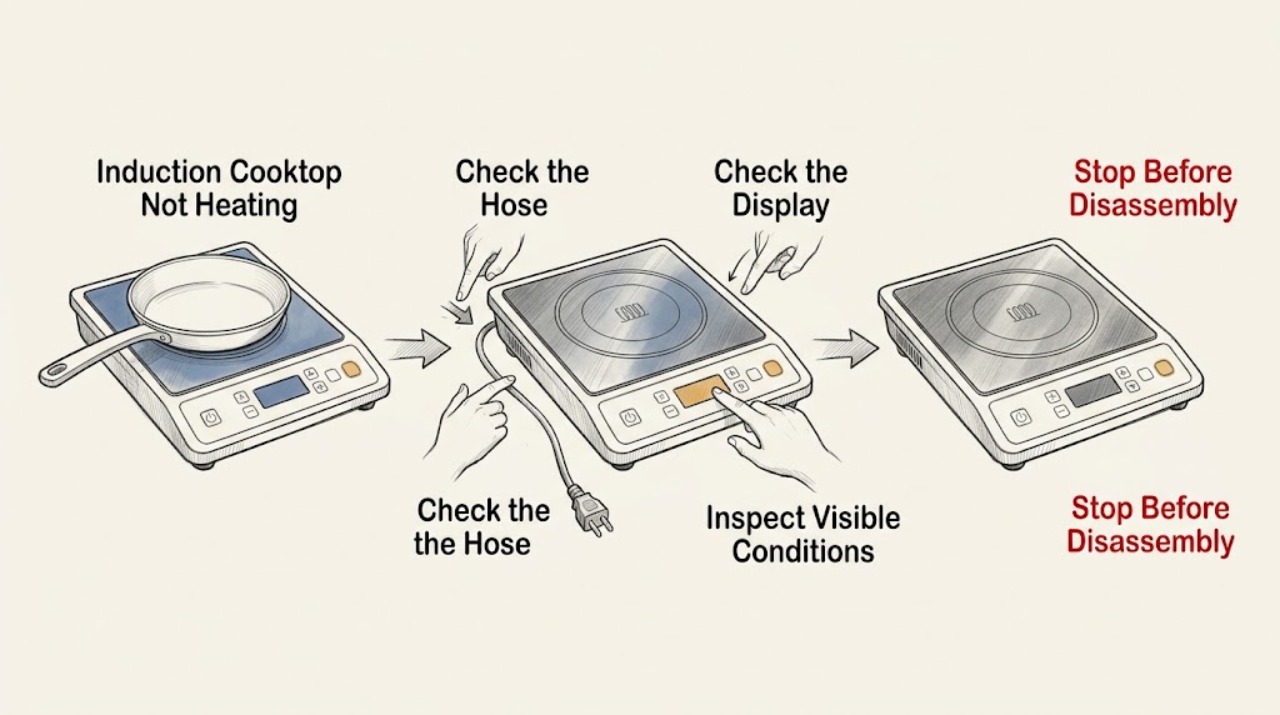
Work through in order
Diagnostic checks
Use only checks that match the exact appliance or system and its official guide.
-
Check 1
Place a clean, dry pan on the affected cooking circle and test the bottom with a household magnet while the pan is cool. Use only cookware whose bottom attracts and holds the magnet; do not use aluminum, copper, glass, ceramic, or other nonmagnetic cookware for this test.
Expected result: The magnet holds firmly, holds only on a small patch, or does not hold anywhere on the bottom; the display may flash or the element may remain inactive.
Next step: If the magnet holds across a useful flat area, continue with pan size and placement. If it does not, use a known induction-compatible pan rather than an adapter or foil and retest once.
Why this matters
Why: GE says induction cookware needs iron content and that a magnet test is the practical compatibility check. A weak or absent magnetic area can prevent the element from recognizing the pan or can limit the heated area; this does not identify an element failure.
-
Check 2
With compatible cookware cool and empty, center its flat magnetic base inside the circular graphics for the selected element. Confirm the base sits flat and makes full contact with the glass, and that the pan does not overlap the controls or metal trim.
Expected result: The pan is too small for the selected element, off-center, warped, rocking, or flat and centered; the power display may flash and then turn off.
Next step: Move the pan to the matching element or use a compatible pan that meets the exact model's minimum size. If the same pan is recognized on another element but not this one, note that comparison for service rather than repeatedly cycling the control.
Why this matters
Why: GE says an induction burner may not activate when cookware is too small, off-center, or not flat, and that the element generates heat only over the cooking circle. Correct placement can restore detection; a flat centered compatible pan that remains unrecognized points beyond the cookware.
-
Check 3
Starting with the pan centered, select the affected element and press On, then use the plus or minus control to choose a heat level as the model's control layout shows. Observe the display without repeatedly touching other zones or covering the touch panel with a cloth or utensil.
Expected result: The power level appears and the pan begins to heat, the display flashes and then clears, the control lock indicator is present, or the touch panel does not respond.
Next step: If the control lockout is active, unlock it using the exact model instructions and make one normal selection. If the display still will not accept a compatible pan and setting, continue to the power check and then stop for service if the symptom persists.
Why this matters
Why: GE identifies an improperly set control as a cause of a nonworking induction burner. A flashing or cleared level commonly corresponds to pan detection or placement, while an unresponsive panel may be control lockout or a control fault rather than a heating-coil problem.
-
Check 4
Observe whether the whole cooktop has power, whether the display is dark, and whether other elements or controls respond. From the outside, check the appliance's accessible circuit-breaker or fuse status and reset a tripped breaker only as household instructions permit; do not remove an electrical cover or probe the supply.
Expected result: The entire panel is dark, only one element is inactive, the breaker is tripped, all other elements work, or the breaker trips again after reset.
Next step: If a single accessible reset restores normal operation, make one supervised pan test. If the panel stays dark, the breaker trips again, or only one element remains inactive with a known-compatible pan, stop using the cooktop and arrange qualified service.
Why this matters
Why: GE lists a blown fuse or tripped breaker as a possible no-power cause. A whole-panel failure points toward supply or appliance power; one inactive element with other elements working makes pan detection, that element's control, or an internal element fault more likely. A repeated trip is not a condition to keep resetting.
-
Check 5
After the cooktop is cool enough to handle safely, compare the same known-compatible, flat pan on another element only if the model manual permits normal use of that element. Keep each test supervised, use the matching control, and stop if the glass cracks, an error appears, or the pan or surface behaves abnormally.
Expected result: The pan heats on another element but not the original one, no element recognizes it, or the original element works after repositioning the pan.
Next step: Do not swap parts or open the cooktop. Record the pan, element, display indication, and result of each one-time comparison and provide those details to qualified service.
Why this matters
Why: Heating on another element makes cookware compatibility less likely and localizes the symptom to the original zone or its control, although it does not identify which internal part is faulty. No element recognizing a verified pan keeps power, control, and cookware possibilities open.
-
Check 6
After the external checks, make one supervised heating attempt with a compatible centered pan and record the model, affected element, pan type, display code or flashing behavior, control response, and breaker result. Stop immediately for a cracked glass surface, smoke, burning odor, sparking, unusual heat outside the pan area, repeated breaker operation, or a damaged cord.
Expected result: The pan heats normally, the element remains inactive with the verified pan and correct setting, or a physical or electrical safety symptom appears.
Next step: Stop using the cooktop for persistent inactivity or any safety symptom and arrange qualified appliance service. Do not remove the glass, access the induction coil, measure live wiring, or bypass a control or temperature safeguard.
Why this matters
Why: A successful test supports a cookware, placement, setting, or temporary power explanation but does not prove that the cooktop has no intermittent fault. Persistent inactivity or any safety symptom requires internal diagnosis outside the reader's safe boundary.
Use your observations
Decision map
Find the observation that best matches what you see, then follow the next safe action.
-
PATH 01Safety boundary
What you see
Does a magnet hold to the flat bottom of the pan and does the pan meet the exact model's minimum size?
Do this next
Center the pan flat within the element circle and retry the correct On and power controls once.
Why this path and its safety boundary
Safety stop: Use a verified induction-compatible pan with a sufficiently large magnetic base; do not conclude that the cooktop is faulty from a nonmagnetic pan.
-
PATH 02Safety boundary
What you see
Does the power level flash and then turn off or does the cooktop show an F?
Do this next
Treat the display as a pan-recognition or placement clue: check magnetic material, flat contact, size, and centering before testing the control again.
Why this path and its safety boundary
Safety stop: Continue to the control and power branches if the display accepts a setting but the pan does not heat.
-
PATH 03Safety boundary
What you see
Does the panel respond when the correct element is selected and On followed by a power setting is pressed?
Do this next
Observe the pan for normal heating and compare only one additional element if necessary.
Why this path and its safety boundary
Safety stop: Check the model's control-lockout state and then the accessible power status. Persistent unresponsive controls require service.
-
PATH 04Safety boundary
What you see
Is the whole cooktop dark or has an accessible breaker tripped?
Do this next
Use the household procedure for one safe breaker or fuse check. If the panel remains dark or the breaker trips again, stop and arrange electrical or appliance service.
Why this path and its safety boundary
Safety stop: If other elements work and only one zone fails with verified cookware, record the comparison and arrange service rather than opening the cooktop.
-
PATH 05Safety boundary
What you see
Does a verified compatible pan remain cold, or is there smoke, sparking, cracked glass, burning odor, unusual heat, or repeated breaker operation?
Do this next
Stop using the cooktop and arrange qualified service. Do not remove the glass, access internal electronics, or perform live electrical measurements.
Why this path and its safety boundary
Safety stop: If the pan heats after a safe pan, placement, control, or power correction, monitor normal use and keep the exact model manual available.
Helpful context
Understand the symptom
Why the glass may feel cool
Induction transfers energy into magnetic cookware through a field below the glass. GE explains that the uncovered part of an induction surface remains relatively cool, so a cool-looking cooking zone does not by itself prove that the element is broken. Judge the result by whether a compatible pan heats and whether the display accepts the pan and power setting.
Use the model manual for electrical work
The checks below are limited to the pan, surface placement, touch controls, and accessible household power status. Installation wiring, the induction coil, cooling system, control board, and glass assembly are not user-adjustable. If a compatible pan and correct settings do not restore heat, record the display behavior and arrange service.
Safety boundary
Stop conditions
- Stop using the cooktop for a cracked glass surface, smoke, sparking, burning odor, unusual heat outside the pan area, a damaged cord, a repeated breaker trip, or any persistent error with a verified compatible pan.
- Do not remove the glass or cabinet, access the induction coil or control board, measure live wiring, bypass a temperature or control safeguard, or use foil or an improvised metal object as a pan.
When checks do not resolve it
Need a professional?
Call a qualified appliance technician when the whole cooktop has no power after the accessible supply check, a single element remains inactive with a verified magnetic pan and correct setting, the touch controls remain unresponsive, an error returns, or any glass, smoke, sparking, cord, overheating, or repeated-breaker symptom appears.
Common questions
FAQ
Why is my GE induction cooktop on but not heating the pan?
Check that the pan attracts a magnet, has a sufficiently large flat magnetic base, is centered on the correct element, and makes full contact with the glass. Then confirm the element was selected and a power level was set. If a verified pan remains cold, arrange service.
What does a flashing F mean on a GE induction cooktop?
GE says the cooktop can flash F when cookware is missing, has been removed, or is not centered on the element. Check the pan's magnetic bottom, size, flat contact, and position before retrying the normal control selection.
Can a stainless-steel pan work on a GE induction cooktop?
Only if the bottom contains enough iron to attract and hold a magnet. GE lists magnetic stainless steel among compatible materials but notes that some stainless products are not magnetic. Test the actual pan bottom rather than relying on the material name.
When should I stop troubleshooting a GE induction cooktop?
Stop for cracked glass, smoke, sparking, burning odor, unusual heat outside the pan area, a damaged cord, repeated breaker operation, or persistent inactivity with a verified compatible pan. Do not open the cooktop or perform live electrical tests; arrange qualified service.
Read the exact guide
Official sources
- Electric Range & Cooktop - Surface Burners Not Heating WellGE Appliances · GE smooth-top and induction pan contact, surface safety, and service guidance
- Electric Range & Cooktop - Induction Cooktop FAQsGE Appliances · GE induction heating mechanism, magnetic cookware, control lockout, automatic pan detection, and display F behavior
- Electric Range & Cooktop - Induction Cookware Size and ShapeGE Appliances · GE induction pan size, centering, flat contact, element-circle coverage, and model-manual boundary
- Induction CookingGE Appliances · GE Profile induction heating mechanism, magnetic-pan requirement, and cool unused cooking surface
- Brand Names of Cookware Compatible with Induction CooktopsGE Appliances · GE induction cookware magnetic-material test, compatible materials, pan contact, and cookware exclusions
- Electric Range & Cooktop - Induction Burners Not Working or Flashing Power LevelGE Appliances · GE induction cooktop pan detection, placement, controls, household power, and service guidance
Community feedback
Share a repair observation
Share a plain-text repair observation. Accepted observations are published automatically; this page may take a moment to update.