
On this page
Start here
Quick answer
For the GE Profile PHP9036DT family, first verify the pan rather than assuming the cooktop has failed: the flat bottom should attract a magnet, meet the affected element's minimum size, sit centered with full contact, and not overlap the controls. GE's opened PHP9036/PHP9036DTBB owner manual says that if a pan is not detected for more than 25 seconds, the element indicator flashes and the control turns off. A repeatable shutoff at about 7 seconds on every burner, despite a known induction-compatible pan and a correct one-time start sequence, is therefore not the manual's documented 25-second pan-detection timeout; it needs qualified service rather than more cookware or breaker experiments. The manual is a PHP9036 family document and the GE support page identifies the suffix variant PHP9036DTBB, so confirm the full label before applying model-specific guidance. Do not lift the built-in cooktop, open the underside, test live wiring, or replace an induction board from this symptom alone.
Before you begin
Safety first
- Owner checks are limited to reading the full model label, checking cookware magnetism/size/centering, using normal controls once, observing timing from outside, and checking visible power or damage. Do not lift or open the built-in cooktop, remove glass or underside panels, reach induction coils or fans, probe live wiring, bypass pan detection or thermal protection, use compressed air inside, or order a board, coil, fan, sensor, or glass assembly from the seven-second symptom alone.
Work through in order
Diagnostic checks
Use only checks that match the exact appliance or system and its official guide.
-
Check 1
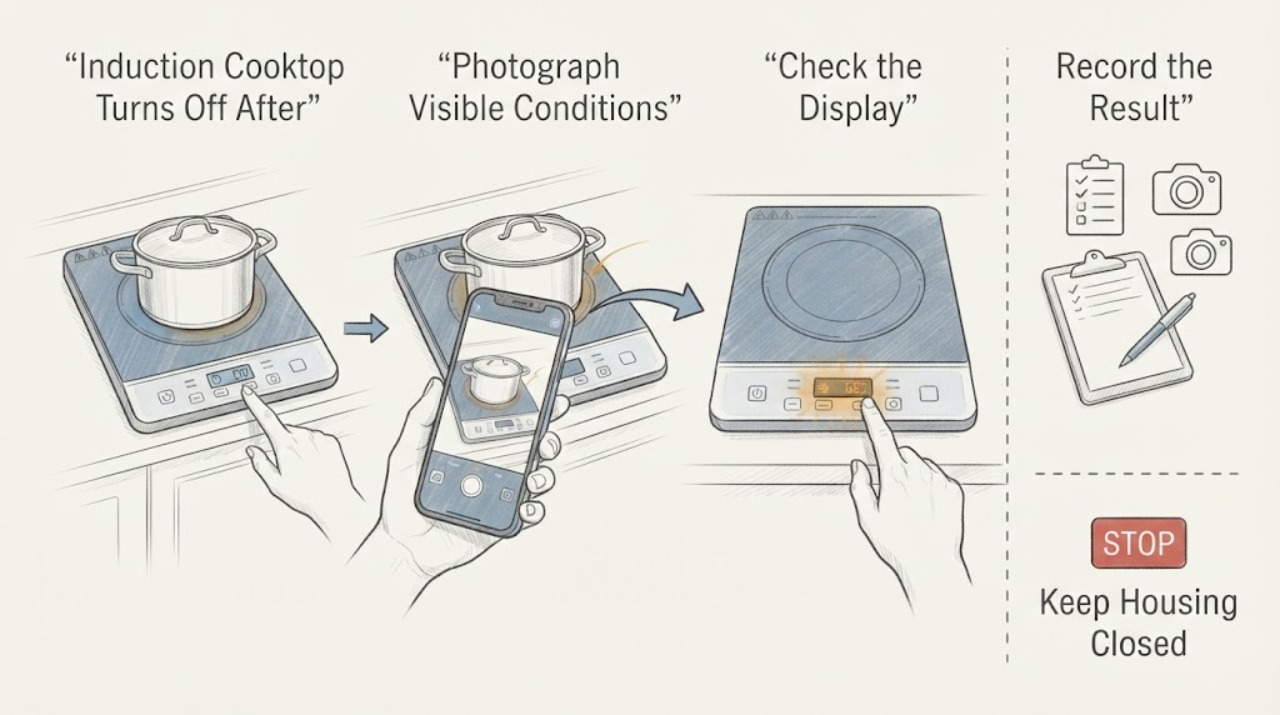
Photograph the full cooktop label and write down the complete model and serial, including every suffix, then record whether the shutoff affects one burner or all burners and whether it occurs at about 7 seconds each time. Do not lift the cooktop or remove a cover to read the label.
Expected result: The label matches PHP9036DT or a suffix variant, the timing is consistently about 7 seconds, only one zone stops, or all zones stop together.
Next step: Keep the label photo and timing record. Use the matching GE manual and give the full identity to service; do not use a near-model manual as proof of an internal part failure.
Stop if: Do not pull out the built-in cooktop, remove the glass, or access wiring to obtain the model.
Why this matters
Why: The official GE support page identifies PHP9036DTBB as a specific model variant, while the manual covers the PHP9036 family. Complete identity and zone scope are needed before transferring family guidance; an all-zone, repeatable timing pattern is different from one pan failing to detect.
-
Check 2
With the pan cool, dry, and empty, test the flat bottom with a household magnet and inspect it visually for a warped base. Place a known induction-compatible pan in the center of the affected ring, with its base large enough for that element and making full contact with the glass; keep it clear of the control strip.
Expected result: The magnet holds across a useful area and the pan is flat and correctly sized; it holds only weakly or on a small patch; the pan is too small, warped, or off-center; or a second known-compatible pan gives the same result.
Next step: Correct only a clear cookware or placement issue and make one normal test. If a correctly sized, centered pan still shuts off, record the result and move to service rather than trying adapters or metal objects.
Stop if: Do not use foil, a loose metal object, or a pan adapter as a test, and do not scrape or strike the glass.
Why this matters
Why: GE identifies magnetic material, minimum pan size, correct centering, and full contact as conditions for induction detection. If two suitable pans fail on the same zone, cookware is less likely, but that still does not identify a coil, board, sensor, or wiring fault.
-
Check 3
Start one affected element using the normal GE control sequence: turn the cooktop on, select the element, and set a heat level with the power arc or plus/minus control while the compatible pan remains centered. Do not repeatedly tap controls or run multiple cycles to reproduce the symptom.
Expected result: The element heats normally; the power-level indicator flashes and the element turns off after roughly 25 seconds; or it turns off after roughly 7 seconds with the pan still centered.
Next step: If the pan is not detected, correct cookware or placement once. If a suitable pan remains present and the element or every burner cuts out at about 7 seconds, stop repeating tests and arrange qualified GE appliance service.
Stop if: Do not enter a diagnostic menu, defeat pan detection, bridge a sensor, or open the cooktop to observe the control electronics.
Why this matters
Why: GE documents a greater-than-25-second no-pan detection timeout. A 25-second flash-and-off response is consistent with the documented pan-detection behavior; a stable 7-second cutoff is a different timing pattern and should not be relabeled as the normal timeout without further evidence.
-
Check 4
If the exact manual permits ordinary use of another zone, compare the same known-compatible, centered pan on one other zone once. Record whether the original zone alone stops, the second zone works, or both zones and the remaining burners stop on the same short timing.
Expected result: Only one zone fails; the same pan works on another zone; or every zone turns off after about 7 seconds.
Next step: Record the comparison and request qualified service for persistent one-zone failure or an all-zone seven-second pattern. Do not swap coils, boards, or wiring based on the comparison.
Stop if: Stop immediately for cracked glass, smoke, sparks, abnormal heat, a burning odor, or a repeated supply trip; do not move the appliance to perform the comparison.
Why this matters
Why: A pan that works on another zone makes cookware compatibility less likely and localizes the symptom to the original zone or its control, without identifying an internal part. All-zone, same-timing behavior is more consistent with a shared cooktop condition than with one pan position.
-
Check 5
From a dry, safe position, check only the visible control response and accessible household breaker or fuse state; inspect the exposed glass and control surface for cracks, liquid, or objects. Reset an accessible tripped breaker only once if household instructions permit and there is no damage; do not remove an electrical cover.
Expected result: The whole panel is dark, the breaker trips again, the cooktop powers normally but still cuts out, liquid or an object is on the controls, or the glass is cracked or damaged.
Next step: Remove only a safe external object or liquid after the surface is cool and dry, then make no more than one normal test. For a repeat trip, damage, or persistent cutoff, leave the cooktop off and arrange qualified appliance or electrical service.
Stop if: Do not touch wet controls, reset a breaker repeatedly, use an extension cord, probe terminals, or continue cooking on cracked glass.
Why this matters
Why: A supply interruption or covered control can mimic a cooktop failure, but a repeated trip is an electrical fault path. A powered cooktop that consistently cuts out with correct cookware is not made safe by repeated breaker resets.
-
Check 6
Prepare the service handoff with the complete model and serial, pan material and magnet result, element tested, exact shutoff timing, whether the pan stayed centered, display or indicator behavior, breaker result, and any fan or hot-surface observation. Do not use compressed air, remove the cooktop, or try to reproduce the fault after the record is complete.
Expected result: The event history is complete; the model suffix is unknown; the code or indicator is unclear; or every burner has the same seven-second cutoff with known-compatible cookware.
Next step: Keep the cooktop out of service and contact qualified GE appliance service. Provide the full record rather than ordering a board, coil, fan, or glass assembly from the symptom.
Stop if: Do not open the underside, access the induction units, measure live wiring, or bypass a thermal or control safeguard.
Why this matters
Why: The exact GE manual and service path depend on model identity. A consistent all-zone seven-second pattern is a meaningful symptom for a technician, but the official manual and the community report do not prove which internal assembly is responsible.
Use your observations
Decision map
Find the observation that best matches what you see, then follow the next safe action.
-
PATH 01Next step
What you see
A flat, magnetic pan of the correct minimum size is centered with full glass contact, the controls are set normally, and one zone turns off after approximately 25 seconds with a flashing power indicator when the pan is not detected.
Do this next
Correct the pan type, size, or position once and make one supervised test. If a suitable pan remains present but the zone still stops, record it and request service.
Why this path and its safety boundary
Why it matters: This matches the GE PHP9036 family manual's documented pan-detection timeout more closely than a seven-second hardware conclusion.
-
PATH 02Next step
What you see
The same known-compatible, correctly centered pan is present, but every burner on the PHP9036DT reports a repeatable shutoff at about 7 seconds.
Do this next
Stop repeated cooking and breaker tests, keep the cooktop off, and arrange qualified GE appliance service with the full model, pan result, and timing record.
Why this path and its safety boundary
Why it matters: The timing differs from GE's documented greater-than-25-second pan-detection timeout, and the all-zone scope makes a single-pan placement explanation less likely. It does not identify a board, coil, sensor, or other component.
-
PATH 03Next step
What you see
A pan fails the magnet test, is below the element's minimum size, is warped, or becomes recognized after centering or switching to a known-compatible pan.
Do this next
Use only the compatible, flat, correctly sized pan and follow the normal control sequence. Request service if the same symptom occurs with a verified pan.
Why this path and its safety boundary
Why it matters: The observed cutoff is more consistent with pan detection or placement than with a confirmed internal cooktop failure.
-
PATH 04Next step
What you see
Only one zone remains inactive with a verified pan while another zone heats normally, or the whole panel is dark with normal visible household power.
Do this next
Record the zone comparison and arrange qualified service. Do not exchange induction units or open the cooktop based on this observation.
Why this path and its safety boundary
Why it matters: The result localizes the symptom toward a zone/control path or cooktop power condition, but an external comparison cannot name the failed internal part.
-
PATH 05Next step
What you see
Smoke, sparks, a strong burning smell, a hot or scorched connection, liquid in the controls, cracked glass, or a repeated breaker trip accompanies the cutoff.
Do this next
Stop using the cooktop, isolate power only from a safe dry position if possible, and obtain qualified appliance or electrical help. Do not reopen or move the built-in appliance.
Why this path and its safety boundary
Why it matters: This is an electrical, fire, liquid, or glass safety path and overrides any pan-timing interpretation.
Helpful context
Understand the symptom
Why seven seconds matters
The opened GE PHP9036 family manual describes a pan-detection timeout: when cookware is removed or not detected for more than 25 seconds, the element's power indicator flashes and the control turns off. That is different from a PHP9036DT report in which every burner repeatedly stopped after about seven seconds. The timing is useful evidence, not a self-diagnosis: it helps separate a normal pan-detection response from a persistent whole-cooktop fault that needs service.
Verify the cookware once
GE's manual says induction cookware should have a magnetic bottom, be large enough for the element, and make full contact with the glass. A magnet that sticks only to a small patch, a warped base, an undersized pan, or an off-center placement can prevent detection. Correct those conditions for one supervised test; do not use foil, a metal object, or a pan adapter as a diagnostic substitute.
The model and safety limit
The assigned identity is PHP9036DT. GE's official support record displays the suffix variant PHP9036DTBB and links a manual covering the PHP9036 family, so the full label matters before any model-specific conclusion. Stop for smoke, sparks, a burning smell, a hot or scorched connection, cracked glass, liquid in the controls, or a repeated breaker trip. Do not remove or lift this built-in cooktop to inspect fans, coils, boards, terminals, or wiring.
When checks do not resolve it
Need a professional?
Call qualified GE appliance service for a persistent all-zone seven-second cutoff with verified cookware, recurring one-zone failure, an unresponsive or dark panel, or any need to access internal electronics. Call a qualified electrician for a hot or damaged connection, sparks, smoke, liquid near electrical parts, or repeated breaker operation.
Safety scope: Owner checks are limited to reading the full model label, checking cookware magnetism/size/centering, using normal controls once, observing timing from outside, and checking visible power or damage. Do not lift or open the built-in cooktop, remove glass or underside panels, reach induction coils or fans, probe live wiring, bypass pan detection or thermal protection, use compressed air inside, or order a board, coil, fan, sensor, or glass assembly from the seven-second symptom alone.
Have this ready
- Provide the full model and serial including suffix, market, display and indicator behavior, exact shutoff timing, whether one or all zones are affected, pan material and magnet result, pan size and placement, control sequence, comparison-zone result, breaker observations, and any smoke, odor, heat, liquid, cracked-glass, or fan history.
Common questions
FAQ
Why does my GE PHP9036DT induction cooktop turn off after 7 seconds?
First verify a flat, magnetic, correctly sized, centered pan and the normal control sequence. GE's PHP9036 family manual documents a greater-than-25-second pan-detection timeout, while the exact PHP9036DT report describes every burner stopping after about seven seconds. If the seven-second pattern repeats with a verified pan, treat it as a service symptom rather than a confirmed cookware or board diagnosis.
Could the seven-second shutoff simply mean the pan is not detected?
It can be a pan issue if the pan is nonmagnetic, too small, warped, or off-center. Correct those conditions once. However, the opened GE manual describes the no-pan control timeout as more than 25 seconds, so a repeatable all-zone seven-second cutoff with a known-compatible centered pan should not be dismissed as the documented normal timeout.
Should I replace the induction board or open the GE cooktop?
No. The timing and zone pattern do not identify a board, coil, sensor, fan, or wiring fault, and the built-in cooktop presents electrical and glass hazards. Record the full model, pan checks, timing, and any breaker or safety symptoms, then arrange qualified service.
Read the exact guide
Official sources
- Owner's ManualGE Appliances · Opened the official GE owner manual linked from the PHP9036DTBB support page. The cover lists PHP9030 and PHP9036 families. It states that a pan not detected for more than 25 seconds causes the element control to turn off, and it describes magnetic, flat, correctly sized cookware and the pan-detection indicators. It is not proof of an internal component failure or of every suffix variant's exact service design.
- User Manual & Care for PHP9036DTBBGE Appliances · Opened the official GE support page for model PHP9036DTBB, a suffix variant of the assigned PHP9036DT identity. The page identifies the product as a 36-inch built-in touch-control induction cooktop and links its owner manual; it does not diagnose the seven-second symptom.
- GE Induction Turns Off After 7 SecondsReddit r/appliancerepair · Opened the exact Reddit post. The author identifies a GE induction cooktop as PHP9036DT, reports that each burner turns off after about seven seconds despite induction cookware, and later reports a service visit and parts work. The thread does not prove a particular failed component, design defect, or durable repair outcome.
Community feedback
Share a repair observation
Share a plain-text repair observation. Accepted observations are published automatically; this page may take a moment to update.