
On this page
Start here
Quick answer
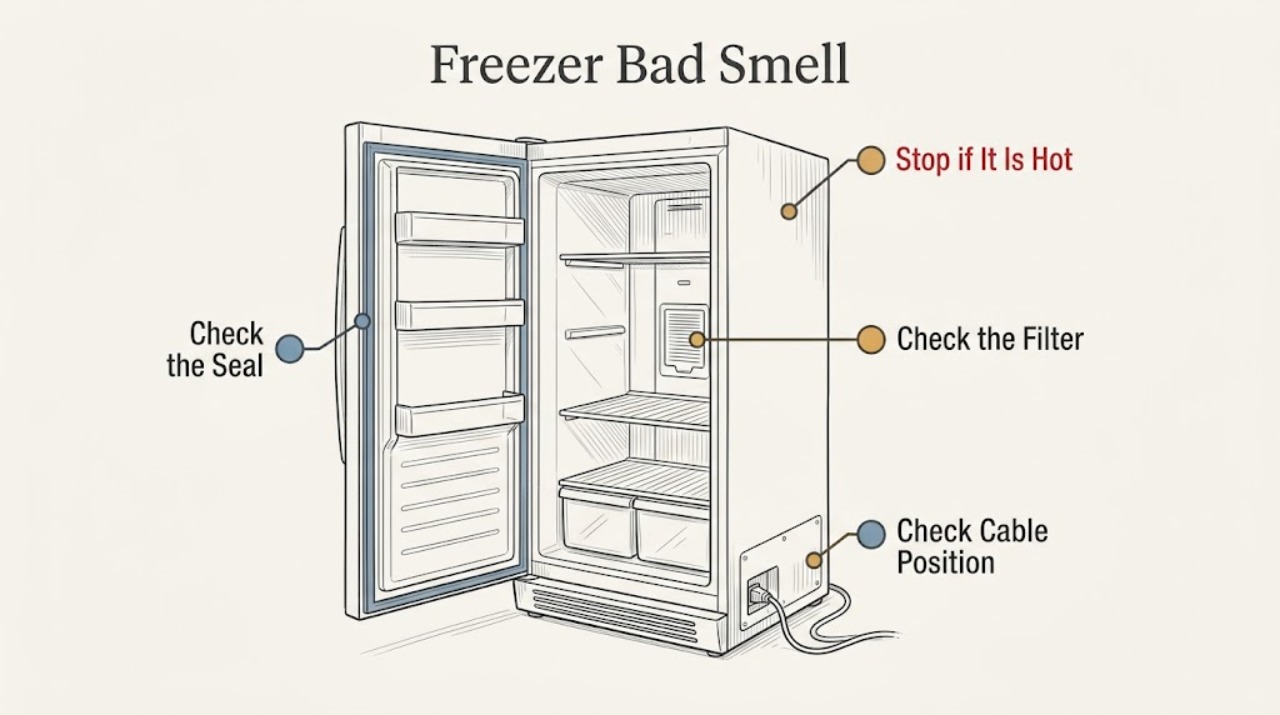
A Haier freezer smell is commonly from new plastic, improperly sealed food, or residue on the interior rather than a mechanical part. Unplug the freezer, remove and inspect the food, and clean the interior and gasket with Haier's mild baking-soda-and-warm-water method; rinse and dry it, and do not use bleach, ammonia, harsh solvents, abrasives, or strongly scented cleaners. A sharp burnt, scorched, melting-plastic, or electrical smell is different from ordinary food or new-plastic odor: stop using the freezer, disconnect power only when safe, keep away from smoke or fire, and arrange qualified service.
Work through in order
Diagnostic checks
Use only checks that match the exact appliance or system and its official guide.
-
Check 1
Classify the odor without putting your face inside the cabinet: note whether it is new-plastic, spoiled-food, damp or residue-like, or sharp and scorched; identify whether it is strongest inside, around the gasket, or near the cord and rear of the freezer.
Expected result: A mild new-plastic smell or a localized food smell supports an interior-cleaning path. A sharp scorched, melting-plastic, or electrical smell, smoke, visible heat damage, or an odor strongest at the plug is a safety stop rather than a cleaning problem.
Next step: For a possible electrical smell, stop, disconnect power only when safe, and arrange qualified service. For a food or new-material smell with no hazard signs, continue with the disconnected interior inspection.
Why this matters
Why: Haier states that the freezer's mechanical parts should not produce an odor, so the character and location of the smell matter more than simply how strong it seems.
-
Check 2
Turn the temperature control off, unplug the freezer, and remove food and loose packaging while checking the cabinet, baskets, floor, gasket, and visible cord area for spilled liquid, residue, scorching, or melting.
Expected result: A leaked package, residue under a basket, or material caught at the gasket can account for an interior odor. Liquid near electrical parts, a damaged cord, charred plastic, or a hot plug is not an ordinary food odor and makes cleaning unsafe.
Next step: If there is damage, smoke, or heat, leave the freezer unplugged and call qualified service. If the cabinet and cord look safe, keep questionable food isolated and continue to clean only accessible surfaces.
Why this matters
Why: Disconnecting power prevents the appliance from running while the source is located and follows Haier's cleaning procedure.
-
Check 3
Inspect each food package and the cabinet seams, shelves, baskets, drain area, and door gasket for residue or an opened seal; remove the source and discard food according to applicable food-safety guidance.
Expected result: If the smell follows one package or a visible spill, the source is likely food or residue rather than the cooling hardware. If no food source is present and the odor is strongest outside the cabinet, cleaning alone may not resolve it.
Next step: Keep the freezer unplugged while cleaning. If the odor is unexplained, returns quickly, or is strongest at the cord, compressor area, or rear enclosure, stop and arrange service instead of adding fragrance.
Why this matters
Why: Haier specifically identifies improperly wrapped or sealed food as a source of freezer odor.
-
Check 4
Wipe the interior and gasket with Haier's mild baking-soda-and-warm-water cleaning solution using a soft sponge or cloth, then rinse with clean warm water and dry all accessible surfaces completely.
Expected result: A food or residue odor should reduce after the source is removed and the liner is rinsed and dried. A smell that remains despite a clean, dry cabinet suggests absorbed odor, an overlooked source, or a non-interior fault.
Next step: Do not use bleach, ammonia, abrasive pads, solvents, concentrated detergents, or strongly scented cleaners. Leave the freezer disconnected until it is dry and safe to reconnect.
Why this matters
Why: Haier's cleaning guidance is intended to remove residue without exposing the liner to products that can damage it or leave a persistent scent.
-
Check 5
Clean the door gasket and check that it is clean, pliable, and sealing against the cabinet; confirm no package is pressing the door or lid open before restoring power.
Expected result: A dirty or poorly sealing gasket can let warm air and moisture enter, making odors persist and allowing additional residue to form. A clean, intact gasket with a closed door removes that common source from the next test.
Next step: Correct only a visible packaging or gasket issue. If the gasket is torn, distorted, or cannot seal, arrange service or model-specific replacement guidance rather than forcing the door or using an unverified sealant.
Why this matters
Why: Haier says the gasket should be kept clean and pliable to ensure a proper seal.
-
Check 6
Reconnect power only when the freezer, cord, plug, and surrounding floor are dry and free of damage, set the model's normal temperature control, and monitor the odor from a distance during one normal cooling cycle.
Expected result: If the smell stays gone and the freezer cools normally, food residue or a temporary new-material odor was likely. If the odor returns, the freezer does not start or cool, the plug warms, or a sharp smell appears outside the cabinet, the issue is unresolved.
Next step: Stop immediately for smoke, sparks, a hot plug, burning odor, or rapid warming; disconnect power only when safe and arrange qualified service. Do not repeat restart attempts to mask a recurring odor.
Why this matters
Why: A controlled restart verifies that cleaning did not leave moisture and that the odor is not being generated by an electrical or cooling fault.
Use your observations
Decision map
Find the observation that best matches what you see, then follow the next safe action.
-
PATH 01Next step
What you see
The smell is mild new plastic and the freezer is otherwise operating normally.
Do this next
Clean and dry the interior with the mild method, keep food properly sealed, and monitor whether the odor fades with normal use.
-
PATH 02Next step
What you see
A package leaked or a visible food residue is the clear source.
Do this next
Remove the source, clean and rinse the liner and gasket with power disconnected, dry completely, and follow food-safety guidance for affected food.
-
PATH 03Next step
What you see
The odor is sharp, scorched, electrical, or strongest at the plug, cord, or rear enclosure.
Do this next
Stop immediately, disconnect power only when safe, keep away from smoke or sparks, and arrange qualified electrical or appliance service.
-
PATH 04Next step
What you see
The smell remains after the interior and gasket are clean and dry, or returns when the freezer runs.
Do this next
Do not add fragrance or repeat restart attempts. Keep the appliance out of service and request qualified diagnosis.
-
PATH 05Next step
What you see
The freezer is also not starting, not cooling, or warming food while the smell persists.
Do this next
Keep the door closed as much as possible, protect food using an appropriate cold-storage plan, and arrange service for the combined odor and cooling symptom.
Helpful context
Understand the symptom
Identify the smell before cleaning
A mild plastic smell on a new freezer, a food smell after a package leaked, and a sharp scorched or electrical smell are different situations. Note when the smell began, whether it is strongest inside the cabinet or near the cord and rear of the appliance, and whether the freezer is still running and cold. Do not taste questionable food to identify an odor.
The electrical-smell boundary
If the odor resembles burning insulation, melting plastic, or scorching, stop using the freezer. Keep clear of smoke, sparks, or a hot plug; disconnect power only if it can be done without touching a damaged cord or entering an unsafe area, and arrange qualified electrical or appliance service. Do not remove the rear cover, spray cleaner into vents, or keep reconnecting the appliance to see whether the smell returns.
Why food and materials can smell
Haier notes that the plastic smell of a new unit should dissipate with time and that improperly wrapped or sealed food can transfer odors. The liner can also retain residue. Strongly scented cleaning products may be absorbed by plastic parts and affect food, so a mild unscented cleaning approach is safer for the cabinet.
When checks do not resolve it
Need a professional?
Use qualified service for any suspected electrical or burnt odor, a recurring unexplained smell, or a freezer that also fails to start or cool.
Common questions
FAQ
What usually causes a Haier freezer to smell?
Haier identifies new plastic, improperly wrapped or sealed food, and residue requiring interior cleaning. Its mechanical parts should not normally produce an odor.
What can I use to clean a smelly Haier freezer?
With power disconnected, use Haier's mild baking-soda-and-warm-water method on a soft cloth or sponge, then rinse with clean warm water and dry. Avoid bleach, ammonia, harsh chemicals, abrasives, and strongly scented cleaners.
Is a burning or electrical smell normal in a freezer?
Treat a sharp scorched, melting-plastic, or electrical smell as a stop condition, not as ordinary food or new-plastic odor. Disconnect power only when safe and arrange qualified service.
What if the smell comes back after cleaning?
If the cabinet and gasket are clean and dry but the smell returns when the freezer runs, or the freezer also stops cooling, keep it out of service and request qualified diagnosis rather than adding fragrance or repeatedly restarting it.
Read the exact guide
Official sources
- Haier - Chest and Upright Freezer Not Coming On | Haier AppliancesHaier Appliances · Haier chest and upright freezers; controls and compressor behavior vary by model
- Haier - Odor in Refrigerator or Freezer | Haier AppliancesHaier Appliances · Haier refrigerators and chest or upright freezers; verify model-specific cleaning instructions
- Haier - Chest and Upright Freezer Cleaning and Maintenance | Haier AppliancesHaier Appliances · Haier chest and upright freezers; use the exact model manual for additional access details
Community feedback
Share a repair observation
Share a plain-text repair observation. Accepted observations are published automatically; this page may take a moment to update.