
On this page
Start here
Quick answer
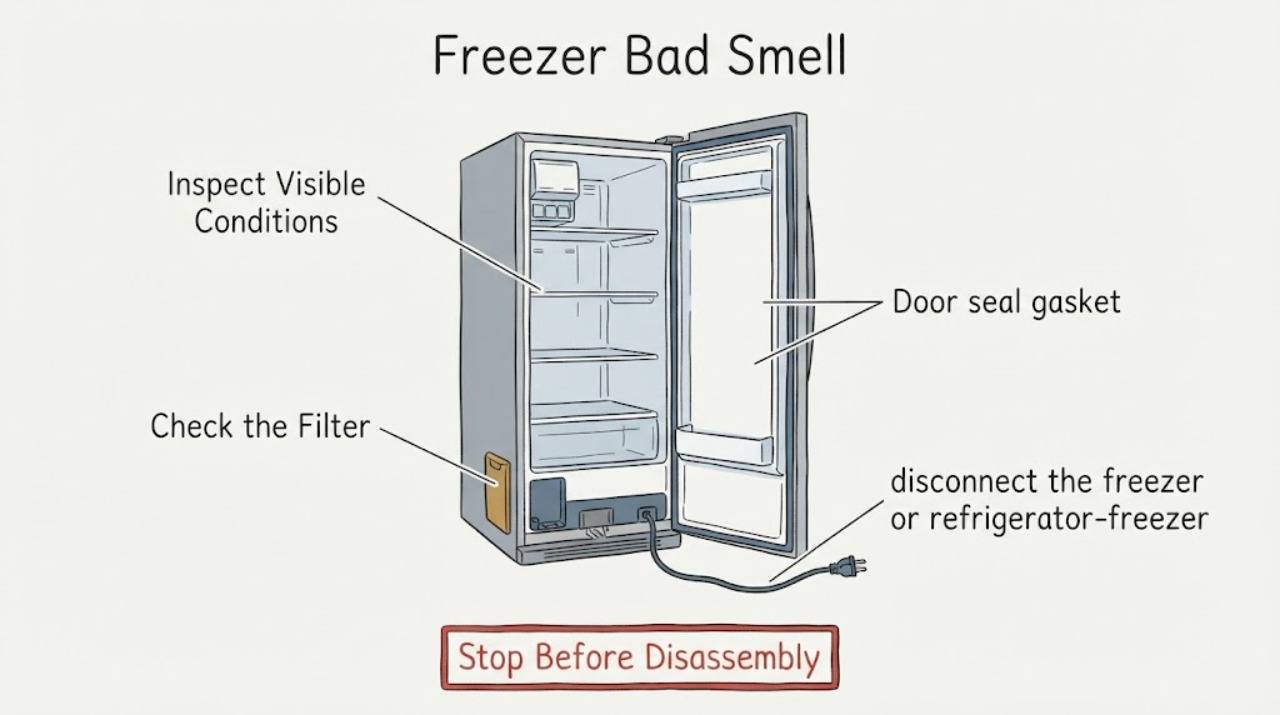
A bad smell in a Samsung freezer usually starts with spoiled food, an uncovered strong-smelling item, a spill or residue, stale ice, or water that is not draining correctly. Empty the freezer, remove questionable food, inspect the ice and visible drain area, and wipe the interior with a soft cloth and mild refrigerator-safe detergent; dry everything before restocking. Do not use benzene, thinner, chloride, bleach products, open flames, or mixed cleaning chemicals. A new plastic odor can fade, but a burning or electrical smell, smoke, unusual heat, suspected refrigerant leak, water near electrical parts, or food that may have been contaminated is a stop condition: keep the freezer off and arrange qualified service or food-safety advice.
Work through in order
Diagnostic checks
Use only checks that match the exact appliance or system and its official guide.
-
Check 1
With the freezer door open only as long as needed, inspect every package, drawer, shelf, ice container, and the floor of the compartment. Discard expired, leaking, thawed-and-questionable, or visibly spoiled food without opening it to smell. Look for an unsealed strong-smelling food, a broken package, sticky residue, crumbs, or liquid under a drawer.
Expected result: The odor is strongest beside one food or spill; several containers are open; the smell is spread through the compartment; or there is no food or residue source.
Next step: Remove the source and continue to the safe cleaning check. If food may have contaminated other food, discard the affected items and follow local food-safety guidance rather than relying on odor alone.
Why this matters
Why: Samsung identifies spoiled food, rotting produce, unsealed food, spills, crumbs, and residue as common odor sources. A localized source supports a cleanup; a widespread odor after the source is gone points to hidden residue, ice, drain, filter, seal, or an appliance-side issue.
-
Check 2
Before cleaning, disconnect the freezer or refrigerator-freezer from power using the normal safe procedure and move food to a safe cold location. Remove shelves, bins, drawers, and the ice container according to the model manual. Wipe the interior and removable parts with a soft cloth or sponge and mild detergent suitable for refrigerator surfaces, then rinse residue away and dry completely.
Expected result: The smell reduces when a removable part is cleaned; residue is found under a seal or drawer; the smell remains after the interior is clean and dry; or the plug, cord, outlet, or surrounding area is wet or damaged.
Next step: Reassemble only when surfaces are fully dry and the manual permits it. Do not mix cleaners, spray liquid into vents, use a hair dryer, or continue if the electrical area is wet or damaged; keep the appliance off and arrange service.
Why this matters
Why: A removable part or trapped spill can hold odor after the visible food is gone. Samsung recommends mild cleaning and complete drying, while warning against benzene, thinner, chloride, and Clorox-type products because of surface and fire risks. A wet or damaged electrical area is a safety issue, not a cleaning step.
-
Check 3
Inspect the ice container and any dispenser ice for an odd smell or taste without consuming questionable ice. Empty stale or clumped ice, wash and dry the removable container as the manual allows, and check whether a recently installed or replaced water filter or an unused dispenser coincides with the change. If the model has a user-replaceable filter, use the manual's shutoff and replacement procedure; do not force a stuck filter.
Expected result: Only ice or dispensed water smells odd; the ice has been stored unused for a long time; the smell began after installation or filter replacement; or the ice and water are normal while the freezer compartment smells.
Next step: Discard questionable ice and refresh it only after the container is clean and dry. If the odor returns in fresh ice, the filter cannot be handled normally, or water connections leak, stop using the dispenser and arrange model-specific service.
Why this matters
Why: Samsung notes that new water lines, a recently changed filter, or stale unused ice can temporarily affect water or ice smell. A compartment odor with normal ice shifts attention back to food, spills, seals, drain, or a service fault.
-
Check 4
Look for moisture, frost, or a dirty strip around the freezer door seal, and check the visible interior drain area for pooled water, residue, or ice. Confirm that packages are not preventing the door from closing and that interior air vents are not blocked. Do not remove a rear panel or chip at ice with a sharp tool, and do not pour liquid into a hidden drain unless the model manual explicitly instructs it.
Expected result: The gasket is dirty or not sealing; water or residue collects at the bottom; frost is building near the rear; vents are blocked; or there is no visible moisture, frost, or seal problem.
Next step: Clean and dry the accessible gasket and remove packaging that prevents closure. If water returns, frost rapidly builds, a drain is hidden behind a panel, or the odor persists, keep the appliance operating only if there is no hazard and arrange qualified service; do not use sharp tools or improvised heat.
Why this matters
Why: A poor seal can admit warm moist air, while a blocked defrost drain can leave water or ice where residue develops. Samsung's leak guidance identifies food particles and debris in the defrost drain as a possible cause of water leakage and directs service when the source is not safely resolved.
-
Check 5
From outside the appliance, check for a hot cabinet, smoke, scorch marks, a damaged cord or plug, unusual compressor or fan behavior, hissing with an unfamiliar odor, or a smell that is strongest near the rear or electrical area. Do not touch a wet plug, move a heavy appliance alone, open a sealed cooling system, or investigate a suspected refrigerant leak. If the freezer is flooded, isolate power only when it can be done safely.
Expected result: The odor is burning, electrical, solvent-like, or accompanied by smoke, heat, hissing, visible damage, water near electrical parts, or repeated breaker trips; or it is a cool food odor with no external hazard.
Next step: For smoke, heat, sparks, repeated trips, suspected refrigerant or gas leakage, or a wet electrical area, leave the appliance off, ventilate or leave the area as appropriate, and contact emergency or qualified service help from a safe location. Do not restart it to see whether the smell returns.
Why this matters
Why: Samsung treats burning smell, smoke, damage, liquid entry, and gas leakage as safety issues requiring the appliance to remain unused and professional help. A cool food odor with a clean, dry, intact appliance supports the low-risk cleaning and source-removal path instead.
Use your observations
Decision map
Find the observation that best matches what you see, then follow the next safe action.
-
PATH 01Next step
What you see
The smell is localized to spoiled food, an open strong-smelling container, a spill, crumbs, or residue, with no heat or electrical warning.
Do this next
Discard the source, clean removable parts and accessible surfaces with mild detergent, dry completely, and monitor without tasting questionable food.
Why this path and its safety boundary
Why it matters: A food or surface source is the most supported explanation.
-
PATH 02Next step
What you see
The compartment is clean but the odor is limited to old, clumped, newly installed, or recently filter-serviced ice or water.
Do this next
Discard questionable ice or the first affected water, clean the ice container, and follow the exact model manual for filter handling; request service if fresh ice or water still smells abnormal.
Why this path and its safety boundary
Why it matters: Stale ice or a temporary water-line or filter taste is possible.
-
PATH 03Next step
What you see
There is a dirty or loose door seal, pooled water, frost near the drain, or residue that returns after cleaning.
Do this next
Clean the accessible seal and remove obstructions; do not chip ice or remove panels. Arrange qualified service if water or frost returns or the source is hidden.
Why this path and its safety boundary
Why it matters: A seal, defrost-drain, condensation, or water-path problem may be sustaining the odor.
-
PATH 04Next step
What you see
The freezer is new and has a mild plastic smell that is fading, with no smoke, heat, damage, or food contamination.
Do this next
Follow the manual's commissioning and ventilation guidance, keep food safely stored, and request service if the odor persists, intensifies, or changes character.
Why this path and its safety boundary
Why it matters: A temporary new-appliance odor is possible rather than a confirmed failure.
-
PATH 05Next step
What you see
The odor is burning, electrical, chemical or solvent-like, or accompanies smoke, overheating, hissing, visible damage, refrigerant concern, water near electrical parts, or a breaker trip.
Do this next
Stop using the freezer and do not restart it. Disconnect power only if safe and dry to do so; otherwise keep clear and use the property's emergency procedure. Arrange qualified appliance service and obtain food-safety advice for exposed food.
Why this path and its safety boundary
Why it matters: This is an immediate safety stop, not a deodorizing problem.
Helpful context
Understand the symptom
Separate a food odor from an appliance odor
Smell the freezer contents, the ice container, the door gasket area, and the outside rear or lower area separately. A sour, rotten, fishy, or sweet sticky smell usually follows food or a spill. A smell that is hot, sharp, solvent-like, smoky, or electrical is not a cleaning problem. Do not taste questionable food or ice to identify a smell.
Protect food while you inspect
Keep the door closed as much as practical and move food to a safe cold location before a longer clean. Discard food that is spoiled, leaking, visibly contaminated, or whose safety is uncertain. Do not put flammable sprays, chemicals, dry ice, candles, or electrical appliances inside the freezer.
Safety boundary
Stop conditions
- Stop immediately for burning smell, smoke, sparks, unusual heat, visible electrical damage, repeated breaker trips, or a wet plug or outlet.
- Keep the freezer off and obtain qualified help for suspected refrigerant or gas leakage, hissing with an unfamiliar odor, flooding near electrical parts, or a smell strongest at the rear or electrical area.
- Do not use benzene, thinner, chloride, bleach products, open flames, flammable sprays, mixed cleaning chemicals, or a hair dryer inside the freezer.
- Do not chip ice with a sharp object, remove hidden panels, open a sealed cooling system, or handle internal wiring as a homeowner check.
Only after diagnosis
Potential parts
- freezer door gasket
Consider only when the seal is visibly damaged or fails the model's closure check and a technician confirms it is allowing moisture or frost that sustains the odor.
Confirm the complete model and manufacturer fit information before ordering. - defrost drain or drain-pan component
Consider only when recurring water, frost, or residue remains after accessible cleaning and a technician confirms a drain or pan fault.
Drain and pan designs vary by model; do not remove hidden panels or infer fit from appearance. - water filter or ice-system component
Consider only when fresh ice or dispensed water remains abnormal after refreshing ice and following the model's filter procedure, and service confirms a water-path fault.
Verify the exact model, filter specification, and approved fit information before replacement. - odor filter or air-circulation component
Consider only when the manual identifies a replaceable filter or a technician confirms an air-circulation fault after the odor source is removed.
Only use model-approved components and follow the manual's replacement instructions.
When checks do not resolve it
Need a professional?
Arrange qualified service when a bad smell remains after removing food, cleaning, drying, refreshing ice, and checking accessible seals and drains; when water or frost returns; when a filter or ice system cannot be handled normally; or when the source is behind a panel or in the cooling, electrical, or sealed system. Stop immediately for burning or electrical odor, smoke, overheating, sparks, repeated breaker trips, suspected refrigerant or gas leakage, flooding, or food contamination that needs professional assessment.
Common questions
FAQ
Can spoiled food make the whole Samsung freezer smell bad?
Yes. Samsung lists spoiled food, rotting produce, open strong-smelling food, spills, crumbs, and residue as common odor sources. Remove the source, clean accessible surfaces and removable parts with mild detergent, and dry them fully.
Why does only the ice smell bad?
Stale unused ice, a recently installed water line, or a recently replaced filter can temporarily affect ice or water smell. Discard questionable ice and follow the model's filter instructions; request service if fresh ice remains abnormal.
What cleaning products are unsafe for a Samsung freezer?
Samsung warns against benzene, thinner, chloride, and Clorox-type products. Use a soft cloth or sponge and mild refrigerator-safe detergent, never mix cleaners, and dry all surfaces fully before restoring food.
When is a freezer smell an emergency?
Stop using it for burning or electrical odor, smoke, unusual heat, sparks, repeated breaker trips, suspected refrigerant or gas leakage, flooding near electrical parts, or visible damage. Do not restart it to test the smell; get qualified help from a safe location.
Read the exact guide
Official sources
- How to remove bad odors from a Samsung refrigeratorSamsung Gulf Support · Samsung refrigerator and freezer odor causes, mild cleaning, food, ice, and water checks
- Why does refrigerator smell so awfulSamsung India Support · Samsung refrigerator and freezer food odor, drain tray, water filter, ice, and new-appliance odor guidance
- What should I do if I suspect my Samsung fridge/freezer is leaking water?Samsung UK Support · Samsung freezer door seal, defrost drain, drip pan, water connections, frost, and leak escalation
- Easy steps to a cleaner Samsung refrigeratorSamsung Canada Support · Samsung refrigerator cleaning, spills, deodorizing, ice freshness, filter, seals, and ventilation
- Samsung Refrigerator has a Bad OdourSamsung Australia Support · Samsung refrigerator and freezer spoiled food, spills, cleaning, ice, and odor guidance
- Home Appliance Terms and ConditionsSamsung US Support · Samsung home-appliance electrical, burning smell, smoke, liquid entry, gas, fire, and freezer safety boundaries
Community feedback
Share a repair observation
Share a plain-text repair observation. Accepted observations are published automatically; this page may take a moment to update.