
On this page
Start here
Quick answer
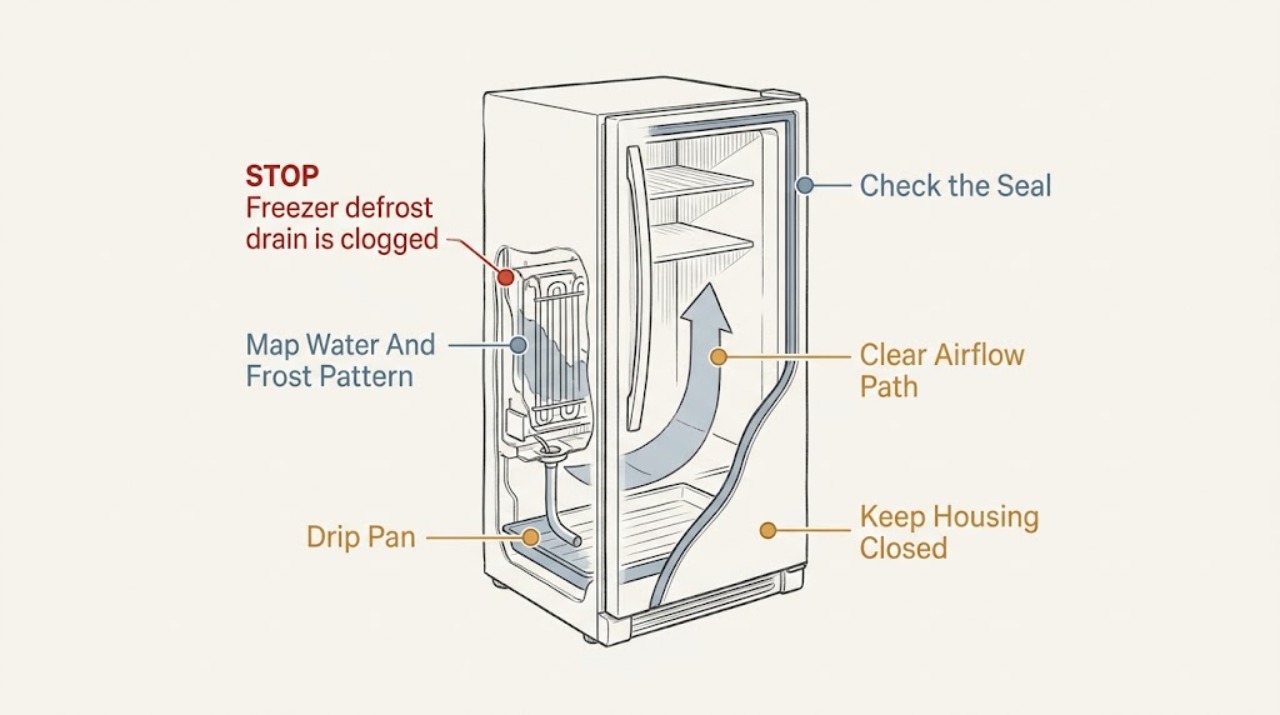
A Samsung freezer defrost drain that is blocked by food debris or ice can leave water or a sheet of ice under the drawers, on the freezer floor, or outside the appliance during defrost. First confirm that the water is not a spill, dispenser leak, or condensation, and check that the door closes, the gasket seals, and food is not pressed against the rear wall or vents. Turn the appliance off and let the ice thaw with food protected; use only the drain-access and cleaning procedure in the exact Samsung model manual and your local Samsung support guidance. Samsung says some drain holes are at the rear and may be behind a panel, while other guidance recommends service inspection rather than self-repair. Do not use a hair dryer, open flame, sharp tool, boiling water, or force a panel. If the drain is inaccessible, the leak or frost returns, cooling is weak, or water reaches electrical parts, arrange qualified Samsung appliance service.
Before you begin
Safety first
- This article covers ordinary-access observation, food protection, power isolation, model-guided thawing, and only an explicitly model-approved drain procedure. Do not open electrical or sealed-system covers, puncture the liner, probe live parts, use unapproved heat or water pressure, or continue through a water, electrical, cooling, or food-safety hazard.
Work through in order
Diagnostic checks
Use only checks that match the exact appliance or system and its official guide.
-
Check 1
Dry the visible water, remove only loose food or ice that is safe to handle, and map where the water or ice returns: under a drawer, on the freezer floor, at the rear wall, in the drain tray area, or on the outside floor.
Expected result: Record whether the symptom appears during or after defrost, repeats on its own, follows a spill or dispenser use, or is accompanied by a warm cabinet or heavy rear-wall frost.
Next step: Continue with the door, food, vent, level, and drain checks when the water source is plausible and there is no electrical hazard; service an unexplained or recurring leak.
Stop if: Stop if water reaches an outlet, cord, light, control, or other electrical part, or if the freezer is warming food; disconnect power only if safe and arrange service.
Why this matters
Why: Samsung says defrost water normally goes to a drain tray and that a blocked drain can make water leak or freeze over. Samsung also notes that spills and condensation can be mistaken for appliance leaks.
-
Check 2
Close the freezer fully and inspect the gasket around the entire opening for dirt, tears, gaps, or a section pulled away; remove packages blocking closure and check that the appliance is stable and correctly leveled.
Expected result: Note whether a sheet of paper slides out without resistance, cold air can be felt around the seal, the door rebounds open, food touches the back wall, or the cabinet is tilted forward.
Next step: Clean the gasket with a soft cloth and warm soapy water, remove obstructions, restore ordinary leveling only as described in the manual, and monitor; request service for a damaged seal or persistent gap.
Stop if: Do not force the door, heat or reshape the gasket, remove hinges, tip a loaded appliance, or keep food in a freezer that cannot seal.
Why this matters
Why: Samsung says an incompletely closed door lets the appliance warm and form water, while a poor seal admits warm moist air that becomes frost. Samsung also says leveling helps doors close and allows water to drain correctly.
-
Check 3
Rearrange food so it is not pressed against the rear wall or blocking freezer vents, and keep hot or recently cooked food out until it has cooled according to the manual's use guidance.
Expected result: Record whether packages were covering vents, touching the rear wall, preventing a drawer or door from closing, or producing unusual frost after hot food was loaded.
Next step: Leave the vents and door path clear, reduce unnecessary door opening, and monitor after the existing frost is safely cleared; escalate if frost or water returns with correct loading.
Stop if: Do not scrape around hidden fan or electrical parts, force a drawer, block the vents, or keep operating if airflow is blocked by heavy ice or food is warming.
Why this matters
Why: Samsung says food against the back wall can affect airflow and cause ice on the bottom, blocked vents can worsen frost, and hot food raises humidity that can form ice.
-
Check 4
Protect food, turn the appliance off, and disconnect power before manual defrosting or cleaning; locate the exact model manual and follow its approved drain-access procedure rather than assuming that a panel or drain hole is user-accessible.
Expected result: Confirm that food is in a suitable insulated container, towels can contain meltwater, the manual identifies the drain location and method, and no water can contact electrical parts.
Next step: If the manual permits an accessible drain check, continue only with that exact method. If the drain is hidden, access requires disassembly, or the manual is unclear, leave the task to service.
Stop if: Do not use a hair dryer, heat gun, open flame, electrical heater, sharp tool, boiling water, pressure, or forced panel removal.
Why this matters
Why: Samsung instructs owners to turn off power and let ice melt for a suspected blocked drain, while its regional pages differ on whether flushing or opening a cover is appropriate. The model and region therefore determine the safe procedure.
-
Check 5
After the model-approved thaw or drain cleaning, dry the freezer, restore any drain cover or tray exactly as directed, reconnect power, and monitor the next normal cooling/defrost period for flow, temperature, and new ice.
Expected result: Classify the result as dry with stable freezing, a resolved one-time puddle, recurring bottom ice or water, heavy rear-wall frost, weak cooling, or a leak near electrical parts.
Next step: Arrange qualified Samsung appliance service for recurrence, poor cooling, heavy rear-wall frost, a non-resolving drain, or any damaged tray, gasket, or internal component.
Stop if: Do not repeatedly thaw or reset the appliance, bypass a defrost control, open sealed panels, or continue with an electrical, active-leak, or food-safety hazard.
Why this matters
Why: A dry cabinet after an approved procedure supports a resolved obstruction but does not prove the defrost system is healthy. Samsung directs service when frost or a leak returns, and identifies damaged or blocked drain-tray components as service issues.
Use your observations
Decision map
Find the observation that best matches what you see, then follow the next safe action.
-
PATH 01Safety boundary
What you see
Ice or water returns beneath a Samsung freezer drawer or on the freezer floor, particularly during or after an automatic defrost period.
Do this next
Turn off power, protect food, let ice melt, and inspect only the drain location and cleaning method approved for the exact model and region.
Why this path and its safety boundary
Why it matters: A blocked or frozen defrost drain is plausible because Samsung says debris or ice can block the drain and make water leak or freeze over.
Safety stop: Stop for an inaccessible drain, water at electrical parts, heavy rear-wall frost, poor cooling, or recurrence after the approved procedure.
-
PATH 02Safety boundary
What you see
The water appeared once after a spill, recent power-off period, dispenser or ice activity, or melting ice outside the drain path and does not return after cleanup.
Do this next
Clean and dry the area, verify the door and food arrangement, and observe for recurrence without opening internal panels.
Why this path and its safety boundary
Why it matters: Samsung notes that condensation and spills can be mistaken for an appliance leak, so a clogged drain is not established by one puddle.
Safety stop: Request service if the water returns, the source cannot be identified, or cooling and food condition deteriorate.
-
PATH 03Safety boundary
What you see
The gasket is dirty, damaged, pulled away, unevenly contacting, or the door is blocked or not level, and frost is concentrated around the opening or vents.
Do this next
Clean the gasket, remove the obstruction, and correct ordinary leveling or closure issues as the manual permits; service a torn or persistently leaking seal.
Why this path and its safety boundary
Why it matters: Warm moist air entering through an imperfect seal can create frost and extra meltwater that overloads the drain path.
Safety stop: Do not force or heat the gasket, remove hinges, or store food in a freezer that cannot close and seal.
-
PATH 04Safety boundary
What you see
Food touches the rear wall, blocks vents, holds a drawer or door open, or hot food was loaded before frost and bottom ice appeared.
Do this next
Rearrange food, keep vent paths clear, avoid loading hot food, and allow approved thawing before judging whether the drain issue returns.
Why this path and its safety boundary
Why it matters: Samsung links rear-wall contact, blocked vents, and hot food to poor airflow, added moisture, and ice formation; the drain may be receiving abnormal frost load.
Safety stop: Do not scrape hidden fan or wiring areas, force drawers, or continue if heavy frost blocks airflow or food is warming.
-
PATH 05Safety boundary
What you see
The drain is behind a cover not authorized by the manual, the blockage does not clear, the drip tray is damaged or overflowing, or water or ice returns.
Do this next
Keep water contained, protect food, and arrange qualified Samsung appliance service with the exact model, symptom location, photos, and the steps already performed.
Why this path and its safety boundary
Why it matters: Samsung's guidance directs service inspection for blocked drainage in some regions and for leaks or frost that remain after basic checks; a damaged tray also needs replacement by service.
Safety stop: Do not force the cover, probe the drain, pour unapproved water into the appliance, or repeatedly power-cycle it.
-
PATH 06Safety boundary
What you see
The freezer is warming, heavy frost blocks airflow, water reaches an outlet or wiring, the cord is hot or damaged, or there is smoke, sparking, or another electrical warning.
Do this next
If safe, disconnect power at the plug or breaker, protect food, keep the appliance out of service, and arrange qualified repair; use local emergency procedures for smoke or fire.
Why this path and its safety boundary
Why it matters: This exceeds routine drain cleaning and may involve cooling, defrost, electrical, or food-safety risk.
Safety stop: Do not touch wet live parts, remove covers, restart repeatedly, bypass controls, or continue using the freezer through a severe electrical or temperature hazard.
Helpful context
Understand the symptom
Start with the location and the actual source of the water
A Samsung support guide says defrost water normally travels to a drain tray during the defrost cycle. A clogged drain can make water leak into the product or freeze over, but a spill, melting ice from another source, or condensation can look similar. Water or ice under a drawer or on the freezer floor, especially when it returns after defrost, supports a drain or frost investigation; it does not identify a particular failed part by itself.
Check the door, gasket, food placement, and airflow
Warm moist air entering through a door that is not fully closed can create frost and more meltwater. Samsung recommends checking for food blocking closure, cleaning and inspecting the rubber seal, leaving clearance around the vents, and keeping food from leaning against the back wall. Leveling can also affect door closure and drainage. Correct these ordinary conditions before assuming that the drain itself is the only problem.
Thaw and access the drain only as the model allows
Samsung's regional guidance is not identical: one guide says to turn off power and wait for the ice to melt, warns against pouring hot water into the drain, and recommends diagnosis; another describes a small rear drain hole and warm-water flushing for some models. Treat the exact Owner's Manual and local support guidance as controlling. Never use a hair dryer or other heat source, sharp tool, boiling water, pressure, or forced panel removal. A drain hidden behind a cover or a blockage that does not clear is a service boundary.
Use recurrence and cooling performance to set the service boundary
After the approved thaw or cleaning, dry the cabinet and observe whether water drains normally and whether ice or water returns. Samsung says frost that returns after the door and food checks should be serviced, and it directs service when an unresolved leak continues. A warm freezer, heavy rear-wall frost, recurring bottom ice, or water near electrical parts may involve a defrost, airflow, seal, drain-tray, or control problem rather than a one-time obstruction.
Safety boundary
Stop conditions
- Turn off and unplug before manual defrosting or cleaning, keep meltwater away from electrical parts, and protect food if the freezer is warming.
- Do not use a hair dryer, heat gun, electrical heater, open flame, sharp tool, boiling water, or high-pressure water; do not puncture the liner or force a panel.
- Follow the exact Samsung model manual and local support guidance. Do not assume that a rear drain, cover, tray, or flushing procedure is accessible or approved for every model.
- Stop for water at an outlet, cord, light, control, or wiring; smoke, sparks, a hot or damaged cord; active uncontrolled leaking; or food that is thawing unsafely.
- Do not repeatedly thaw or reset the appliance when the drain is inaccessible, the leak or frost returns, cooling is weak, or heavy rear-wall ice remains.
Only after diagnosis
Potential parts
- defrost drain tube, drain grommet, drain tray, or drain cover
Consider this category only when the exact model and qualified diagnosis confirm a damaged, displaced, cracked, or persistently obstructed drain component after the approved cleaning path is checked.
Match the complete Samsung model and revision; drain hardware differs by refrigerator/freezer format and should not be selected from the symptom alone. - defrost heater, sensor, thermostat, or electronic control
Consider this category only when recurring ice, rear-wall frost, or poor cooling leads a qualified technician to diagnose a defrost-system or control fault rather than a simple obstruction.
Confirm the exact model, measured fault, wiring, and service procedure before ordering; do not bypass a sensor or control. - freezer door gasket or hinge-related sealing assembly
Consider this category only when a damaged or persistently leaking gasket or door alignment is confirmed as a contributor to frost and drain loading.
Match the complete Samsung model and gasket profile; do not force, heat, or reshape the seal without model-specific instructions.
When checks do not resolve it
Need a professional?
Arrange qualified Samsung appliance service when the drain is hidden or requires disassembly, an approved thaw or clean does not restore drainage, water or ice returns, the drip tray is damaged or overflowing, heavy rear-wall frost remains, or cooling is weak. Disconnect power if safe when water reaches electrical parts or the cord is damaged or hot; follow local emergency procedures for smoke or fire.
Safety scope: This article covers ordinary-access observation, food protection, power isolation, model-guided thawing, and only an explicitly model-approved drain procedure. Do not open electrical or sealed-system covers, puncture the liner, probe live parts, use unapproved heat or water pressure, or continue through a water, electrical, cooling, or food-safety hazard.
Common questions
FAQ
What does a clogged Samsung freezer defrost drain look like?
Water or ice under a freezer drawer, on the freezer floor, or on the floor outside after defrost can fit a clogged-drain pattern. Samsung also warns that spills and condensation can look similar, so clean and map the source before opening anything.
Where is the Samsung freezer defrost drain?
Samsung UK says it is usually a small opening at the back or bottom of the freezer and may be behind a plastic or metal panel. Location and access vary by model; use the exact Owner's Manual and do not force a cover.
Can I flush a Samsung freezer defrost drain myself?
Regional Samsung guidance differs. Some models may permit a conditional warm-water flush, while other Samsung guidance recommends power-off thawing and service diagnosis and warns against pouring hot water into the drain. Follow the exact model and local instructions; inaccessible or recurring blockages need service.
Can I use a hair dryer or knife to remove Samsung freezer ice?
No. Samsung warns against using a hair dryer, and sharp tools can damage the liner or hidden components. Turn the appliance off and use only the model-approved thawing procedure; do not use an open flame, electrical heater, boiling water, or forced panel removal.
Why does my Samsung freezer drain clog again after thawing?
Recurring ice or water can mean debris or ice remains in the drain, or that a door seal, airflow, defrost, tray, or control problem is creating more moisture or frost. Samsung directs service when frost or leakage returns or cooling becomes weak.
Read the exact guide
Official sources
- Frost forms in the Samsung freezer, refrigerator, or ice bucketSamsung US · Samsung US support guidance for multiple refrigerator/freezer formats; exact controls and procedures remain model-specific.
- What should I do if I suspect my Samsung fridge/freezer is leaking water?Samsung UK · Samsung UK regional guidance for multiple fridge/freezer designs; it explicitly notes that drain access can be behind a panel and procedures vary.
- Water leaks in a Samsung refrigeratorSamsung US · Samsung US leak guide for refrigerator formats that may include a freezer compartment; exact water-system configuration varies.
- Cooling issues with Samsung refrigerator or freezerSamsung US · Samsung US troubleshooting guide spanning refrigerator and freezer cooling complaints; model settings vary.
- Why does my Samsung refrigerator drain tray leak?Samsung Gulf · Samsung Gulf guidance applicable to many refrigerator designs; exact model manual and local service instructions control.
- Why does my refrigerator have condensation, frost or a leak?Samsung Singapore · Samsung Singapore regional support guidance; local support and the installed model manual control the procedure for other regions.
Community feedback
Share a repair observation
Share a plain-text repair observation. Accepted observations are published automatically; this page may take a moment to update.