
On this page
Start here
Quick answer
A Samsung freezer door that will not seal is most often being held open by a package, shelf, drawer, or ice; has a dirty, displaced, or damaged gasket; or is not aligned with the cabinet. With the freezer closed, clear anything touching the door, clean and dry the gasket, and use a flashlight or paper check around the full perimeter to find a gap. If frost is blocking the opening, remove only loose frost with a damp cloth or plastic scraper as Samsung permits—never use a hair dryer or heat. A gasket that is torn, warped, or still leaves a gap after the obstruction and frost are gone, a drawer or hinge that is visibly misaligned, recurring frost, or loss of cooling calls for Samsung-specific or qualified appliance service.
Before you begin
Safety first
- This article covers ordinary-access observation, cleaning, safe gasket reseating, and model-approved light-frost handling only. A technician should handle hinge or rail removal, alignment hardware, panels, electrical diagnosis, defrost-system work, and sealed-system repairs.
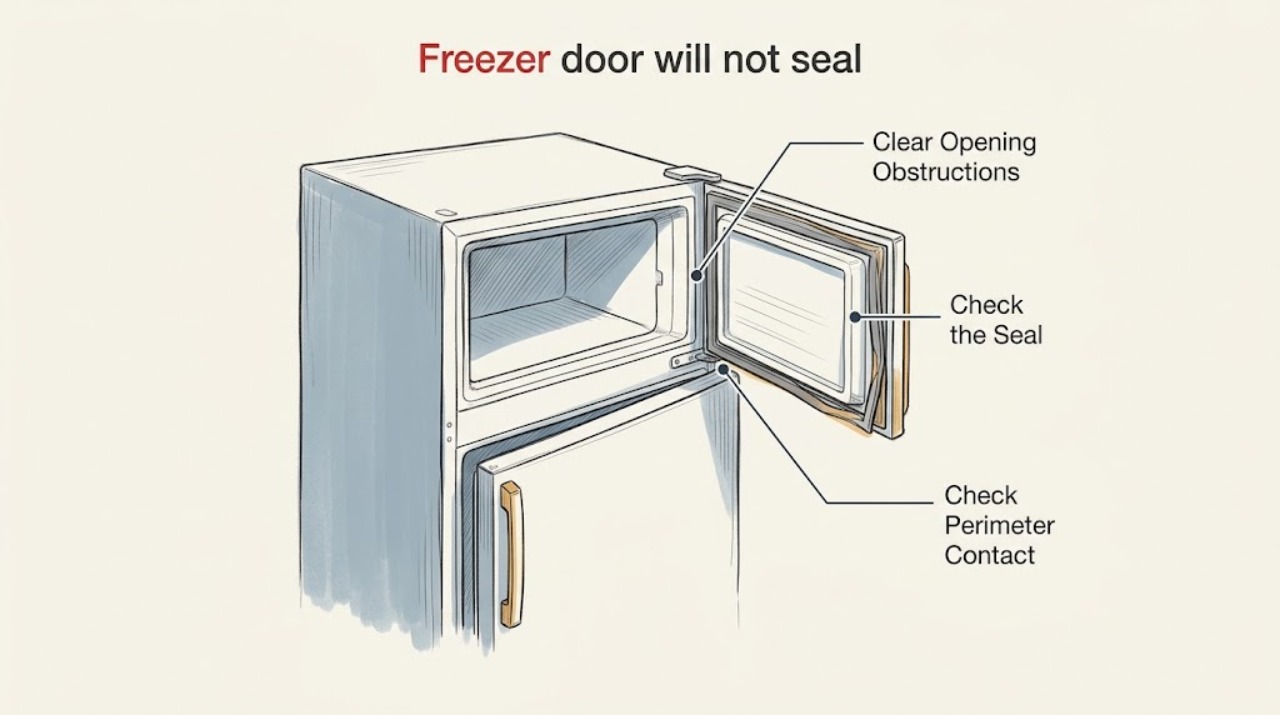
Work through in order
Diagnostic checks
Use only checks that match the exact appliance or system and its official guide.
-
Check 1
Close the freezer gently and inspect the complete opening from the front and both lower corners. Remove only food packages or removable shelves, bins, or drawers that visibly project into the door path, then check that each removable item is seated in its intended position.
Expected result: Note whether one package, shelf edge, drawer front, rail, ice buildup, or a loose item touches the gasket or stops the door before it reaches the cabinet; also note whether the door closes evenly after the obstruction is removed.
Next step: Run the perimeter seal check after the opening is clear. If a drawer or rail will not seat without force, leave it in place and use the exact Samsung model instructions or request service.
Stop if: Do not force a drawer, rail, shelf, or door, remove hinge hardware, or reach behind panels to correct an obstruction.
Why this matters
Why: If the door closes evenly once an obstruction is cleared, the gasket may not be the failed component. If nothing touches the door but a corner remains open, the next checks should focus on the gasket, frost, or alignment rather than repeatedly rearranging food.
-
Check 2
With the door open, inspect the rubber freezer gasket around its entire perimeter and clean its contact surface with a soft cloth and warm soapy water, then dry it. If a section has pulled out of its channel but is otherwise intact, press it back into the channel gently without stretching it.
Expected result: Classify the gasket as clean and seated, dirty but intact, partly displaced, folded or twisted, torn, hardened, warped, or impossible to inspect without removing trim.
Next step: Close the door without forcing it and repeat the flashlight or paper check. If the gasket is damaged or will not stay seated, record the model information and arrange Samsung-specific or qualified appliance service.
Stop if: Do not use adhesive, solvents, a knife, heat, abrasive tools, or a hair dryer on the gasket; stop if inspection requires removing panels or trim.
Why this matters
Why: Residue, a displaced section, or a fold can create a local air gap and may be corrected by cleaning or gentle reseating. A tear, hard deformation, or persistent warped section is a seal-replacement or service problem, not a reason to glue, cut, or reshape the gasket.
-
Check 3
Close the empty or safely rearranged freezer door normally and use a flashlight from inside the darkened compartment, or slide a single sheet of paper at multiple points between the gasket and cabinet while the door is closed. Check the top, latch side, hinge side, and both lower corners rather than testing one spot only.
Expected result: Record whether the gasket contacts all around, whether light is visible at one repeatable location, or whether paper slips freely along a long section; do not pull hard enough to deform the gasket.
Next step: Compare the gap with the gasket inspection and frost check. If the gap remains with a clear opening and intact gasket, stop adjusting the door by force and provide the gap location to a technician.
Stop if: Do not wedge the door, clamp the gasket, bend the door, loosen hinges, or remove cabinet parts to improve the test result.
Why this matters
Why: Contact all around makes an open-door obstruction less likely, while one repeatable gap points toward local gasket displacement, frost, or alignment. A long gap or paper that slips easily after cleaning supports a warped seal or door/cabinet alignment issue and can explain recurring frost or poor cooling.
-
Check 4
If frost is preventing the gasket or door from reaching the cabinet, remove light accessible frost with a damp cloth; for heavier buildup, follow the exact Samsung model's defrost instructions or arrange service. Keep the freezer door open only as long as needed and dry the gasket and contact surface before closing it.
Expected result: Note whether frost is only on the contact edge, is packed around a drawer or rail, covers a broad wall or vent area, or returns after the door has been cleaned and fully closed.
Next step: After safe frost removal, repeat the perimeter contact check and watch whether frost reappears. If buildup is heavy, returns, or the freezer is not cooling, use the model-specific defrost/service path rather than applying heat.
Stop if: Never use a hair dryer, heat gun, knife, screwdriver, or other sharp tool to remove freezer frost; stop if water reaches electrical components or if the liner or gasket is damaged.
Why this matters
Why: Frost at the contact edge can physically hold the door open and may explain a temporary gap. Broad or recurring frost indicates repeated warm-air entry or another defrost/airflow issue; clearing the visible ice alone will not prove the seal is fixed.
-
Check 5
Observe the door or pull-out freezer drawer from the side while closing it normally, and compare the top and bottom gaps with the cabinet. Confirm that visible drawer fronts, rails, and shelves are seated as the exact Samsung model instructions show; check only accessible external alignment or leveling guidance and do not remove hinge hardware.
Expected result: Record whether the door is visibly low or high on one side, the drawer front is skewed, a rail stops short, the cabinet appears out of level, or the door closes squarely but still leaks at the gasket.
Next step: Use the exact model manual for any permitted external leveling step. If a hinge, rail, alignment shim, or cabinet adjustment is implicated, document the side and gap and arrange qualified appliance service.
Stop if: Do not loosen or remove hinges, bend the door, dismantle drawer rails, insert an improvised shim, or open panels to correct alignment.
Why this matters
Why: A repeatable one-sided gap or a drawer that cannot travel to its closed position makes alignment, hinge, rail, or a cabinet-level issue more likely than a dirty seal alone. A square door with a damaged contact edge keeps the gasket as the stronger suspect.
-
Check 6
After the door appears to seal, keep openings brief and monitor for renewed frost, warm food, a fan-related alert, water from melting ice, or a door that springs back open. If the display shows an error, record the exact code and model instead of repeatedly unplugging or changing settings.
Expected result: Classify the result as a stable seal with normal cooling, a seal that looks closed but develops frost again, inadequate cooling or food warming, a documented freezer fan/error indication, or water/electrical damage.
Next step: Keep the door closed and arrange Samsung-specific or qualified service for recurring frost, food warming, an error code, water damage, or any result that does not remain corrected. Give the technician the gap location, photos, and exact code.
Stop if: Stop using the freezer if water reaches electrical parts, the door cannot remain closed, food-safety conditions are uncertain, or diagnosis would require energized electrical or sealed-system work.
Why this matters
Why: A stable contact pattern without renewed frost supports a corrected obstruction, gasket, or frost cause. Recurring frost or cooling loss means warm air may still be entering or a related freezer system fault may be present; Samsung notes that a freezer fan code can occur when a fan is frozen by an open door or gasket gap.
Use your observations
Decision map
Find the observation that best matches what you see, then follow the next safe action.
-
PATH 01Safety boundary
What you see
A package, shelf, drawer, rail, or loose ice was touching the opening, and the door now closes squarely with full gasket contact and no repeatable flashlight gap.
Do this next
Keep contents below the gasket path, confirm removable bins and drawers remain seated, and recheck the perimeter if frost or a gap returns.
Why this path and its safety boundary
Why it matters: The immediate no-seal symptom was likely caused by the obstruction rather than a failed gasket, but the freezer should still be watched for renewed frost or warming.
Safety stop: If the obstruction cannot be cleared without force or the door still springs open, stop and request service.
-
PATH 02Safety boundary
What you see
The opening is clear, but residue, a folded edge, or a gasket section pulled from its channel is found; gentle cleaning or reseating restores contact around the perimeter.
Do this next
Dry the contact surface, close the door normally, and monitor for recurring frost or cooling loss over subsequent use.
Why this path and its safety boundary
Why it matters: The gasket condition was a plausible local cause, and the improved contact supports that diagnosis. It does not justify gluing or reshaping the seal.
Safety stop: If the gasket will not stay in its channel, is torn, hardened, or remains warped, stop home adjustments and arrange a compatible gasket/service assessment.
-
PATH 03Safety boundary
What you see
No obstruction remains, the gasket is clean and intact, but the flashlight or paper check shows a repeatable gap at one corner or along one side, with a visibly skewed door or drawer.
Do this next
Photograph the gap and provide the model number to Samsung-specific or qualified appliance service; use only model-manual external checks and do not alter hinge hardware.
Why this path and its safety boundary
Why it matters: Door, hinge, drawer-rail, cabinet-level, or alignment-shim involvement becomes more likely than surface dirt. The exact Samsung model determines which adjustment, if any, is permitted.
Safety stop: Do not bend the door, loosen hinges, dismantle rails, or insert an improvised shim.
-
PATH 04Safety boundary
What you see
Frost is packed on the contact edge or around a drawer, or frost returns after the door appears closed and the gasket has been cleaned.
Do this next
Use only the safe, model-approved defrost path, repeat the perimeter contact check, and request service if frost is heavy, returns, or cooling is affected.
Why this path and its safety boundary
Why it matters: Frost can hold the door open, while recurring frost suggests warm moist air is still entering or a related defrost/airflow problem needs diagnosis. Removing visible ice once is not proof of a lasting seal.
Safety stop: Do not use a hair dryer or sharp tool, and stop if meltwater approaches electrical parts or the liner is damaged.
-
PATH 05Safety boundary
What you see
The door appears to close and the gasket contacts the cabinet, but food warms, frost keeps returning, a freezer fan/error indication appears, or the door will not remain closed.
Do this next
Keep the door shut, preserve the exact error code and model information, and arrange Samsung-specific or qualified appliance service; do not open panels or attempt energized electrical checks.
Why this path and its safety boundary
Why it matters: A visible seal is not sufficient to rule out a persistent gap, airflow/defrost issue, or another freezer fault. Samsung identifies a gasket gap as one possible cause of a frozen freezer fan and directs service for unresolved cooling problems.
Safety stop: Stop immediately for water near electrical parts, damaged wiring, an unsafe temperature condition, or any need to work inside the cabinet.
-
PATH 06Safety boundary
What you see
The door path is clear, but the gasket is torn, hardened, visibly warped, or leaves a long gap after cleaning and safe reseating.
Do this next
Arrange a model-specific gasket diagnosis and replacement through Samsung or a qualified appliance technician, confirming the freezer model before any part is ordered.
Why this path and its safety boundary
Why it matters: The seal itself is no longer providing reliable contact. Ordering a generic seal or forcing the existing one into shape could create another leak or fit problem.
Safety stop: Do not glue, cut, heat, stretch, or tape the gasket as a repair.
Helpful context
Understand the symptom
Find the gap before changing a part
Start with the door closed and the freezer contents undisturbed enough to see the perimeter. A package, shelf edge, drawer front, or rail that projects into the opening can look like a failed seal even when the gasket is intact. Inspect the rubber gasket for food residue, ice, a section pulled out of its channel, a fold, or a tear. A flashlight or paper check at several points around the perimeter helps distinguish one localized gap from a door that is being held open across a whole side. Samsung notes that a poor seal lets warm, moist air enter and can lead to frost, so treat a visible gap as a cooling issue as well as a door issue.
Frost and alignment need different next steps
Light frost on the gasket or at the threshold can be wiped with a damp cloth, while heavier frost may need a model-approved defrost procedure. Do not direct hot air at the liner or gasket. If the gap is confined to one corner after the opening is clear, the door, hinge, drawer rail, or cabinet alignment may need model-specific adjustment; do not remove a hinge or improvise a shim. If frost returns after the door closes, the gap remains, or the freezer is no longer holding temperature, stop repeated home checks and arrange service.
Protect the freezer while deciding whether it needs service
Keep the door closed as much as practical while checking it, and move temperature-sensitive food according to your food-safety plan if the freezer is warming. Do not keep forcing the door, compressing the gasket with tools, or operating with a damaged seal. Samsung's cooling guidance uses a paper-resistance check and directs service for a warped or damaged seal; model-specific drawer, hinge, and sensor arrangements should be handled from the exact manual or by a qualified technician.
Safety boundary
Stop conditions
- Do not use a hair dryer, heat gun, open flame, knife, screwdriver, or sharp tool to remove freezer frost or reshape the gasket.
- Do not bend the door, loosen or remove hinges, dismantle drawer rails, open panels, or work on energized electrical or sealed-system components.
- Do not glue, cut, stretch, tape, or substitute a gasket without confirming the exact Samsung freezer model and compatible repair path.
- Stop for water near electrical parts, damaged wiring or liner, food warming with uncertain food safety, a door that cannot remain closed, or recurring frost and cooling loss.
- If an error code appears, record the exact code and model and use the model-specific Samsung guidance or qualified service rather than guessing at a component.
- Keep the freezer door closed as much as practical while awaiting service and avoid repeated forced closing that could worsen the gasket or alignment.
Only after diagnosis
Potential parts
- freezer door gasket
Consider this category only when the exact model's gasket is torn, hardened, warped, or still leaves a gap after the opening is clear and the seal is cleaned and safely reseated.
Confirm the complete Samsung freezer model and the manufacturer's fit information before ordering; a similar-looking gasket is not evidence of compatibility. - freezer door hinge
Consider this category only when a qualified diagnosis finds a damaged or worn hinge causing a repeatable one-sided gap or door sag after obstructions and gasket issues are ruled out.
Confirm the exact door style, side, freezer configuration, and model-specific fitment with Samsung or a qualified technician before ordering. - freezer door alignment shim
Consider this category only if the exact Samsung model uses an approved alignment shim and a qualified diagnosis identifies alignment correction as the cause of the persistent gap.
Do not improvise a shim or assume one fits; confirm the model-specific procedure, dimensions, and installation responsibility before ordering.
When checks do not resolve it
Need a professional?
Arrange Samsung-specific or qualified appliance service when the gasket is torn, hardened, or warped; a gap remains after the opening is clear and the gasket is clean; a hinge, drawer rail, cabinet alignment, or alignment shim appears involved; frost returns; cooling is inadequate; a freezer error code appears; water reaches electrical parts; or safe diagnosis would require removing panels or hardware.
Safety scope: This article covers ordinary-access observation, cleaning, safe gasket reseating, and model-approved light-frost handling only. A technician should handle hinge or rail removal, alignment hardware, panels, electrical diagnosis, defrost-system work, and sealed-system repairs.
Common questions
FAQ
Why will my Samsung freezer door not seal?
Check for a package, shelf, drawer, rail, or frost holding the opening open; then inspect the gasket for dirt, displacement, folds, or damage. A repeatable gap after those checks can indicate door, hinge, drawer, cabinet, or alignment trouble that needs exact-model service.
How can I check whether the freezer gasket is sealing?
Close the door normally and check the top, hinge side, latch side, and lower corners with a flashlight from inside or a sheet of paper at several points. A repeatable light gap or paper that slips easily after cleaning indicates that the gasket or alignment needs further attention.
Can frost stop a Samsung freezer door from sealing?
Yes. Frost at the contact edge or around a drawer can physically hold the door open, and a continuing gap lets warm moist air create more frost. Remove only light accessible frost with a damp cloth or follow the exact model's defrost guidance; do not use a hair dryer or sharp tool.
What should I do if the freezer gasket is pulled out of its channel?
If the gasket is intact, clean and dry it and gently press the displaced section back into its channel, then repeat the perimeter check. If it will not stay seated, is torn, hardened, or warped, stop reshaping it and arrange a model-specific gasket or service assessment.
Should I adjust the Samsung freezer hinges or add a shim?
Do not loosen hinges, bend the door, dismantle drawer rails, or insert an improvised shim. If the gap is one-sided after the opening and gasket are checked, record the location and use the exact Samsung model instructions or qualified appliance service to determine whether alignment hardware is appropriate.
Why is frost coming back after the Samsung freezer door appears closed?
A door can look closed while a localized gasket or alignment gap still admits warm moist air. Recheck contact around the whole perimeter, inspect for a displaced or damaged gasket, and arrange service if frost returns, cooling is poor, or a fan-related error appears.
When should I call for Samsung freezer door-seal service?
Call when the gasket is damaged, a gap remains after clearing obstructions and cleaning, a drawer or hinge is visibly misaligned, frost returns, food warms, water reaches electrical parts, or an error code appears. Have the exact model, gap location, photos, frost pattern, and code ready.
Read the exact guide
Official sources
- Frost forms in the Samsung freezer, refrigerator, or ice bucketSamsung · Samsung support guidance for frost caused or worsened by door opening and sealing conditions; use the exact model manual for a full defrost procedure.
- Samsung refrigerator or freezer doors will not closeSamsung · Samsung support guidance for refrigerator and freezer door-closure symptoms; exact drawer, hinge, and model configuration instructions control a particular appliance.
- Samsung refrigerator error codesSamsung · Samsung error-code guidance; exact code meaning and reset or repair steps depend on the model and displayed code.
- Cooling issues with Samsung refrigerator or freezerSamsung · Samsung support guidance for cooling symptoms in refrigerators and freezers; the paper test is an observation aid and does not replace model-specific service diagnosis.
Community feedback
Share a repair observation
Share a plain-text repair observation. Accepted observations are published automatically; this page may take a moment to update.