
On this page
Start here
Quick answer
First separate normal freezer runtime from rapid short cycling. Haier notes that a freezer may run for more than half of the time, and some chest models may run 80–90% of the time; a hot room, a warm load, frequent openings, a long-open lid or door, initial installation, or recovery after a power outage can extend that runtime. Rapid starts and stops every few minutes, a compressor that clicks off or becomes very hot, a freezer that is warming, or a tripped breaker is different: stop use and arrange qualified appliance service. For a safe first check, record the start-and-stop pattern, confirm the temperature setting and any Fast Freeze mode, check the load and door or lid seal, look for heavy frost, and verify the manufacturer's required airflow clearance. Do not open the sealed cooling system, bypass a control, or order a compressor or relay before a model-specific diagnosis.
Before you begin
Safety first
- This article covers ordinary-access observation, control-setting review, closure and airflow checks, and only the exact model's documented defrost procedure. A technician must handle energized electrical parts, the compressor or start device, refrigerant, sealed tubing, control replacement, and any concealed fault.
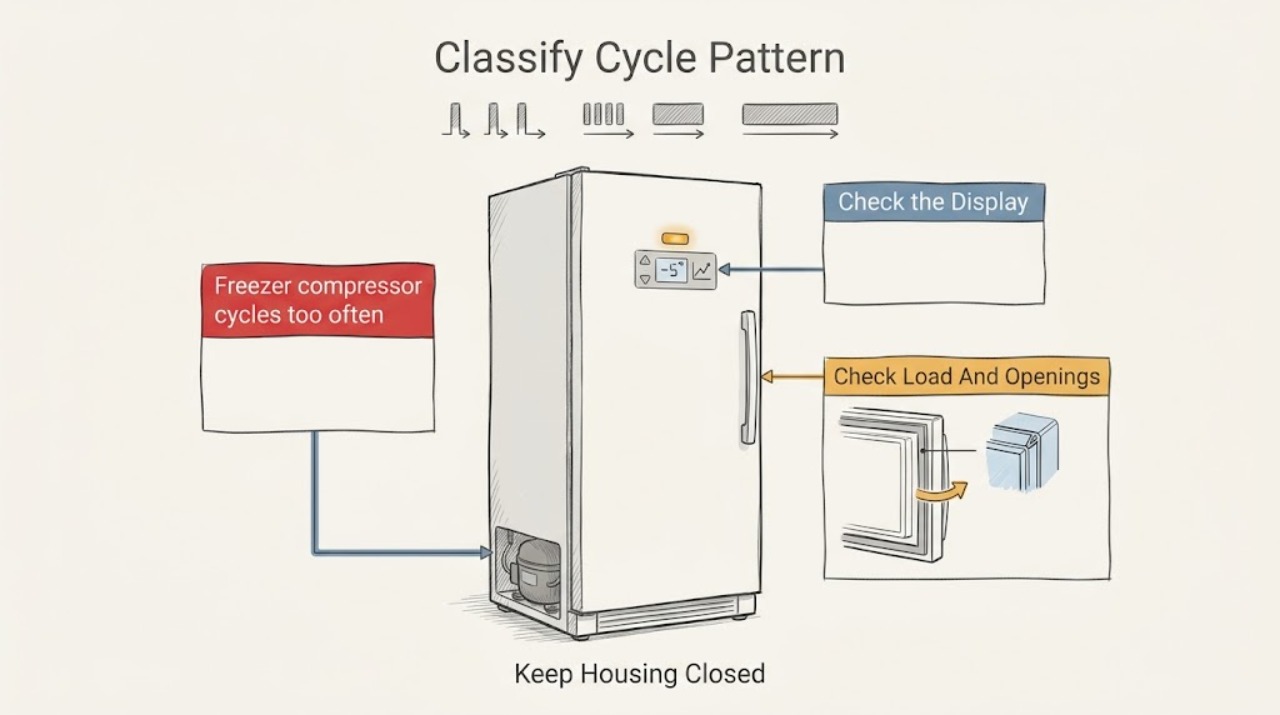
Work through in order
Diagnostic checks
Use only checks that match the exact appliance or system and its official guide.
-
Check 1
From a dry, stable position, observe one normal cooling period without touching wiring or the compressor. Note when the compressor starts, how long it runs, the time until the next start, and whether the freezer is holding or losing cold.
Expected result: The unit runs for a long stretch and then rests while the contents remain frozen, or it starts and stops every few minutes, clicks off, and fails to restore cold.
Next step: For stable cold, continue with the load, setting, seal, frost, and airflow checks. For rapid retries or poor cooling, stop the test, keep the lid or door closed, and use the service branch.
Stop if: Stop immediately for smoke, a burning or electrical smell, sparking, a damaged cord, a breaker trip, a compressor that repeatedly clicks off, or a compartment that is warming.
Why this matters
Why: Long runtime with stable cold can fit Haier's normal recovery and environmental guidance. Rapid retries, failed starts, or warming food suggest a fault rather than ordinary duty cycle.
-
Check 2
Read the control position and display without opening an electrical panel. If the model has Fast Freeze or a similar temporary mode, check whether it is still selected; compare the control with the exact owner's instructions before changing it.
Expected result: The control is set colder than needed, Fast Freeze is active after a temporary load, or the setting is already at the documented normal position with no special mode active.
Next step: If the model instructions allow a normal setting, return to that setting once and allow the documented stabilization period before judging the cycle. Do not keep lowering the control when the freezer cannot reach temperature.
Stop if: Do not bypass the temperature control, remove its cover, alter wiring, or make repeated setting changes while the compartment is warming.
Why this matters
Why: A colder target or temporary fast-freeze mode can make the compressor run longer. An unchanged, documented setting makes the control less likely to explain the symptom and shifts attention to load, seal, frost, airflow, or cooling performance.
-
Check 3
Review the last day of use: note whether warm food was added, the freezer is nearly empty or tightly packed, or the door or lid has been opened often or left ajar. Close it fully and remove only an obvious package or shelf obstruction that prevents the gasket from contacting.
Expected result: The long runtime began after a warm load, frequent openings, a long-open door or lid, or a load that restricts closure; or there is no such change and the freezer is still warming.
Next step: Keep the door or lid closed while the unit recovers and reassess the cycle only after the model's normal recovery period. If it cannot close or the temperature does not recover, stop experimenting and arrange service.
Stop if: Do not force an obstructed lid or door, move a heavy loaded freezer alone, or continue operation when food is thawing and the compressor is repeatedly retrying.
Why this matters
Why: Haier identifies warm food, frequent or long openings, a door or lid left open, and a lightly loaded freezer as reasons for longer operation. No use-related explanation, especially with poor cooling, points toward a sealing, frost, airflow, control, or cooling-system issue.
-
Check 4
With the door or lid closed, inspect the visible gasket contact around the full perimeter for a folded section, dirt, ice, a gap, or an object preventing closure. Then check that the cabinet has the clearance required by the exact model; Haier's general loud-freezer guidance calls for at least 4 inches all around.
Expected result: The gasket contact is even and the cabinet has the documented clearance, or there is a visible gap, ice, damaged gasket, blocked vent, or inadequate clearance.
Next step: Remove only loose obstructions and correct placement without disturbing the appliance. If the gasket is torn, permanently distorted, or cannot contact, obtain model-specific service; do not use a generic seal as a fit test.
Stop if: Do not pry the gasket out, remove panels, place the unit against a wall to test it, or operate it if the lid or door cannot close securely.
Why this matters
Why: A leak at the door or lid lets warm humid air in and can extend runtime and frost. Restricted external airflow can also reduce heat rejection. An intact seal and adequate clearance make those causes less likely.
-
Check 5
Look at the accessible interior walls, vents, and evaporator-cover area without removing panels. Record whether frost is light and even, heavy enough to restrict space or airflow, or concentrated in an unusual pattern.
Expected result: Frost is about 1/4 inch thick or more, vents are obscured, the freezer is not cooling evenly, or there is little frost but the compressor cycles rapidly and the temperature rises.
Next step: If the exact model permits user defrosting, remove food, turn the thermostat Off or unplug as directed, let all frost melt, dry the interior, restore the drain plug if present, and return the control to the documented middle or normal position. If the frost pattern is unusual, the freezer warms, or the model procedure is unclear, arrange service.
Stop if: Never use a sharp or metallic tool, heat gun, or open flame on frost; do not remove an evaporator cover or pierce cooling tubing.
Why this matters
Why: Haier says frost forms as room air and freezer air interchange and generally calls for defrosting at about 1/4 inch. Heavy frost can impede performance; little frost with rapid retries and poor cooling is not a reason to scrape coils and may indicate a control or sealed-system fault.
-
Check 6
Record the room conditions and the final response after one controlled recovery period: hot or humid location, recent installation or outage, cycle interval, cabinet temperature, unusual click or buzz, and whether a breaker or overload has operated.
Expected result: The freezer reaches its target after the room or load normalizes, or it remains warm and short-cycles, overheats, trips protection, or makes a new harsh sound.
Next step: Keep the records and model information for a qualified appliance technician. Preserve food according to its temperature and safety needs; do not keep restarting a unit that cannot maintain cold.
Stop if: Do not open the sealed system, handle refrigerant, bypass an overload or thermostat, remove energized covers, or perform live electrical tests.
Why this matters
Why: A normalizing temperature after a known load, outage, or hot-room event supports extended recovery. Persistent short cycling with poor cooling or electrical protection points to a control, start device, compressor, supply, or sealed-system diagnosis.
Use your observations
Decision map
Find the observation that best matches what you see, then follow the next safe action.
-
PATH 01Safety boundary
What you see
The compressor runs for a long period but the freezer remains cold, and the pattern began after initial installation, a power interruption, a warm load, frequent openings, or a hot or humid room.
Do this next
Keep the door or lid closed, allow the documented recovery period, and monitor one complete cycle. If cold is not restored or rapid retries begin, move to service.
Why this path and its safety boundary
Why it matters: Extended runtime is more consistent with recovery or heat load than with a failed compressor. The absence of rapid retries or warming is the important distinction.
Safety stop: Stop if food is thawing, the compressor repeatedly clicks off, smoke or electrical odor appears, or protection trips.
-
PATH 02Safety boundary
What you see
A cold-control setting is unusually cold or Fast Freeze remains active, or the symptom follows a warm or lightly loaded compartment, frequent openings, an obstructed door or lid, or a visible gasket gap.
Do this next
Restore only the model-documented normal setting, remove loose closure obstructions, keep the unit closed, and reassess after stabilization. Repair or replace a damaged gasket only after exact model confirmation.
Why this path and its safety boundary
Why it matters: The observed pattern makes a control or heat-intrusion cause more likely than a compressor diagnosis, although failure to recover can expose a second problem.
Safety stop: Do not keep turning the control colder, force closure, or use the freezer when its door or lid cannot seal.
-
PATH 03Safety boundary
What you see
Heavy frost covers the interior or vents, or the cabinet is installed with less clearance than the model requires, and cooling is uneven or recovery is slow.
Do this next
Follow the exact model's safe defrost procedure or correct only loose external obstructions. If frost returns quickly, the model cannot be safely defrosted, or cooling remains poor, arrange service.
Why this path and its safety boundary
Why it matters: Frost or heat-rejection restriction can account for long runtime. This branch does not establish a refrigerant or compressor fault.
Safety stop: Never chip frost with metal, use flame or high heat, remove covers, or pierce a cooling line.
-
PATH 04Safety boundary
What you see
The compressor starts and stops every few minutes, clicks off or becomes very hot, the freezer is warming, or a breaker or overload trips after the basic checks.
Do this next
Stop use, keep the door or lid closed, protect the food as needed, and arrange qualified appliance service. Give the technician the cycle interval, temperature trend, sounds, model number, and any protection trips.
Why this path and its safety boundary
Why it matters: This pattern is not explained by normal long runtime alone. A temperature control, start device, compressor, electrical supply, or sealed-system problem needs model-specific diagnosis.
Safety stop: Do not repeatedly reset power, bypass controls or overloads, remove electrical covers, take live measurements, or work on refrigerant tubing.
-
PATH 05Safety boundary
What you see
The freezer makes gurgling, bubbling, or an occasional control click while it holds temperature, versus a new harsh buzz, repeated click-off, or sound paired with warming.
Do this next
For normal sound with stable cold, continue monitoring. For a new harsh sound or any sound paired with failed starts, overheating, or warming, use the service branch.
Why this path and its safety boundary
Why it matters: Haier describes refrigerant movement and a temperature-control click as normal sounds. The cooling result and start behavior determine whether a sound is benign.
Safety stop: Stop if the sound accompanies smoke, electrical odor, a tripped breaker, repeated failed starts, or loss of cold.
Helpful context
Understand the symptom
Define the symptom before calling it a fault
A freezer that runs for long periods while holding its target temperature is not showing the same symptom as a compressor that starts, stops, and retries every few minutes. Haier describes long runtime as common while a freezer pulls down a warm load, recovers after a power interruption, or operates in a hot or humid room. Listen for the interval between starts and record the compartment temperature rather than judging the condition from sound alone. Gurgling or bubbling refrigerant sounds and a click as the temperature control cycles can be normal; repeated clicking with failed cooling is not a reason to keep testing.
Check load, control, door seal, frost, and airflow as one pattern
The useful distinction is the combination of observations. A warm load, frequent lid or door openings, an overly cold control setting, Fast Freeze left on where the model provides it, a weak gasket contact, heavy frost, or blocked cabinet airflow can all extend recovery. Haier's temperature guidance uses 0°F as the storage target and says to allow 24 hours after a setting change before judging the result. Do not keep turning the control colder to compensate for a seal, frost, airflow, or cooling-system problem.
Know when the compressor is beyond ordinary user checks
A short-cycle pattern can involve the temperature control, start device, electrical supply, compressor, or sealed cooling system, and the same sound can have more than one cause. Keep the work to ordinary visual and temperature observations. Do not remove electrical covers, take live measurements, add refrigerant, pierce tubing, bypass the thermostat, or repeatedly reset a breaker. If the freezer is warming, the compressor repeatedly fails to start, the cabinet has a burning smell, or protection trips, preserve the food safely and arrange qualified diagnosis.
Safety boundary
Stop conditions
- Stop using the freezer for smoke, sparks, a burning or electrical smell, a damaged cord, a tripped breaker, or repeated compressor start failure; isolate power only from a safe, dry position.
- Do not remove electrical covers, bypass the thermostat or overload, take live electrical measurements, or repeatedly reset a protection device.
- Do not open the sealed cooling system, pierce tubing, add or release refrigerant, or attempt compressor or start-device work.
- Never chip frost with a sharp or metallic tool, heat gun, or flame; use only the exact model's documented defrost procedure.
- Do not force a warped door or lid, pry out a gasket, move a loaded freezer alone, or keep operating when the seal cannot close securely.
- Stop self-checks when the freezer is warming, food is thawing, or rapid short cycling continues after the safe setting, load, seal, frost, and airflow checks.
Only after diagnosis
Potential parts
- temperature control or sensor
Consider this category only if model-specific testing shows that the control or sensor is not commanding temperature correctly after load, seal, frost, and airflow causes are ruled out.
Confirm the exact Haier model, control design, connector, and manufacturer's fit information before ordering; do not bypass the control as a test. - compressor start device or overload
Consider this category only when a qualified technician confirms repeated failed starts, click-off behavior, or a start-circuit fault for the exact model.
Confirm the exact compressor and electrical specifications with the technician and manufacturer; this is not a user-accessible substitute or universal fit. - door or lid gasket
Consider this category only if the perimeter inspection confirms a torn, distorted, or noncontacting gasket after loose obstructions and frost are addressed.
Confirm the exact model and gasket profile, mounting method, and fit information before ordering; do not force a mismatched seal.
When checks do not resolve it
Need a professional?
Arrange qualified appliance service when the compressor starts and stops every few minutes, the freezer is warming, a breaker or overload trips, the compressor becomes unusually hot, the gasket or cabinet airflow cannot be corrected, heavy frost returns after the documented defrost procedure, or normal setting and load checks do not restore a stable cycle. Provide the exact model, control and Fast Freeze state, room and load history, temperature readings, cycle interval, sounds, frost pattern, and any power-protection event.
Safety scope: This article covers ordinary-access observation, control-setting review, closure and airflow checks, and only the exact model's documented defrost procedure. A technician must handle energized electrical parts, the compressor or start device, refrigerant, sealed tubing, control replacement, and any concealed fault.
Common questions
FAQ
How often should a Haier freezer compressor run?
There is no single duty cycle for every Haier freezer. Haier says more than half-time operation can be normal and that some chest models may run 80–90%, especially in a hot or humid room or during recovery from a warm load. Judge the pattern with cabinet temperature: stable cold with long runtime differs from starts and stops every few minutes with warming.
Can Fast Freeze make a Haier freezer run longer?
Yes, Haier lists Fast Freeze as a possible reason for long operation on models that provide it. Check the exact manual or control display, return to the documented normal mode when the temporary load is complete, and allow the model's stabilization period. Do not use a colder setting to hide poor cooling.
Does heavy frost cause a Haier freezer to cycle too often?
Heavy frost can restrict usable space or airflow and extend recovery. Haier says frost forms as room and freezer air interchange and gives about 1/4 inch as a general point to defrost. Use only the exact model's defrost procedure; never chip frost with metal, flame, or high heat.
When is a Haier freezer's clicking sound a concern?
Haier describes an occasional click as the temperature control cycling and gurgling or bubbling as refrigerant movement. A repeated click-off pattern that accompanies failed starts, a very hot compressor, warming food, or a tripped breaker is different and needs qualified service.
Should I replace the Haier freezer compressor or relay first?
No. Rapid cycling can involve the control, start device, compressor, electrical supply, airflow, or sealed cooling system. Keep those parts conditional until a qualified technician identifies the fault for the exact model; do not open the sealed system or bypass a control as a test.
Read the exact guide
Official sources
- Freezer operates too longHaier · Haier service guidance used for model-dependent setting, mode, and airflow checks; exact product instructions control.
- Haier - Chest and Upright Freezer Running But Not Getting ColdHaier Appliances · Used for the assigned topic's warming or failed-cooling branch, not as proof of a specific internal failure.
- Haier - Chest and Upright Freezer Normal SoundsHaier Appliances · Used only to distinguish ordinary sound from sound paired with failed cooling or rapid retries.
- Haier - Defrosting Chest or Upright FreezerHaier Appliances · Used for a heavy-frost branch only when the installed model permits user defrosting.
- Haier - Chest and Upright Freezer Running Too MuchHaier Appliances · Direct Haier guidance for the assigned freezer symptom; exact model instructions control where they differ.
- Haier - Freezer Temperature SettingHaier Appliances · Used to frame a controlled setting check; the exact control and manual for the installed model take precedence.
- Haier - Freezer is LoudHaier Appliances · Used for a general clearance check; the exact model installation instructions control.
- Haier - Freezer Running All the TimeHaier Appliances · Direct Haier guidance for deciding whether long runtime is normal; it does not by itself diagnose rapid short cycling.
Community feedback
Share a repair observation
Share a plain-text repair observation. Accepted observations are published automatically; this page may take a moment to update.