
On this page
Start here
Quick answer
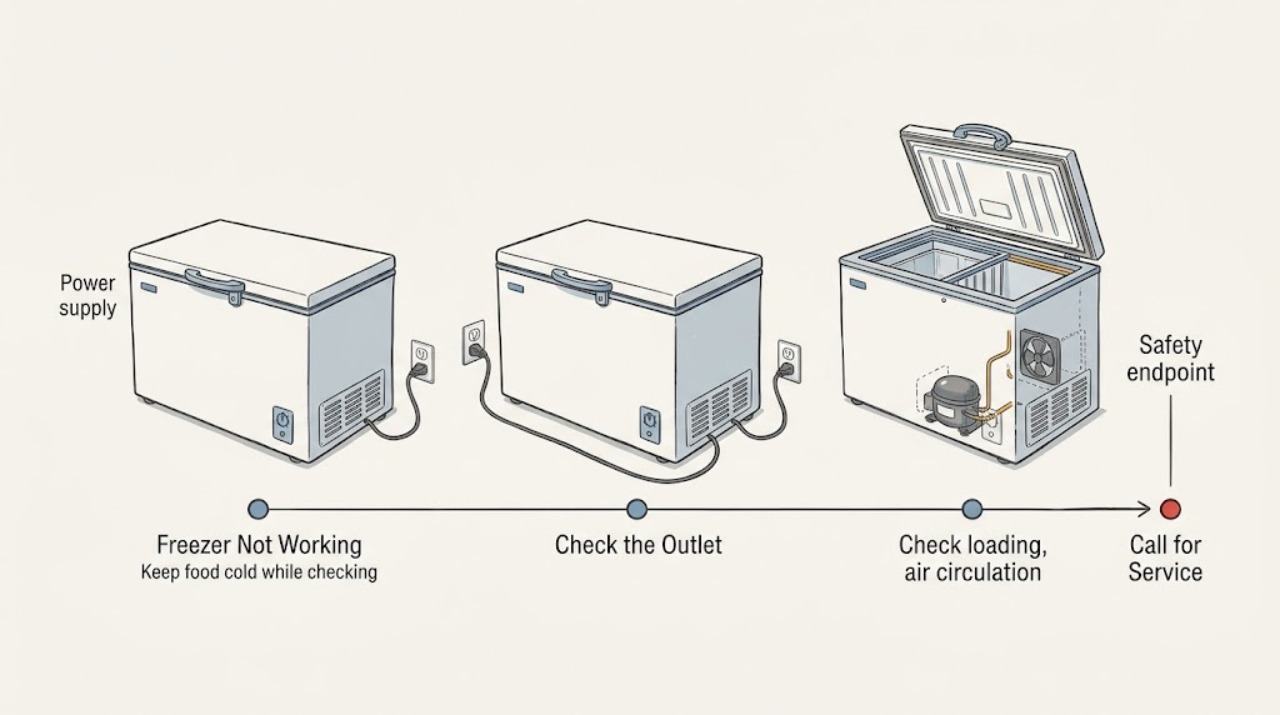
If a Haier freezer is not working, keep the door or lid closed and protect the food before repeated troubleshooting. Check the plug, working outlet, accessible breaker, and temperature control without opening the cabinet; Haier also identifies a door or lid left ajar, a damaged gasket, blocked air circulation, frequent opening, warm food, and a recent installation or outage as causes of poor cooling or long run time. Clean or inspect only cool, accessible surfaces, and disconnect power before cleaning. If the display or light is dead with a working circuit, the compressor or fan does not run, the freezer stays warm after the settings, seal, and airflow checks, or there is burning odor, a hot cord, water, smoke, or repeated breaker tripping, stop and arrange qualified Haier service. Use a freezer thermometer and follow food-safety guidance rather than judging food by smell alone.
Work through in order
Diagnostic checks
Use only checks that match the exact appliance or system and its official guide.
-
Keep food cold while checking for immediate hazards
Keep the lid or door closed and check the freezer exterior from a dry, safe position. Stop for smoke, burning or melting odor, a hot or damaged cord, water near the outlet or controls, visible arcing, a damaged cabinet, or a breaker that trips again. If there is no hazard, place an appliance thermometer in the freezer if one is available and note the current temperature without rearranging food unnecessarily.
Expected result: A hazard is present, the freezer is warming but still cold, or the freezer is at room temperature and food is thawing.
Next step: For a hazard, isolate power only if safe and arrange qualified service. For warming or thawing food, keep the door closed, transfer food to a working freezer or iced cooler when necessary, and use the FDA temperature and time guidance before keeping or discarding food. Then continue only if the appliance is safe.
Why this matters
Why: A fire, shock, or water hazard requires service rather than troubleshooting. A warming freezer can still protect food if the door stays closed, but thawing food requires an immediate food-safety plan and a separate appliance diagnosis.
-
Confirm the outlet, plug, breaker, and temperature control
Check that the freezer plug is fully seated in a dry, working outlet and look at the accessible household breaker or fuse. Confirm that the temperature control is not in Off, Min, or 0 and is set to a cooling position for the model. Do not open an outlet, remove an electrical cover, use an extension lead in place of the required supply, or keep resetting a breaker that trips.
Expected result: The outlet is dead, the breaker is tripped or will not stay on, the control was Off or at its minimum position, or power and settings are correct but the freezer remains silent or warm.
Next step: Have a qualified electrician check a dead or repeatedly tripping circuit. If the control was off, restore the model-approved setting and allow the unit to run while monitoring it. If power and settings are correct but it stays silent or warm, stop and arrange Haier service.
Why this matters
Why: A dead outlet or repeated trip is a household electrical issue. An off control can make the freezer appear not to operate. A powered freezer with a correct setting but no operation points to the appliance power, control, or cooling system.
-
Check loading, air circulation, and recovery conditions
With the door or lid opened only briefly, check that packages are not pressing against internal air vents or preventing the door from closing. Note whether the freezer was recently installed, had a long power outage, received a large amount of warm food, or has been opened frequently. Do not pack food tightly against vents and do not use a sharp tool to remove frost.
Expected result: An air vent is blocked, a package holds the door or lid open, the freezer was recently loaded with warm food, or the unit is recovering from installation or an outage; alternatively, loading and airflow are clear but the temperature remains high.
Next step: Restore clear airflow, remove only the item blocking closure, close the freezer, and allow recovery without repeated opening. If the unit remains warm after a reasonable model-directed recovery period or never starts, arrange service rather than adding more warm food.
Why this matters
Why: Haier identifies blocked air circulation, open doors or lids, warm food, frequent opening, and recovery after installation or a long outage as reasons for poor cooling or extended run time. Clear loading with persistent warmth points toward a mechanical or sealed-system fault.
-
Inspect and clean the door or lid gasket
When the freezer is cool and safe to handle, inspect the gasket around the complete door or lid perimeter for dirt, tears, hard spots, or a visible gap. Remove packages that interfere with closure. Clean the gasket with a soft cloth and the mild solution described by Haier, then dry it; do not use solvents, abrasives, metal pads, or force a distorted lid or door into alignment.
Expected result: The gasket is dirty but flexible and seals after cleaning, or it is torn, distorted, hard, or still leaves a gap when the door or lid is closed.
Next step: Close the freezer and monitor the temperature after a single gasket-cleaning correction. If the gasket is damaged or the seal remains incomplete, stop using the freezer if it cannot hold safe temperature and arrange service for the correct model-specific seal or alignment.
Why this matters
Why: A poor gasket seal lets warm air enter and can create frost or excessive run time. A clean, intact gasket that still leaves a gap indicates a door, hinge, lid, or cabinet alignment issue beyond a cleaning check.
-
Separate normal running from a failed cooling system
Listen and feel only at the exterior for a normal compressor or fan operating sound and check the temperature again after the model's recovery period. Do not remove the rear cover, touch a fan, scrape an evaporator, add refrigerant, or test live components. If cleaning is needed, unplug or disconnect power before wiping accessible surfaces and restore the model's temperature setting afterward.
Expected result: The freezer begins cooling and the temperature moves toward the set point, the compressor runs continuously without cooling, the fan is silent or obstructed, or the unit remains warm and silent with correct power and settings.
Next step: Monitor one closed-door recovery period if the temperature is falling. If it remains warm, runs continuously without cooling, makes an abnormal sound, or the fan or compressor does not operate, stop using it and arrange qualified Haier service; do not open the sealed system.
Why this matters
Why: Cooling after a setting, airflow, or gasket correction supports a correctable operating condition. Continuous running without cooling, an inaccessible or failed fan, or persistent silence with power suggests a control, compressor, fan, or sealed-system problem.
Use your observations
Decision map
Find the observation that best matches what you see, then follow the next safe action.
-
PATH 01Safety boundary
What you see
There is smoke, burning or melting odor, a hot or damaged cord, water near electrical parts, arcing, cabinet damage, or a breaker that trips again.
Do this next
Stop using the freezer, isolate power only from a safe position, keep clear, and arrange qualified service. Do not reset the breaker repeatedly or open the appliance.
Why this path and its safety boundary
Safety stop: True
-
PATH 02Safety boundary
What you see
The outlet is dead or the breaker will not stay on, while the freezer is otherwise dry and intact.
Do this next
Leave the freezer disconnected and have the household circuit checked by a qualified electrician. Keep the door or lid closed and protect the food in a working freezer or iced cooler.
Why this path and its safety boundary
Safety stop: True
-
PATH 03Next step
What you see
The control was Off or at its minimum position, airflow was blocked, a door or lid was held open, or the gasket was dirty, and cooling returns after one safe correction.
Do this next
Keep the door or lid closed and monitor the freezer thermometer through one recovery period. If the temperature does not fall or the symptom returns, arrange service.
-
PATH 04Safety boundary
What you see
The gasket is torn or distorted, the door or lid cannot seal, or frost and warm air continue despite a clean gasket and clear closure.
Do this next
Limit door openings and transfer food if the freezer cannot maintain a safe temperature. Arrange a qualified service visit for the model-specific seal, alignment, or cooling diagnosis.
Why this path and its safety boundary
Safety stop: True
-
PATH 05Safety boundary
What you see
The freezer has correct power and settings but remains warm and silent, runs continuously without cooling, or has an abnormal compressor or fan behavior.
Do this next
Stop using the freezer and request qualified Haier service for the fan, control, compressor, or sealed cooling system. Do not remove covers, scrape frost with a sharp tool, or work on refrigerant.
Why this path and its safety boundary
Safety stop: True
-
PATH 06Safety boundary
What you see
Food temperature is uncertain after the freezer failure or outage.
Do this next
Keep the door closed until food can be checked safely. Use a thermometer and official food-safety guidance; do not taste food to decide whether it is safe, and discard food when the time or temperature history is unsafe or unknown.
Why this path and its safety boundary
Safety stop: True
Helpful context
Understand the symptom
Protect food and people first
Keep the freezer door or chest lid closed while you assess it. Move food to a working freezer or an insulated cooler with ice if needed, and use an appliance or food thermometer. Do not taste questionable food or rely on odor alone. Stop the appliance check for smoke, a burning smell, a hot or damaged cord, water near electrical parts, unusual arcing, or a breaker that trips again.
No light, no compressor, and warm food are different symptoms
A completely dark or silent freezer starts with power and the control setting. A powered freezer that runs but stays warm points toward airflow, door sealing, frost, the fan, compressor, or sealed cooling system. A freezer that is recovering after installation, a long outage, or a large warm load may run longer before reaching its normal temperature.
Use the exact Haier model manual for anything beyond the exterior
Haier makes chest and upright freezers with different controls and access points. Record the complete model, whether the unit is silent or running, the control position, the measured temperature, frost pattern, and when the problem began. Do not remove covers, work on refrigerant, or diagnose a compressor or control board by sound alone.
Only after diagnosis
Potential parts
- Haier freezer door or lid gasket
Consider this only when inspection or service confirms a torn, distorted, or non-sealing gasket after the accessible cleaning and closure checks.
Confirm the complete Haier model and gasket profile before ordering; chest and upright freezer seals are not interchangeable by appearance alone. - Haier freezer evaporator or condenser fan assembly
Consider this only when a qualified technician confirms a failed fan or fan motor rather than blocked airflow, frost, or a control signal issue.
Fan assemblies are model-specific and may be behind covers; do not bypass a fan or access it while powered. - Haier freezer temperature sensor or control
Consider this only after service diagnosis identifies a sensor or control fault with the freezer's power, seal, airflow, and compressor operation verified.
Confirm the exact model and manufacturer-approved part before replacement; do not choose a sensor from a symptom alone.
When checks do not resolve it
Need a professional?
A technician is required for persistent no-operation or no-cooling, repeated electrical trips, a failed fan or compressor, a damaged door or lid seal, recurring frost or temperature problems, or any suspected sealed-system or control fault.
Common questions
FAQ
Why is my Haier freezer completely dead?
Check the plug, working outlet, accessible breaker, and temperature control without opening the freezer. If the circuit is working but the freezer remains dark and silent, stop and arrange qualified Haier service.
Why is my Haier freezer running but not getting cold?
Check the temperature setting, blocked vents, warm food, frequent opening, and the door or lid gasket. Haier identifies these as cooling or extended-run factors. If the freezer remains warm after one closed-door recovery period, request service for the fan, compressor, control, or sealed system.
Should I keep opening a Haier freezer to check the food?
No. Keep the door or lid closed as much as possible. Use an appliance thermometer, transfer food to a working freezer or iced cooler when necessary, and follow FDA food-safety guidance. Do not taste food to decide whether it is safe.
Can I repair a Haier freezer compressor or refrigerant system myself?
No. Do not remove covers, access the compressor or fan while powered, add refrigerant, or open the sealed system. A qualified technician should diagnose those parts after the safe exterior checks.
Read the exact guide
Official sources
- Freezer does not operate or Power-On Light is not onHaier · Haier freezer not operating or power light off, temperature control, plug, fuse, and breaker checks
- Haier - Refrigerator Running but Not CoolingHaier Appliances · Haier freezer or freezer compartment not cooling, outlet, thermostat, door openings, warm food, gasket, temperature setting, air vents, and service
- Haier - Chest and Upright Freezer Cleaning and MaintenanceHaier Appliances · Haier freezer power isolation before cleaning, temperature-control reset, gasket cleaning, gasket sealing, and cleaning-product limits
- Haier - Chest and Upright Freezer Running Too MuchHaier Appliances · Haier freezer extended running, high room temperature or humidity, warm food, open door or lid, gasket, frequent opening, and post-installation or outage recovery
- Food and Water Safety During Power Outages and FloodsU.S. Food and Drug Administration · Freezer failure and outage food protection, closed-door storage, thermometers, transfer to coolers, temperature checks, and discard decisions
Community feedback
Share a repair observation
Share a plain-text repair observation. Accepted observations are published automatically; this page may take a moment to update.