
On this page
Start here
Quick answer
A refrigerator that is not cooling does not by itself prove compressor failure. Haier's US support guidance first says to verify the outlet, power state, temperature control, door use, gasket seal, temperature setting and unobstructed air vents; it routes a continuing problem to service. Haier also says a very cold garage or basement can keep a refrigerator's compressor off because the thermostat does not call for cooling, and gives a 55°F–80°F design environment for its refrigerators. Check these external conditions and record whether one compartment or both are warm. Do not open the sealed refrigeration system, add refrigerant, test compressor terminals, or replace a compressor based only on noise or lack of cooling. Arrange model-specific service if cooling does not return or food is warming.
Before you begin
Safety first
- Only external user checks are provided. Refrigerant work, sealed-system opening, compressor electrical testing, component replacement and cabinet disassembly require qualified service.
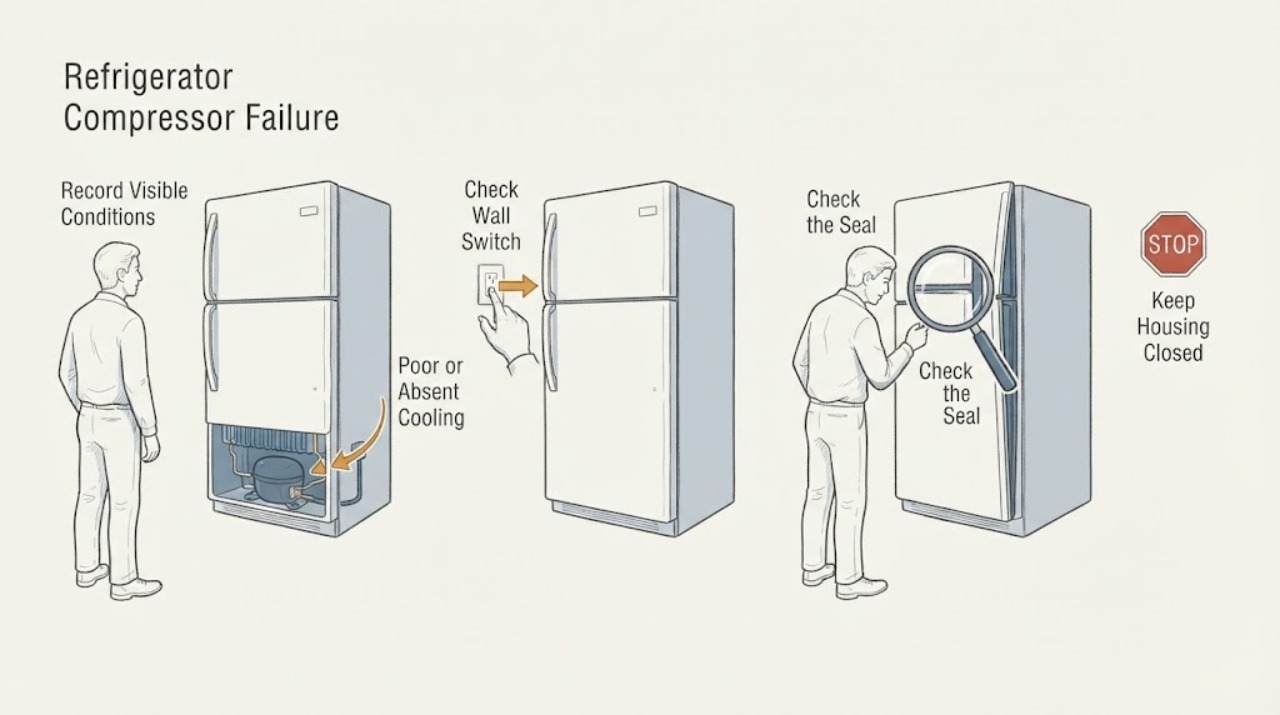
Work through in order
Diagnostic checks
Use only checks that match the exact appliance or system and its official guide.
-
Check 1
Record whether the fresh-food section, freezer, or both sections are warm, and note whether the refrigerator has power, lights or a display while the cooling complaint is present.
Expected result: Both compartments are warm, only one compartment is warm, or the unit has no power/display.
Next step: If only one section is affected, continue with its air-vent and loading check; if there is no power, address the safe outlet/breaker boundary first.
Stop if: If the behavior cannot be characterized safely, record the model and temperature symptoms for service instead of listening for a compressor diagnosis.
Why this matters
Why: Haier's guide separates general no-cooling from a single-compartment airflow issue; no power is not evidence of compressor failure.
-
Check 2
Verify from a dry, safe position that the refrigerator is plugged into a working outlet, is switched on, and has its temperature control set to a cold setting supported by the exact model guide.
Expected result: The plug or outlet is not supplying power, the unit or cooling control is off, or power and controls are normal.
Next step: If the outlet, plug, or control is abnormal, correct only the accessible condition without touching wet or damaged electrical parts; then allow the refrigerator time to cool.
Stop if: If power and controls are normal, continue with door, gasket and airflow checks rather than testing compressor terminals.
Why this matters
Why: Haier lists power, the on state and the temperature control as first checks; correcting them does not establish a compressor fault.
-
Check 3
Check that doors are not being opened frequently, the gaskets sit flat and seal, and warm food has had time to reach the fresh-food temperature after loading.
Expected result: A door is ajar, a gasket has a visible gap or damage, frequent opening or a recent warm load explains the temperature change, or these conditions are normal.
Next step: Close the door, correct only the accessible loading or gasket position, and allow the appliance to stabilize; arrange service if the seal is damaged.
Stop if: If doors and gaskets are normal and temperatures remain high, continue with the air-vent and environment checks.
Why this matters
Why: Haier identifies door openings, gasket sealing and warm food as non-compressor explanations for a refrigerator that has not reached temperature.
-
Check 4
Inspect the affected compartment's accessible air vents for food or containers blocking circulation, and do not remove panels or covers to reach hidden fans or refrigeration parts.
Expected result: A vent is blocked, or the vents are clear but one compartment remains warm.
Next step: Move items away from the vent without overpacking and allow the compartment to stabilize; use the exact manual if the airflow layout differs.
Stop if: If airflow is clear and the compartment remains warm, request model-specific service rather than opening the cabinet.
Why this matters
Why: Haier says an obstructed compartment vent can explain one section not cooling; a clear vent does not prove a compressor or fan failure.
-
Check 5
Check the room where the refrigerator operates, especially a garage or basement, and compare it with Haier's stated environment guidance; do not move a refrigerator or alter its installation alone if doing so creates a lifting, gas, water or electrical hazard.
Expected result: The room is below about 25°F, outside the stated 55°F–80°F design environment, or within the stated range.
Next step: Correct the environment only when safe and permitted by the installation instructions, then monitor temperatures; do not use a compressor replacement as the first conclusion.
Stop if: If the environment is suitable and cooling remains poor, arrange exact-model service for a professional diagnosis.
Why this matters
Why: Haier says a very cold room can keep the thermostat from calling for the compressor, while operation outside the design range can cause improper operation; this is not proof of compressor failure.
-
Check 6
Stop troubleshooting and protect the food when the refrigerator remains warm after the external checks, food is soft or unsafe, there is a burning smell, repeated breaker operation, damaged cord, water near electrical parts, or a fault indication.
Expected result: Cooling is not restored, food is warming, or an electrical, water or fault hazard is present.
Next step: Move perishable food to a suitable working refrigerator or cooler, disconnect power only if safe, record the exact model and symptoms, and arrange Haier or qualified appliance service. Do not open the sealed system or perform live electrical tests.
Why this matters
Why: The symptom needs qualified diagnosis; the opened Haier sources do not support a user confirmation of compressor failure or sealed-system repair.
Use your observations
Decision map
Find the observation that best matches what you see, then follow the next safe action.
-
PATH 01Next step
What you see
The room is very cold, especially below about 25°F, and the freezer contents remain frozen while the refrigerator section is warm.
Do this next
Bring the appliance environment within the model's permitted range only if safe and permitted, then monitor temperatures before requesting a sealed-system diagnosis.
Why this path and its safety boundary
Why it matters: Haier says a cold room can keep the compressor off because the thermostat does not call for cooling, so this condition does not establish a failed compressor.
-
PATH 02Next step
What you see
Only one compartment is warm and an accessible air vent is blocked.
Do this next
Clear the vent by rearranging food and allow the compartment to stabilize; request service if it remains warm.
Why this path and its safety boundary
Why it matters: Haier identifies obstructed compartment vents as an external explanation for one section not cooling.
-
PATH 03Next step
What you see
Power, controls, doors, gaskets, vents and room conditions are suitable, but both sections remain warm.
Do this next
Protect food and arrange exact-model professional service; do not add refrigerant, open tubing, or test compressor terminals.
Why this path and its safety boundary
Why it matters: The external explanations have not resolved the cooling loss, but this result still cannot identify the compressor or another sealed-system component.
-
PATH 04Next step
What you see
There is a burning odor, repeated breaker operation, damaged cord, water near electrical parts, smoke, or a fault indication.
Do this next
Stop using the refrigerator, isolate power only if safe, keep clear of wet or damaged parts, protect the food, and arrange qualified service.
Why this path and its safety boundary
Why it matters: The situation may involve an electrical or water hazard and is outside a safe cooling check.
Helpful context
Understand the symptom
"Compressor failure" is a repair hypothesis, not an observation that can be confirmed from a refrigerator being warm. Haier's US support page begins with power, controls, door use, gasket seal, temperature and air-vent checks. It also distinguishes a single warm compartment from a refrigerator that is not cooling generally.
Room conditions can change the result. Haier says a very cold garage or basement can keep the compressor off because the thermostat does not call for cooling, and gives a 55°F–80°F operating environment for its refrigerators. This is an environmental explanation, not evidence that the compressor is good or bad.
Keep the decision at the user-safe boundary: verify the external conditions, protect food that is warming, and arrange model-specific service if cooling remains poor. Do not open the sealed refrigeration circuit, add or release refrigerant, measure compressor terminals, or replace a compressor from a noise or temperature symptom alone.
When checks do not resolve it
Need a professional?
Arrange Haier or qualified appliance service when cooling remains poor after the power, control, gasket, door, vent and environment checks, when both sections are warm, or when a fault or food-temperature problem is present. The exact model is required for diagnosis; the symptom alone does not confirm compressor failure.
Safety scope: Only external user checks are provided. Refrigerant work, sealed-system opening, compressor electrical testing, component replacement and cabinet disassembly require qualified service.
Common questions
FAQ
How can I tell if my Haier refrigerator compressor has failed?
You cannot confirm that from a warm refrigerator alone. Haier's US support guidance first calls for power, controls, door/gasket, temperature and vent checks, and its cold-room guidance describes an environment that can keep the compressor off. Persistent loss of cooling needs exact-model professional diagnosis.
Can a cold garage make a Haier refrigerator seem to have compressor failure?
Yes. Haier says a room below about 25°F can keep the thermostat from calling for cooling, and gives a 55°F–80°F design environment for its refrigerators. Check the permitted environment before treating the compressor as failed.
What should I check if only the refrigerator or freezer section is warm?
Check that the affected compartment's accessible air vents are not obstructed, as Haier directs. A blocked vent can explain one warm section; clear vents with persistent warming require model-specific service.
Should I add refrigerant or replace the compressor myself?
No. The opened Haier user support pages do not establish a sealed-system diagnosis or authorize refrigerant work, compressor-terminal testing, or replacement from this symptom. Keep the appliance safe and arrange qualified service.
Read the exact guide
Official sources
- What to do if the compressor does not work?Haier Saudi Arabia · Haier Saudi Arabia regional caution that an unplugged appliance or automatic defrost cycle can explain a compressor that is not running
- Haier - Refrigerator or Freezer Use in Garage or BasementHaier Appliances · Haier US refrigerator cold-room operating boundary and compressor-off environmental explanation
- Haier - Refrigerator Running but Not CoolingHaier Appliances · Haier US refrigerator external no-cooling checks and service boundary
Community feedback
Share a repair observation
Share a plain-text repair observation. Accepted observations are published automatically; this page may take a moment to update.