
On this page
Start here
Quick answer
Start with the door itself: remove only an obvious item that is preventing closure, make sure bins and shelves are seated, and check that no food or container is jarring the door. Haier's refrigerator guidance links a door that is not tightly closed with an unlevel appliance or an obstructing food container, and separately identifies a dirty, worn, cracked, or mismatched gasket as a service issue. Inspect the gasket all the way around for dirt, folds, tears, or a gap; a slightly raised welded corner can be normal only when the seal still contacts the cabinet. Check for frost or ice at the door edge or back wall, but do not chip or heat it aggressively. If the door remains misaligned, a hinge or drawer needs adjustment, the gasket has a persistent gap, or the refrigerator must be moved or opened, stop forcing it and arrange model-specific Haier service. Do not remove hinges, alter the door spring or wiring, or use the refrigerator with a persistent seal gap.
Before you begin
Safety first
- This article covers external observation, safe load rearrangement, reseating visible storage, gentle gasket cleaning, and visual checks for level, alignment, and frost. Do not remove hinges or panels, alter wiring or springs, move a built-in or loaded unit, or apply direct heat to ice.
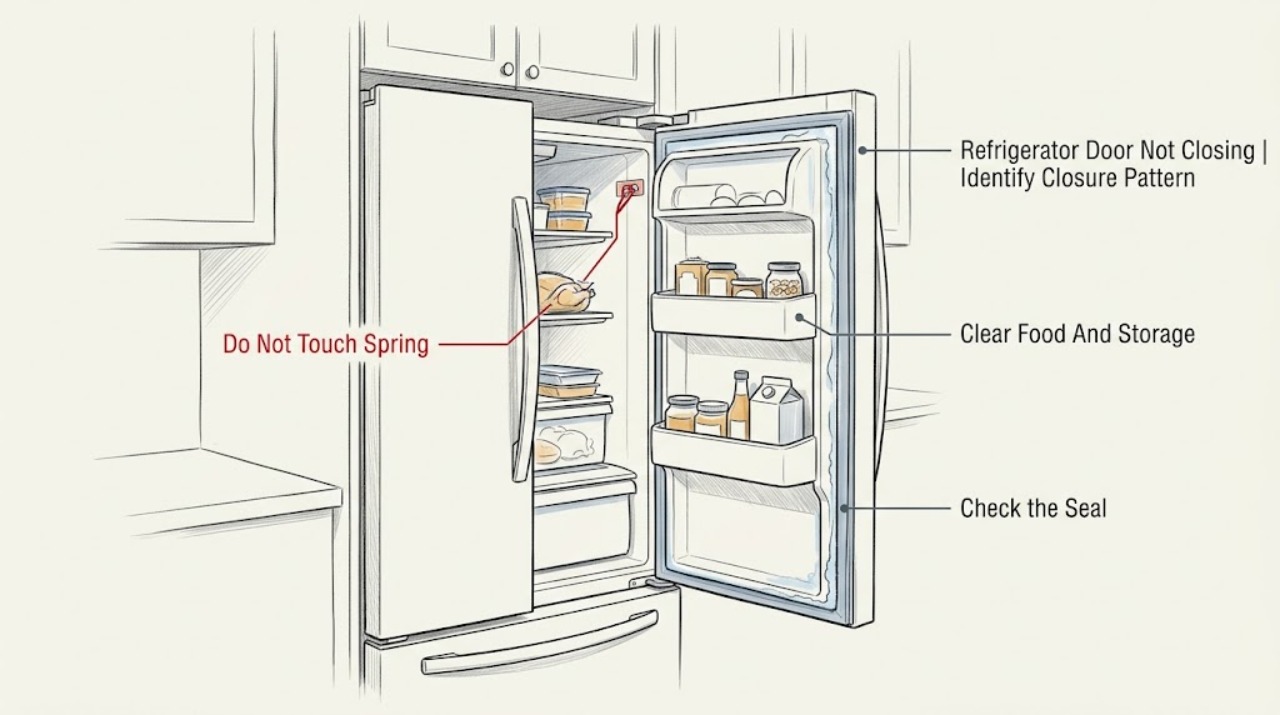
Work through in order
Diagnostic checks
Use only checks that match the exact appliance or system and its official guide.
-
Check 1
Record whether the main door, a French-door leaf, a freezer drawer, or another door is affected; note whether it rebounds, stops before the cabinet, or closes with a visible gasket gap. Record any recent loading, cleaning, moving, defrosting, or installation change.
Expected result: The door is blocked by resistance, sits unevenly, closes but leaks air at one section, or is held open by frost or ice.
Next step: Use the load, gasket, level, frost, or service branch below. Stop forcing the door if it binds or a hinge, liner, wire, or seal appears damaged.
Stop if: Do not continue using the refrigerator with a persistent gasket gap, exposed wiring, sharp damaged metal, or a door that could fall or swing unexpectedly.
Why this matters
Why: The pattern separates an obstruction or alignment issue from a sealing issue and identifies whether a door-style-specific manual is needed.
-
Check 2
Inspect the closing edge, door bins, shelves, drawers, and rear wall for a food package or container that projects into the path. Reseat only a removable shelf or bin that is visibly out of its normal position, then try the door without force.
Expected result: A container, package, shelf, or drawer is jarring the door, the door closes after rearrangement, or the path is clear but the door still rebounds or sits unevenly.
Next step: Rearrange the load and verify that the door closes without pressure. If the path is clear and closure remains poor, continue to the gasket and level checks rather than pushing harder.
Stop if: Do not overload the door, force a drawer, or pry a shelf or bin into position.
Why this matters
Why: Haier identifies food or containers jarring the door as a cause of poor closure. A clear path with persistent rebound makes level, gasket, alignment, or hinge issues more likely.
-
Check 3
Inspect the gasket around the complete door perimeter and wipe visible dirt from the gasket and cabinet contact surface with a soft, damp cloth. Look for folds, cracks, hardening, separation, a mismatched profile, or a section that never contacts the cabinet.
Expected result: The gasket is dirty but intact, a corner is slightly raised without a cabinet gap, a persistent gap remains, or the gasket is worn, cracked, separated, or visibly mismatched.
Next step: Clean and reassess an intact gasket. Arrange Haier service for a persistent gap or damaged seal; do not order a replacement by appearance alone.
Stop if: Do not stretch, cut, glue, heat, reshape, or remove the gasket, and do not keep the appliance in service with a persistent gap.
Why this matters
Why: Haier says a slightly raised welded corner can be normal when the seal remains tight, but a real gap or damaged, worn, or mismatched gasket can prevent sealing and requires service or model-specific replacement.
-
Check 4
From a safe external position, look for cabinet rocking, a changed floor position, one door sitting lower than another, and frost or ice at the closing edge or rear wall. Do not slide, tip, or adjust a loaded or built-in refrigerator.
Expected result: The cabinet rocks or is visibly out of position, one door is misaligned, frost or ice physically interferes, or the unit appears stable and clear.
Next step: Remove only an obvious external obstruction and use the exact model manual for any defrost or leveling procedure. Call service for persistent frost, built-in alignment, or a door that remains uneven.
Stop if: Do not chip ice, apply direct heat, adjust hidden leveling or hinge hardware, or pull a built-in unit forward.
Why this matters
Why: Haier links tight closure with level ground and identifies frost or ice and air entering through a door gap as related refrigerator conditions. Visible misalignment or ice does not identify which hinge or defrost part is responsible.
-
Check 5
After the visible load and gasket checks, close the door normally and inspect the gasket contact all around without pulling hard on the door. If using a simple paper or coin contact check, treat it only as a rough observation and follow the exact model guidance rather than using it to justify an adjustment.
Expected result: The gasket contacts the cabinet around the perimeter, one section has no contact, the door closes only when pressed, or the contact check varies at a hinge or corner.
Next step: Arrange model-specific service for a gap, uneven contact, or a door that requires pressure. Keep the door closed normally and avoid repeated slamming while waiting.
Stop if: Do not bend the door, adjust a hinge, replace a seal, or continue normal use when food safety or cooling is compromised by the gap.
Why this matters
Why: Uniform contact makes a simple obstruction less likely and a seal or alignment issue more likely when the refrigerator still runs warm or accumulates frost. Haier's own gasket guidance routes an actual gap to service.
-
Check 6
Record the full Haier model, affected door or drawer, gap location, gasket condition, cabinet position, frost condition, and whether cooling or alarms changed. Leave the appliance alone and arrange service when the door remains misaligned or an internal hinge, liner, wire, or control would need access.
Expected result: The issue disappears after unloading, a gasket gap persists, the door is uneven, frost returns, the door or drawer is heavy or unstable, or wiring or a hinge is visible or damaged.
Next step: Contact Haier service with the model and observations. Keep the refrigerator closed without force and protect food if cooling is compromised; use an appliance technician for installation or door hardware.
Stop if: Do not remove hinges, open door panels, disturb wiring, adjust a spring or drawer mechanism, tip the appliance, or continue operation with a dangerous or unsealed door.
Why this matters
Why: A persistent closure problem can involve model-specific hinges, door structure, drawer slides, gasket fit, defrost or moisture conditions, wiring, or installation alignment and cannot be safely selected from a generic parts list.
Use your observations
Decision map
Find the observation that best matches what you see, then follow the next safe action.
-
PATH 01Safety boundary
What you see
The door stops against a container, package, shelf, drawer, or door bin and closes normally after the visible load is rearranged.
Do this next
Keep the closing path clear and check that removable storage is seated. Reassess the gasket only if the door still leaves a gap.
Why this path and its safety boundary
Why it matters: Haier specifically identifies food or containers jarring the door as a closure cause; this pattern is less consistent with a failed hinge or gasket.
Safety stop: Do not force or slam the door against an obstruction.
-
PATH 02Safety boundary
What you see
The door reaches the cabinet but one section of gasket never contacts, or the gasket is dirty, cracked, worn, separated, or mismatched.
Do this next
Clean an intact gasket and arrange model-specific service for a persistent gap or damaged seal; do not fit an unverified replacement.
Why this path and its safety boundary
Why it matters: A sealing problem is more likely than a simple load issue. Haier treats a real gap as a service condition, while a slight corner lift without a gap may be normal.
Safety stop: Do not stretch, glue, heat, cut, or remove the gasket.
-
PATH 03Safety boundary
What you see
The cabinet rocks, the refrigerator has shifted, or one door or drawer sits visibly lower or higher and the load and gasket are clear.
Do this next
Use the exact manual or qualified appliance service for leveling and alignment. Do not slide or tip a loaded or built-in refrigerator.
Why this path and its safety boundary
Why it matters: Leveling or alignment is more likely, but the correct adjustment depends on door style, installation, and model.
Safety stop: Stop if the door is unstable, the appliance could fall, or moving it would strain water, power, or refrigerant connections.
-
PATH 04Safety boundary
What you see
Frost or ice is visible at the closing edge or rear wall and physically prevents full closure, or the seal gap is followed by recurring frost.
Do this next
Follow only the exact manual's safe defrost guidance and arrange service for recurring frost, hidden ice, or a persistent gap.
Why this path and its safety boundary
Why it matters: Moisture entering through a gap or a model-specific frost or defrost condition may be involved; ice removal alone may not correct the cause.
Safety stop: Do not chip ice with sharp tools, apply direct heat, or open refrigeration panels.
-
PATH 05Safety boundary
What you see
The door remains uneven or unstable after visible checks, a hinge or drawer needs adjustment, a panel or wire is damaged, or cooling and alarms change because the door cannot seal.
Do this next
Leave the appliance closed without force and arrange Haier or qualified appliance service with the model, affected door, gap location, and cooling observations.
Why this path and its safety boundary
Why it matters: A model-specific hinge, door structure, drawer mechanism, wiring, control, or installation issue is more likely and is not a safe generic repair.
Safety stop: Do not remove hinges, open panels, disturb wiring, adjust springs, tip the appliance, or continue operation with a dangerous or unsealed door.
Helpful context
Understand the symptom
Define what “not closing” means
A door that rebounds because a bottle or shelf is in the way is different from a door that reaches the cabinet but leaves a gasket gap. Note whether the problem affects one door, both French doors, a freezer drawer, or the main cabinet door; whether it began after loading, cleaning, moving, or defrosting; and whether the cabinet is cooling normally. Do not push harder to overcome resistance, because that can hide an obstruction or stress the hinge and seal.
Clear the load and reseat removable storage
Open the door only as far as needed and look along the closing edge, door bins, shelves, drawers, and the rear wall for a container, package, shelf, or drawer that projects into the path. Make sure a removable bin or shelf is fully seated. Haier specifically points to food or a container jarring the door, so a closure problem that disappears after rearranging the load is not evidence of a bad hinge or gasket. Keep heavy or tall items from pressing against the door until the fit is confirmed.
Inspect the gasket without replacing it
Wipe visible dirt from the gasket and cabinet contact surface with a soft, damp cloth, then inspect the entire perimeter for folds, cuts, hardening, separation, or a section that never touches the cabinet. Haier notes that a slightly lifted gasket corner can be normal when the seal remains airtight, while an actual gap calls for service. A gasket that is worn, cracked, or mismatched should be identified by the model rather than substituted by appearance.
Check cabinet position and frost from the outside
Look at the appliance from the front and side for obvious rocking, a changed position, or a door that sits lower or higher than its mate. Haier's guidance connects tight closure with level ground and warns that an open gap allows air into the cabinet. Also look for frost or ice at the closing edge or on the rear wall; Haier describes frost and ice as a possible refrigerator-compartment condition associated with door sealing and moisture. Do not tip, slide, or adjust leveling hardware on a loaded or built-in unit without the exact manual.
Treat persistent frost or a gap as a different fault
If ice is holding the door open, do not chip it with a sharp object or apply a direct heat source near plastic, wiring, or refrigerant components. A brief, supervised defrost approach is model-dependent; use only the exact Haier manual. If frost quickly returns, the gasket never contacts the cabinet, or the door cannot close after visible ice and load issues are resolved, the cause may involve alignment, a hinge, a door liner, a defrost or moisture condition, or another internal issue.
Do not turn a door problem into a hinge repair
Haier publishes model and region-specific manuals and service routes. A misaligned door, heavy drawer, hinge that binds, damaged door liner, door wiring, or built-in installation may require supported adjustment or parts that cannot be selected from a generic page. Record the full model, the affected door or drawer, the location of any gap, and what changed before contacting Haier service. Keep the door closed by a safe temporary arrangement only if it does not crush the gasket or prevent normal ventilation around the appliance.
Safety boundary
Stop conditions
- Stop forcing the door for a persistent gap, unstable door, sharp damaged metal, exposed wiring, water leak, or a door that could fall or swing unexpectedly.
- Do not remove hinges, open door panels, disturb wiring, adjust springs or drawer mechanisms, or move a loaded or built-in refrigerator.
- Do not chip frost or ice with sharp tools or apply direct heat near plastic, wiring, or refrigeration components.
- Do not stretch, cut, glue, heat, reshape, or replace a gasket without the exact model and qualified guidance.
- Protect food and arrange service if the door cannot seal and cooling or temperature safety is compromised.
When checks do not resolve it
Need a professional?
Arrange model-specific Haier appliance service when a clear load path and clean, intact gasket do not restore full closure, when a gasket gap persists, when the cabinet or doors are uneven, when frost returns, or when a hinge, drawer, door panel, wiring, leveling mechanism, or built-in installation would need access. Stop immediately for an unstable door, exposed wiring, a leak, sharp damage, or a persistent seal gap that compromises cooling.
Safety scope: This article covers external observation, safe load rearrangement, reseating visible storage, gentle gasket cleaning, and visual checks for level, alignment, and frost. Do not remove hinges or panels, alter wiring or springs, move a built-in or loaded unit, or apply direct heat to ice.
Read the exact guide
Official sources
- Icing up in the refrigerator compartmentHaier · Haier Egypt refrigerator troubleshooting guidance; frost location and defrost handling vary by model.
- Haier Service SupportHaier · Official Haier India support hub; available service channels and contacts vary by market and model.
- Whether the refrigerator gasket can be changedHaier · Haier India support guidance; gasket replacement and door construction vary by refrigerator, freezer, model, and production period.
- Haier Manual DownloadHaier · Official Haier support page for selecting a refrigerator model and its manual; model and regional availability determine the instructions.
- The appliance runs frequently or runs for a too long period of timeHaier · Haier India refrigerator troubleshooting guidance; door style, leveling method, gasket construction, and service path vary by model.
- Door is not tightHaier · Haier India refrigerator gasket guidance; the described seal construction and contact check are not a universal replacement or adjustment procedure for every model.
Community feedback
Share a repair observation
Share a plain-text repair observation. Accepted observations are published automatically; this page may take a moment to update.