
On this page
Start here
Quick answer
A hard failure-rate percentage for the LG LTCS20020W compressor is not supplied by the opened LG support materials, and warranty duration is not a failure-rate estimate. Start by separating normal compressor or fan noise from a cooling symptom: LG says humming, rumbling, and some refrigerant-flow sounds can be normal, while persistent abnormal noise or inadequate cooling needs service. The LTCS20020W support page lists a five-year sealed-system parts-and-labor term and a ten-year linear/inverter-compressor parts term with five years of labor for the U.S. warranty; those terms do not predict an individual unit's failure probability. This page addresses an existing appliance fault, not a purchase recommendation.
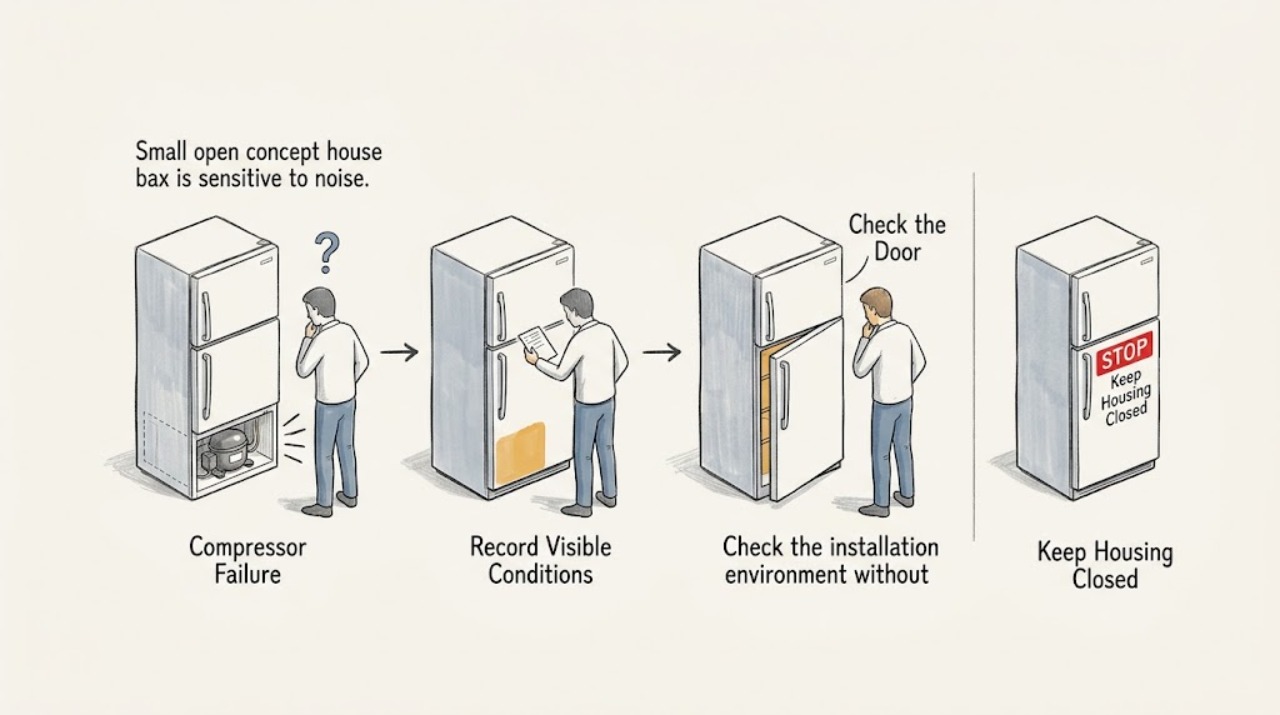
Work through in order
Diagnostic checks
Use only checks that match the exact appliance or system and its official guide.
-
Check 1
Confirm the complete rating-plate model is LTCS20020W and record two separate facts for the same period: whether the refrigerator and freezer are maintaining their normal cooling, and what sound is heard, where it comes from, and when it occurs. Do not infer a compressor failure from sound alone.
Expected result: Cooling is stable and the noise is intermittent, or cooling is weak or changing and the sound is continuous, irregular, or accompanied by repeated clicking or failed starts.
Next step: Use the full model and the sound/cooling record for service. If cooling is deteriorating, protect food and arrange qualified LG appliance service rather than waiting for the noise to become louder.
Stop if: Do not remove the rear cover, touch the compressor or wiring, or order a compressor from a noise description.
Why this matters
Why: LG's model support page provides model-specific manuals and warranty information, while LG's noise guidance explains that compressor and fan sounds vary with operating state. Cooling loss changes the case from an acoustic nuisance to a refrigeration fault; noise without cooling loss does not prove compressor failure.
-
Check 2
Listen from a safe standing position for the sound pattern without placing hands on the cabinet: distinguish a low hum or rumble while cooling, a brief click or start/stop sound, a short air-release sound after opening a door, and a rattle or vibration that changes when the surrounding room or door is disturbed.
Expected result: The sound follows compressor or fan operation and fades as temperature stabilizes, occurs briefly after door movement, or is irregular/continuous and does not settle.
Next step: For a normal pattern with stable cooling, monitor without repeated power cycling. For irregular, continuous, or worsening noise, request LG service and report the timing rather than trying to test the motor.
Stop if: Stop using the appliance for smoke, burning odor, sparks, a hot cord or outlet, exposed wiring, or rapidly worsening noise with loss of cooling.
Why this matters
Why: LG identifies humming, rumbling, refrigerant-flow, and some pressure sounds as normal operating sounds. A small quiet room can make normal sounds seem louder, while irregular or continuously abnormal noise warrants inspection; none of these observations alone identifies a failed compressor.
-
Check 3
Check the installation environment without moving the refrigerator: note whether the cabinet sways, whether the floor is hard and level, whether a wall or nearby object is transmitting vibration, and whether the sound began after the appliance was moved or cleaned. Do not reach underneath or adjust hardware unless the exact guide authorizes it.
Expected result: The refrigerator rocks, sits on a resonant or uneven floor, touches a nearby surface, or the noise began immediately after moving or reconnecting it; alternatively, the cabinet is stable and the sound persists during ordinary operation.
Next step: Follow the user guide for safe leveling or clearance only when the adjustment is accessible and the appliance remains stable. After a move, follow LG's stated wait instruction before reconnection; request service if noise or cooling problems continue.
Stop if: Do not tip the refrigerator, pull it by the water line or cord, detach panels, or continue operating an unstable appliance.
Why this matters
Why: LG says an unlevel or swaying refrigerator can transmit louder compressor noise, and that after moving or cleaning the appliance the refrigerant needs time to stabilize before reconnection. A stable installation with persistent abnormal noise keeps an appliance fault in consideration.
-
Check 4
Compare the symptom with the LTCS20020W product information without assuming optional equipment: confirm whether this model has the optional ice-maker configuration, note whether the complaint is ice-only or includes cabinet warming, and record any recent power, cleaning, or move event. Do not use an ice-maker symptom as a compressor diagnosis.
Expected result: Only optional ice production is affected while cabinet cooling is stable, or both ice production and refrigerator/freezer cooling are impaired.
Next step: For an ice-only issue, use the model's ice-maker documentation or service path. For warming compartments or loss of cooling, stop relying on noise comparisons and arrange qualified refrigeration service.
Stop if: Do not open the sealed system, bypass a temperature control, charge refrigerant, or use an unverified ice-maker or compressor part.
Why this matters
Why: LG's product specification identifies the LTCS20020W as a top-freezer refrigerator with an optional ice maker and a linear compressor. An ice-only problem can be in the optional ice/water system; simultaneous cooling loss requires refrigeration diagnosis, but the public materials do not establish a component-level failure from this symptom pair.
-
Check 5
For a repair-versus-replacement discussion, give LG or a qualified technician the full model, serial information, installation history, cooling record, and sound recording; ask whether the confirmed issue is the ice-maker/water path, fan, control, or sealed cooling system. Treat warranty terms as coverage information only.
Expected result: The technician confirms a compressor or sealed-system fault, confirms another cause of noise/cooling loss, or cannot yet verify a compressor failure.
Next step: Use the technician's confirmed system and the applicable warranty terms to decide the next service step. If no compressor fault is confirmed, do not replace the refrigerator solely because the room makes normal sounds noticeable.
Stop if: Do not convert warranty duration, online anecdotes, or a noise recording into a failure-rate claim or a guaranteed repair outcome.
Why this matters
Why: LG's LTCS20020W support page lists warranty coverage for the sealed system and linear/inverter compressor, but does not publish a hard failure rate. A diagnosis is needed before deciding whether repair or replacement is sensible, especially in a noise-sensitive room.
Use your observations
Decision map
Find the observation that best matches what you see, then follow the next safe action.
-
PATH 01Next step
What you see
Cooling is stable and the sound is an intermittent hum, rumble, brief click, air-release, or refrigerant-flow sound that follows normal operation and settles.
Do this next
Keep the refrigerator level and clear of contact with surrounding objects, then monitor. Do not pursue a compressor replacement from sound alone.
Why this path and its safety boundary
Why it matters: LG describes these sound families as normal operating behavior in appropriate contexts; noise sensitivity in a small open-plan home can make them more noticeable without a compressor failure.
-
PATH 02Next step
What you see
Cooling is weak or unstable, the compressor repeatedly fails to maintain temperature, or the sound is irregular or continuous rather than a normal operating cycle.
Do this next
Protect food and arrange qualified LG appliance service with the exact model and symptom timeline. Do not open the sealed circuit or repeatedly power-cycle it to provoke a start.
Why this path and its safety boundary
Why it matters: A refrigeration or control fault is more concerning than room acoustics, but the symptom still cannot identify whether the compressor, fan, control, or sealed system is at fault.
-
PATH 03Next step
What you see
The sound began after moving or cleaning, the cabinet sways, or vibration is amplified by an uneven floor or nearby surface while cooling remains normal.
Do this next
Follow LG's move/reconnection and leveling guidance, keeping the refrigerator stable. Request service if the sound does not settle or cooling changes.
Why this path and its safety boundary
Why it matters: Installation or refrigerant-stabilization conditions can amplify normal compressor noise; this pattern is less specific for compressor failure than simultaneous cooling loss.
-
PATH 04Next step
What you see
The full model cannot be confirmed, only ice production is affected, or the claimed compressor failure is based on a hard-failure-rate question rather than observed cooling loss.
Do this next
Identify the model and separate the ice/water symptom from cabinet cooling and noise. Use LG documentation or qualified service before selecting a part or replacement path.
Why this path and its safety boundary
Why it matters: The evidence is insufficient for a component or replacement recommendation. LTCS20020W has an optional ice-maker configuration, and warranty terms are not reliability statistics.
Helpful context
Understand the symptom
LG's support page identifies LTCS20020W variants and provides manuals, troubleshooting, and warranty information. Its published warranty terms can help a service conversation, but they are not population-level reliability data and should not be converted into a claimed compressor failure rate.
For a noise-sensitive open-plan room, the useful first decision is whether the sound is a normal operating sound that the room makes more noticeable, or whether cooling performance is failing. LG's noise guidance describes normal compressor, fan, refrigerant-flow, and pressure-related sounds, while its service guidance calls for inspection when noise is irregular or continuous.
When checks do not resolve it
Need a professional?
Call qualified LG appliance service for weak or unstable cooling, repeated failed starts, irregular or continuous abnormal noise, or any suspected compressor or sealed-system fault. Stop using the appliance for smoke, burning odor, sparks, a hot cord or outlet, exposed wiring, or rapid loss of cooling. Do not remove covers, test energized components, open or recharge the sealed system, or turn warranty duration, online anecdotes, or room noise into a compressor failure-rate claim.
Common questions
FAQ
Is there hard public failure-rate data for the LG LTCS20020W compressor?
The opened LG support and specification materials do not provide a population-level LTCS20020W compressor failure rate. They provide warranty terms and operating guidance, which should not be converted into a percentage estimate.
Does a loud hum mean the compressor is failing?
Not by itself. LG describes compressor and fan humming or rumbling as normal operating sounds in context, and says a small room or uneven installation can make them seem louder. Loss of cooling or irregular continuous noise needs service diagnosis.
What does the LG warranty say about the compressor?
The LTCS20020W U.S. support page lists a ten-year parts term and five-year labor term for a linear/inverter compressor, plus five years of parts and labor for the sealed system. Coverage terms are not a guarantee of failure or a reliability statistic; confirm the full warranty terms for the appliance.
Read the exact guide
Official sources
- LG LTCS20020W: Support, Manuals, Warranty & More | LG USA Product Support PageLG USA · The opened LG support page identifies LTCS20020W.ASWQEUR, provides model manuals and troubleshooting access, and lists the published U.S. warranty terms: one year parts/labor, five years sealed-system parts/labor, and ten years parts with five years labor for a linear/inverter compressor. It does not publish a compressor failure-rate statistic.
- LTCS20020_ LG Builder Spec SheetLG Electronics USA · The opened LG specification sheet lists LTCS20020W among the finish variants, identifies an optional ice maker, and identifies a linear compressor and standard cooling system. It is used for model identity and system separation, not for a reliability claim.
- [LG refrigerator - noise] A strange sound is heardLG USA Support · LG's opened support article describes normal and potentially concerning refrigerator sound patterns. It says compressor/fan humming or rumbling and refrigerant-flow sounds can occur during normal operation, while irregular or persistent abnormal noise warrants service; the article notes that guidance is for all models and images may differ.
- LG Refrigerator - Troubleshooting Refrigerator Noises After It Was Moved or CleanedLG USA Support · LG's opened article says compressor and fan noise may be heard after moving or cleaning, that the refrigerant needs time to stabilize before reconnection, and that an unlevel or swaying refrigerator can amplify compressor noise. It also notes that a small room can make operating sound seem louder.
Community feedback
Share a repair observation
Share a plain-text repair observation. Accepted observations are published automatically; this page may take a moment to update.